
PUERTO RICO · EDUCATION AND HEALTH
Puerto Rico’s public schools, public university and health system all run on tight budgets, and the federal rules behind its health funding change within a year. This guide explains how each works and why US readers should care, since Puerto Ricans are US citizens.
The island is a US territory, not a state, so Washington funds its health programmes by different formulas than it uses for the states. Our Puerto Rico explained guide covers the wider picture, and this one follows the classroom, the campus and the clinic.
Key Facts
- Schools Puerto Rico’s public school agency serves 231,010 students in 872 schools, down 41% in 30 years.
- Medicaid About 1.3 million people use Medicaid or the Children’s Health Insurance Program, public insurance for low-income residents.
- Cliff Washington’s 76% share of Medicaid costs ends 30 September 2027, then falls to 55% unless Congress acts.
- Income Median household income was US$27,213 in 2024, a third of the US figure of US$81,604.
- As of 19 November 2026, 13:00 GMT.
A plain-English guide to Puerto Rico’s schools, its public university and its health coverage, and to the federal funding rules that decide how much each can spend.
The Big Picture: Three Systems, One Funding Problem
Puerto Rico is a US territory, not a state, and that status shapes how Washington pays for its services. The Congressional Research Service, Congress’s research arm, said on 22 June 2023 that the island gets capped Medicaid money, not open-ended matching funds.
The same report shows the cap at US$367 million in fiscal year 2019 and US$3.275 billion in 2023. The Centers for Medicare and Medicaid Services (CMS), the federal health insurance agency, said the Affordable Care Act added US$5.4 billion from 1 July 2011 to 30 September 2019.
Schools face another squeeze: the Puerto Rico Department of Education told the island’s House Appropriations Committee on 30 April 2026 that enrolment is down 41% over 30 years. Our guide to the island’s population and ethnic groups explains the shrinking population behind that fall.
The University of Puerto Rico works under the Oversight Board, the federal panel that controls the island’s budget. Health care runs on a capped formula whose higher federal share ends on 30 September 2027, and the US Census Bureau, the federal statistics agency, put 2024 incomes at a third of the US median.
In Plain English
- Medicaid Public health insurance for low-income people, paid jointly by the federal government and the island.
- Medicare Advantage Private plans that run Medicare benefits, the federal health insurance for older people.
- FMAP The federal share of Medicaid costs, set as a percentage (the Federal Medical Assistance Percentage).
- Oversight Board The federal panel created by PROMESA, the 2016 federal law on Puerto Rico’s debts, to control the island’s budget.
- Department of Education The government agency that runs the public schools, grouped in seven educational regions.
- ASES The Spanish initials of the Puerto Rico Health Insurance Administration, which runs the island-wide Medicaid system.
Public Schools: Fewer Pupils, Rising Costs
The Puerto Rico Department of Education told the island’s House Appropriations Committee on 30 April 2026 that it serves 231,010 students in 872 public schools. Education Secretary Eliezer Ramos Parés presented the budget request, and the schools sit in seven educational regions.
The department said enrolment is down 41% over 30 years. The fall comes as the island’s overall population shrinks.
The department told the committee that special education serves 86,949 students, more than a third of the total. Our report on a Senate bill about immigrant students covers a separate school debate.
The department reported 47,878 employees on its payroll, including teaching, administrative and support staff. The department gave no separate teacher count, so we cannot say how many staff teach.
Félix Ángel Pérez Rivera, the department’s assistant secretary for legal affairs, told the Puerto Rico Senate’s education committee on 31 May 2023 that 638 public schools closed from August 2012 to May 2021. The department also pledged at that hearing that no further schools would close.

The School Budget and the Oversight Board
The department told the committee that it is asking for a state budget increase of US$542 million for 2026–27. We could not confirm a single total for the whole department from the hearing documents, so we give no overall figure.
The Oversight Board, set up by the 2016 PROMESA law, certified a US$33.6 billion consolidated budget for fiscal year 2027 on 29 June 2026. Its press release said “The Department of Education continues to face structural pressures”, citing expired federal pandemic-relief funds and one-off money used for recurring costs, including special education.
Our guide to the island’s key political players explains who holds power around the Board. The Board’s wording points to one-off money paying for costs that return every year.
The University of Puerto Rico
The University of Puerto Rico (UPR) describes itself in Spanish as “11 unidades, una universidad”, from Aguadilla and Arecibo to Río Piedras and Utuado. UPR said in August 2025 that Río Piedras, its flagship campus in San Juan, began the 2025–26 semester with 12,507 students.
Of those, 9,782 were undergraduate and 2,725 graduate, UPR said, an increase on the prior year. UPR President Zayira Jordán Conde said the growth is more than an institutional achievement.
When it certified the island’s budgets on 29 June 2026, the Oversight Board rejected the proposed fiscal 2027 UPR budget put forward by Governor Jenniffer González-Colón’s government as violating PROMESA and UPR’s certified fiscal plan. The Board certified its own UPR budget, with US$1.2549 billion in revenues and US$177.1 million for pensions.
The Board flagged UPR’s pension funding shortfalls and urged operational and financial reforms. Systemwide enrolment is not published in the sources we could open, so Río Piedras is our only campus count.
Medicaid and the 2027 Cliff
Medicaid at a Glance
- Federal share Public Law 117-328, enacted 29 December 2022, raised the federal share (FMAP) from 55% to 76% through 30 September 2027, CMS said.
- Limit The 76% applies only until the annual ceiling is reached, CMS said.
- Doctor pay Up to US$300 million a year for fiscal 2023–2027 if the island sets a doctor payment floor at 75% of the Medicare Part B rate (the part that covers doctors’ services), the Congressional Research Service said.
- Integrity A further US$75 million a year if programme-integrity conditions are met, the Congressional Research Service said.
The Puerto Rico Department of Health is the single state agency for Medicaid, CMS said. The Puerto Rico Health Insurance Administration, known as ASES, runs the system, which about 1.3 million people used in January 2026, all through managed care, where insurers are paid to run the plans.
The Federal Register, the US government’s official daily journal, confirmed on 28 November 2025 that “the FMAP for Puerto Rico shall be 76 percent through September 30, 2027”. The Congressional Research Service said the share returns to 55% in fiscal year 2028, with capped funding “significantly reduced” unless Congress acts.
A multisector committee created by the governor’s office to lobby Congress on health funding issued its final report in early October 2026. Its own estimate, from a body set up to press Congress for funds, is that at least 860,000 people could lose coverage without more federal money, and it says Congress must act before 1 October 2027.
The Puerto Rico Federal Affairs Administration (PRFAA), the island government’s Washington office, said on 22 July 2026 that it is protecting access for more than 1.3 million American citizens. It described the 76% share as running for fiscal years 2023 to 2027, with the cliff on 30 September 2027.
Medicare Advantage for Older Islanders
The Governor’s office said on 5 August 2026 that more than 670,000 seniors depend on Medicare Advantage, about 96% of the island’s Medicare beneficiaries. It calls that the highest rate in the US, and Medicare Advantage means private plans that run Medicare benefits.
The statement says benchmark payment rates, which set what plans receive, are about 41% below the national average and about 20% below the US Virgin Islands. The statement says CMS gave Puerto Rico a 4.01% rise in its 2027 rate notice, the annual payment announcement, against 2.48% nationally.
Representative Greg Murphy and 13 other members of the US House asked the US Department of Health and Human Services (HHS) and CMS for a minimum benchmark of 70% of the national average from 2028, and the Governor welcomed the request. These figures are the government’s own account, not an independent calculation.
Hospitals and Doctors
Data from the Health Resources and Services Administration (HRSA), a US health agency, as tabulated by KFF, a health-policy research group, show 42 primary care shortage designations in Puerto Rico as of 31 December 2025. A designation, formally a Health Professional Shortage Area, is a federal label for areas with too few clinicians.
HRSA said 574,059 people lived in those areas and that 28.9% of primary care need was met, against 48.18% for the whole US. It said 138 more practitioners would lift the designations, while the US has 8,467 designations covering 92,285,375 people.
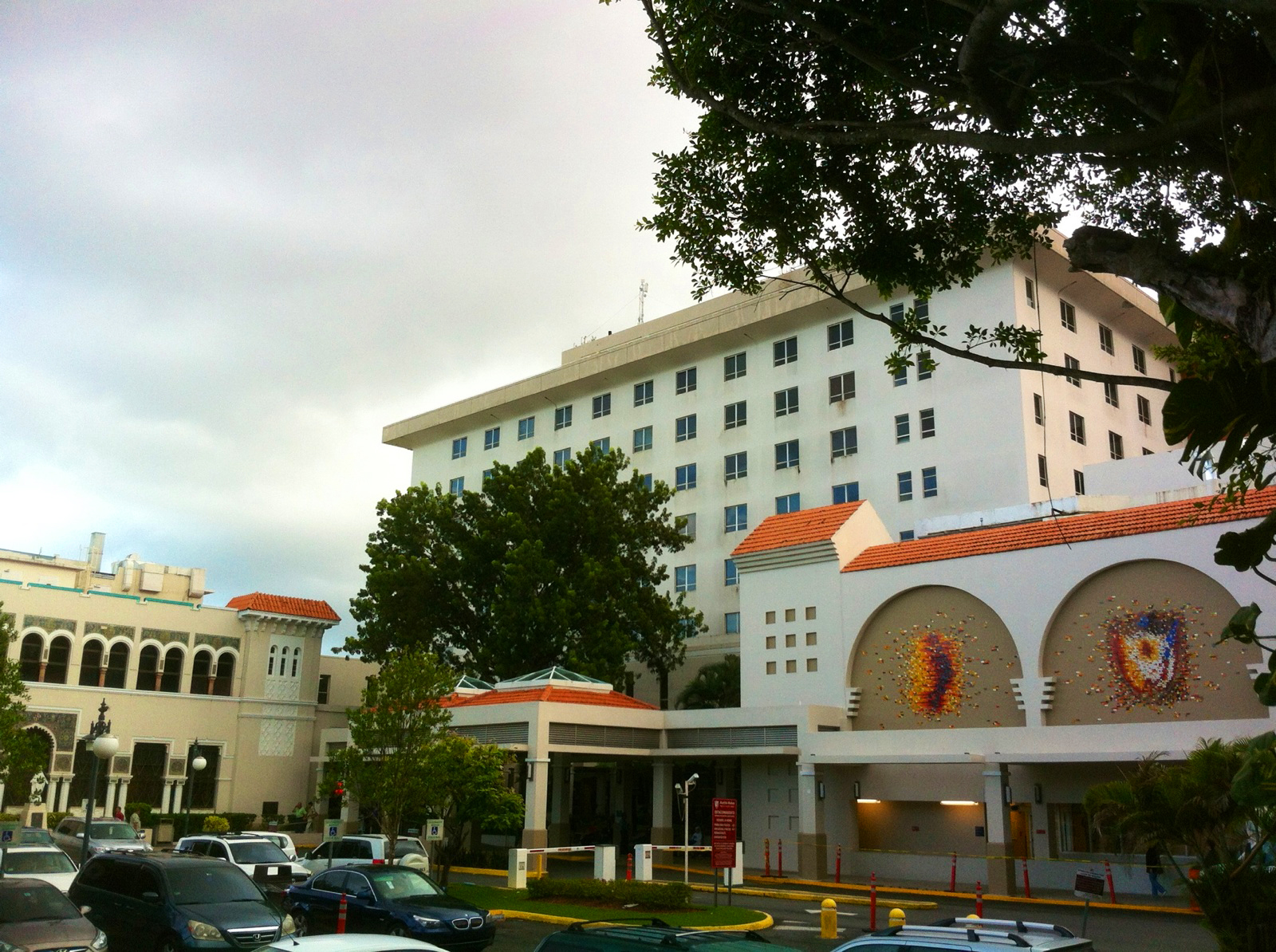
We could not confirm how many licensed hospitals the island has, because the Health Department’s licensing list was not available to us. The photograph above shows Hospital Auxilio Mutuo, a private hospital in San Juan.
Disease adds to the strain, and our earlier article on the dengue outbreak tracks the 2026 cases. Readers who want the case counts will find them there, not here.
How Puerto Rico Compares With the Mainland
The Census Bureau’s American Community Survey, its yearly household survey, put Puerto Rico’s median household income at US$27,213 in 2024. The US figure was US$81,604 and Mississippi’s was US$59,127, in briefs of September 2025.
That makes Puerto Rico’s median about 46% of Mississippi’s and 33% of the US figure. Mississippi is one of the four lowest-income states, with Arkansas, Louisiana and West Virginia.
The Gini index runs from 0 for equal incomes to 1 for total inequality, and Puerto Rico’s was 0.548 in 2023. It was 0.534 in 2024 against 0.481 for the US, the Census Bureau said, higher than in all 50 states and the District of Columbia.
The Census Bureau put the poverty rate at 37.3% in 2024, down from 39.6% in 2023, against 12.1% for the US. With the shortage and Medicare figures above, that shows why public programmes carry so much weight on the island.
What to Watch
Two dated checkpoints matter most. One is the end of the higher federal Medicaid share, set by federal law, and the other is the deadline the island’s leaders have asked Congress to meet.
Dated Checkpoints
- 30 September 2027 CMS and the Federal Register confirm the 76% federal share only through this date, and the Congressional Research Service said capped funding is to be significantly reduced from fiscal year 2028.
- 1 October 2027 The federal share falls to 55% unless Congress acts, the Congressional Research Service said.
- Before 1 October 2027 The governor’s office and the multisector committee ask Congress to act; no vote date is published in the sources we opened.
Two Views on the Funding Gap
The Oversight Board said on 29 June 2026 that “Medicaid constitutes one of the most material fiscal risks facing the fiscal year 2027 Commonwealth Budget” (the island government’s formal title is the Commonwealth). In its UPR budget decision it also urged reforms, and it warned of structural pressures at the Education Department, so it does not treat extra spending as the only answer.
The Board added that the Puerto Rico Health Insurance Administration must submit any proposed Medicaid benefit or service changes to the Board and the Puerto Rico Office of Management and Budget for review and approval. The government and the multisector committee make a different case: the federal cap is too low and Congress must act.
What It Means for You
If you are a US taxpayer or voter, the decision sits with Congress, because the 76% federal share ends on 30 September 2027. The 55% rate returns from 1 October 2027 unless lawmakers act, and the committee, which exists to press Congress for funds, estimates at least 860,000 people could lose coverage.
If you or a relative uses Medicare Advantage on the island, the Governor’s office says benchmark rates are about 41% below the national average. Members of the US House have asked for a floor of 70% from 2028, but plan prices are not in our sources, so ask your insurer.
If you plan to move to the island, HRSA’s summary as of 31 December 2025 shows 28.9% of primary care need met, against 48.18% for the US. Ask any clinic about waiting times before you commit.
If you are a student or parent, the Education Department says more than a third of its 231,010 pupils are in special education. Río Piedras had 12,507 students in autumn 2025, and tuition per credit is not published in the sources we could open.
What Is Not Known
Open Questions
- Systemwide UPR enrolment and tuition per credit.
- The number of licensed hospitals, since no official list was opened.
- The exact Medicaid funding the island will receive after 2027.
- Whether Congress will act.
- The Education Department’s teacher count.
Frequently Asked Questions
How many students are in Puerto Rico’s public schools?
The Education Department told the island’s House Appropriations Committee on 30 April 2026 that it serves 231,010 students in 872 public schools. Enrolment is down 41% over 30 years.
What is the Oversight Board?
A federal panel created by the 2016 PROMESA law that controls the island’s budget. On 29 June 2026 it certified a US$33.6 billion consolidated Commonwealth budget for fiscal year 2027.
How many people are on Medicaid in Puerto Rico?
About 1.3 million people were enrolled in Medicaid and CHIP (its children’s health programme) in January 2026, CMS said. The system is delivered entirely through managed care.
When does Puerto Rico’s higher Medicaid funding end?
The 76% federal share runs through 30 September 2027. Unless Congress acts, it returns to 55% in fiscal year 2028, the Congressional Research Service said.
How many seniors use Medicare Advantage in Puerto Rico?
The Governor’s office said on 5 August 2026 that more than 670,000 seniors depend on it, about 96% of Medicare beneficiaries on the island. The statement calls that the highest rate in the US.
How does Puerto Rico’s income compare with the US?
The Census Bureau put median household income at US$27,213 in 2024, against US$81,604 for the US. The island’s poverty rate was 37.3%, against 12.1% for the US.
Sources: US Census Bureau ACSBR-025, September 2025; US Census Bureau ACSBR-026, September 2025; CMS Medicaid.gov Puerto Rico overview, accessed 19 November 2026; Congressional Research Service IF11012, 22 June 2023; Federal Register, 28 November 2025; Oversight Board press release, 29 June 2026; PRFAA statement, 22 July 2026; PRFAA statement, 5 August 2026; University of Puerto Rico, Río Piedras enrolment release, August 2025; HRSA shortage-area summary, 31 December 2025 (as tabulated by KFF); Oversight Board decision on the UPR budget, 29 June 2026; Puerto Rico government, multisector committee final report, October 2026; Puerto Rico Department of Education, budget testimony to the House Appropriations Committee, 30 April 2026.
This article was produced by The Rio Times’ automated AI newsroom. Editorial responsibility: Matthias Camenzind, Publisher and Editor-in-Chief. The Rio Times also runs Ask Rio Times, which answers from 100,000+ of our own articles, the daily Latin America Power Map, and prediction-market odds on elections and markets.. How we use AI · Report an error
Expat Guide to Puerto Rico
What The Rio Times publishes for foreigners who live in or move to Puerto Rico.
Start here
- How to Move to Puerto Rico in 2026
- Cost of Living in Puerto Rico in 2026
- Puerto Rico Security and Crime Explained 2026
- Moving to Puerto Rico 2026 Step by Step
Understand Puerto Rico