Puerto Rico Dengue Reaches 922 Cases This Year
HEALTH · PUERTO RICO
Key Facts
- —The country Puerto Rico, a US territory in the Caribbean, where the Health Department considers dengue endemic because cases appear all year.
- —What happened The Health Department’s weekly report, dated 23 September, counts 922 dengue cases with symptoms starting between 1 January and 16 September 2026.
- —The numbers 456 patients (49.5%) were hospitalised, 36 (3.9%) had severe dengue and four deaths were linked to the disease, with two more under investigation (report of 23 September).
- —What it means for you Weekly cases sat below the epidemic threshold in mid-September. The department still urges repellent, window screens and emptying anything that holds water.
- —Still open Whether the two deaths under review are confirmed as dengue. The report for week 38 had not been published as of 3 October.
Puerto Rico dengue cases reached 922 in 2026, and nearly half of those patients needed a hospital bed. The Health Department’s weekly arboviral report, dated 23 September, puts the hospitalised share at 49.5%.
The figures gained wider attention this week after Iris Cardona, the department’s principal medical officer, presented them in Caguas. Metro Puerto Rico and NotiCel reported her remarks on 2 and 3 October.
What the Puerto Rico dengue report shows
The report covers week 37, with symptom onset up to 16 September. Of the 922 cases, 626 were confirmed by molecular or antigen tests and 296 were probable, based on antibody tests.
Some 36 patients met the World Health Organization definition of severe dengue. Four deaths were linked to the disease this year, and two more remain under investigation.
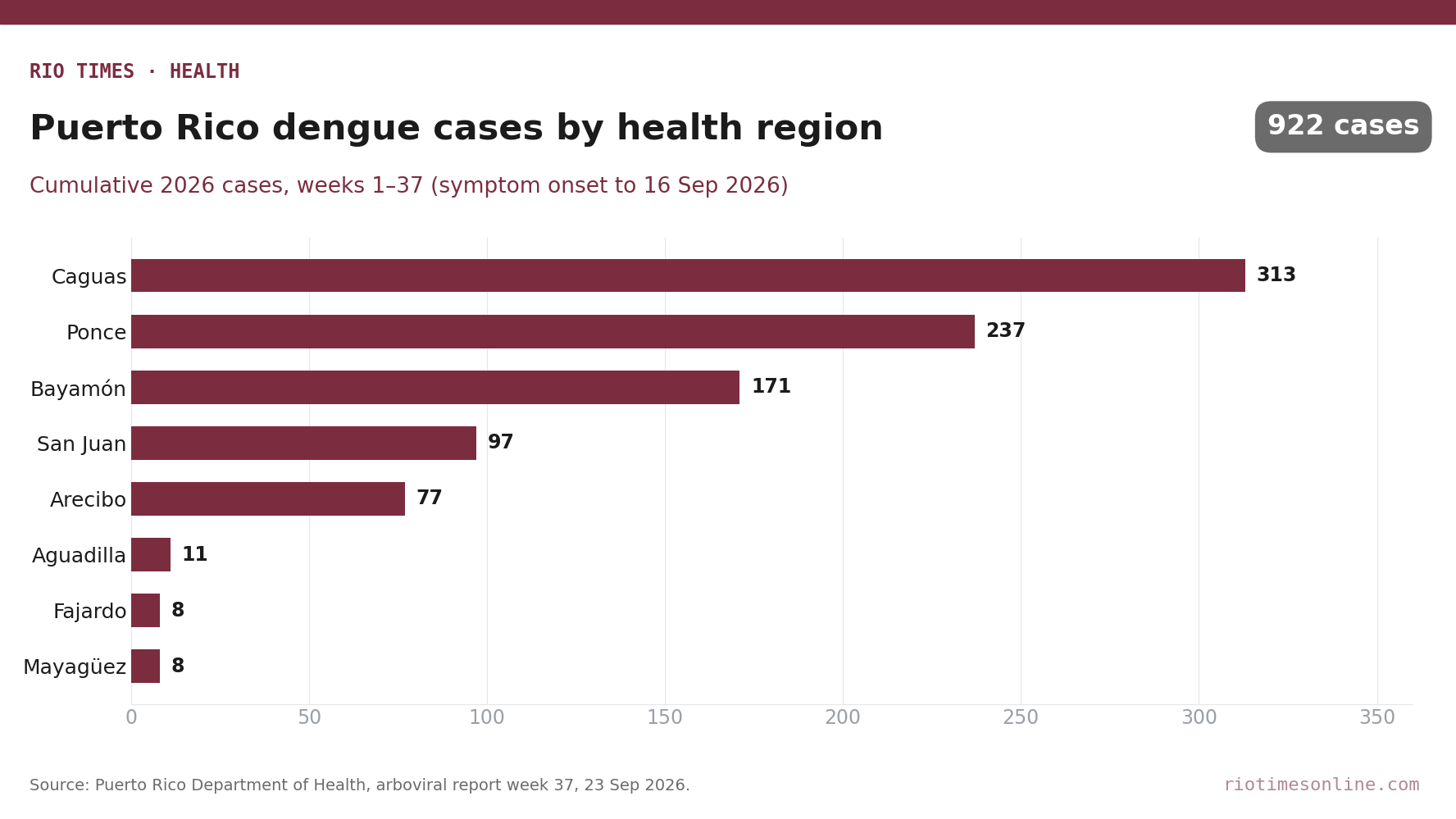
Cases cluster in the east and south. The Caguas health region leads with 313 cases, followed by Ponce with 237 and Bayamón with 171.
By municipality, Caguas has the most cases, at 118. Arroyo and Guayama have the highest rates, with about 241 and 238 cases per 100,000 residents.
Who is getting sick
Teenagers and children carry a large share of the burden. People aged 10 to 19 account for 312 cases, about a third of the total.
Almost all typed cases are serotype 3: 561 of 567, or 98.9%. Three were type 1, and the three type 2 cases were linked to travel outside the island.
Why the hospital share needs context
The surveillance system is based on laboratory results. Mild infections that never reach a clinic or a test are therefore not in the count.
The share is also not new. In 2025 the island logged 3,385 cases, of which 51.7% were hospitalised and nine deaths were linked to dengue.
Transmission has eased since the 2024 epidemic. The department declared a dengue public health emergency in March 2024, according to the report.
Health Secretary Víctor Ramos did not extend it beyond 31 December 2025, El Nuevo Día reported. He said cases had stayed below the threshold for almost 20 weeks.
How the island fights the mosquito
Cardona spoke at the sixth annual Puerto Rico Vector Convention, held at the Caguas fine arts centre. The island’s Vector Control Unit is a programme created in 2016 with the US Centers for Disease Control and Prevention (CDC).
From 2024 to December 2025, a CDC project in Bayamón put over 54,500 passive emanators in 5,450-plus homes, NotiCel reported. The devices release transfluthrin, which disorients mosquitoes and cuts their ability to bite.
Another programme fits screens on doors and windows in eight San Juan public housing complexes since January 2026. Unit director Julieanne Miranda Bermúdez said continued cases demand effective, sustainable options for towns and communities.
For background on the territory, see Puerto Rico Explained 2026, a U.S. Territory Guide and Moving to Puerto Rico 2026 Step by Step.
What Is Not Yet Known
The data are preliminary and subject to revision, the department says. It is unclear whether the two deaths under investigation will be added to the toll.
It is also unclear how the autumn months will shape the Puerto Rico dengue curve. The week 38 report had not appeared on the department’s data portal by 3 October.
Sources: Puerto Rico Department of Health, arboviral surveillance report, week 37, 23 Sep 2026 · NotiCel, 3 Oct 2026 · Metro Puerto Rico, 2 Oct 2026 · El Nuevo Día, 12 Dec 2025
Editorial responsibility: Matthias Camenzind, Editor-in-Chief · Editorial standards · Report an error