Igbo Culture and Language in Nigeria Explained for 2026

NIGERIA · IGBO CULTURE
Key Facts
- —What it is Igbo is both an ethnic group indigenous mainly to southeastern Nigeria and the name of its principal language, a member of the Niger-Congo family.
- —Why it matters Igbo communities shape business, social and cultural life in major cities such as Abuja, Lagos and Port Harcourt, not only in the southeast.
- —The numbers Nigeria has more than 525 indigenous languages, according to the National Institute for Cultural Orientation as of April 2025, and over 250 ethnic groups.
- —The catch Igbo is not uniform; it has many dialects, and a visitor may hear different pronunciations or vocabulary in different communities.
- —Who is who As of 4 October 2026, Nigeria’s president is Bola Ahmed Tinubu, GCFR; Olayemi Cardoso is governor of the Central Bank of Nigeria.
- —What it means for you For a foreigner, investor or expat, understanding Igbo customs such as kola nut hospitality, age grades and town unions can open doors that English alone cannot.
Igbo is far more than a language: it is a living cultural system of festivals, family networks, traditional institutions and a global diaspora that reaches from Enugu to Abuja, Lagos, London and Houston.
Nigeria is one of the most linguistically and culturally diverse countries on earth. This guide explains what Igbo means in 2026, how it fits into Nigeria’s wider cultural map, and what a foreigner should know before doing business, travelling or living among Igbo communities.
What Igbo Means: People, Language and Identity
The Igbo people are indigenous primarily to southeastern Nigeria, particularly the states of Abia, Anambra, Ebonyi, Enugu and Imo.
Large Igbo populations live in Abuja, Lagos and other Nigerian cities, as well as throughout the global diaspora. The spelling Igbo is standard in English. You may still encounter the older form Ibo in colonial-era writing, but Igbo is generally preferred today.
In everyday usage, Igbo identity may refer to language, ancestry, cultural traditions, community institutions and shared historical experience. A person can be Igbo by ancestry while speaking English or Nigerian Pidgin as a first language.
Igbo belongs to the Niger-Congo language family, one of three major language families in Nigeria. The National Institute for Cultural Orientation identifies Afro-Asiatic, Nilo-Saharan and Niger-Congo as the primary families represented across the country.
The Igbo Language: Dialects and Useful Expressions
Igbo is not completely uniform across the southeast. Standard written Igbo has developed through education, publishing, broadcasting and religious use, but local speech can vary considerably.
A visitor who learns a few expressions may therefore hear different pronunciations or vocabulary in different communities. Tone and pronunciation matter in Igbo. Written accents and underdots can distinguish sounds and meanings, so a phrase copied without its correct marks may not be pronounced accurately.
Foreigners should avoid assuming that all southeastern Nigerians speak Igbo.
| English | Igbo |
|---|---|
| Hello / greetings | Ndewo |
| How are you? | Kedu? |
| I am fine | Ọ dị mma |
| Thank you | Daalụ |
| Welcome | Nnọọ |
| Yes | Ee |
| No | Mba |
| Please | Biko |
| God | Chukwu |
| Person / human being | Mmadụ |
The New Yam Festival: Harvest, Identity and Urban Celebration
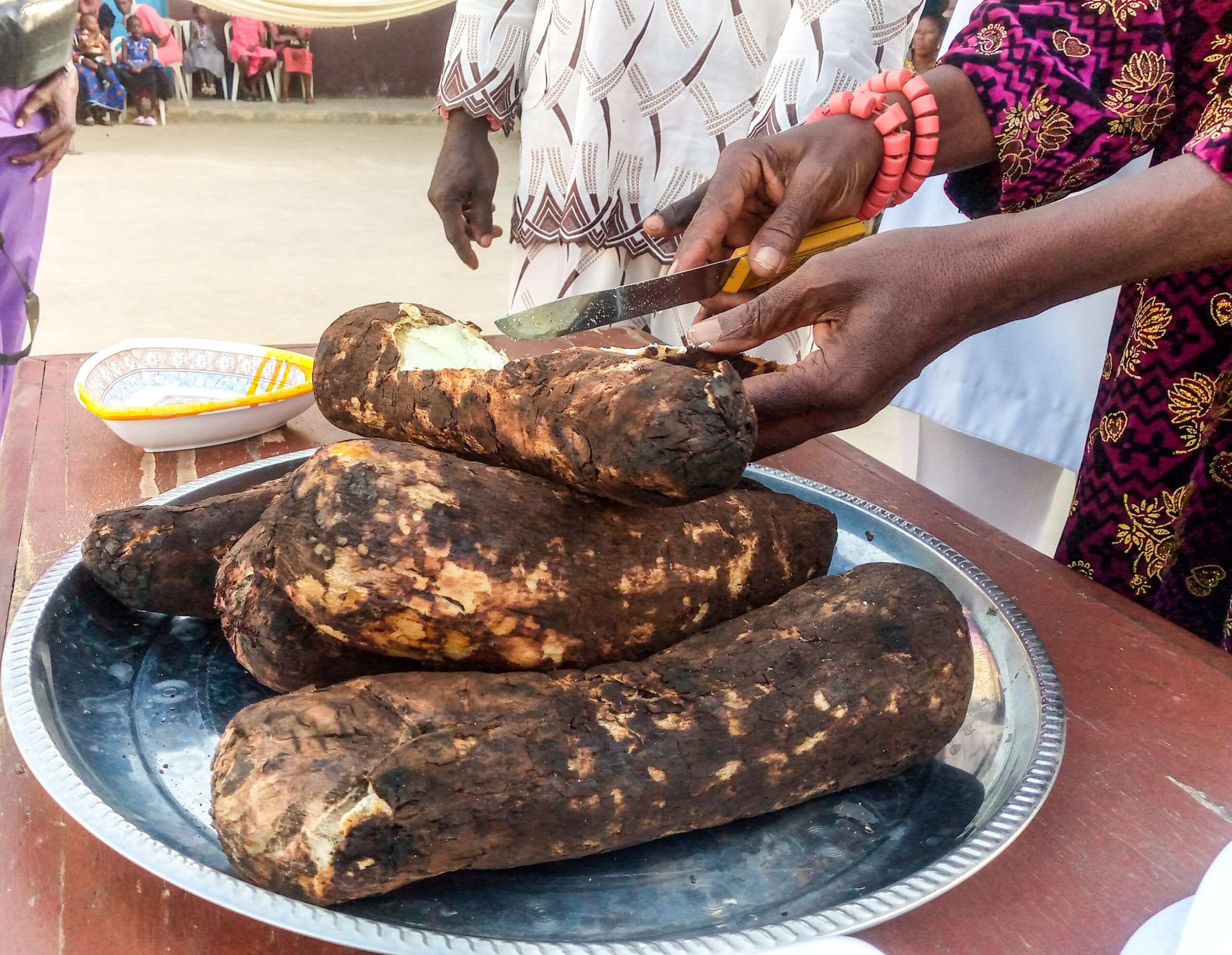
The New Yam Festival is one of the best-known Igbo cultural traditions. It is commonly associated with the beginning of the yam harvest and with thanksgiving, community renewal and cultural continuity. The festival is known by different names in different communities. One widely used term is Iri Ji, meaning eating yam. Another is Iwa Ji, often translated as yam breaking.
The timing and rituals vary by locality, but the festival commonly includes presentation of the first yams, prayers and thanksgiving, traditional dances and music, community meetings, visits by families and guests, wearing of traditional clothing, and eating roasted, boiled or pounded yam. Kola nuts and palm wine are used in customary hospitality, and traditional rulers and community leaders are recognised.
Yam has historically represented more than food in Igbo society. It is associated with agricultural skill, prosperity, social standing, resilience and the rewards of work. In some communities, the first yams are not eaten until the appropriate ceremony has taken place.
The 2026 Abuja New Yam Festival
On 29 September 2026, Igbo residents in Abuja marked a New Yam Festival featuring traditional music, drumming, dancing, cultural performances and traditional dress. The event was organised by Igbo youths in Abuja and included participation from members of the Igbo community and people from other Nigerian ethnic groups.
Kalu Omechia, identified in the report as patron of the Igbo Youth Association in Garki, Abuja, described the event as a celebration by Igbo youths of their cultural tradition. The Abuja celebration illustrates an important feature of contemporary Nigerian culture: festivals are not limited to ancestral villages. They are also held in national and commercial centres where internal migration has created large urban communities.
The festival is therefore simultaneously a harvest celebration, a religious and customary observance, a reaffirmation of identity, a diaspora-style homecoming, a networking and community event, and a public cultural showcase. Dates differ across Igbo communities. There is no single nationally fixed New Yam Festival date for every town or state.
Igbo Social Values and Traditional Institutions
Igbo societies are internally diverse, but several cultural themes recur across many communities. Family networks remain important in social life, property matters, ceremonies and business relationships. Decisions may involve extended family members, age grades, town unions or community associations.
For an expatriate or investor, this means that the formal corporate contact may not be the only person whose support matters. Local legitimacy and trusted introductions can be significant. Many Igbo communities organise people into age grades or age-based associations. These groups can support community projects, social welfare, ceremonies and local development.
Town unions connect people from the same community, including residents living in Lagos, Abuja, other Nigerian states or overseas. They may help finance roads, schools, healthcare projects and community events. Traditional rulers remain culturally important in many communities, even though Nigeria’s formal governmental authority rests with elected and appointed institutions. Their influence varies by state, locality and subject matter.
Kola Nut Hospitality
The kola nut is an important symbol of welcome, prayer, dialogue and communal fellowship in many Igbo ceremonies. Its presentation and blessing may follow established local customs. A visitor should wait for the host or elder to explain the procedure rather than handling the kola nut casually.
Igbo Clothing, Religion and Worldview
The red cap is a widely recognised symbol of Igbo male traditional dress, although its meaning depends on context. It may signal age, status, title or participation in a formal cultural event. Visitors should distinguish between clothing worn as everyday fashion and clothing that carries ceremonial or chiefly significance.
Nigeria’s major religions are Christianity and Islam, alongside indigenous religious traditions. The distribution varies geographically and by community. However, traditional beliefs and practices continue to influence festivals, names, family rituals, concepts of land and ancestry, and the role of traditional institutions.
Many Nigerians combine Christian or Muslim religious practice with cultural customs that predate those religions. It is therefore inaccurate to treat traditional culture and contemporary religious identity as mutually exclusive.
Nigeria’s Major Languages: Where Igbo Fits
Nigeria has English as its official language and uses several major Nigerian languages in education, broadcasting, commerce and public life. English is Nigeria’s official language and is widely used as the country’s lingua franca, including in government, education, business and interethnic communication. A foreign investor can conduct formal business in English, but English alone does not eliminate the importance of local languages and cultural knowledge.
Nigerian Pidgin is widely used in informal communication and is particularly prominent in southern Nigeria and urban centres. It is not simply bad English; it is a flexible contact language with its own vocabulary, grammar and regional varieties.
Hausa is one of the most important languages of northern Nigeria and is also widely used across West Africa. Yoruba is primarily associated with southwestern Nigeria. Igbo is predominantly associated with southeastern Nigeria.
Nigeria has more than 250 ethnic groups and more than 500 languages. The exact number depends on how researchers distinguish between a language and a dialect. The Federal Government describes Nigeria as having more than 50 languages and more than 250 ethnic groups and dialects, while also noting estimates of approximately 350 linguistic groups.
The National Institute for Cultural Orientation states that Nigeria has more than 525 indigenous languages. This is the newest and most specific official estimate located. The older federal figure of over 50 languages appears to use a different classification and is substantially older. Nigeria does not appear to have a single current official language census that resolves the differences among languages, dialects, ethnic groups and linguistic groups.
Language, Ethnicity and Nationality Are Not the Same Thing
A Nigerian’s ethnic identity, first language, religion and place of residence may all be different. An Igbo person may have grown up speaking English or Nigerian Pidgin. A Yoruba person may live permanently in Abuja. A Hausa speaker may be Christian or Muslim. A Nigerian with parents from different ethnic groups may identify with more than one heritage.
Someone may understand a language without speaking it fluently. Urban Nigerians may use English or Pidgin at work and a heritage language at home. Foreigners should ask, Which languages do you speak? rather than assuming language from a person’s name, state or appearance.
Nigerian names frequently carry religious, historical, familial or philosophical meaning.
What Igbo Culture Means for Foreigners, Investors and Expats
For a foreigner, Igbo culture is not a barrier but a set of practical signals. Knowing when to wait for a host to bless the kola nut, recognising the significance of a red cap, or understanding that a town union may influence a community decision can prevent misunderstandings and build trust.
For an investor, the key insight is that Nigeria is not a single-culture market. Language, local networks and regional history can strongly influence how people communicate and do business. A deal that looks settled on paper may still require the support of extended family members, age grades or community associations.
For an expat living in Abuja or Lagos, the urban New Yam Festival is a reminder that cultural life is not confined to ancestral villages. Attending such events, asking respectful questions and learning a few Igbo greetings can open social and professional doors.
As of 4 October 2026, Nigeria’s head of state and government is President Bola Ahmed Tinubu, GCFR. Nigeria’s vice president is Senator Kashim Shettima. The Central Bank of Nigeria is headed by Olayemi Cardoso, who took office on 22 September 2023.
What to Watch in Nigerian Culture and Language
The Federal Ministry of Art, Culture, Tourism and the Creative Economy is the principal federal portfolio directly covering Nigerian culture. Its remit includes Nigerian culture and heritage, creative industries, museums, monuments and national heritage, cultural festivals and artistic production, and promotion and preservation of Nigeria’s cultural diversity.
For languages, responsibility is distributed rather than held by one ministry alone. Relevant federal cultural institutions include the Centre for Black and African Arts and Civilization, the National Council for Arts and Culture, and the National Commission for Museums and Monuments. Their October 2026 directors-general or director-level heads require confirmation from each institution’s official website or governing ministry.
The National Bureau of Statistics is the main national agency responsible for developing, managing and safeguarding official statistics.
Related reading: Cameroon Neighbours Explained, Central Africa in 2026; Eritrea Explained 2026, a Red Sea Country Guide; DR Congo Neighbours Explained, Central Africa in 2026; more from Africa.
Frequently Asked Questions
What does Igbo mean?
Igbo refers both to an ethnic group indigenous mainly to southeastern Nigeria and to its principal language. The Igbo people are concentrated in Abia, Anambra, Ebonyi, Enugu and Imo states, with large communities in Abuja, Lagos and the global diaspora.
How many languages are spoken in Nigeria?
Nigeria has more than 525 indigenous languages, according to the National Institute for Cultural Orientation as of April 2025. The Federal Government also describes Nigeria as having more than 250 ethnic groups and dialects.
What is the New Yam Festival?
The New Yam Festival is an Igbo harvest celebration associated with thanksgiving, community renewal and cultural continuity. It is known as Iri Ji or Iwa Ji in different communities and includes prayers, dances, traditional dress and the eating of yam.
Is Igbo the same everywhere?
No. Igbo contains many dialects and varieties. Local speech can vary considerably in pronunciation and vocabulary.
What is the kola nut in Igbo culture?
The kola nut is an important symbol of welcome, prayer, dialogue and communal fellowship in many Igbo ceremonies. A visitor should wait for the host or elder to explain the procedure rather than handling the kola nut casually.
Do all southeastern Nigerians speak Igbo?
No. The southeast also includes important communities speaking languages such as Ibibio, Efik, Ijaw, Annang and several others. Foreigners should ask which languages a person speaks rather than assuming language from name, state or appearance.
Who is Nigeria’s president in 2026?
As of 4 October 2026, Nigeria’s head of state and government is President Bola Ahmed Tinubu, GCFR. Nigeria’s vice president is Senator Kashim Shettima.
Sources: fmacce.gov.ng, africanews.com, fmino.gov.ng, nipsskuru.gov.ng, statehouse.gov.ng, fmino.gov.ng. Retrieved 4 October 2026.
This article was produced by The Rio Times’ automated newsroom system. How we use AI · Report an error · Editorial responsibility: Matthias Camenzind, Editor-in-Chief
Part of our ongoing coverage
Africa: The New Scramble — the great-power contest over the continent.