
NIGERIA · CULTURE
Key Facts
- —The country Africa’s most populous nation, about 237.5 million people in 2025.
- —The music Burna Boy, Wizkid and Tems hold four Grammys between them.
- —What happened Behind the Scenes became Nollywood’s first film past ₦2 billion (US$1.5 million).
- —The heritage UNESCO lists two Nigerian World Heritage sites and eight intangible elements.
- —Coming up Headies in Toronto, 25 October; CAF Awards in Lagos, 7 December.
- —US visas Washington suspended new Nigerian tourist and student visas from January 2026.
From Afrobeats and Nollywood to a Nobel laureate, Nigeria’s cultural figures now reach far beyond West Africa.
Nigeria culture reaches Americans mainly through Afrobeats, Nollywood films and novels. A fairly small group of musicians, filmmakers, writers and organisers carries much of that reach.
This guide names the key figures as of October 2026, from Grammy winners to festival founders. Daily news is in the Rio Times Nigeria section.
How Nigeria Culture Reached the World
Nigeria had about 237.5 million people in 2025, World Bank data show, far more than Ethiopia, the next most populous African country. That scale gives its artists a large home audience before they ever tour abroad.
Its music, films and books draw on Yoruba, Igbo, Hausa and many other traditions. Lagos, the commercial capital, hosts most of the venues in this guide.
In the north, Kano is home to Kannywood, one of the country’s major film industries. In September 2026 the National Theatre held its creative summit there, its first outside Lagos.
Culture policy sits with Hannatu Musawa, the federal Minister of Art, Culture, Tourism and the Creative Economy. Obi Asika heads the National Council for Arts and Culture, the federal agency that promotes the arts.
The National Theatre in Lagos, renamed after the writer Wole Soyinka in 2024, reopened on 1 October 2025 after renovation. On 1 October 2026 it hosted the premiere of MKO, a documentary on the late politician Moshood Abiola.
How the state shapes daily life is covered in Nigeria politics explained. For one of the big traditions, see Igbo culture and language in Nigeria.

Afrobeats and the Musicians Who Took It Global
Two similar words describe two eras of Nigerian music. Afrobeat, without an s, is the style created by Fela Kuti, the bandleader and activist born in 1938.
The Recording Academy, which runs the Grammys, calls it a merger of Yoruba and other African styles with funk, jazz and rock. Fela, who died in 1997, paired that sound with outspoken political messages.
In 2025 his album Zombie entered the Grammy Hall of Fame. In 1998 his daughter Yeni Kuti launched Felabration, a week of events around his 15 October birthday.
In 2000 she and her brother Femi, a six-time Grammy nominee, opened the New Afrika Shrine in Lagos. Dates and venues for this year are in the Felabration guide.
Afrobeats, with an s, is today’s pop sound, blending African rhythms with R&B, hip-hop and dancehall. These are its leading names, with their Recording Academy record as of October 2026.
- Burna Boy: one Grammy from 13 nominations. His album Twice as Tall won Best Global Music Album at the 2021 ceremony, and the Academy says he was the first African artist to headline and sell out major stadiums in the US and Europe.
- Wizkid: one Grammy from six nominations, for the Brown Skin Girl video with Beyoncé and Blue Ivy Carter in 2021. His song Essence, with Tems, was nominated in 2022.
- Tems: two Grammys from eight nominations, for Wait for U with Future and Drake in 2023 and for her own Love Me JeJe in 2025.
- Davido: five nominations and no win yet, most recently for With You, recorded with Omah Lay, in 2026.
- Ayra Starr: two nominations, for Rush in 2024 and for Gimme Dat with Wizkid in 2026.
- Asake and Olamide: nominated together for Amapiano in 2024; Asake was nominated again with Wizkid for MMS in 2025.
- Rema: his song Calm Down, remixed with US singer Selena Gomez, won Top Afrobeats Song at the 2023 Billboard Music Awards.
The Grammys added Best African Music Performance in 2024, and Tems won it in 2025. South Africa’s Tyla took it in 2024 and 2026, so Tems is its only Nigerian winner so far.
Nigerian acts still filled three of the five nominations in 2026. At home, the top music awards are the Headies, founded by Ayo Animashaun, chief executive of the music channel HipTV.
The 18th Headies are set for Toronto, Canada, on 25 October 2026, with a watch party in Lagos. The money side is covered in how Afrobeats became a Nigerian export.
Nollywood, the Box Office and the Censors
Nollywood is the nickname for Nigeria’s film industry. Its box-office record holder is Funke Akindele, an actor, producer and director.
Her film Behind the Scenes opened in cinemas on 12 December 2025. The Nigerian Film Corporation, the federal film agency, says it was the first Nollywood production to pass ₦2 billion (about US$1.5 million).
By late January 2026 it had passed ₦2.4 billion (about US$1.8 million), according to Lagos governor Babajide Sanwo-Olu. The previous record, Everybody Loves Jenifa, was also hers, at ₦1.88 billion (about US$1.4 million), Premium Times reported.
Conversions use the Central Bank of Nigeria’s official rate of 7 October 2026, ₦1,331 to US$1. At that rate the record gross is modest by Hollywood standards, but it is large for a market priced in naira.
Films must be classified by the National Film and Video Censors Board (NFVCB), set up in 1993, before public release. Its director-general, Shaibu Husseini, has said the board wants to cut classification time to under 24 hours.
The board also polices content. In August 2026 it moved to block Living in Colours, an unclassified gay-themed web series on YouTube, Premium Times reported.
The industry’s big awards night is the Africa Magic Viewers’ Choice Awards (AMVCA), run by the pay-TV group MultiChoice. At the 12th edition in Lagos on Saturday, 9 May 2026, My Father’s Shadow won Best Movie.
Its director, Akinola Davies Jr., won Best Director. The historical epic Lisabi: A Legend Is Born won Best Indigenous Language (West Africa), for films in local languages.
For an Igbo-language example, see the box-office run of Ikenga: The Last Festival. Funke Akindele’s earlier record is covered in Behind the Scenes becomes Nollywood’s biggest film.
Writers Who Shaped How the World Reads Nigeria
Chinua Achebe came to prominence in 1958 with his novel Things Fall Apart. In 2007 he won the Man Booker International Prize for his body of work, the Booker Prize Foundation records.
Wole Soyinka, born in Abeokuta in 1934, won the 1986 Nobel Prize in Literature. The Nobel citation praised a writer “who in a wide cultural perspective and with poetic overtones fashions the drama of existence.”
Soyinka remains a public voice in his nineties. In October 2025 the US consulate in Lagos revoked his visa, and he told reporters he knew of no reason for it.
Ben Okri won the 1991 Booker Prize for The Famished Road. Okri has described the novel as the story of a spirit child in Lagos around the time of independence.
Chimamanda Ngozi Adichie became a MacArthur Fellow in 2008, after Purple Hibiscus (2003) and Half of a Yellow Sun (2006). The foundation said the second book humanised “the Biafran tragedy,” Nigeria’s civil war over the breakaway Republic of Biafra.
Together these writers gave foreign readers their picture of Nigeria, from colonial rule to civil war. Since October 2025, Soyinka’s name has also stood on the National Theatre in Lagos.
Visual Artists and the Fight Over Heritage
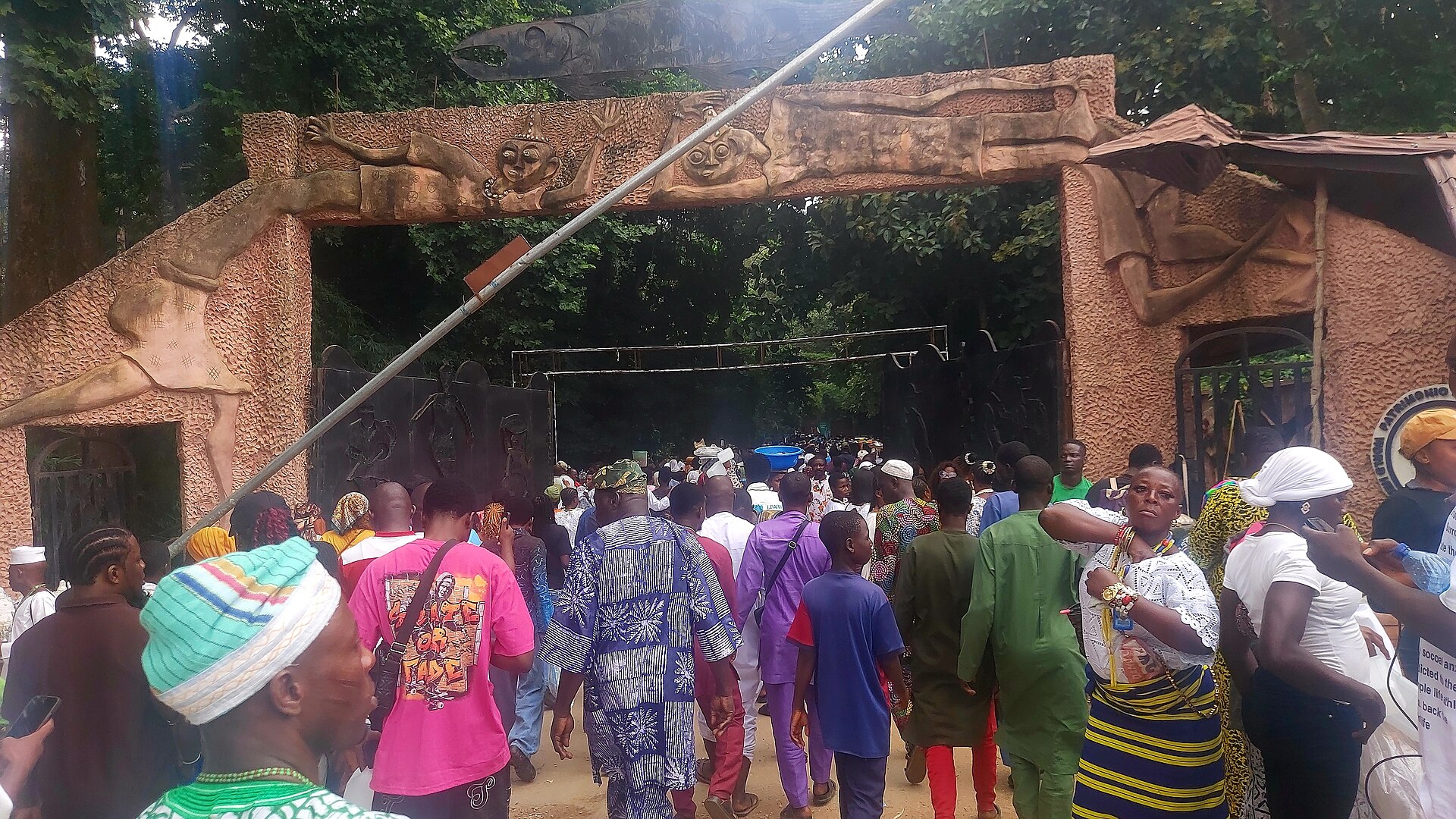
In Osogbo, the Austrian artist Susanne Wenger and the New Sacred Art movement filled the Osun-Osogbo Sacred Grove with large sculptures. UNESCO credits that work with restoring the grove’s spiritual character.
El Anatsui, born in Ghana in 1944, has been based in the Nigerian university town of Nsukka since 1975. He won the Venice Biennale’s Golden Lion for Lifetime Achievement in 2015.
The Biennale called him a leading member of the Nsukka School of artists. His Tate Modern commission, Behind the Red Moon, ran from October 2023 to April 2024, built from bottle tops sourced in Nigeria.
Nigeria’s pavilion at the 2017 Venice Biennale, How About Now?, showed work by Peju Alatise, Victor Ehikhamenor and Quddus Onikeku.
Heritage is also contested at home. In November 2025 Edo State’s governor, Monday Okpebholo, challenged Benin City’s new Museum of West African Art.
He said the project would be restored to its “original and rightful purpose” as a Benin Royal Museum. Days later, men described as armed thugs disrupted the museum’s preview opening.
Okpebholo then revoked the museum’s land title, saying the site would revert to the historic Benin Central Hospital, Premium Times reported.
Sport Icons From the NBA to the Super Falcons
Hakeem Olajuwon, born in Lagos in 1963, led the Houston Rockets to NBA titles in 1994 and 1995. The Naismith Basketball Hall of Fame, which enshrined him in 2008, lists his 3,830 blocked shots as an NBA record.
In football, Victor Osimhen won the Confederation of African Football (CAF) men’s Player of the Year award in 2023. Ademola Lookman followed in 2024, and Morocco’s Achraf Hakimi won in 2025, Premium Times reported.
The women’s team, the Super Falcons, hold a record ten African titles, CAF says. Goalkeeper Chiamaka Nnadozie was CAF’s women’s goalkeeper of the year in 2024 and 2025.
At the 2026 Women’s Africa Cup of Nations in Morocco, they lost 1-0 to Cameroon in the quarter-finals. A 2-1 play-off defeat to South Africa in August ended their 2027 World Cup hopes, Premium Times reported.
The men’s Super Eagles reached the semi-finals of the Africa Cup of Nations in Morocco in January 2026. They did not qualify for the 2026 World Cup in North America.
Lagos will host the 2026 CAF Awards on Monday, 7 December. CAF’s executive committee approved the date on 2 October, Premium Times reported.
Media Figures, Festivals and Fashion
Behind the stars stands a layer of media entrepreneurs. Ayo Animashaun, chief executive of HipTV, founded the Headies, and MultiChoice’s Africa Magic brand runs the AMVCA.
Reality television also makes celebrities. In October 2026 Temi Nkem, season 11 winner of the reality show Big Brother Naija, received ₦90 million (about US$68,000) in cash.
Omoyemi Akerele founded Lagos Fashion Week in 2011. It won the 2025 Earthshot Prize, a global environmental award, in the Build a Waste-free World category.
Festivals are an easy way for visitors to meet Nigeria culture in person. These are the main ones, with their UNESCO status where it applies.
- Osun-Osogbo Festival, Osogbo: a 12-day procession in July and August for Osun, the Yoruba goddess of the river. The grove has been a UNESCO World Heritage site since 2005.
- Durbar in Kano: parades of horsemen in ceremonial dress at the two Eid holidays, inscribed by UNESCO in 2024. In 2025 security agencies banned Kano’s Sallah Durbar amid a dispute between two rival emirs.
- Argungu Fishing Festival: a fishing contest and cultural festival in Kebbi State, on UNESCO’s list since 2016.
- Sango Festival, Oyo: a festival in Oyo honouring Sango, a Yoruba deity, added by UNESCO in 2023.
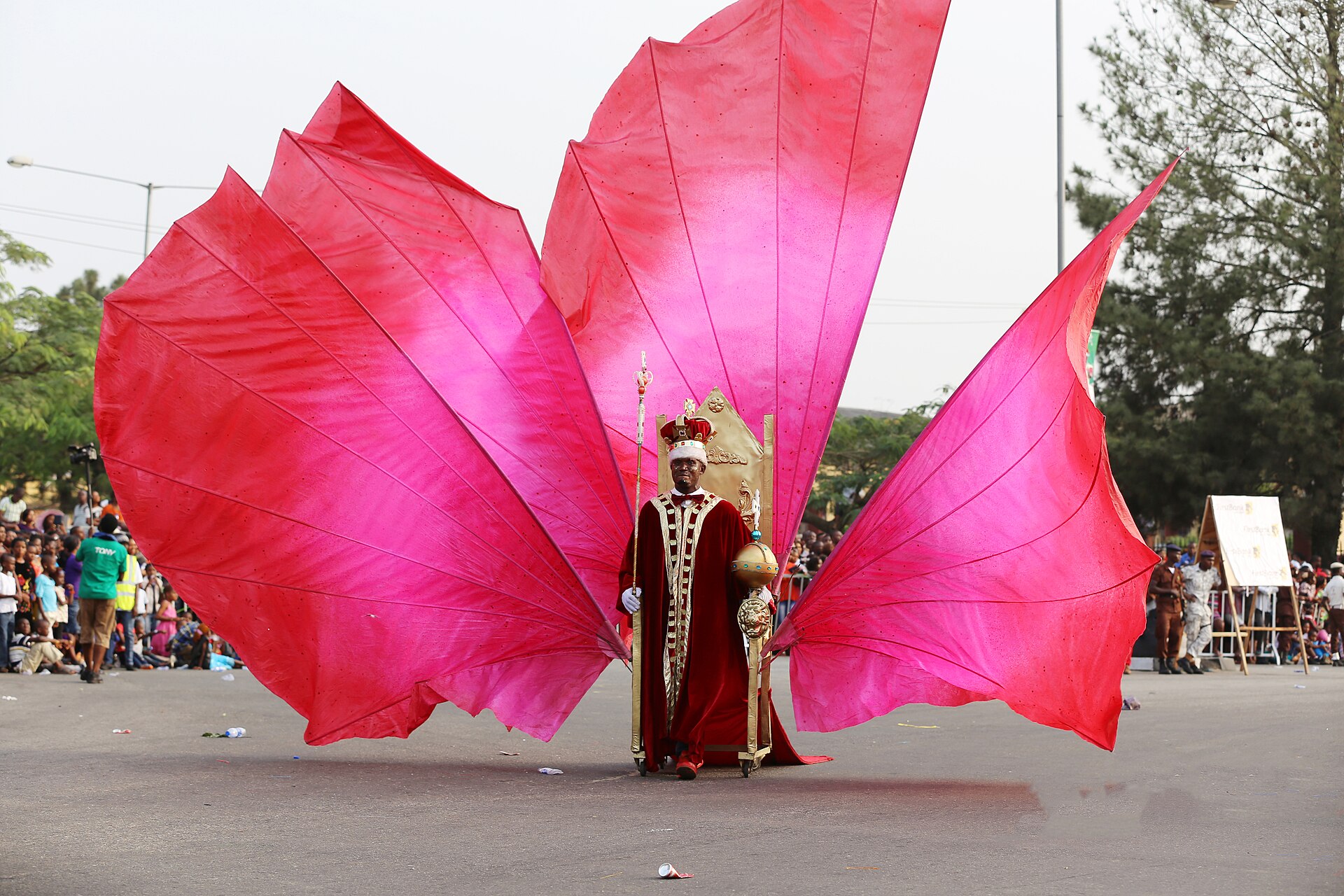
- Calabar Carnival, Cross River State: a December street parade. The state tourism bureau counted more than 248,000 visitors and ₦17.4 billion (about US$13 million) in December 2025; see the Calabar Carnival guide.
- Felabration, Lagos: a week of events at the New Afrika Shrine around Fela Kuti’s 15 October birthday.
- Lagos Fashion Week: runway shows, usually in late October, with a focus on sustainable design; see Lagos Fashion Week 2026.
Nigeria’s other World Heritage site is the Sukur Cultural Landscape, listed in 1999. UNESCO’s intangible list also includes the Ijele masquerade, the Ifa divination system and Kwagh-Hir theatre.
What It Means for US Readers
The biggest practical issue is travel. Proclamation 10998, signed by President Donald Trump on 16 December 2025, took effect on 1 January 2026.
It suspends entry for Nigerians on immigrant visas and on business, tourist, student and exchange visas (B, F, M and J). Performer visas are not on that list, but consulates must shorten the validity of other visas issued to Nigerians.
Athletes travelling for major sporting events are exempt. Visa holders as of 1 January 2026 were not affected, the US Embassy said, according to Premium Times.
Commercially, the pull runs the other way. At an August 2026 workshop in Lagos, US Consul General Brandon Hudspeth called Nigeria’s music industry “a significant trade and investment opportunity.”
He named Universal Music Group, EMPIRE, Sony and Warner Music Group among labels helping Nigerian artists reach global audiences. Strong copyright protection, he argued, is what gives US investors confidence.
Washington has spent about US$1.2 million on cultural preservation in Nigeria over five years, the consulate says. A US$125,000 grant announced in August 2026 will document the Lejja iron-smelting site in Enugu State, dated to about 2000 BC.
The State Department rates Nigeria Level 3, “Reconsider Travel,” citing crime, terrorism, unrest, kidnapping and uneven health care. Festival visitors should read that advisory and its area-specific warnings before booking.
Fans in North America can catch the Headies in Toronto on 25 October. Nollywood titles also reach US screens through streaming, as with Akindele’s Finding Me on Amazon Prime Video in March 2025.
The wider business picture is in who runs Nigeria’s economy. Ties with Washington are covered in Nigeria geopolitics explained.
What Is Not Known
It is not known when, or whether, Washington will ease Proclamation 10998 for Nigerians. No amendment to it had appeared in the Federal Register by 8 October 2026.
No official body has published a final gross for Behind the Scenes. The last widely reported figure was ₦2.4 billion (about US$1.8 million), in January 2026.
How the dispute over the Museum of West African Art in Benin City ends is unclear. The size of the creative economy is also uncertain.
One widely quoted figure, ₦1.97 trillion (about US$1.5 billion) for 2025, came from a research group, not the statistics office. The winners of the Headies on 25 October and the CAF Awards on 7 December are not yet known.
Frequently Asked Questions
What is Nigeria best known for culturally?
Afrobeats music, Nollywood films and writers such as Wole Soyinka and Chinua Achebe. The Osun-Osogbo Sacred Grove and the Durbar in Kano are also recognised by UNESCO.
What is the difference between Afrobeat and Afrobeats?
Afrobeat is the style Fela Kuti built from Yoruba music, funk, jazz and rock. Afrobeats is the broader pop sound of today’s stars, such as Burna Boy, Wizkid and Tems.
Which Afrobeats stars have won Grammy Awards?
Burna Boy and Wizkid have one each, both from 2021, and Tems has two, from 2023 and 2025. Davido has five nominations but no win as of October 2026.
What is Nollywood?
Nollywood is the nickname for Nigeria’s film industry. As of October 2026, its record holder is Funke Akindele’s Behind the Scenes, at over ₦2.4 billion (about US$1.8 million).
Who are the best-known Nigerian writers?
Wole Soyinka won the 1986 Nobel Prize in Literature, and Chinua Achebe wrote Things Fall Apart. Ben Okri won the 1991 Booker Prize, and Chimamanda Ngozi Adichie became a MacArthur Fellow in 2008.
Which Nigerian festivals and sites does UNESCO recognise?
The Osun-Osogbo Sacred Grove and the Sukur Cultural Landscape are World Heritage sites. UNESCO also lists the Durbar in Kano, the Argungu fishing festival and the Sango Festival in Oyo.
Can Nigerian artists still perform in the United States?
They can apply, because performer visas are not among the categories suspended by Proclamation 10998. Consulates must shorten their validity, and tourist and student visas for Nigerians are suspended.
Sources: Recording Academy, Burna Boy Grammy record; Recording Academy, Wizkid; Recording Academy, Tems; Recording Academy, Davido; Recording Academy, Ayra Starr; Recording Academy, Asake; Recording Academy, Best African Music Performance 2024–2026; Recording Academy, 63rd Grammy winners; Recording Academy, Fela Kuti’s musical family (31 July 2025); Billboard, Rema (2023 Billboard Music Awards); UNESCO World Heritage Centre, Nigeria; UNESCO, Osun-Osogbo Sacred Grove; UNESCO Intangible Cultural Heritage, Nigeria; Nobel Prize, Wole Soyinka facts; Booker Prizes, Chinua Achebe; Booker Prizes, The Famished Road; MacArthur Foundation, Chimamanda Adichie; La Biennale di Venezia, Golden Lion 2015 for El Anatsui; La Biennale di Venezia, 2017 national participations; Tate Modern, El Anatsui: Behind the Red Moon; Naismith Basketball Hall of Fame, Hakeem Olajuwon; CAF, Women’s Africa Cup of Nations 2026 draw (16 January 2026); National Film and Video Censors Board; Earthshot Prize, Lagos Fashion Week; Lagos Fashion Week, about; Federal Register, Proclamation 10998; US Mission Nigeria, music industry IP workshop (20 August 2026); US Mission Nigeria, Lejja preservation grant (24 August 2026); Central Bank of Nigeria, official exchange rates (7 October 2026); World Bank, population data; Premium Times, Behind the Scenes passes N2.4bn (27 January 2026); Premium Times, 2025 box office and Everybody Loves Jenifa; Premium Times, NFVCB reforms; Premium Times, NFVCB and Living in Colours; Premium Times, AMVCA 2026 winners; Premium Times, Headies to hold in Toronto; Premium Times, Headies 2026 nominees and date; Premium Times, CAF Awards 2026 in Lagos; Premium Times, Nigeria misses the 2026 World Cup; Premium Times, AFCON semi-final; Premium Times, Super Falcons miss the 2027 World Cup (14 August 2026); Recording Academy, Grammy Hall of Fame list; Premium Times, US revokes Soyinka’s visa; Premium Times, National Theatre reopens as Wole Soyinka Centre; Premium Times, MKO premiere; Premium Times, culture minister and NCAC; Premium Times, Kano creative summit and Kannywood; Premium Times, MOWAA land revoked; Premium Times, Kano Sallah Durbar banned (2025); Premium Times, Calabar Carnival 2025 figures; Premium Times, Big Brother Naija season 11; Premium Times, US partial travel ban; Premium Times, US Embassy on effective date; Premium Times, dRPC creative economy estimate (all accessed 8 October 2026).
Editorial responsibility: Matthias Camenzind, Editor-in-Chief · Editorial standards · Report an error
Part of our ongoing coverage
Africa: The New Scramble — the great-power contest over the continent.