Argentina and the United States, Relations Explained

ARGENTINA · UNITED STATES RELATIONS
Key Facts
- —What is happening Argentina and the United States signed a trade and investment agreement on 5 February 2026 and launched a joint infrastructure corridor on 23 September 2026, while a 10% US tariff now applies to most Argentine goods.
- —Why it matters Argentina is a conservative-led partner of Washington with lithium, copper and Vaca Muerta shale, and the United States is its largest foreign investor, with US$20.9 billion invested as of 2023.
- —The numbers US goods trade with Argentina was US$18.3 billion in 2025 with a US surplus of US$1.7 billion, and the US surplus from January to August 2026 was US$266.6 million.
- —Who is who Javier Milei is Argentina’s president, Pablo Quirno its foreign minister and Luis Caputo its economy minister, while Peter Lamelas is the US ambassador and Christopher Landau the US Deputy Secretary of State.
- —What to watch Watch whether Argentina’s Congress takes up the trade agreement, whether the 10% US tariff is lowered, and whether Argentina rejoins the US Visa Waiver Program that ended for it in 2002.
- —Prediction markets Polymarket: Javier Milei 46.5% and Axel Kicillof 29.5% to win Argentina’s 2027 presidential election (27 October, 9:35 a.m. ET).
- —Power Index Argentina ranks 4th of 14 in The Rio Times Latin America Power Index, with 61.2 points (October 2026 edition).
- —What it means for you Americans can visit Argentina for up to 90 days without a visa, while Argentines still need a US visa, and US firms may bid for projects under the new corridor.
This guide explains where the two countries stand in October 2026. It covers trade, tariffs, visas, investment, minerals and security.
Argentina US relations in October 2026 rest on a signed trade deal, a new US tariff and a push for minerals. For US readers, the effects show up in visas, investment and trade.
The United States is Argentina’s largest foreign investor, with US$20.9 billion invested as of 2023, the State Department says. Washington also runs a trade surplus with Argentina in both goods and services.
Argentina US Relations at a Glance
Javier Milei, a free-market conservative, has been Argentina’s president since December 2023, and the next presidential election is due in October 2027. His party won the midterm elections of 26 October 2025, a US Senate Banking Committee minority letter says.
On 21 October 2026, Karina Milei, the president’s sister and secretary general, met US Ambassador Peter Lamelas at the Casa Rosada. Argentina’s government said they discussed the bilateral relationship and US company investment projects.
Some deputies see it differently, and an undated draft resolution speaks of unconditional alignment with Washington. It asks Foreign Minister Pablo Quirno to explain the trade deal, which its authors say Congress has not debated.
Companion pillars cover the politics behind this, Argentina Geopolitics Explained 2026 and Argentina Politics Explained, Who Holds Power in 2026. Foreign investors are mapped in Argentina Foreign Powers and Investors in 2026.
Argentina is one of the countries scored in The Rio Times Latin America Power Index, which ranks power, alignment and business conditions. The Key Facts box above shows Argentina’s live rank.
The Trade Agreement and Its Terms
The two governments signed the Agreement on Reciprocal Trade and Investment on 5 February 2026. US Trade Representative Jamieson Greer, who leads the White House trade office, signed with Quirno.
Argentina agreed to lower duties and licensing barriers on US goods, including motor vehicles and many farm products. It also pledged not to tax digital services in ways that discriminate against US companies.
Argentina opens duty-free quotas for US goods, including 80,000 metric tons of beef in 2026, 10,000 vehicles and 1,000 tons of cheese. It must also open its market to US poultry within one year of the deal taking effect.
On minerals, Argentina must let US investors mine and process critical minerals and energy on terms no less favourable than local investors. Washington will consider supporting such projects through its export credit and development finance agencies.

The deal starts 60 days after both sides exchange written notices that their legal steps are complete. Either side can end it with six months’ notice.
The original text lets each side impose additional tariffs. As of 27 October 2026 we found no official notice that the deal has entered into force.
The US Tariff on Argentine Goods
On 20 February 2026 the Supreme Court held that an emergency-powers law, IEEPA, does not authorise tariffs. A presidential order of the same day ended the duties imposed under it, including the reciprocal tariffs.
A temporary 10% import surcharge ran for 150 days from 24 February 2026, until 24 July 2026. It exempted items such as beef, energy, pharmaceuticals and certain critical minerals.
Since 24 July 2026 Washington applies a 10% tariff on Argentine products under Section 301, a law aimed at unfair foreign practices. The notice lists exemptions and cites Argentina’s pledge to ban imports made with forced labour.
Most other covered economies face 12.5% under the same notice, so Argentina’s rate is lower than theirs. Section 232 duties, which protect national security sectors such as steel, are not affected by the ruling or the order.
A Protocol of Amendment posted by the US Trade Representative replaces the tariff wording that relied on the struck-down emergency orders. It commits Washington to give listed Argentine goods the most-favoured-nation rate, the standard rate for trading partners.
That promise stays subject to Section 232, 201 and 301 actions, so new US tariffs remain possible. The protocol page shows no signing date, and the protocol starts only once the deal itself is in force.
Trade in Numbers
The US Trade Representative counts US$29.9 billion of goods and services trade with Argentina in 2025, up 14.7% on 2024. The United States ran a surplus of US$1.7 billion in goods and US$6.1 billion in services.
The Census Bureau puts US goods exports to Argentina at US$9.97 billion in 2025 and imports at US$8.28 billion. From January to August 2026 exports were US$6.77 billion and imports US$6.51 billion, a US surplus of US$266.6 million.
The balance turned in July and August 2026, when the United States imported US$103.7 million and US$158.2 million more than it exported. Trade with Argentina is therefore close to balanced this year.
INDEC, Argentina’s statistics office, shows consumer prices 33.5% higher in August 2026 than a year earlier. The IMF projects growth of 2.1% in 2026, and the peso traded near 1,540 per US$ on 27 October.
Investment, Minerals and the Andes-Atlantic Corridor
The State Department counts more than 300 US companies in Argentina and US$20.9 billion of US direct investment as of 2023. RIGI, Argentina’s incentive regime for large investments, dates from June 2024 and offers 30 years of tax and currency stability.
On 23 September 2026 Quirno and US Deputy Secretary of State Christopher Landau launched the Andes-Atlantic Corridor in New York. It aims to modernise railways, waterways, ports, pipelines and power lines linking Argentine mines and oil fields to Atlantic ports.
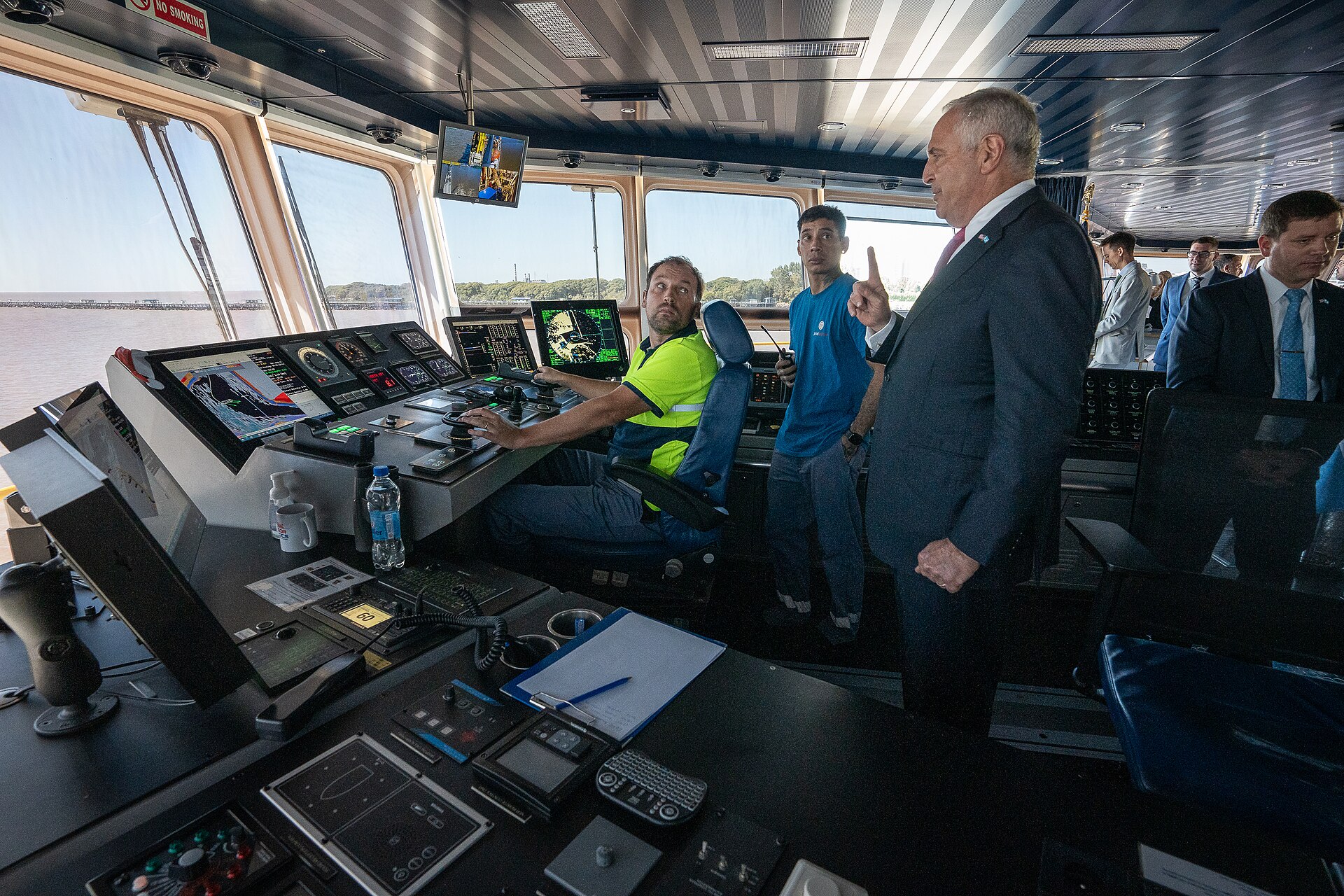
The US side promises to promote financing from the DFC, its development finance agency, and from EXIM Bank, its export credit agency. Argentina’s foreign ministry names Vaca Muerta, the shale oil and gas formation in Neuquen province, as a priority.
The ministry also cites a US-Argentina Critical Minerals Framework Agreement and links the corridor to a G7 infrastructure partnership. Argentina commits to clear concession rules and stronger investment protections.
Argentina is part of the lithium triangle it shares with Bolivia and Chile, which our lithium triangle guide explains. Salt flats such as the Salar del Hombre Muerto are where US interest in critical minerals meets Argentine geology.
The US Treasury Swap and Crisis Lending
On 9 October 2025 the US Treasury announced a US$20 billion swap with Argentina’s central bank, which dates its agreement 20 October. Argentina drew US$2.5 billion and repaid it in December 2025, the central bank and Treasury’s fund balance sheet show.
Treasury wrote on 20 January 2026 that no drawings were outstanding. Senator Elizabeth Warren, a Democrat, asked on 4 February 2026 for proof that the agreement itself had ended.
The same letter quotes President Donald Trump saying before the vote that Washington would not be generous with Argentina if Milei lost. Argentina’s central bank renewed a CNY130 billion (US$19.5 billion) swap with China’s on 5 August 2026, as this China lending report explains.
Visas, Travel and Deportations
Argentines need a US visitor visa, because Argentina is not on the Visa Waiver Program list as of 27 October 2026. A Federal Register notice of 21 February 2002 ended its participation.
Chile is on the list, so Chileans can travel for 90 days or less with an approved ESTA, the online travel authorisation. Argentines who want the same treatment must wait for a US designation that has not been announced.
Americans need no visa for stays of up to 90 days in Argentina, says a State Department page updated in April 2024. Its travel advisory of 20 May 2026 is Level 1, with extra caution in Rosario.
Deportation numbers for Argentines in 2026 are not published in a source we could verify, so we give none. Argentines in the United States should check US immigration authorities for current rules.
Readers who want to live in Argentina can use two practical guides. See Argentina Visa Guide: Every Option for Living There and Moving to Argentina: Residency, Bank, Rent, Health for details.
Security and Military Ties
The trade agreement contains a security chapter. The United States promises to work with Argentina to streamline defence trade, and Argentina promises to cooperate on export controls and sanctions.
If Washington adopts a national or economic security trade measure, Argentina will, where appropriate, adopt one with similar effect. It will also explore an inbound investment screening mechanism.
The State Department’s undated country profile calls Argentina a key ally on counterterrorism, with a regional leadership role. It notes that Argentina listed Hezbollah, a Lebanese militant group, as a terrorist organisation in 2019, a Latin American first.
The foreign ministry says the corridor also supports security and critical supply chains. For crime and policing inside Argentina, see Argentina Security and Crime Explained 2026.
People, Aid and the Diaspora
The Migration Policy Institute, a Washington research group, tabulates US Census data on Argentine-born residents. For 2022 it reports about 60% naturalised as US citizens and a median household income of US$86,000.
The same undated profile says the State Department allocated US$3.1 million to Argentina for fiscal year 2020. We could not confirm 2025 or 2026 aid amounts.
The people behind these figures are described in Argentina Population and Ethnic Groups Explained 2026. Our country hub, Argentina, lists all current coverage.
What It Means for US Readers
Travellers from the United States can enter Argentina for up to 90 days without a visa. Argentine visitors to the United States still need one.
US exporters gain lower Argentine duties only once the deal is in force, so the quotas are not yet usable. US importers of Argentine goods face a 10% tariff with listed exemptions.
Investors should note that RIGI terms and the corridor target mining, energy and transport. None of this is investment advice, and returns depend on inflation, the peso and policy.
What Prediction Markets Say
Polymarket, where users bet real money, shows Javier Milei at 46.5% and Axel Kicillof at 29.5% to win in 2027. Those prices are from 27 October 2026, 9:35 a.m. ET, and Kicillof is the Peronist governor of Buenos Aires province.
About US$1.13 million has traded on the full election market, and about US$281,000 on the Milei contract. The market asks who wins in 2027, not about US relations, but the next president will decide whether the trade deal advances.
Why we show this: prediction markets turn real-money bets into a live probability that moves within minutes of the news, which is why investors, campaigns and newsrooms in the United States now follow them closely. We show them next to polls and official results, never instead of them.
What Is Not Known
We found no official notice that the 60-day clock has started, and no primary record that Argentina’s Congress has voted. Ratification status is therefore unconfirmed.
The agreement text names no duty-free US quota for Argentine beef, so we give none. We also could not confirm whether the US$20 billion Treasury agreement has formally ended.
No primary count of Argentines in the United States, of Argentines deported in 2026, or of recent US aid could be confirmed. The status of the US court case over the 2012 nationalisation of YPF, Argentina’s oil company, was also not verified.
The protocol date and the deal start date are not stated, and the 10% tariff has no announced end date. September 2026 inflation figures were not available to us in the series we used.
Frequently Asked Questions
Do Argentina and the United States have a trade agreement?
They signed the Agreement on Reciprocal Trade and Investment on 5 February 2026. It starts 60 days after both sides notify completion of legal steps, and we found no such notice.
What US tariff applies to Argentine goods?
Since 24 July 2026 the United States applies a 10% Section 301 tariff on products of Argentina, with listed exemptions. Most other covered economies face 12.5%.
Do Argentines need a visa for the United States?
Yes, Argentines need a US visitor visa because Argentina is not in the Visa Waiver Program as of 27 October 2026. Argentina left the program in 2002.
Do Americans need a visa for Argentina?
No, US citizens can visit Argentina for tourism or business for up to 90 days without a visa. Check the State Department entry page and the Level 1 advisory of 20 May 2026 before travelling.
Is the United States the largest investor in Argentina?
Yes, the State Department says US direct investment stock was US$20.9 billion as of 2023, the largest of any country. More than 300 US companies operate there.
What is the Andes-Atlantic Corridor?
It is a US-Argentina initiative launched on 23 September 2026 to modernise railways, ports, pipelines and power lines. It aims to raise exports of minerals, oil and gas through US-backed investment.
Sources: USTR, signing of the Argentina agreement, 5 February 2026; USTR, agreement text, February 2026; USTR, Protocol of Amendment to the agreement (undated); White House, joint statement on the framework, 13 November 2025; USTR, Argentina trade data 2025; US Census Bureau, trade in goods with Argentina; Federal Register, Section 301 notice, 28 July 2026; Federal Register, temporary import surcharge, 25 February 2026; Federal Register, Ending Certain Tariff Actions, 25 February 2026; US Supreme Court, Learning Resources v. Trump, 20 February 2026; US Senate Banking Committee minority, letter to the Treasury, 4 February 2026; State Department, 2025 Investment Climate Statement, Argentina; State Department, U.S. Relations With Argentina; State Department, Visa Waiver Program; State Department, Argentina travel advisory, 20 May 2026; State Department, Argentina entry requirements; Federal Register, termination of Argentina’s Visa Waiver designation, 21 February 2002; Argentine Foreign Ministry, Andes-Atlantic Corridor, 23 September 2026; Casa Rosada, official activity, October 2026; Argentine Chamber of Deputies, draft resolution on the agreement; INDEC consumer price index via datos.gob.ar; Central Bank of Argentina, cancellation of Treasury swap operations, 9 January 2026; Central Bank of Argentina, China swap renewal, 5 August 2026; Congressional Research Service, U.S. Financial Support to Argentina, 30 December 2025; IMF DataMapper, real GDP growth and inflation; Migration Policy Institute, South American immigrants, 2022 ACS tabulation; open.er-api.com exchange rates, 27 October 2026; Polymarket, Argentina Presidential Election Winner, 27 October 2026 (all accessed 27 October 2026).
This article was produced by The Rio Times’ automated newsroom system. How we use AI · Report an error · Editorial responsibility: Matthias Camenzind, Editor-in-Chief
Expat Guide to Argentina
What The Rio Times publishes for foreigners who live in or move to Argentina.
Start here
- Argentina Security and Crime Explained 2026
- Argentina Money Guide for US Travelers
- Best Places to Live in Argentina for Expats 2026
- How to Open a Bank Account in Argentina as a Foreigner in 2026: Tax ID, Dollars, Apps
City guides
Coming up in Argentina
- Mendoza Things to Do, 9 to 31 October 2026 31 Oct
- IRONMAN San Juan in Argentina on 1 November 2026 1 Nov
- Mar del Plata Film Festival 2026: 5 to 15 November 5 Nov
- Primavera Sound Buenos Aires 2026: Gorillaz, The Strokes to Headline 28 Nov
Understand Argentina