Kicillof vs Milei: Argentina’s 2027 Election Explained

ARGENTINA · EXPLAINER
Key Facts
- —The country Argentina elects its president and vice president directly, for four years, in up to two rounds of voting.
- —Why it matters The 2027 vote decides whether the libertarian programme of President Javier Milei gets a second term or a Peronist challenger takes over.
- —Why now A year before the vote, Milei’s camp says he will run, Axel Kicillof keeps his plans open and the government is trying to suspend the primaries.
- —What happened On Friday 16 October, Cabinet Chief Diego Santilli pointed to Kicillof as a possible 2027 rival, which put the matchup at the centre of debate.
- —The numbers Round one is won with over 45% of valid votes, or 40% plus a ten-point lead. Runoff polls range from a 19-point Milei lead to a nearly 9-point Kicillof lead.
- —What it means for you US holders of Argentine bonds and shares face an election calendar that analysts already see in bond prices and country risk.
- —Still open Whether Kicillof runs, whether Congress suspends the PASO primaries, and which Peronist leader ends up facing Milei.
- —Prediction markets Polymarket gives Javier Milei a 49.5% chance and Axel Kicillof a 29.5% chance of winning the 2027 presidency (16 October, 1:35 p.m. ET).
- —Power Index Argentina ranks 4th of 14 in The Rio Times Latin America Power Index, with 61.2 points (October 2026 edition).
Kicillof vs Milei is the matchup that already frames Argentina’s 2027 presidential election, due on Sunday 24 October 2027. No ticket is formal yet: Milei’s camp says he will run again, while Kicillof keeps his plans open.
Kicillof vs Milei: The Contest in One Page
Javier Milei, the libertarian president since December 2023, is the incumbent the whole race will be measured against. His allies in the party La Libertad Avanza say he will run for re-election.
Axel Kicillof, the Peronist governor of Buenos Aires Province, is a leading opposition figure tested against Milei in several polls. He has governed the province for almost seven years, Perfil reports.
La Nación’s guide says the 2027 vote also covers 130 deputies, 24 senators and the governors of 21 provinces. The national electoral code sets the vote for the fourth Sunday of October, which falls on 24 October 2027.
How Argentina Elects a President
Articles 94 to 98 of the constitution make the country one district and allow up to two rounds. The winner of round one needs over 45% of valid votes, or 40% plus a lead above ten points.
If neither test is met, the two leading tickets meet in a runoff within 30 days, under article 96. Article 90 lets a president be re-elected once in a row, so Milei may stand.
Electoral law governs the primaries and the calendar, which is why the PASO fight matters. The voting thresholds are written in the constitution and sit beyond the reach of an ordinary law.
Where the Two Men Stand Today
Lower-house speaker Martín Menem said on Sunday 11 October that the President “is going for re-election”, Perfil reports. He added that La Libertad Avanza will seek lasting alliances with governors who share its agenda of lower taxes and deregulation.
Kicillof also leads the Peronist PJ party in Buenos Aires Province, Perfil reports. In an interview on Thursday 15 October he would not say whether he wants the presidency.
He said candidacies “can represent a problem of division” and called this year “a year of construction”. He proposed an alliance “as wide as we can”, open to radicals and developmentalists.
On Friday 16 October, Cabinet Chief Diego Santilli, named to the post on 28 June, pointed to Kicillof as a possible rival in 2027. Our report Santilli Warns Governors on Kicillof, 16 Oct covers what he told Radio Mitre.
Why the Polls Disagree
Runoff polls on Kicillof vs Milei point in opposite directions this year. A May poll by Isasi/Burdman put Milei ahead 54% to 35%, El Economista reports.
An August poll by Tendencias put Kicillof ahead 46.1% to 37.4%, Perfil reports. A September poll by Proyección, of 1,354 people, found Milei on 40.8% and Kicillof on 40.2%.
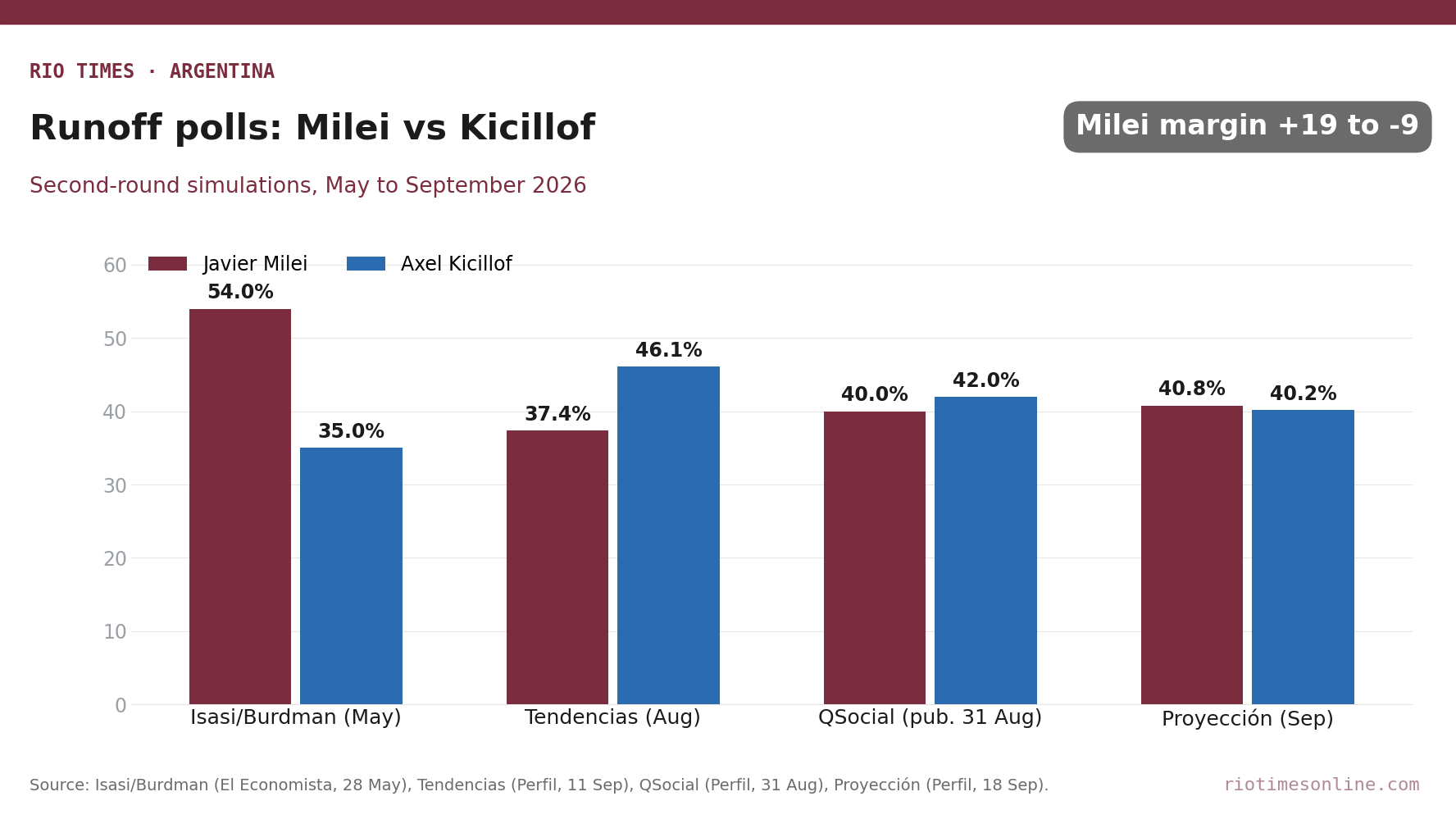
Proyección’s margin of error was 2.66 points, so Perfil calls that result a technical tie. QSocial, in a poll Perfil published on 31 August, had Kicillof on 42% and Milei on 40%.
The runoff spread runs from a 19-point Milei lead in May to a lead of almost nine points for Kicillof in August. Different firms, dates and questions make direct comparison hard, so no single poll settles who leads.
In round one, a Clarín average of twelve polls had Milei on 33.1% and Kicillof on 25.7%, La Capital reported in July. Tendencias had Kicillof ahead 33.7% to 32.4% in round one in August.
Myriam Bregman, a leader of the Left Front, took 10.2% in that Tendencias poll and Juan Schiaretti 6.6%. Both trail the two main names, and the field behind them is not settled.
The Primaries Fight That Shapes the Race
The PASO are Argentina’s open, simultaneous and compulsory primaries, and the government wants to suspend them. La Nación reports that this needs an absolute majority of Congress, which means 37 votes in the Senate.
The same report says the government counts 21 allied senators and still has to win over 16. Santilli told Radio Mitre on 16 October “I think it will work” and “we will have electoral reform”, La Gaceta reports.
Menem calls the primaries “an unnecessary expense”, and Santilli puts the cost of one at about US$200 million, his own figure. Kicillof says Milei’s re-election plan is to scrap the PASO and says he has called governors to block it.
Perfil reports that business circles say the opposition still has to settle its own internal contest. It adds that the market is waiting to see whether the government scraps the PASO.
The earlier push for provincial votes is in Argentina Woos 5 Radical Governors to Suspend Primaries. The wider map of power is in Argentina Politics Explained, Who Holds Power in 2026 and Who Dominates Argentina, Elites and Regions Explained.
What It Means for You
For US holders of Argentine bonds and New York-listed shares, 2027 is a question of whether Milei’s policies continue. Perfil reports country risk back near 640 basis points, and Fundación Capital says electoral uncertainty is already priced into bonds.
Nothing changes for travellers or residents before the vote, and the race sets no new rule for investment or exchange today. The stabiliser is that the voting thresholds are written in the constitution, which a normal law cannot alter.
Menem’s earlier remarks on Milei’s plans are in Argentina’s Menem Says Milei Runs Again, Bets Show 56%. Readers tracking the contest can follow it on our Latin America Election Watch page.
What Is Not Known
Kicillof has not declared a candidacy, and the reports reviewed show no agreed Peronist ticket. No source reviewed names a running mate for Milei.
It is not known whether Congress will suspend the PASO, because La Nación counts the government 16 Senate votes short. Santilli’s US$200 million cost figure is his own and has not been checked against an electoral authority.
The polls disagree, so who leads today is not known. The price data alone do not explain the sharp move in the betting prices below.
What Prediction Markets Say
Polymarket’s market on the 2027 presidential winner priced Javier Milei at 49.5%, Axel Kicillof at 29.5% and Sergio Massa at 16% on Friday 16 October (1:35 p.m. ET). The whole market has traded about US$926,000, with about US$244,000 on Milei and US$136,000 on Kicillof.
From about 55% on 14 October, Milei fell to near 47% by 8 p.m. ET on 15 October. Kicillof slid from 32.5% to 29.5%, while Massa jumped from about 7% to near 19% by midday UTC on 16 October, then eased to 16%.
These are real-money bets, not polls, and the price data alone do not explain the moves. Thin trading in the smaller contracts can swing prices quickly.
Why we show this: prediction markets turn real-money bets into a live probability that moves within minutes of the news, which is why investors, campaigns and newsrooms in the United States now follow them closely. We show them next to polls and official results, never instead of them.
Frequently Asked Questions
When is Argentina’s 2027 presidential election?
The first round falls on Sunday 24 October 2027, the fourth Sunday of October. A runoff, if needed, must follow within 30 days under the constitution.
How does a candidate win in the first round?
A ticket needs more than 45% of valid votes, or at least 40% with a lead above ten points. Otherwise the top two tickets meet in a runoff.
Is Milei allowed to run again?
Article 90 of the constitution allows a president to be re-elected once in a row. Lower-house speaker Martín Menem said on 11 October that Milei will run.
Has Kicillof said he will run for president?
No, he has said only that candidacies can divide the opposition and that this is a year of construction. He wants a wide opposition alliance first.
Who is ahead in Kicillof vs Milei polls?
It depends on the poll, with runoff leads from a 19-point Milei edge in May to a nearly 9-point Kicillof edge in August. Polymarket gave Milei 49.5% and Kicillof 29.5% on 16 October.
What are the PASO and why do they matter?
The PASO are open, simultaneous and compulsory primaries held before the general election. The government wants to suspend them, and Kicillof says that is part of Milei’s re-election plan.
Sources: Perfil, 11 October 2026; Perfil, 15 October 2026; Perfil, 16 October 2026; Perfil on country risk, 16 October 2026; La Nación, 15 October 2026; La Gaceta, 16 October 2026; Perfil on Tendencias, 11 September 2026; Perfil on Proyección, 18 September 2026; Perfil on QSocial, 31 August 2026; El Economista on Isasi/Burdman, 28 May 2026; La Capital, 13 July 2026; BAE Negocios, 28 June 2026; Constitution of Argentina, articles 90 to 98. Prediction-market prices and price history from Polymarket public data, 16 October 2026. Quotations are translated from Spanish.
This article was produced by The Rio Times’ automated newsroom system. How we use AI · Report an error · Editorial responsibility: Matthias Camenzind, Editor-in-Chief
In depth
Read More from The Rio Times