
Published Tuesday, 27 October, 7:25 a.m. ET (12:25 p.m. Paris) · Source: French Interior Ministry, union confederations
Key Facts
This story is part of our coverage of the why France is in crisis. Dates, times and how to follow it are in our guide.
- Next protest: The Yellow Vests, a grassroots anti-tax movement, called rallies for Saturday, October 31, 2026.
- Nationwide strike: Five union confederations called a strike for Thursday, November 5, 2026, over wages, pensions, public services and budget cuts.
- Saturday turnout: France's Interior Ministry counted 410,000 marchers on October 24, 110,000 of them in Paris; the CGT, a major union federation, claimed about 800,000.
- Arrests and injuries: Police made 1,314 arrests on October 24, half the previous weekend's total, and 53 officers were hurt.
- Security deployment: France deployed 70,000 police and gendarmes for the October 24 demonstrations.
- Prediction markets: Kalshi, a US prediction market, prices a 9% chance of a French state of emergency before Jan. 1, 2027 (Oct. 27, 7:22 a.m. ET).
Unions Escalate Pressure
In our France protests coverage, the story is shifting: France's protest wave is moving from weekend marches to the workplace. Five union confederations (CFDT, CGT, FO, Unsa and FSU) have called a nationwide strike for Thursday, November 5, over wages, pensions, public services and planned budget cuts of about US$60 billion (€54 billion, at EUR/USD 1.115).
The strike could hit transport, energy and schools, but how many workers will join is not yet known. Before that, the Yellow Vests, a grassroots movement born in 2018 over fuel taxes, have called rallies on Saturday, October 31, in defence of public freedoms.
Saturday's Mobilisation
On Saturday, October 24, demonstrations took place across France after the previous weekend's riots and looting. France's Interior Ministry counted 410,000 participants nationwide, including 110,000 in Paris, while the CGT, one of the country's biggest union federations, put it near 800,000.
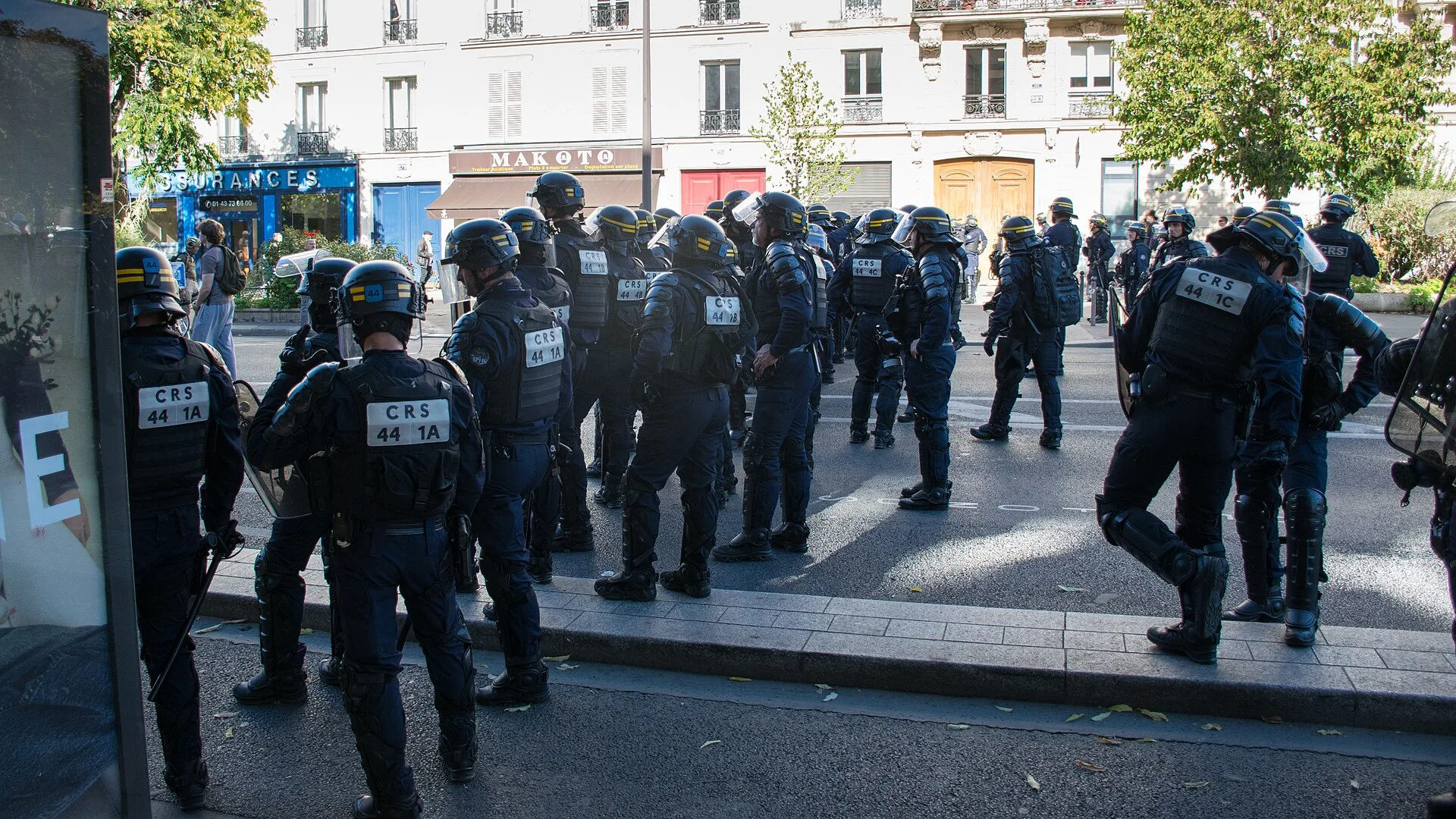
Authorities deployed 70,000 police and security personnel, and the Interior Ministry's provisional tally recorded 1,314 arrests, half the previous weekend's figure. Some 53 security officers were injured, compared with more than 1,100 a week earlier.
The demonstrations were largely peaceful during the day, but clashes later occurred in Paris, Marseille, Lyon and Bordeaux. Police used tear gas, water cannon and other crowd-control measures, while youths set rubbish bins on fire in Marseille.
Government Response
Interior Minister Laurent Nuñez said high-risk groups had broken away from the marches. President Emmanuel Macron had said only union-requested marches would be authorised on October 24, and Lyon, Nice and Montpellier banned wider gatherings.
The government's heavier security operation appears to have reduced the scale of disorder: turnout was lower by the official count, arrests fell from the previous weekend, and reported police injuries dropped sharply. The unions dispute the official turnout figures.
In Plain English
The CGT, CFDT, FO, Unsa and FSU are France's main union federations, and a joint call means they act together. A general strike means workers in many sectors stop work on the same day.
Background
The protests grew from anger over the cost of living and public services, drawing students, workers, unions and the Yellow Vests. The previous major day, October 17, drew 550,000 people by the Interior Ministry's count, with 2,628 arrests and more than 1,100 security officers injured.
The Yellow Vests plan sit-ins outside town halls and the National Assembly, France's lower house of parliament.
What It Means for US Readers
For US investors and policymakers, the escalation of France's protest movement into a nationwide strike on November 5 raises the risk of disruption to European supply chains, transport and energy markets. France is the eurozone's second-largest economy and prolonged industrial action could weigh on its growth.
Kalshi, a US exchange regulated by the CFTC (the federal derivatives regulator), prices a 9% chance that France declares a state of emergency before January 1, 2027, and 3% before November 1 (107,094 contracts traded, read 27 October 2026, 7:22 a.m. ET). These are bets, not polls.
Why we show this: prediction markets turn real-money bets into a live probability that moves within minutes of the news, which is why investors, campaigns and newsrooms in the United States now follow them closely. We show them next to polls and official results, never instead of them.
What Is Not Known
It is not yet clear how many workers will strike on November 5, or how far transport, schools and energy supply will be disrupted. No charge or conviction totals have been published for the 1,314 arrests.
No market prices the strike itself, and the exact start times of the October 31 rallies are not confirmed.
Frequently Asked Questions
When is the next nationwide strike in France?
Five union confederations have called a strike for Thursday, November 5, 2026. They cite wages, pensions, public services and planned budget cuts.
How many people participated in Saturday's protests?
France's Interior Ministry counted 410,000 on October 24, including 110,000 in Paris. The CGT union federation put it near 800,000.
This article was produced by The Rio Times’ automated newsroom system. How we use AI · Report an error · Editorial responsibility: Matthias Camenzind, Editor-in-Chief
France in Turmoil
- Why France Is in Crisis, and How Macron Lost His Grip
- Why Is France Protesting? Riots, Curfews and the 2027 Race
- Is It Safe to Travel to France Right Now? Curfews, Strikes
- Who Will Win France’s 2027 Election? Polls and Odds