
CUBA · HISTORY
Key Facts
- Colonial rule Spain ruled Cuba from conquest in the 1510s until 1898, and US forces stayed until 1902.
- Revolution Rebel leader Fidel Castro’s movement took power on 1 January 1959 after the dictator Batista fled.
- Embargo The US declared a trade embargo on 19 October 1960 and extended it to nearly all trade in 1962.
- 2026 US executive orders of 29 January and 1 May 2026 target Cuba’s oil suppliers and key sectors.
- Today Cuba had 10,937,203 people in 2025, and its economy shrank 1.1% in 2024.
- Prediction markets Polymarket, a prediction market: 4.2% that Cuba’s president Díaz-Canel is out; 7.5% US strike on Cuba (10 November 2026, 9:33 a.m. ET).
- Power Index Cuba ranks 14th of 14 in The Rio Times Latin America Power Index, with 22.5 points (November 2026 edition).
Cuba history runs from Spanish conquest in the 1510s, through US occupation after 1898 and the 1959 revolution, to a tense standoff with Washington in 2026. It matters to US readers because Washington’s policy toward the island is changing again in 2026, and Miguel Díaz-Canel, president since 2018, now faces new US pressure (see who holds power in Cuba).
In Plain English
- Embargo An embargo is a ban on trade with a country. The US embargo on Cuba bans most trade between the two countries.
- Platt Amendment The Platt Amendment was a US law of 1901 that let the United States intervene in Cuba. Cuba had to write it into its own constitution to win independence.
- Cold War The Cold War was the long rivalry between the United States and the Soviet Union, which ended with the Soviet collapse in 1991. Cuba became one of its flashpoints in 1962.
- Executive order An executive order is a written directive from the US president that has the force of law. It can change sanctions quickly, but it cannot repeal an act of Congress.
Cuba Before 1898 Under Spanish Rule
Christopher Columbus, the navigator sailing for Spain, reached Cuba on 27 October 1492. Conquest of the island began in 1511.

In 1511 Diego Velázquez, a Spanish conqueror, began taking the island for the Spanish crown. Spanish rule then lasted until 1898.
Havana became the formal capital in 1607. Spanish colonial rule over the island continued after that.
Spain abolished slavery in Cuba by royal decree on 7 October 1886. The decree ended legal slavery on the island, which was still a Spanish colony at that point.
Our guide to Cuba’s population and ethnic groups explains who lives on the island today. That story begins in this colonial period.
Independence Wars and US Occupation
On 10 October 1868 Carlos Manuel de Céspedes, an independence leader, issued the Grito de Yara, a call to arms against Spain. It began the Ten Years’ War, which ran from 1868 to 1878.
The final independence war began with the Grito de Baire on 24 February 1895. José Martí, the independence leader of that war, was killed at Dos Ríos on 19 May 1895.
On 15 February 1898 the US battleship Maine exploded in Havana harbour. The United States and Spain went to war that year.
On 10 December 1898 the two countries signed the Treaty of Paris, the peace treaty, and Spain gave up its claim to Cuba. US forces then occupied the island until 1902.
Republic and Platt Amendment to Batista
The Platt Amendment was an appropriations act, a US spending law, signed on 2 March 1901. It gave the United States a continuing right to intervene in Cuba.
Cuba wrote the amendment into its constitution of 1901 as a condition of independence. The US ended its occupation on 20 May 1902, when it handed authority to the new republic.
A treaty between the two countries repealed the amendment in 1934. Until then the United States held a standing right to step in.
On 10 March 1952 Fulgencio Batista seized power in a military coup. On 26 July 1953 Fidel Castro led a failed attack on the Moncada Barracks, an army base in Santiago de Cuba.
On 1 January 1959 Batista fled to the Dominican Republic. The revolution took power that day.
Cuba Timeline
- 27 October 1492 Columbus reaches Cuba.
- 1511 Diego Velázquez begins the Spanish conquest.
- 10 October 1868 The Grito de Yara starts the Ten Years’ War.
- 7 October 1886 Spain abolishes slavery in Cuba by royal decree.
- 24 February 1895 The Grito de Baire starts the final independence war.
- 15 February 1898 The US battleship Maine explodes in Havana harbour.
- 10 December 1898 The Treaty of Paris ends Spanish claims to Cuba.
- 2 March 1901 The Platt Amendment becomes US law.
- 20 May 1902 The US ends its occupation and hands authority to the Cuban republic.
- 10 March 1952 Batista seizes power in a military coup.
- 1 January 1959 Batista flees and the revolution takes power.
- 19 October 1960 The US declares an embargo on trade with Cuba.
- 17 April 1961 Brigade 2506 lands at the Bay of Pigs.
- 28 October 1962 Khrushchev announces the missiles will be dismantled.
- 17 December 2014 Obama announces steps to normalise relations.
- 11 July 2021 Thousands of Cubans protest across the island.
- 29 January 2026 Trump signs Executive Order 14380.
- 1 May 2026 Executive Order 14404 widens US sanctions.
1959 Revolution and Cold War
Fidel Castro’s new government soon clashed with Washington. On 3 January 1961 the United States broke diplomatic relations with Cuba.
On 17 April 1961 Brigade 2506, a US-backed force of Cuban exiles, landed at the Bay of Pigs. It was defeated within two days.
The Cold War, the rivalry between the United States and the Soviet Union, reached Cuba in October 1962. US reconnaissance photographed Soviet missile sites on the island, and the Office of the Historian, the US State Department’s history office, dates the start of the crisis to 14 October.
President John F. Kennedy told the nation on 22 October and ordered a naval quarantine, a blockade on offensive weapons bound for Cuba. On 28 October the Soviet leader, Nikita Khrushchev, announced the missiles would be dismantled.
In return the United States pledged not to invade Cuba. It also privately signalled that US missiles would leave Turkey.
The Soviet Union, which had placed missiles on the island, ended in 1991. The Cold War ended with it.
The US Embargo on Cuba Explained
An embargo is a ban on trade with a country. On 19 October 1960 the United States declared an embargo on trade with Cuba, except medical supplies and most foodstuffs.
A presidential proclamation of 3 February 1962, numbered 3447, extended the embargo to nearly all trade. The John F. Kennedy Presidential Library keeps the archive listing of that document.
The White House said on 17 December 2014 that the embargo is codified in legislation. Ending it therefore means engaging Congress, the US legislature.
Thaw of 2014 and Protests of 2021
On 17 December 2014 President Barack Obama announced steps to normalise relations with Cuba. On 20 July 2015 the two countries raised their interests sections, small diplomatic offices, to embassies.
In March 2016 Obama visited Cuba. He gave a speech to the Cuban people on 22 March 2016.
On 11 July 2021 thousands of Cubans took to the streets. Human Rights Watch, an international rights group, called them the largest nationwide demonstrations since the 1959 revolution.
Cubalex, a Cuban legal-aid group cited by Human Rights Watch, counted more than 1,400 people detained. It counted more than 700 still behind bars in July 2022.
Cuba in 2026
On 18 and 19 April 2018 the National Assembly, Cuba’s parliament, elected Miguel Díaz-Canel president at a session on those days, according to its own record. The current constitution was proclaimed on 10 April 2019.
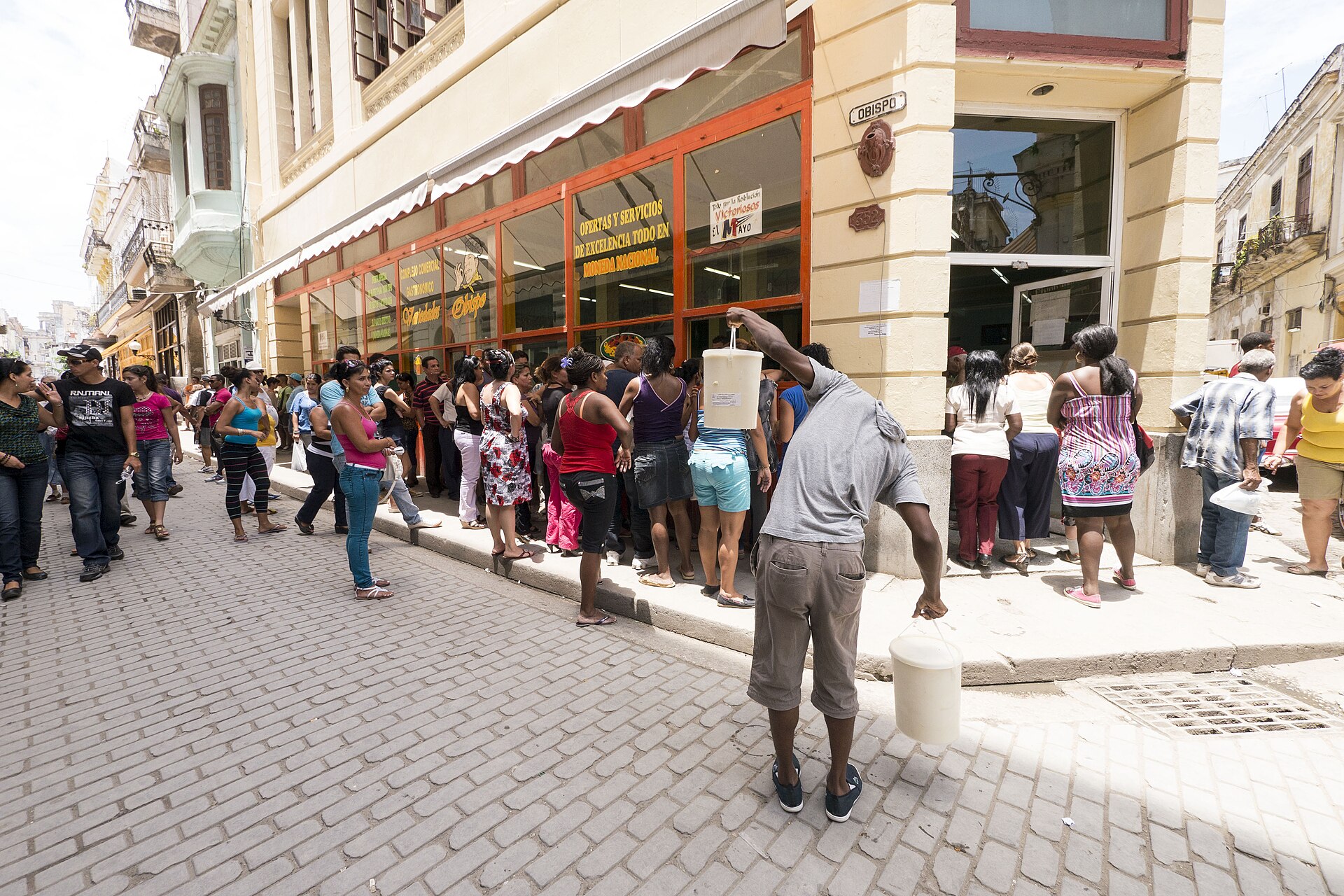
Our explainer on the Cuban power structure shows how the party, state and army fit together. Our guide to who runs the Cuban economy covers the money side.
On 29 January 2026 President Donald Trump signed Executive Order 14380, which declares a national emergency over Cuba. It allows extra tariffs on goods from countries that supply oil to Cuba, effective 30 January 2026.
On 1 May 2026 Executive Order 14404 blocked property of foreign persons operating in Cuba’s energy, defense, metals and mining, financial services or security sectors, or in other sectors the Treasury Secretary names. Such sanctions are normally administered by OFAC, the US Treasury’s Office of Foreign Assets Control.
The World Bank, the international development lender, lists Cuba’s population at 10,937,203 in 2025 and a GDP contraction of 1.1% in 2024. GDP, or gross domestic product, is the value of all goods and services a country produces.
What It Means for US Readers
The White House said on 17 December 2014 that the embargo is codified in legislation. That means Congress, not the president alone, would have to take it up.
The 2026 sanctions can reach foreign firms dealing in Cuba’s energy, defense, mining, financial or security sectors under Executive Order 14404. The order applies to foreign persons, not only to US ones.
The two orders of 2026 were signed on 29 January and 1 May. The embargo itself stays in law.
Our analysis of five scenarios after the US midterms sets out the main paths ahead. It is a useful companion to this history.
What Prediction Markets Say
Polymarket is a prediction market where users bet real money on outcomes, and its prices are bets, not polls. A price of 4.2% is read as an implied chance of 4.2%.
Polymarket, 10 November 2026, 9:33 a.m. ET
- Díaz-Canel out Miguel Díaz-Canel out as leader of Cuba by 31 December: 4.2%, with US$800,507 traded on that market.
- US strike US strike on Cuba by 31 December: 7.5%, with US$5,523,280 traded on that market.
Why we show this: prediction markets turn real-money bets into a live probability that moves within minutes of the news, which is why investors, campaigns and newsrooms in the United States now follow them closely. We show them next to polls and official results, never instead of them.
What Is Not Known
We found no official figure on how far the 2026 US measures change Cuba’s oil imports and blackouts. Any change in daily power supply is therefore unconfirmed.
It is not known whether talks between Washington and Havana will open. The outcome rests on choices that neither government has announced.
It is not known how many protesters from 2021 remain jailed today. A current count is unconfirmed.
Frequently Asked Questions
What is the history of Cuba in short?
Spain ruled Cuba from the 1510s until 1898, and US forces occupied it until 1902. A revolution took power on 1 January 1959, and the US embargo followed in 1960.
When did Cuba become independent?
Spain gave up its claim to Cuba in the Treaty of Paris on 10 December 1898, and US forces stayed until 1902. The US handed authority to the new Cuban republic on 20 May 1902.
What was the Platt Amendment?
It was a US law of 2 March 1901 that gave the United States a continuing right to intervene in Cuba. A treaty between the two countries repealed it in 1934.
When did the US embargo on Cuba start?
The United States declared an embargo on 19 October 1960, except medical supplies and most foodstuffs. A proclamation of 3 February 1962 extended it to nearly all trade, with exceptions for certain food and medicines.
Who is the president of Cuba?
Miguel Díaz-Canel was elected president by the National Assembly on 18 and 19 April 2018. The current constitution was proclaimed on 10 April 2019.
What did the US do on Cuba in 2026?
On 29 January 2026 President Trump signed Executive Order 14380, allowing extra tariffs on goods from countries that supply oil to Cuba. Executive Order 14404 of 1 May 2026 blocks property of foreign persons operating in listed Cuban sectors.
Sources: Library of Congress, Cuba: A Country Study; Library of Congress, Cuba chronology; Office of the Historian, Spanish-American War; Office of the Historian, Cuba; Office of the Historian, Bay of Pigs; Office of the Historian, Cuban Missile Crisis; John F. Kennedy Presidential Library, Cuban Missile Crisis; John F. Kennedy Presidential Library, Proclamation 3447; White House, statement of 17 December 2014; White House, remarks of 22 March 2016; Human Rights Watch, July 2021 demonstrators; US State Department, 2021 Country Report on Cuba; Cuban National Assembly, IX Legislature; Cuban National Assembly, constitutional history; White House, Executive Order 14380, 29 January 2026; White House, Executive Order 14404, 1 May 2026; World Bank, Cuba data.
This article was produced by The Rio Times’ automated AI newsroom. Editorial responsibility: Matthias Camenzind, Publisher and Editor-in-Chief. The Rio Times also runs Ask Rio Times, which answers from 100,000+ of our own articles, the daily Latin America Power Map, and prediction-market odds on elections and markets.. How we use AI · Report an error
Expat Guide to Cuba
What The Rio Times publishes for foreigners who live in or move to Cuba.
Start here
- Moving to Cuba 2026, Step by Step
- Panama Visa Appointment System Launches for Havana Applicants
- Spain and Portugal Close Their Golden Visa Doors, Forcing LATAM Investors to Reroute
Understand Cuba
Cuba and the United States
- What Is Going On Between Cuba and the United States?
- What Is Going On Between Cuba and the United States?
- Can Americans Still Travel to Cuba in 2026?
- Who Runs Cuba in 2026? Raúl Castro and the US Murder Charge