Who Is Gabriel Boric? Chile’s Ex-President, His Record and What He Does Now
PROFILES · CHILE
Key Facts
- —The country Chile is the world’s largest copper producer and one of Latin America’s most stable democracies. Since 11 March 2026 it has been governed by the hard-right president José Antonio Kast.
- —Who he is Gabriel Boric Font, born in Punta Arenas on 11 February 1986. President of Chile from 11 March 2022 to 11 March 2026, and now a former president with no public office.
- —Power base The Frente Amplio, the left-wing party that grew out of the 2011 student protests. He left office with 37 percent approval, according to Cadem.
- —Record A 40-hour working week, a pension reform with a new 7 percent employer contribution, and inflation down from 14.1 percent to 3.5 percent. Two constitutional drafts failed on his watch.
- —Controversies The “Convenios” foundations scandal and the rape case against his former deputy interior minister, both still in court. A complaint against Boric himself was dismissed in February 2025.
- —Outlook He is building a foundation, joined the Club de Madrid in September 2026 and has not ruled out running again in 2029.
Who Gabriel Boric is, what his four years in La Moneda changed, and why Chile’s youngest president remains a leading voice of the opposition to José Antonio Kast.
Gabriel Boric became Chile’s president at 36 and left office at 40, handing the sash to the man he had beaten in 2021. He no longer holds any post. Yet for investors and governments watching Chile, he remains one of the likeliest leaders of the left at the next election in 2029.
This profile covers the man and his record. For the current government, read our profile Who Is José Antonio Kast?, and for the country itself, Chile Explained. Peso figures are converted at about 962 Chilean pesos to the US dollar, the rate in late September 2026.
Early life and career
Gabriel Boric Font was born on 11 February 1986 in Punta Arenas, on the Strait of Magellan. It is one of the southernmost cities in the world. His roots in the far south shaped his politics, and later his tattoos, which include a map of the Magallanes region.
He began studying law at the University of Chile in 2004. He finished the coursework in 2009 but did not pass the final degree examination in 2011, so he never qualified as a lawyer. He has said he wanted to be a writer rather than practise law.
His real training was student politics. In December 2011 he won the presidency of the University of Chile Student Federation, known as FECh, defeating the incumbent, Camila Vallejo. That year Chile’s students were marching in their hundreds of thousands against debt-financed, profit-driven education. Boric led the federation until November 2012.
In 2013 he was elected to Congress. He sat in the Chamber of Deputies from 11 March 2014 to 11 March 2022, representing his home region of Magallanes. In his second race he was the second most-voted deputy in the country.
In 2018 he co-founded Convergencia Social, one of several small parties in the Frente Amplio, or Broad Front. That coalition later merged into a single party, which Boric belongs to today.
Rise to power
The turning point came in late 2019. Protests over inequality had filled Chile’s streets for weeks. On 15 November 2019 Boric signed, in a personal capacity, the cross-party agreement that opened the way to a new constitution. Parts of his own coalition condemned him for it.
That gamble made him the moderate face of the new left. In the July 2021 primary of the Apruebo Dignidad alliance he beat the Communist mayor Daniel Jadue by 60.4 percent to 39.6 percent. In the first round of 21 November 2021 he came second with 25.82 percent, behind Kast.
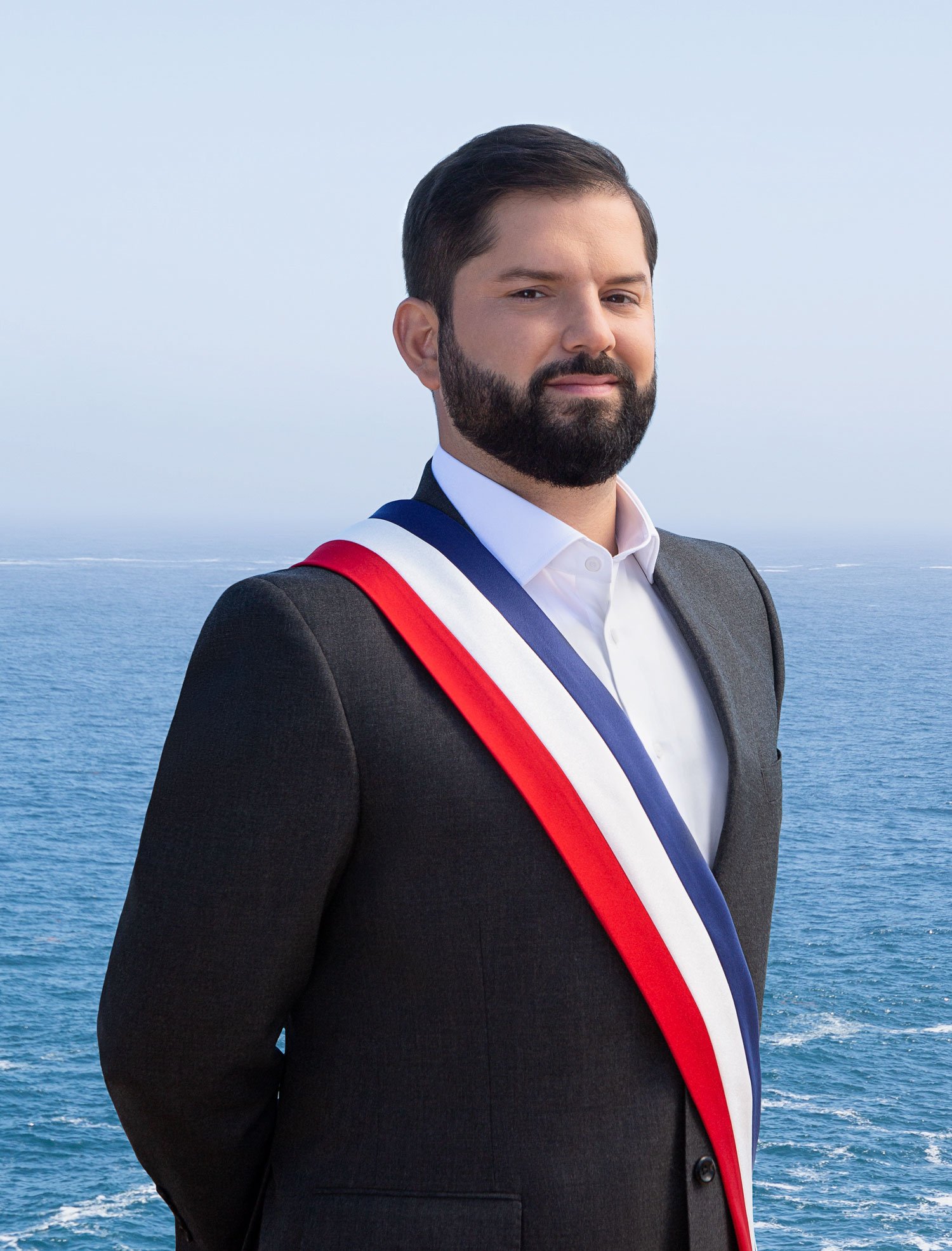
The runoff of 19 December 2021 was a two-way choice between left and right. Boric won 4,620,890 votes, or 55.87 percent, against Kast’s 44.13 percent. He took office on 11 March 2022, aged 36, the youngest president in Chile’s history.
His first cabinet had 14 women among 24 ministers, the first female majority in a Chilean cabinet. Several ministers were former student leaders from 2011, including Vallejo as government spokesperson.
Power base
Boric never had a majority in Congress. He governed first with Apruebo Dignidad, the alliance of the Frente Amplio and the Communist Party. From the start he also gave cabinet posts to the older centre-left parties of the Socialismo Democrático bloc.
His core supporters are young, urban and university-educated voters, and the generation that marched in 2011 and 2019. The Frente Amplio is now the vehicle for that base. Its new president, the deputy Gael Yeomans, calls it the largest party in Chile.
His personal standing has outlived his government’s. In the last Cadem poll of his term, in the first week of March 2026, 37 percent approved of him and 58 percent disapproved. Only 29 percent rated his government good or very good. The gap suggests voters judge the man more kindly than the administration.
Record in office
The constitution
The project that brought Boric to power failed first. On 4 September 2022 voters rejected the left-leaning draft constitution by 61.89 percent to 38.11 percent. Boric had backed it. A second draft, written by a council led by Kast’s Republicans, was rejected in December 2023 by 55.76 percent. The 1980 constitution, amended many times, still stands.
Work and pensions
His lasting reforms are in work and pensions. On 14 April 2023 he signed the law cutting the legal working week from 45 hours to 40, phased in over no more than five years. The minimum wage rose from 350,000 pesos (about US$364) to 539,000 pesos (about US$561) a month by January 2026.
The pension reform took almost his whole term. Congress passed it in January 2025, and Boric promulgated it on 20 March 2025 as Law 21,735. It adds an employer contribution of 7 percent of wages, phased in from August 2025 over about nine years. It also lifts the universal basic pension, the PGU, to 250,000 pesos (about US$260) a month in stages up to 2027.
Chile’s old system relied on workers’ own savings in private funds, the AFPs. The reform keeps the funds but adds a social-insurance element, funded partly by the new employer contribution. The government said 2.8 million current and future pensioners would benefit.
Lithium, prices and growth
In April 2023 he launched a National Lithium Strategy, giving the state a leading role in the most strategic salt flats. In December 2023 the state copper giant Codelco agreed a partnership with SQM, the private producer, in which Codelco holds 50 percent plus one share.
Inflation peaked at 14.1 percent in August 2022, months after he took office. By the end of 2025 it had fallen to 3.5 percent, the lowest in five years, according to the statistics office INE. The economy grew 2.5 percent in 2025, the central bank reported. Across his four years, growth averaged about 2 percent a year, by the news site Emol’s count.
Crime
Crime was his weakest ground politically. Homicides peaked in 2022, his first year. They then fell for three years in a row. The prosecutor’s office counted 1,091 homicide victims in 2025, a rate of 5.4 per 100,000 people, down 11.5 percent on 2024.
Many voters did not feel safer. Kast won the December 2025 runoff with 58.17 percent against Jeannette Jara, Boric’s former labour minister, on a campaign built around crime and migration.
After office: what Boric does now
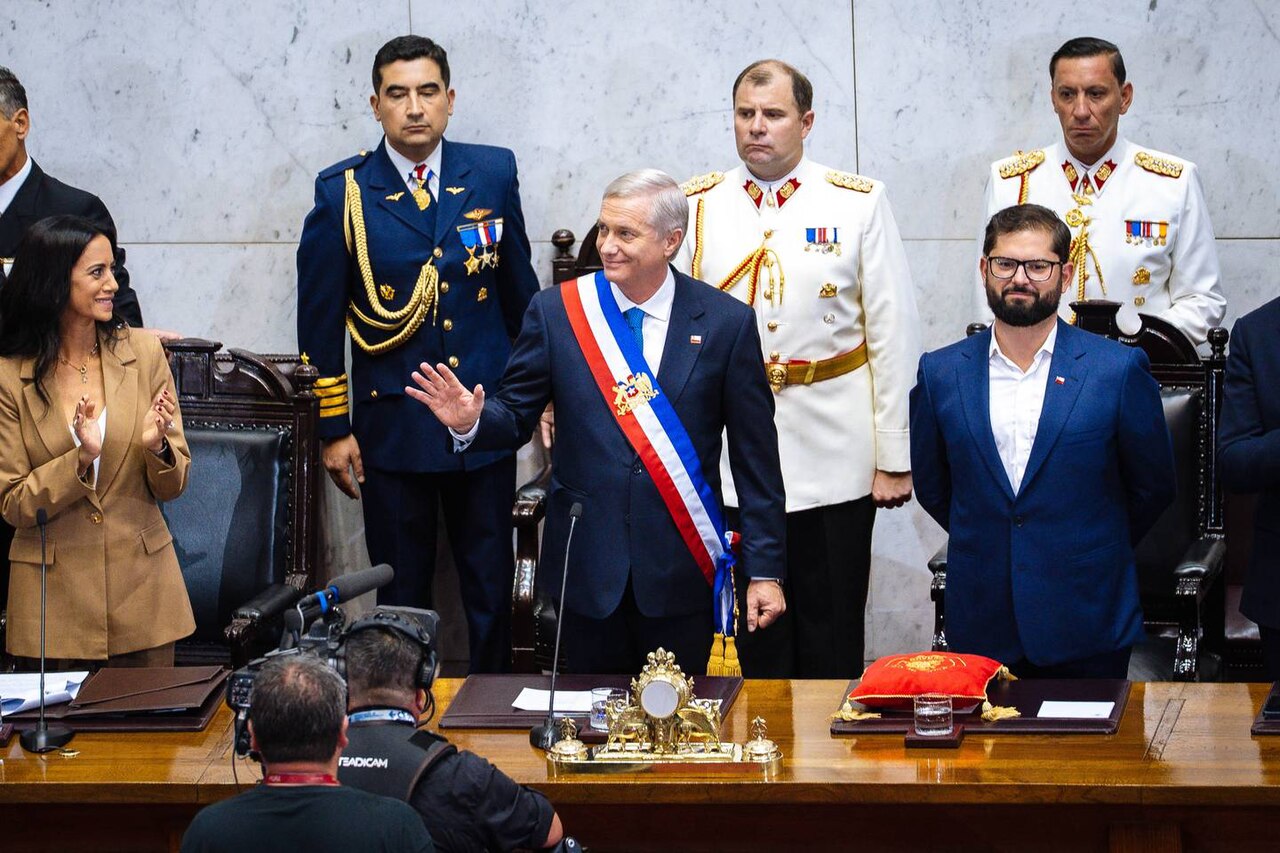
As of 28 September 2026, Gabriel Boric holds no public office. Chile’s constitution bars a president from immediate re-election, so he could not run in 2025. He is free to run again in 2029.
Like other former presidents, he receives a monthly allowance under Law 19,672. In November 2025 La Tercera put it at 7.3 million pesos (about US$7,600). With office and staff funds, the total can reach 17.6 million pesos (about US$18,300) a month.
In March 2026, days after leaving La Moneda, he announced an office in Bellavista, between the Santiago and Recoleta districts. He is setting up a foundation with two former aides. Antonia Illanes, a former deputy sports minister, is executive director; the journalist Nicole Vergara runs communications.
In early June 2026 he ended a European tour of Germany, Wales and England with his partner, Paula Carrasco, and their daughter Violeta. He spoke at the British Library in London and at the Hay Festival in Wales. The trip meant he missed Kast’s first state of the nation address.
In September 2026 he joined the Club de Madrid, a forum of more than 130 former heads of state and government from over 70 countries. Michelle Bachelet, his predecessor but one, is its vice-president.
He has also returned to domestic politics. On 24 September 2026 he and Bachelet issued a joint statement asking Kast to reconsider Chile’s membership of the Shield of the Americas, a US-led security coalition. Public Security Minister Martín Arrau replied the next day. Our report on the two former presidents’ statement has the detail.
Controversies
The foundations case. In mid-2023 it emerged that the housing ministry’s office in Antofagasta had signed agreements worth 426 million pesos (about US$443,000) with Democracia Viva. The foundation was linked to a deputy from Boric’s coalition. The scandal spread to other foundations and became known as the “Convenios” case.
In August 2025 prosecutors sought ten years in prison for the former deputy, Catalina Pérez, and the foundation’s head, Daniel Andrade, for fraud against the state. In August 2026 the Supreme Court ruled that the trial will be held in Antofagasta. Boric himself was not accused. In July 2026 prosecutors closed their inquiry into his close ally, former minister Giorgio Jackson, citing insufficient evidence, Ex-Ante reported.
The Monsalve case. In October 2024 his deputy interior minister, Manuel Monsalve, was accused of raping a subordinate. He resigned and was charged with rape and sexual abuse. Prosecutors seek 14 years in prison. The investigation closed on 21 August 2026 and a trial is pending. Monsalve denies committing any crime.
A complaint against Boric. In September 2024 a woman filed a complaint in Punta Arenas alleging harassment and the sharing of intimate images in 2013. Boric denied it. On 6 February 2025 the Punta Arenas guarantee court closed the case for good, after prosecutors found no evidence he was involved.
Pardons and the UN bid. On 30 December 2022 he pardoned 12 people convicted over the 2019 unrest and a former guerrilla, and his justice minister resigned days later. In 2026 his government’s sponsorship of Bachelet for UN Secretary-General became a new row. Kast withdrew Chile’s backing and Bachelet left the race on 19 September. Kast’s allies blamed Boric for exposing her. Boric replied that the attempt had been worth it.
Voters largely disagreed with the right’s version. In a Cadem survey in the fourth week of September 2026, 45 percent blamed Kast’s government for the failed bid, 24 percent Boric’s and 24 percent Bachelet’s own team.
What to watch
A 2029 candidacy. In London on 1 June 2026 he said his name “will be one of those under discussion”. He added that he does not wake up thinking about returning to the presidency. The Frente Amplio wants to bring forward its choice of candidate, but Yeomans says any Boric bid is a decision for the party.
The foundation. Its name, funding and programme have not been announced. Its first projects will show whether Boric aims at policy work, international networks or a campaign platform.
The Monsalve trial. Prosecutors have listed Boric among their witnesses. A trial would put his government’s handling of the case back in the headlines.
The pension reform under Kast. The employer contribution rises step by step each year. Any attempt by the new government to slow or change it would test Boric’s main legacy.
What this means for foreigners and investors
For companies in Chile, the Boric years are now part of the cost base. Employers pay the rising pension contribution and must fit the 40-hour week into shift planning. Kast has passed a corporate tax cut, but he has not repealed those labour rules.
For anyone judging political risk, Boric is the benchmark for what a left-wing government in Chile looks like. His term passed social reforms through Congress without expropriations or a break with trade partners. Inflation also came down under an independent central bank.
That matters for 2029. Every Chilean presidential election since 2009 has swung power between left and right. If Boric runs, investors would face a known quantity rather than an outsider.
Connected Coverage
Who Is José Antonio Kast? Chile’s President Explained: the Right Turn and What to Watch
Chile Explained: The Country, the Kast Government and What to Watch
Shield of the Americas: 2 Chile Ex-Presidents Ask Kast to Reconsider
Chile Opposition Asks Watchdog to Rule on Kast’s US-Led Security Pact
Sources: Chile’s labour ministry and pensions regulator, the Banco Central de Chile, the statistics office INE, the national prosecutor’s office, the finance ministry, Cadem, and reporting by La Tercera, BioBioChile, CNN Chile, T13, Ex-Ante, The Clinic and Infobae. All accessed 28 September 2026.
- Ministerio del Trabajo — promulgation of the pension reform, March 2025
- Superintendencia de Pensiones — Law 21,735 of 26 March 2025
- Ministerio de Hacienda — minimum wage increases under Boric
- Fiscalía de Chile — national homicide report 2025
- INE — consumer prices, December 2025
- Banco Central de Chile — national accounts 2025
- Pauta — Cadem, Boric’s final approval, March 2026
- Infobae — Boric joins the Club de Madrid, 14 September 2026
What Is Not Known
Whether Boric will run in 2029. He has kept the door open, and his party has not decided. No published poll yet tests him against likely candidates of the right.
What his foundation will do, what it will be called and who will fund it. None of that has been announced.
How the court cases end. The Monsalve trial and the Democracia Viva case are both pending, and either could shape how voters remember his government.
Frequently Asked Questions
Is Gabriel Boric still president of Chile?
No. His term ran from 11 March 2022 to 11 March 2026. José Antonio Kast succeeded him and is president until 11 March 2030.
What is Gabriel Boric doing now?
He holds no public office. He is setting up a foundation from an office in Santiago, joined the Club de Madrid of former leaders in September 2026 and speaks out against some of Kast’s policies.
Can Boric run for president again?
Yes, from 2029. Chile bars immediate re-election, not a later return. Boric has said his name will be under discussion, and his party says the decision is a collective one.
What were Boric’s main achievements?
A 40-hour working week, a pension reform with a new 7 percent employer contribution, a higher minimum wage and a fall in inflation from 14.1 percent in 2022 to 3.5 percent in 2025.
How old was Boric when he became president?
He was 36 when he took office on 11 March 2022, the youngest president in Chile’s history.
This article was produced by The Rio Times’ automated newsroom system. How we use AI · Report an error
Read More from The Rio Times