Who Is María Corina Machado? Venezuela’s Nobel Laureate, Her Record and What Comes Next
PROFILES · VENEZUELA
Key Facts
- —The country Venezuela, on South America’s Caribbean coast, has about 28.5 million people and the world’s largest proven oil reserves. Since US forces seized Nicolás Maduro on 3 January 2026, Delcy Rodríguez has governed as acting president.
- —Who she is María Corina Machado, born in Caracas on 7 October 1967, is an industrial engineer turned opposition leader. She founded the party Vente Venezuela and won the 2025 Nobel Peace Prize.
- —Power base Voters rather than institutions. She won the October 2023 opposition primary with 92.35 percent, but has never held executive office and is barred from running.
- —Record Her camp says tally sheets show its stand-in, Edmundo González, won the July 2024 election by a wide margin. The electoral council declared Maduro the winner.
- —Controversies Venezuelan authorities have accused her of treason and conspiracy several times since 2004. She denies the accusations and has never been convicted.
- —Outlook As of 25 September 2026 she is in Panama, pressing for a new election. Her team says seven attempts to fly home have failed.
Who is María Corina Machado? A plain-English profile of the Nobel Peace Prize winner who leads Venezuela’s opposition. Her return home is now the test of the country’s transition.
María Corina Machado is the best-known opponent of the movement that has ruled Venezuela since 1999. Whether she can go home, and run for president, will tell outsiders whether the post-Maduro opening is real.
Early life and career
Machado was born in Caracas on 7 October 1967. She studied industrial engineering at the Andrés Bello Catholic University. She then took a master’s in finance at IESA, a Caracas business school.
She entered public life through elections rather than parties. In the early 2000s she co-founded Súmate, a civic group that monitored votes and trained volunteers.
Súmate led the 2004 petition drive for a recall referendum against President Hugo Chávez. Chávez survived the vote, and the group’s work made Machado a national figure and a government target.
In May 2005 she met President George W. Bush at the White House. Chávez’s supporters used the image for years as proof that she served Washington. She says she served Venezuelan voters.
She left Súmate in 2010 to run for parliament. In September 2010 she won a National Assembly seat for Miranda state with more votes than any other candidate in the country.
Rise to power
Her first national race was a loss. She ran in the February 2012 opposition primary, which Henrique Capriles won, and then campaigned for him.
In 2012 she took charge of Vente Venezuela, a liberal party she built around herself. It argues for private enterprise, an end to price controls and the opening of the oil industry to private capital.
In March 2014, during street protests against President Nicolás Maduro, she spoke at the Organization of American States. Panama had given her a seat in its delegation to do so.
The ruling majority said that breached the constitution. The Assembly’s president, Diosdado Cabello, stripped her of her seat later that month, and the Supreme Court backed him.
For most of the next decade she was a hardliner on the margins. She rejected negotiations with Maduro and called for elections under new rules.
That changed in 2023. On 30 June the comptroller general barred her from office for 15 years. He cited alleged administrative irregularities and her support for Juan Guaidó’s parallel government.
She ran in the opposition primary anyway. On 22 October 2023 she won more than 2.2 million votes, or 92.35 percent, the organising commission’s final count showed.
Power base
Machado has never controlled an army, a budget or a court. Her power rests on voters, on the diaspora and on foreign governments that listen to her.
The primary gave her a mandate that no other opposition figure could match. Polls since then have kept her ahead. A March 2026 Hercon survey of 1,200 voters put her at 71.2 percent against 12.6 percent for Delcy Rodríguez.
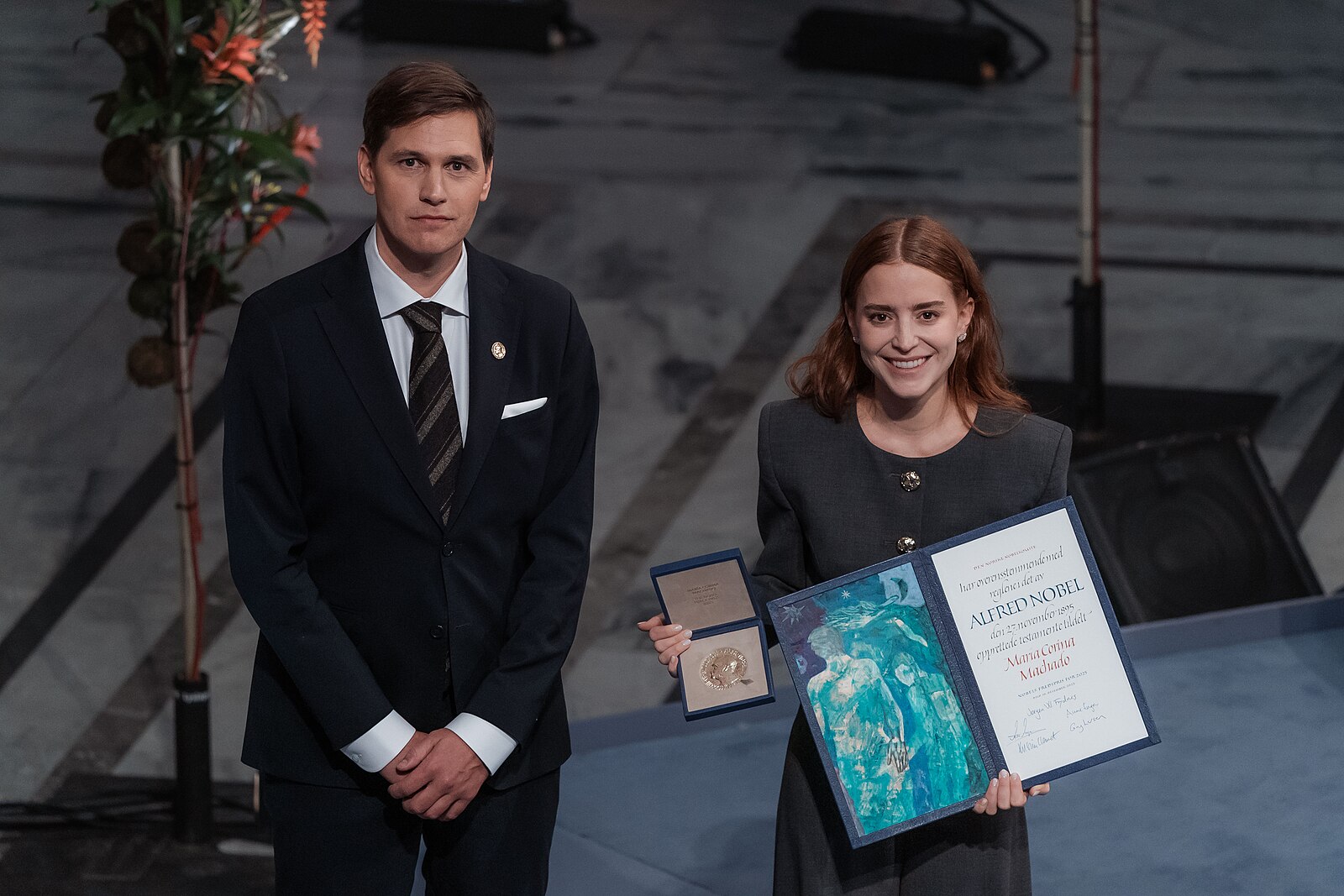
Abroad, she has built a record of awards. The European Parliament gave her and Edmundo González the Sakharov Prize in October 2024. On 10 October 2025 the Norwegian Nobel Committee gave her the Peace Prize.
The committee cited “her tireless work promoting democratic rights for the people of Venezuela”. It also praised her struggle for a peaceful transition. She dedicated the prize in part to Donald Trump.
Her weakness is the same as her strength. She depends on outsiders, above all Washington, to open doors that Venezuelan institutions keep closed.
Record: the 2024 election, the Nobel and exile
Machado has never held executive office, so her record is a campaign record. In January 2024 the Supreme Court upheld her ban, and her first stand-in, the academic Corina Yoris, could not register.
The coalition then named Edmundo González, a retired diplomat little known to voters. Machado campaigned for him across the country, drawing large crowds.
The vote took place on 28 July 2024. The National Electoral Council (CNE) declared Maduro the winner with 51.2 percent against 44.2 percent for González.
The CNE never published results broken down by polling station. The opposition published scans of its own copies of the tally sheets. They showed González with about 67 percent and Maduro with about 30 percent.
The Carter Center, invited as an observer, said the election did not meet international standards. Protests followed and were put down. González went into exile in Spain in September 2024.
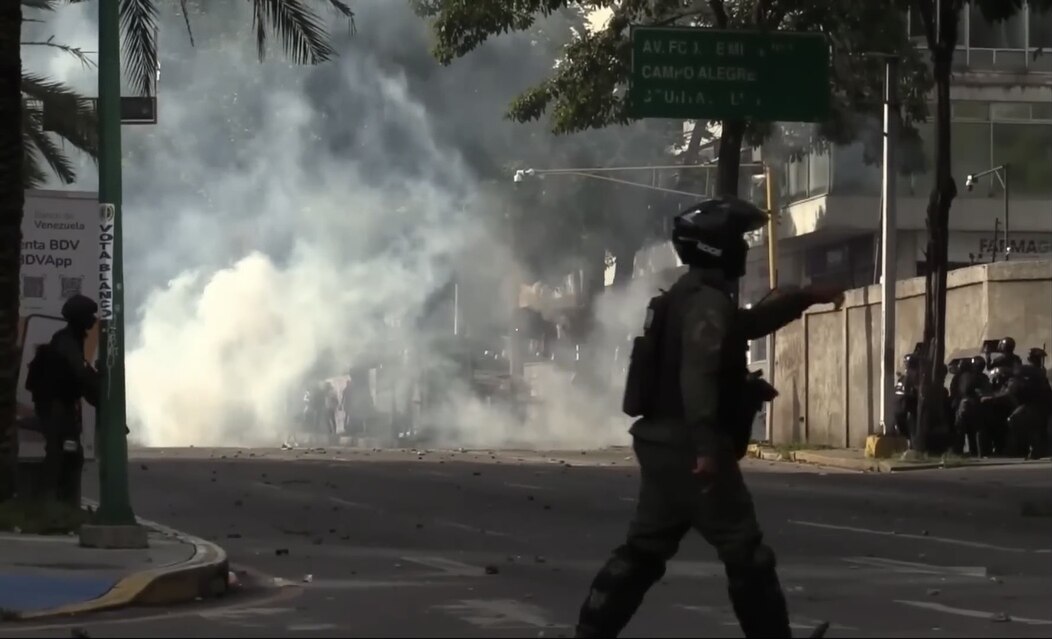
Machado went into hiding inside Venezuela. On 9 January 2025, after she appeared at a rally in Caracas, her team said security forces briefly detained her. Government officials denied it.
In December 2025 she slipped out of the country to collect the Nobel Prize. She missed the ceremony on 10 December, where her daughter, Ana Corina Sosa, accepted on her behalf. Machado reached Oslo the next day.
Then the ground moved. On 3 January 2026 US forces seized Maduro in Caracas and flew him to New York to face narco-terrorism charges, which he denies.
Machado did not inherit power. The Supreme Court told Vice-President Delcy Rodríguez to take over. Trump said Machado lacked “the support within” and “the respect within” the country.
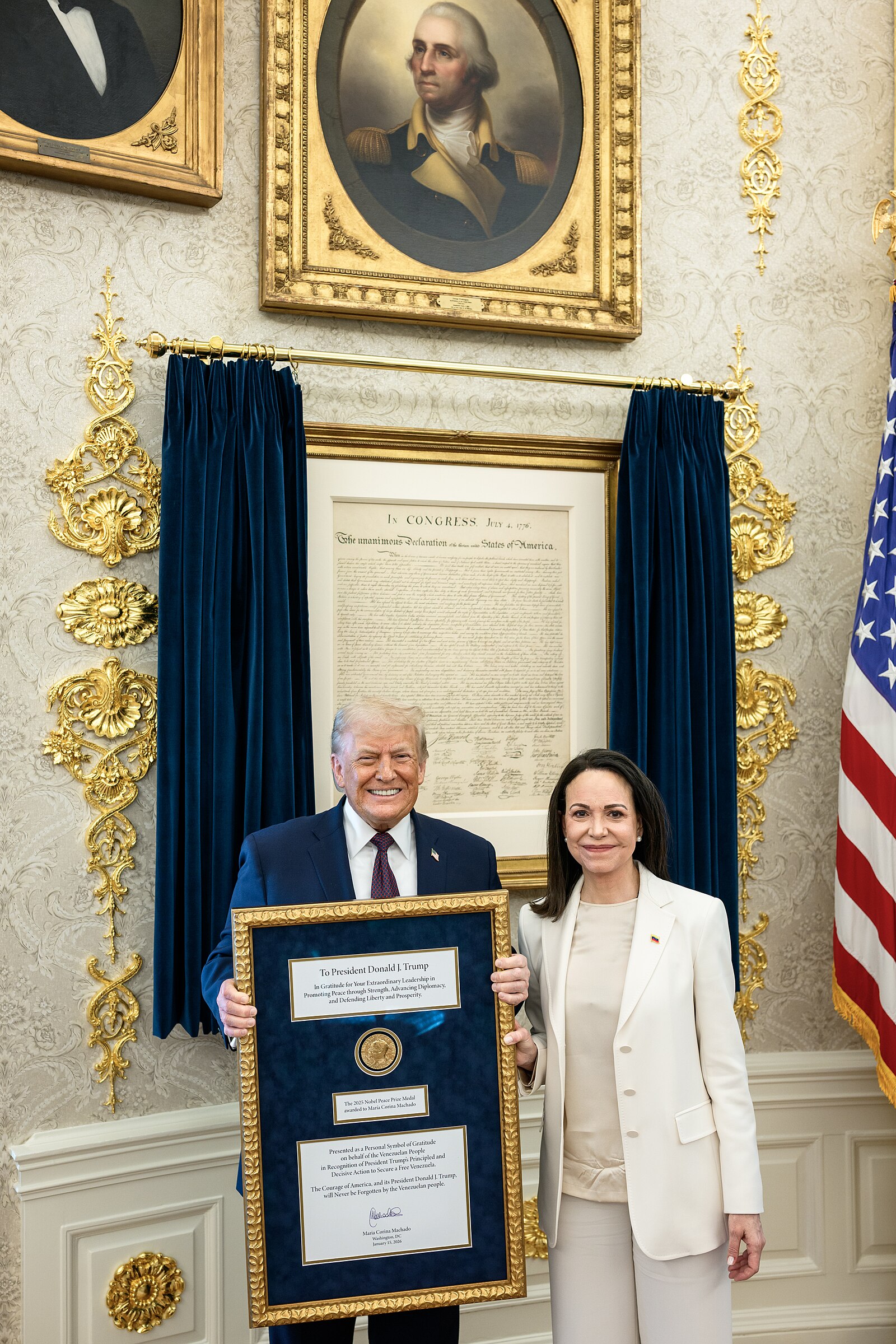
On 15 January 2026 she met Trump in the Oval Office and presented him with her Nobel medal. She called the meeting historic for Venezuela.
On 23 May 2026, in Panama City, she confirmed she would run for president in any new election. She said she intended to return home before the end of 2026, in coordination with the United States.
A first return attempt in late June failed after two earthquakes struck Venezuela. She said the government had closed commercial airspace to keep her out. The New York Times reported that Washington had undercut the trip, and US officials called her attempts “counterproductive”.
On 15 July a US State Department official, Cartwright Weiland, told Congress that Washington would not stop her going back. He called her a Venezuelan citizen with the right to return.
In early September she told The Guardian that Venezuela’s oil belongs to its people, not to what she called an illegitimate regime. Her target was the right of Rodríguez’s government to sign deals.
A second round of US-backed talks between the government and part of the opposition opened in Caracas on 15 September. Machado and González are not at the table.
On Monday 21 and Tuesday 22 September, her team said, three attempts to leave Panama by boat and plane fell through. Her adviser Pedro Urruchurtu put the total at seven failed attempts in recent weeks. Nobody has said who stopped them.
Controversies
The most serious accusations against her have come from Venezuelan authorities. In 2004 prosecutors charged Súmate’s leaders, including Machado, with conspiracy over a US$31,150 grant from the US National Endowment for Democracy. When a court ordered a trial in 2005, Human Rights Watch called prosecuting people for legitimate electoral work “utterly absurd”.
In 2014 the government accused her of plotting against Maduro, citing emails it presented as evidence. She called the accusations false, and a cybersecurity firm hired by one of those named concluded the emails had been forged.
Prosecutors announced conspiracy charges in December 2014. She has never been convicted, and the state has not published a final ruling on those cases.
Her 15-year ban rests on an administrative decision by the comptroller, not on a criminal conviction. The government treats the courts’ endorsement of it as settled law. The opposition wants it lifted.
Her strategy has also divided the opposition. A sector led by Dinorah Figuera, a former Assembly president, negotiates with the government in talks Machado does not attend.
Her choice to give Trump her Nobel medal tied her closely to one US president. She called it gratitude on behalf of Venezuelans for Maduro’s removal. The Nobel Committee replied that a medal can change owners, but the title cannot.
What to watch
The first thing to watch is her return. A safe landing in Caracas would signal that the Rodríguez government accepts her right to campaign. Another blocked attempt would say the opposite.
The second is the election calendar. At the UN General Assembly on 23 September, Rodríguez promised that “there will be elections in Venezuela”. She gave no date, no month and no year.
The third is the electoral council. Machado says her talks with the State Department point to a new CNE board before the end of 2026. The talks in Caracas are meant to deal with the council and the Supreme Court.
The fourth is her ban. If negotiators lift or pardon it, she becomes the favourite in any fair vote. If they do not, the opposition must again choose a stand-in.
The last is Washington. Trump has worked closely with Rodríguez since January. The White House issued no readout of their meeting in New York on 22 September.
What this means for foreigners and investors
For companies signing oil and mining deals with Caracas, Machado is a political risk to price. She argues that the current government has no mandate to sign them.
If she ever governs, she has said the subsoil belongs to Venezuelans. That does not mean contracts would be torn up, but it does mean their legitimacy could be reopened.
For people across the region, the issue is migration. About 6.98 million Venezuelans live elsewhere in Latin America and the Caribbean. Many are Machado voters who may weigh a return on her fate.
For foreign residents inside Venezuela, the practical guide is simple. Political prisoners are still held. How returning opposition figures are treated is the best guide to how far the opening goes.
Connected Coverage
Venezuela Explained: The Transformation, the Oil Economy and What to Watch
Nobel Winner Machado Blocked Three Times From Flying Back to Venezuela
Venezuela Elections Promised at the UN, but Delcy Rodríguez Named No Date
Venezuela: Government, Opposition Restart Talks on Courts and Vote
Venezuela Oil Is Not the Government’s to Sell, Machado Says
What Is Not Known
Who has stopped her flights. Her party has named nobody. Panama’s government has said nothing in public, and Caracas has not commented on the failed attempts.
Whether her ban will be lifted. The government treats the courts’ rulings as settled, and has floated a general pardon instead of a review of her case.
When Venezuelans will vote. Rodríguez promised elections at the UN on 23 September but named no date. The constitutional deadline for a new vote is disputed.
How much support Washington will give her. Trump has praised Rodríguez and questioned Machado’s standing, while the State Department says it will not block her return.
Whether the old criminal cases against her are still open. No Venezuelan court has published a final decision on the conspiracy charges announced in 2004 and 2014.
Sources: The Norwegian Nobel Committee, the European Parliament, the US Congressional Research Service, Human Rights Watch and the 2023 primary commission. All accessed 25 September 2026.
- Norwegian Nobel Committee / Nobel Prize Outreach — the 2025 Peace Prize and its citation
- US Congressional Research Service — Venezuela’s 2024 presidential election (CNE and opposition tallies)
- Comisión Nacional de Primaria final bulletin, via Bloomberg Línea — 2023 primary result
- European Parliament — Sakharov Prize laureates, 2024
- Human Rights Watch — “Venezuela: Court Orders Trial of Civil Society Leaders” (July 2005)
- CBS News — the Oval Office meeting of 15 January 2026 and the Nobel Committee’s statement
- Biographical reference — education, 2010 election, 2014 expulsion and charges
More: Venezuela news in English, every day from The Rio Times.
Frequently Asked Questions
Who is María Corina Machado?
She is a Venezuelan industrial engineer and opposition leader, born in Caracas in 1967. She founded the party Vente Venezuela, won the 2023 opposition primary and received the 2025 Nobel Peace Prize.
Where is María Corina Machado now?
As of 25 September 2026 she is in Panama. Her team says three attempts to travel home failed on 21 and 22 September, and her adviser puts the total of failed attempts at seven.
Why was she not the opposition candidate in 2024?
The comptroller general barred her from public office for 15 years in June 2023, and the Supreme Court upheld the ban in January 2024. The opposition ran Edmundo González instead.
Who won Venezuela’s 2024 election?
The electoral council declared Nicolás Maduro the winner with 51.2 percent but never published detailed results. Opposition tally sheets showed Edmundo González with about 67 percent.
Why did she give her Nobel medal to Donald Trump?
She presented it to him at the White House on 15 January 2026 as a gesture of gratitude for Maduro’s removal. The Nobel Committee said the title of laureate cannot be transferred.
Will Machado run for president?
Yes. She confirmed in Panama City on 23 May 2026 that she would run in any new election. No election date has been set.
This article was produced by The Rio Times’ automated newsroom system. How we use AI · Report an error · Editorial responsibility: Matthias Camenzind, Editor-in-Chief