Venezuela Elections Promised at the UN, but Delcy Rodríguez Named No Date
Venezuela · Politics
Key Facts
- —What happened Acting president Delcy Rodríguez told the UN General Assembly on 23 September 2026 that her country will hold a vote.
- —Her exact words “En Venezuela habrá elecciones” — there will be elections in Venezuela. She spoke in Spanish.
- —The catch Venezuela elections got no date, no month and no year. She said the people would “determine the correct moment”.
- —Who she is Venezuela is a South American country on the Caribbean coast. Rodríguez has run it since January 2026 without winning a vote.
- —How she got there American forces seized president Nicolás Maduro on 3 January 2026. The supreme court told his deputy to take over.
- —What else she raised She restated Venezuela’s claim to the Guayana Esequiba, a large region governed by neighbouring Guyana.
Venezuela’s unelected leader told the world’s governments that a vote is coming. She did not say in which month, or in which year.

Venezuela elections are coming, the country’s acting president told the United Nations. She did not say when.
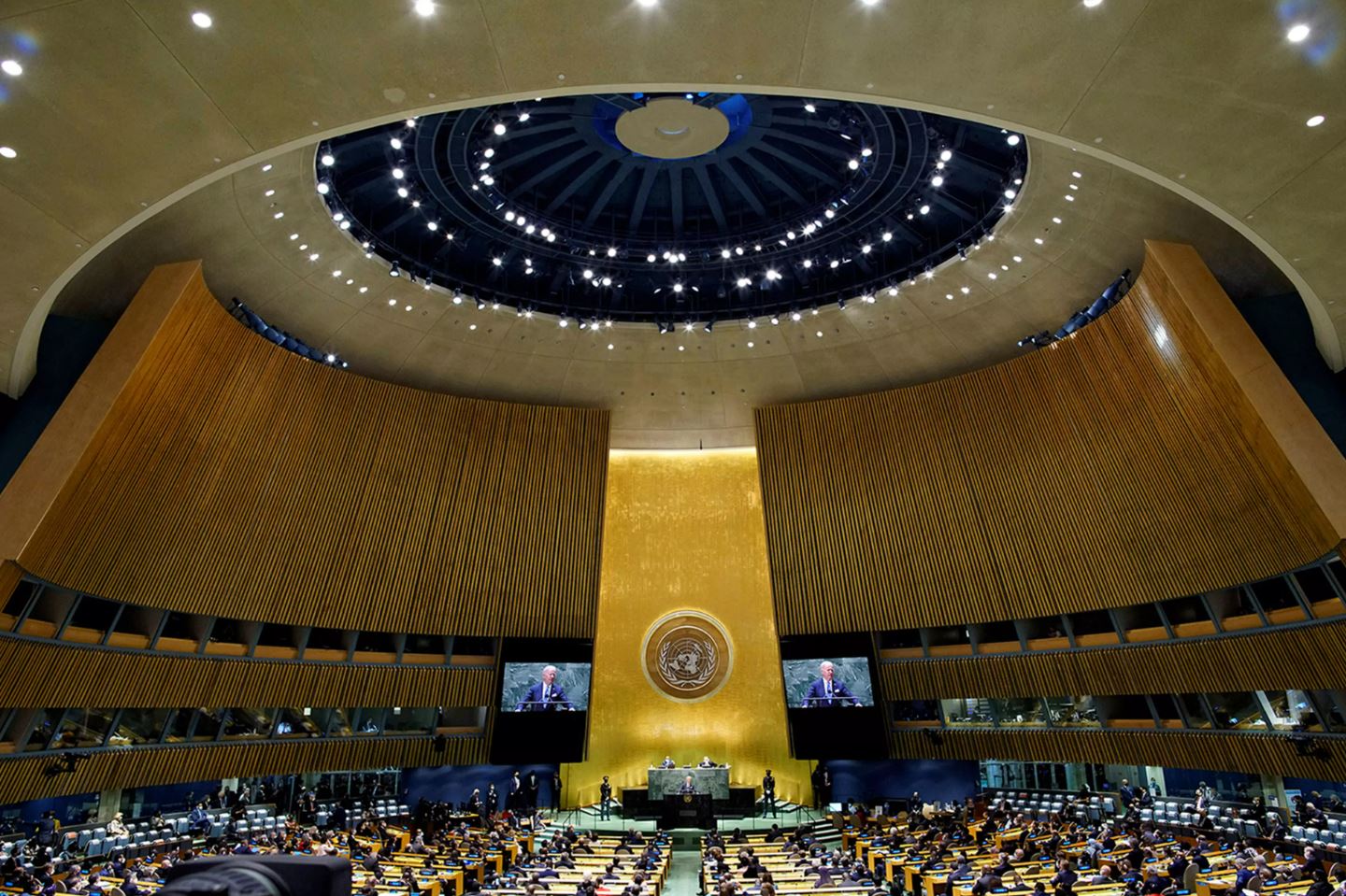
Delcy Rodríguez made the pledge from the rostrum of the General Assembly in New York on Wednesday 23 September 2026. She spoke in Spanish, in the evening sitting of the annual general debate.
One sentence from the address travelled further than the rest. “Quiero decirlo muy claro en esta Asamblea General: en Venezuela habrá elecciones.”
In English: I want to say it very clearly in this General Assembly, there will be elections in Venezuela. What followed carried no calendar at all.
The promise, and the hole in it
Rodríguez said her government had opened talks with parts of the opposition. The aim was a contest run “en igualdad de condiciones para todos”, on equal terms for everyone.
Timing she handed to the public. “El pueblo venezolano, con su sabiduría ancestral, determinará el momento correcto”.
The Venezuelan people, with their ancestral wisdom, will determine the correct moment. Their institutions, she added, would be ready to guarantee it.
No month was named. No year was named, and no stage of an electoral timetable was described.
She also set a wider test for democracy itself. “La democracia no se mide por la existencia de elecciones”, she said.
Democracy is not measured by the existence of elections. It is measured, she argued, by the quality of the competition that precedes them.
Her government, she said, had begun a democratic transformation that was “ordenado, institucional y verificable”. Orderly, institutional and verifiable.
Why an unelected leader is making this promise
Venezuela has been run since January by a president nobody voted for. American forces seized Nicolás Maduro at the presidential palace in Caracas on 3 January 2026 and flew him to New York.
He was arraigned two days later on narcotics and narco-terrorism charges and pleaded not guilty. His trial has not taken place.
The constitutional chamber of Venezuela’s supreme court, the Tribunal Supremo de Justicia, ordered his deputy to take charge. Rodríguez was sworn in on 5 January 2026.
She had been foreign minister from 2014 to 2017 and executive vice-president since 2018, and she listed both posts in her speech. She has never stood for the presidency.
The legal route was unusual. José Ignacio Hernández, a Venezuelan lawyer and visiting scholar at Boston College Law School, wrote that the court invented a category.
He had served Venezuela’s opposition-led interim government as special attorney general from 2019 to 2020. The chamber called it a “forced absence”, he wrote.
That status is not set out in the constitution’s text, he argued, and it let her govern without the usual limits.
The chamber said the step was needed to ensure the “continuity of the State”. A permanent vacancy would have obliged a presidential election within 30 days.
A stand-in is meant to serve 90 days, extendable by the National Assembly. Latin America Reports noted in April that her 90 days had run out on 5 April 2026 with no parliamentary debate.
The territory she raised, and the court she did not
Rodríguez used point seven of her speech to restate Venezuela’s claim to the Guayana Esequiba. It is a 159,500-square-kilometre expanse west of the Essequibo river that makes up most of Guyana’s land area.
Guyana, a small English-speaking country on South America’s north coast, has administered it since colonial times. A Paris tribunal awarded it to British Guiana in 1899, and Venezuela began calling that award void in the 1960s.
She called on Guyana to return to negotiations “tal como lo ordena el Acuerdo de Ginebra”, as the Geneva Agreement requires. That 1966 treaty commits both sides to seek a practical settlement.
Then came the sting. “Los acuerdos que más perduran son los que provienen de negociaciones bilaterales, por encima de organismos externos”.
Agreements last longest when they come from bilateral negotiation, above external bodies. That is a pointed line to deliver at the United Nations.
She never named the International Court of Justice. Guyana took the boundary dispute there on 29 March 2018.
The court heard the merits of the case between 4 and 11 May 2026. No judgment has yet been delivered.
Guyana’s attorney general, Anil Nandlall, expects a binding ruling by or before January 2027. President Irfaan Ali told Al Jazeera this month that Guyana was “prepared for any reaction to the court ruling”.
Sanctions, Washington and the road back
On sanctions she was brief and pointed. “Sabemos que las sanciones socavan las libertades económicas, financieras y retardan el desarrollo humano”, she said.
We know that sanctions undermine economic and financial freedoms and slow human development. The United States has restricted Venezuela’s state and its energy industry since the late 2010s.
Rodríguez herself was designated by the US Treasury in 2018 and taken off the blacklist on 1 April 2026, Al Jazeera reported.
Washington spent this year licensing much energy and banking business back into Venezuela. The underlying executive orders and the main blacklistings remain in force.
She thanked Donald Trump by name for a willingness to resume diplomatic relations and cooperation. She had met the American president briefly the evening before, at a reception Trump hosted in New York.
She also called a recent United States–Venezuela accord one of the largest ever signed. It would steady the hemisphere’s energy balance, she said.
She did not mention Maduro once, and she did not offer the thing her critics have demanded since January. Venezuela elections still have no date.
More: Venezuela coverage, every day from The Rio Times.
Frequently Asked Questions
When will Venezuela hold elections?
No date has been announced. Rodríguez told the General Assembly on 23 September 2026 only that Venezuela will hold elections at a moment decided later.
What language did she speak in?
Spanish. Her address opened with “Muy buenas tardes”, good afternoon, and the United Nations supplied simultaneous interpretation into English and the other official languages.
How did Delcy Rodríguez become acting president?
Venezuela’s supreme court ordered her, as executive vice-president, to take charge after American forces seized Nicolás Maduro on 3 January 2026. She was sworn in two days later.
What is the Guayana Esequiba?
A 159,500-square-kilometre region west of the Essequibo river, governed by Guyana and claimed by Venezuela. The International Court of Justice heard the case in May 2026.
Sources: El Diario’s full Spanish transcript of the speech, El Estímulo on the quotes, Infobae carrying the EFE wire, Efecto Cocuyo on the missing date, El Espectador, The Associated Press, UPI, CNN’s live coverage of the general debate, UN Meetings Coverage for 23 September 2026, NTN24 on the rescheduled slot, José Ignacio Hernández on the court ruling, Latin America Reports on the expired term, Al Jazeera on the lifted sanctions, the International Court of Justice case file, JURIST on the May hearings, Kaieteur News on Guyana’s preparations, CSIS on Hernández’s record, Faegre Drinker on the 2026 sanctions licences, Courthouse News on the arraignment, Britannica on her career
This article was produced by The Rio Times’ automated newsroom system. How we use AI · Report an error
Read More from The Rio Times