Dominican Republic Haiti Team Ban Backed by Abinader

SPORTS · DOMINICAN REPUBLIC
Key Facts
- —The country The Dominican Republic shares the island of Hispaniola with Haiti. Haiti, which reached the 2026 World Cup, plays home matches abroad, currently in Jamaica, Diario Libre reported on 2 October.
- —What happened On Friday 2 October Sports Minister Kelvin Cruz barred Haiti’s national football team from Dominican sports venues. President Luis Abinader backed the veto the same day as government policy.
- —Who is involved Haitian supporters broke down a stadium entrance gate before Haiti’s 4-1 win in Santo Domingo on 1 October, Diario Libre and El Nacional reported. Players’ posts claiming Hispaniola for Haiti fuelled the row.
- —What it means for you Fans should not expect Haiti matches in Dominican stadiums for now. Haiti’s embassy said on 2 October the players spoke for themselves and reaffirmed respect for Dominican sovereignty.
- —Still open The exact scope of the ban, and whether Concacaf, the regional football body, or FIFA will respond. No reaction from either had been reported by 3 October.
The Dominican Republic’s Haiti team ban now has the president behind it. Luis Abinader said on Friday 2 October that his sports minister’s veto on Haiti’s national football team is the government’s position.
“The position of the sports minister is the position of the government,” Abinader told reporters at the Santo Domingo book fair. The minister, Kelvin Cruz, announced the ban on Friday, the day after Haiti won 4-1 in the capital.
What happened at the Félix Sánchez stadium
Before kick-off on Thursday 1 October, Haitian supporters broke down a gate at the Félix Sánchez Olympic Stadium, Diario Libre reported. Several people then slipped into the ground without tickets.
El Nacional described fans destroying the door of one entrance. Cruz said restoring it for this year’s Central American and Caribbean Games in Santo Domingo cost “millions and millions of pesos.”
No damage estimate has been published. Demand had been high: El Día estimated 21,001 tickets sold by 30 September for a stadium that seats 24,500 for sport.
Cruz said his ministry’s rules penalise indiscipline and disrespect. “That is not the behaviour a respectful fan base should show,” he said, according to Diario Libre.
A one-sided rivalry on the pitch
On the pitch, Louicius Don Deedson put Haiti ahead in the ninth minute. Wilson Isidor scored twice, Dorny Romero replied for the hosts and Yassin Fortuné made it 4-1.
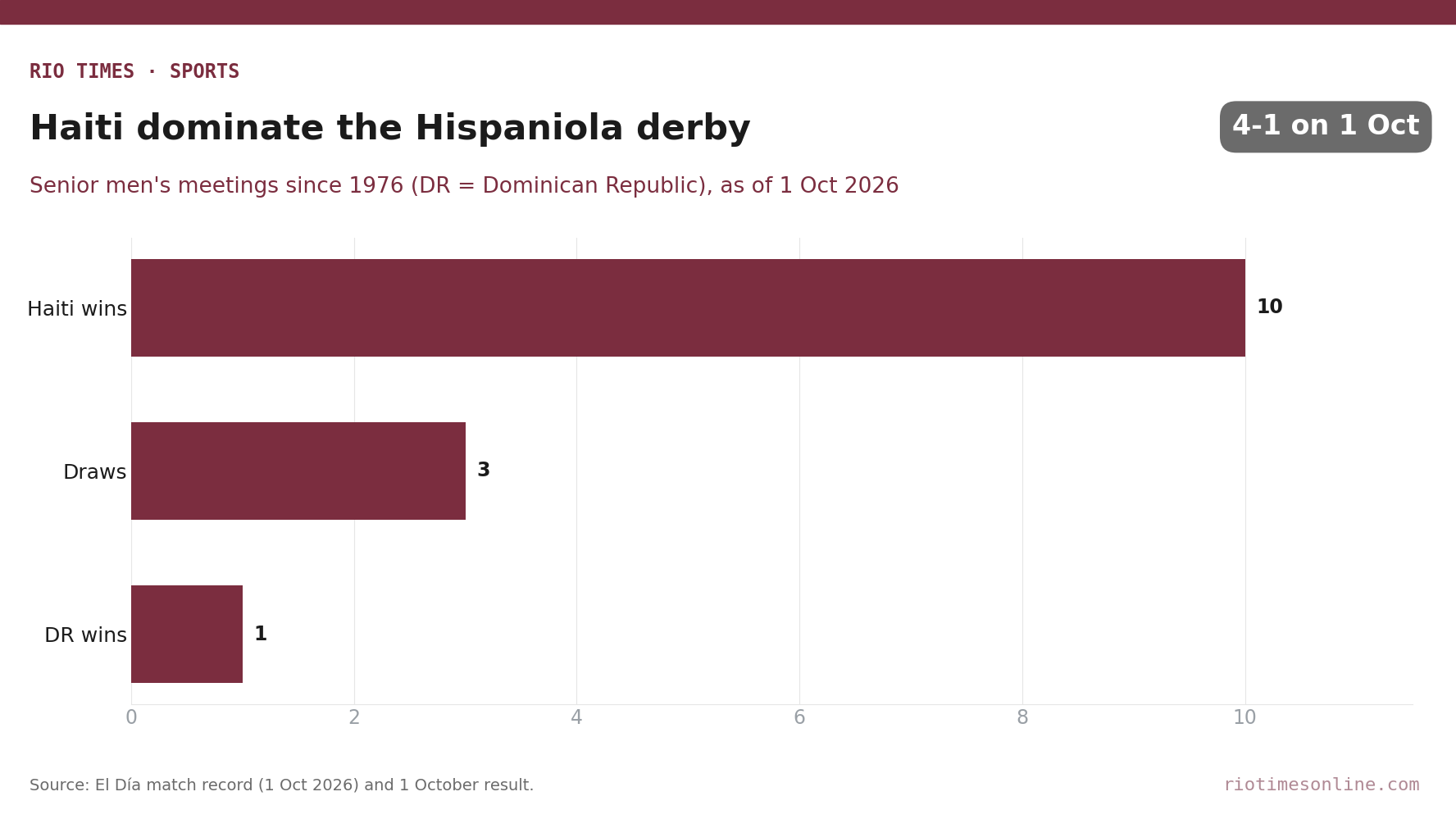
The result extended a lopsided record. El Día counts 14 senior meetings since 1976, with ten Haiti wins, three draws and a single Dominican victory in 2013.
Haiti now has nine points from three Group A games of the Concacaf Nations League, level with Curaçao. On Sunday 4 October Haiti face Costa Rica and the Dominican Republic visit Nicaragua.
The Dominican side opened its group at home in Santiago, as previewed in Dominican Republic vs Nicaragua on September 24: Concacaf Nations League at Estadio Cibao FC in Santiago.
Players’ posts widen the row
After the match Isidor posted “Hispaniola is Haiti,” and forward Duckens Nazon wrote “Hispaniola is for us,” Diario Libre reported. Nazon did not play on Thursday.
José Deschamps, president of Fedofútbol, the Dominican Football Federation, called the remarks disrespect for national sovereignty. He said the federation would take the case to international football bodies.
The Haitian side moved to calm things. In a note dated 2 October, Haiti’s embassy in Santo Domingo said the players’ words do not reflect its government’s position.
It cited the 1929 border treaty and thanked Dominican authorities and security forces for staging the match. Sporting rivalry, it said, must not damage good neighbourly relations.
Critics question who is being punished
Not everyone backs the veto. Football followers quoted by El Nacional on 3 October argue that the Haitian team is not responsible for its supporters’ conduct.
The page Balompíe Dominicano said keeping order is the job of local authorities. Others warned the ban could rebound on Dominican teams and invite FIFA sanctions.
Years of gang violence have kept Haiti’s team away from home, as set out in Haiti Explained 2026: The Gang Crisis, the Transition, the Economy and What to Watch. Asked about home games in Santo Domingo, coach David Badía pointed to Concacaf, adding: “I go where they take me.”
What Is Not Yet Known
The reach of the Haiti team ban is unclear. Diario Libre noted it may not stop Haiti playing in the country as the away side, unless Fedofútbol seeks another venue.
Cruz cited ministry regulations, but no written order has been published. No response from Concacaf, FIFA or the Haitian Football Federation had been reported by Saturday 3 October.
It is also unknown whether anyone was detained over the gate, or what repairs will cost. The Dominican federation’s complaint about the players’ posts has not yet been filed publicly.
Sources: El Día (3 Oct); El Día (1 Oct); El Día (1 Oct, record); El Día (30 Sep); El Nacional (2 Oct); El Nacional (3 Oct); Diario Libre (2 Oct, ban); Diario Libre (2 Oct, Abinader); Diario Libre (2 Oct, players); Diario Libre (2 Oct, embassy); Rezo Nòdwès (2 Oct).
This article was drafted with automated assistance and reviewed before publication. How we use AI · Report an error · Editorial responsibility: Matthias Camenzind, Editor-in-Chief