Who Is Gustavo Petro? Colombia’s Former President Explained: His Legacy and What to Watch
GUIDES · COLOMBIA
Key Facts
- —The person Gustavo Francisco Petro Urrego, born on 19 April 1960 in Ciénaga de Oro, in Córdoba department. An economist, he is a former M-19 guerrilla, a former mayor of Bogotá and a former senator.
- —The office he held President of Colombia from 7 August 2022 to 7 August 2026, the country’s first left-wing head of state. Abelardo de la Espriella succeeded him.
- —The mandate He won the runoff of 19 June 2022 with 50.44 percent and 11,281,013 votes. Rodolfo Hernández took 47.31 percent.
- —His role now Party president of the Pacto Histórico, the left-wing party that carried him to power. He holds no public office and no seat in Congress.
- —The sanctions On the US Treasury sanctions list since 24 October 2025, a month after Washington revoked his visa. The listing was still in place as of September 2026.
- —What comes next The campaign-spending case against his 2022 campaign manager goes to trial with a formal accusation hearing on 30 October 2026. Regional elections follow in October 2027. He cannot run for president again.
Who Gustavo Petro is, what his four years in power changed, and why he still shapes Colombia’s politics.
Gustavo Petro left Colombia’s presidency on 7 August 2026, but he has not left the stage. He leads the main opposition party, disputes his successor’s numbers daily and remains under US sanctions. This profile covers the man and his record. For the country itself, read our companion guide, Colombia Explained: The Country, Its Politics, Its Economy and What to Watch.
Early life and path to power
Petro was born in Ciénaga de Oro, a small cattle town in Córdoba, near the Caribbean coast. His family moved to Zipaquirá, north of Bogotá, when he was a child. He studied economics at the Externado University in Bogotá.
As a teenager he joined the M-19, an urban guerrilla group formed in the 1970s. Its name refers to 19 April 1970, the date of an election it said was stolen. He used the nom de guerre “Aureliano”, after a character in Gabriel García Márquez’s One Hundred Years of Solitude.
The army arrested him in October 1985 for weapons possession. He spent about a year and a half in prison. He was in custody when the M-19 stormed the Palace of Justice in November 1985.
The M-19 signed a peace agreement with the state in March 1990 and became a political party. Petro was elected to the House of Representatives in 1991.
What this does not mean: an amnesty did not erase the past. Opponents still raise his guerrilla years in almost every debate.
In the Senate, from 2006 to 2010, he built a national profile by denouncing links between politicians and right-wing paramilitary groups. He ran for president in 2010 and finished fourth, with about 9 percent.
He was elected mayor of Bogotá for 2012 to 2015. In December 2013 the inspector general, Alejandro Ordóñez, removed him over a botched overhaul of rubbish collection. He also banned him from public office for 15 years.
A Bogotá court ordered his reinstatement in April 2014. In 2020 the Inter-American Court of Human Rights ruled that the removal had violated his political rights.
He lost the 2018 runoff to Iván Duque, with about 41.8 percent against 54 percent. Four years later he won, with the environmental activist Francia Márquez as his running mate. She became Colombia’s first Black vice-president.
The presidency, 2022 to 2026
Petro was sworn in on 7 August 2022. Colombia’s president is head of state and of government, and the constitution allows one four-year term. He governed without a stable majority in Congress, and his coalition with traditional parties broke apart in 2023.
His signature security policy was “Total Peace”. A law passed in November 2022 let the state negotiate with guerrillas and criminal gangs at the same time. The National Liberation Army (ELN) is the largest remaining guerrilla group.
Talks with it were suspended in January 2025 after an ELN offensive in the Catatumbo region. No major group signed a final agreement before he left office. The peace process guide explains each track.
Armed groups grew over the same period. The Council on Foreign Relations, a US think tank, estimated their combined membership at about 15,000 in 2022 and 22,000 in 2025. That does not prove the policy caused the growth, but it did not reverse it.
His social laws had mixed fates. The 2024 pension reform, Law 2381, shifts most workers’ first contributions into the public system.
The Constitutional Court upheld most of it in August 2026 and set 1 April 2027 as its start date. The 2025 labour reform, Law 2466, raised pay for night and Sunday work and remains in force.
His health reform, meant to curb the private insurers known as EPS, never became law. A Senate committee shelved the first version in April 2024 and a second in December 2025, and neither cleared Congress before his term ended.
Instead, his government took over the management of several large insurers. Critics blame those takeovers for unpaid hospital bills and medicine shortages; the government blamed the insurers’ old debts.
The fiscal record is the most disputed part of his legacy. A 2022 tax reform aimed to raise about 20 trillion pesos a year (about US$6.0 billion). That conversion uses 3,356 pesos to the dollar, the market rate on 28 September 2026.
The central government deficit then widened from 4.3 percent of gross domestic product (GDP) in 2023 to 6.7 percent in 2024. For scale, the European Union asks members to stay under 3 percent.
In June 2025 his government suspended Colombia’s fiscal rule, a legal cap on deficits, for three years. All three big rating agencies downgraded Colombia in 2025. S&P and Fitch now rate it below investment grade, and Moody’s at the lowest investment-grade step.
There were gains too. Unemployment fell from 11.2 percent in 2022 to 8.9 percent in 2025, says the statistics office DANE.
That was the lowest annual rate since 2001. Monetary poverty fell from 36.6 percent in 2022 to 31.8 percent in 2024.
The political model
Petro’s programme rested on three ideas. The state should lead the economy. Colombia should move away from oil and coal.
Peace should come through talks rather than force. He stopped signing new oil and gas exploration contracts, a policy his successor is now reversing.
He governed through his account on X, often late at night, and through mass rallies. Ministers learned policy from his posts.
What this does not mean: a post was not a decree. Rules changed only when a decree or a law was published.
Relations with Washington became the worst in decades. In January 2025 he turned back two US military deportation flights.
Donald Trump threatened 25 percent tariffs, and Colombia accepted the flights within hours. In September 2025 the US decertified Colombia on drugs for the first time since 1997, with a waiver that kept aid flowing.
On 26 September 2025 the State Department revoked his US visa. He had urged US soldiers, at a pro-Palestinian rally in New York, to disobey Trump.
On 24 October 2025 the Treasury put him on its sanctions list. The former first lady Verónica Alcocer, his son Nicolás and his interior minister Armando Benedetti were listed too.
That listing blocks any assets under US jurisdiction and scares off banks that clear dollars. Petro denies any link to drug trafficking.
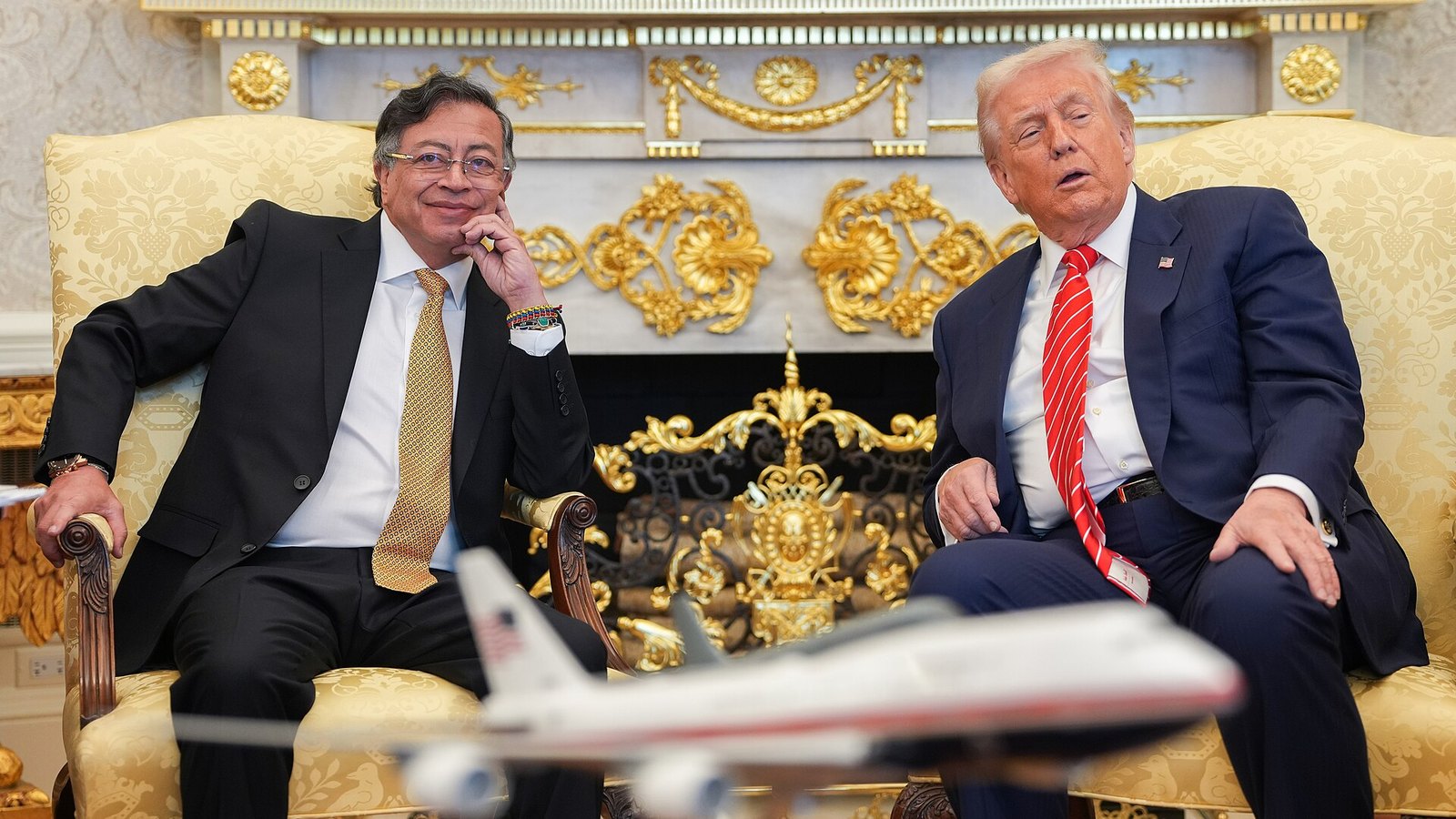
He met Trump at the White House on 3 February 2026 and asked him by phone in July to lift the sanctions. As of September 2026, they remained.
Life after the presidency
Petro did not attend his successor’s inauguration. He had called the June 2026 result a fraud.
An international audit by CAPEL, part of the Inter-American Institute of Human Rights, found no manipulation. He has not published evidence that overturns that finding.
In July 2026 he accepted the presidency of the Pacto Histórico party. On 26 August the party presented a shadow cabinet of 13 former officials to track each ministry.
It has no legal status. Senator Iván Cepeda, the runner-up in 2026, leads the opposition in Congress.
The constitution bars an ex-president from leaving the country for a year without Senate permission. Senators approved his request in August, by 73 votes to 11, on condition that he report each trip. His first trip abroad was to Mexico, where he lectured at the National Autonomous University (UNAM) on 2 September.
A European trip followed in mid-September. Semana, a Bogotá news magazine, reported that his notice to the Senate arrived after he left.
El Tiempo later reported that he had informed the Senate. Either way, his movements are closely watched.
He now fights his successor in public. De la Espriella said in a televised address that he had inherited a looted treasury.
Petro answered with his own debt figures. Colombian law gives the reply airtime to opposition parties, not to individuals, so his party said it would use its slot.
On 10 September he announced a renewed alliance with Claudia López, a former Bogotá mayor who had broken with him. The target is the regional elections of October 2027. He cannot run for president again, because a 2015 constitutional amendment bans re-election outright.
Controversies and critics
The campaign money comes first. On 27 November 2025 the National Electoral Council (CNE), which polices campaign finance, sanctioned his 2022 campaign.
It found that spending limits were exceeded and that unions had made banned contributions. The council confirmed the decision in 2026.
Among the contributions it cited were 500 million pesos (about US$149,000) from FECODE, the teachers’ union. Colombian law bars companies and other legal entities from funding presidential campaigns. The sanctions fell on campaign officials and two coalition parties, not on Petro personally.
The criminal case targets Ricardo Roa, his 2022 campaign manager and later chief executive of Ecopetrol, the state oil company. Prosecutors allege he allowed spending of about 1,664 million pesos (about US$496,000) over the legal limits.
He sought a plea deal in July 2026. His trial stage opens with a formal accusation hearing on 30 October 2026, and he is presumed innocent.
Roa faces a separate case over the purchase of a Bogotá flat. Our report on the hearings sets out both timetables.
Petro himself can be investigated only by the House of Representatives’ Accusations Commission, which keeps jurisdiction over acts committed in office. It holds about 200 complaints against him and has rarely brought any former president to trial.
His son Nicolás, a former regional legislator, faces charges of money laundering and illicit enrichment linked to campaign money. The case was still before the courts as of September 2026.
The new government has added pressure. In August 2026 it handed prosecutors a 135-page dossier, the “Libro de la Verdad”, alleging corruption under Petro.
The chief prosecutor said it proves nothing on its own. In September the state withdrew bodyguards from 20 Petro-era allies.
Supporters see a campaign of persecution. Petro said on 1 September that he had filed a complaint against his successor at the International Criminal Court. No court has convicted Petro of any crime.
What to watch
The Roa trial, from 30 October 2026, is the first courtroom test of the 2022 campaign money. A plea deal that names others would matter more than a verdict.
The US sanctions list is the second. Washington decertified Colombia again on 15 September 2026, on a record covering mostly Petro’s final year in office. Any delisting of Petro would come from the Treasury, not from a presidential remark.
The third is the fight over the fiscal inheritance. De la Espriella has ordered talks with the International Monetary Fund (IMF).
Our IMF report covers the options. How that deal is framed will shape how Petro’s legacy is judged.
Finally, the left’s strength. The October 2027 regional elections will show whether Petro still commands votes, or whether Cepeda and newer figures take over the movement.
What this means for foreigners and investors
Petro no longer makes policy, so his posts no longer move Colombian law. They can still move sentiment. His party is the largest single opposition bloc, and street protest remains a tool of the left.
The peso reacts to fiscal news from both camps. It traded at about 3,356 to the US dollar on 28 September 2026, according to market data. Our guide to investing in Colombia covers stocks and government bonds.
For companies, the sanctions matter in one practical way. Any firm with US exposure should screen dealings with Petro, his named relatives and Benedetti. What this does not mean: Colombia is not under sanctions, and ordinary business with Colombian firms is not restricted.
For residents, nothing in visa or tax rules changed because Petro left. The residency and visa guide and the tax guide remain the reference. Petro’s pension reform, if Congress fixes the returned articles, takes effect in April 2027 and affects anyone contributing in Colombia.
Connected Coverage
Colombia Explained: The Country, Its Politics, Its Economy and What to Watch
Who Is Abelardo de la Espriella? Colombia’s President Explained
Colombia Peace Process 2026: ELN, FARC and Investor Risk
Colombia Residency and Visa Guide 2026: Routes, Costs and an October Deadline
Moving to Colombia: 90-Day Visa-to-Cédula Plan
Taxes in Colombia for Expats: The 183-Day Residency Rule Explained
Investing in Colombia for Foreigners: Stocks and Government Bonds Explained
Banking in Colombia for Expats: Cédula Rules
Colombia Healthcare for Foreigners: EPS and Private Plans
Buying Property in Colombia as a Foreigner
Is Colombia Safe for Foreigners? Guide
Cost of Living in Colombia: A Realistic 2026 Budget
Retire in Colombia 2026: Pensionado Visa and Costs
Colombia’s New President Dismantles ‘Total Peace’, Signs Extraditions
Colombia Labour Rules From the Petro Era Are Scrapped, and Unions Are Angry
The US$3.6 Billion Deal Petro Killed Now Haunts Ecopetrol
Sources: Biography from the Presidency of Colombia and contemporary reporting; election results from the National Registry; unemployment and poverty from DANE; deficit figures from the finance ministry; sanctions from the US Treasury; the drug determination from the White House; campaign-finance decisions from the National Electoral Council as reported by the Colombian press. Checked on 28 September 2026.
- Presidency of Colombia — biography of Gustavo Petro
- US Treasury — sanctions on Gustavo Petro and associates, 24 October 2025
- The White House — 2027 “Majors List”, 16 September 2026
- El Colombiano — CNE sanctions the Petro 2022 campaign, 27 November 2025
- Vanguardia — CNE sanction becomes final, 29 April 2026
- El Espectador — Ricardo Roa trial to open in October 2026
- El Colombiano — the Accusations Commission and its backlog, September 2026
- Council on Foreign Relations — Preventing Renewed Conflict in Colombia
- El Colombiano — DANE: 2025 unemployment at 8.9 percent
- DANE — monetary poverty bulletin 2024
- La República — net central government debt at the close of 2025
- El Universal — Petro says he filed an ICC complaint, 1 September 2026
What Is Not Known
Whether any case will reach Petro himself. The Accusations Commission holds about 200 complaints, but it was reported in September 2026 to be short of funds and largely idle. No timetable exists for a decision on the 2022 campaign file.
What Roa will say. A plea deal requires information useful to prosecutors. Whether he offers any, and about whom, is not public.
Whether the US sanctions will be lifted. Petro asked Trump directly in July 2026. The Treasury has published no review, and the reasons for the listing have not been set out in a public court record.
How large the fiscal hole really is. The new government and Petro’s former finance team use different baselines. Net central government debt closed 2025 at 58.5 percent of GDP, La República reported, but the 2026 figures are not final.
Whether he keeps control of the left. Cepeda won about 12.7 million votes in the 2026 runoff, more than Petro’s total in 2022. Who leads the movement into 2030 is open.
Frequently Asked Questions
Is Gustavo Petro still president of Colombia?
No. Petro’s term ended on 7 August 2026. Abelardo de la Espriella is president until 7 August 2030. Petro now leads the opposition Pacto Histórico party and holds no public office.
Was Gustavo Petro a guerrilla?
Yes. He joined the M-19 urban guerrilla group as a teenager and spent about a year and a half in prison after his arrest in 1985. The M-19 made peace with the state in 1990, and Petro entered Congress in 1991.
Why is Petro under US sanctions?
The US Treasury added him to its sanctions list on 24 October 2025 under a drug-trade order, alongside relatives and a minister. Petro denies any link to drug trafficking. The listing blocks assets under US jurisdiction and was still in force as of September 2026.
Can Petro run for president again?
No. A 2015 constitutional amendment bars anyone who has held the presidency from being elected again. He can still lead his party and campaign for its candidates, starting with the regional elections of October 2027.
Is Petro being investigated?
His 2022 campaign was sanctioned by the electoral council, and its manager, Ricardo Roa, faces a formal accusation hearing, the start of his trial, on 30 October 2026. Complaints against Petro himself sit with a congressional commission. No court has convicted him of any crime.
What did Petro change for foreigners in Colombia?
Mainly labour and pension rules. The 2025 labour reform raised night and Sunday pay, and the pension reform is due to take effect in April 2027. Visa and tax rules for foreigners were not overhauled under him.
This article was produced by The Rio Times’ automated newsroom system. How we use AI · Report an error
In depth
Read More from The Rio Times