
PERU · CITY GUIDE
Key Facts
- What is happening Trujillo’s province passed one million people in the 2025 census, but the city district itself lost residents.
- Why it matters The province holds 67.0% of La Libertad’s businesses, in a region of 2,056,445 people.
- The numbers The city district had about 298,000 people in 2025, down 0.7% a year since 2017.
- Who is who Roy Arbaiza, of the Patriotic Party of Peru, leads the October mayoral count with 26.6%.
- What to watch Watch the expected 6 December governor runoff and any new extension of the crime emergency in Trujillo.
- Power Index Peru ranks 5th of 14 in The Rio Times Latin America Power Index, with 54.7 points (October 2026 edition).
- What it means for you The US State Department rates Peru Level 2, exercise increased caution, as of 3 September 2026.
Trujillo is a big trading city on Peru’s northern coast, home to farm exporters and busy shops. This guide explains how it works in late 2026.
This guide explains Trujillo, the capital of Peru’s La Libertad Region and a trade hub on the northern coast. Its province passed one million people in the 2025 national census.
Every figure carries its year. US$ values use the Central Reserve Bank of Peru’s interbank rate of 3.464 soles (S/) per US$1 on 30 October 2026.
The Rio Times Peru page covers the country daily, and the Peru Explained guide profiles the national government. For the people behind the numbers, read the Peru population and ethnic groups explainer.
Trujillo’s Place in Peru
Trujillo is a large city on Peru’s northern coast and the capital of the La Libertad Region. INEI, Peru’s national statistics institute, presented the region’s 2025 census results in the city.
INEI counted about 34.16 million people in Peru in 2025. Four provinces passed one million: Lima Metropolitana with 9.6 million, Arequipa, Trujillo and the port province of Callao.
La Libertad had 2,056,445 residents, 6.0% of Peru, making it the third most populous region after Lima and Piura. It grew 1.1% a year between 2017 and 2025.
A district is the smallest local-government unit in Peru, and the built-up city spreads across several. INEI counted about 298,000 people in Trujillo district, 199,000 in La Esperanza and 110,000 in El Porvenir.
Trujillo district shrank 0.7% a year between 2017 and 2025, one of three districts INEI named with falling numbers. Salaverry, a port district, grew 5.1% a year and Chao 6.3%.
From Almagro’s Villa to the Chimú Capital
Spanish conquistador Diego de Almagro founded the Villa de Trujillo on 6 December 1534, the municipality’s own planning document records. The town became Trujillo de Nueva Castilla in 1535.
Long before the Spanish, the Chimú people built Chan Chan, a vast adobe city near the modern city. Carved relief walls and wooden figures mark its Nik An palace, as the photo shows.

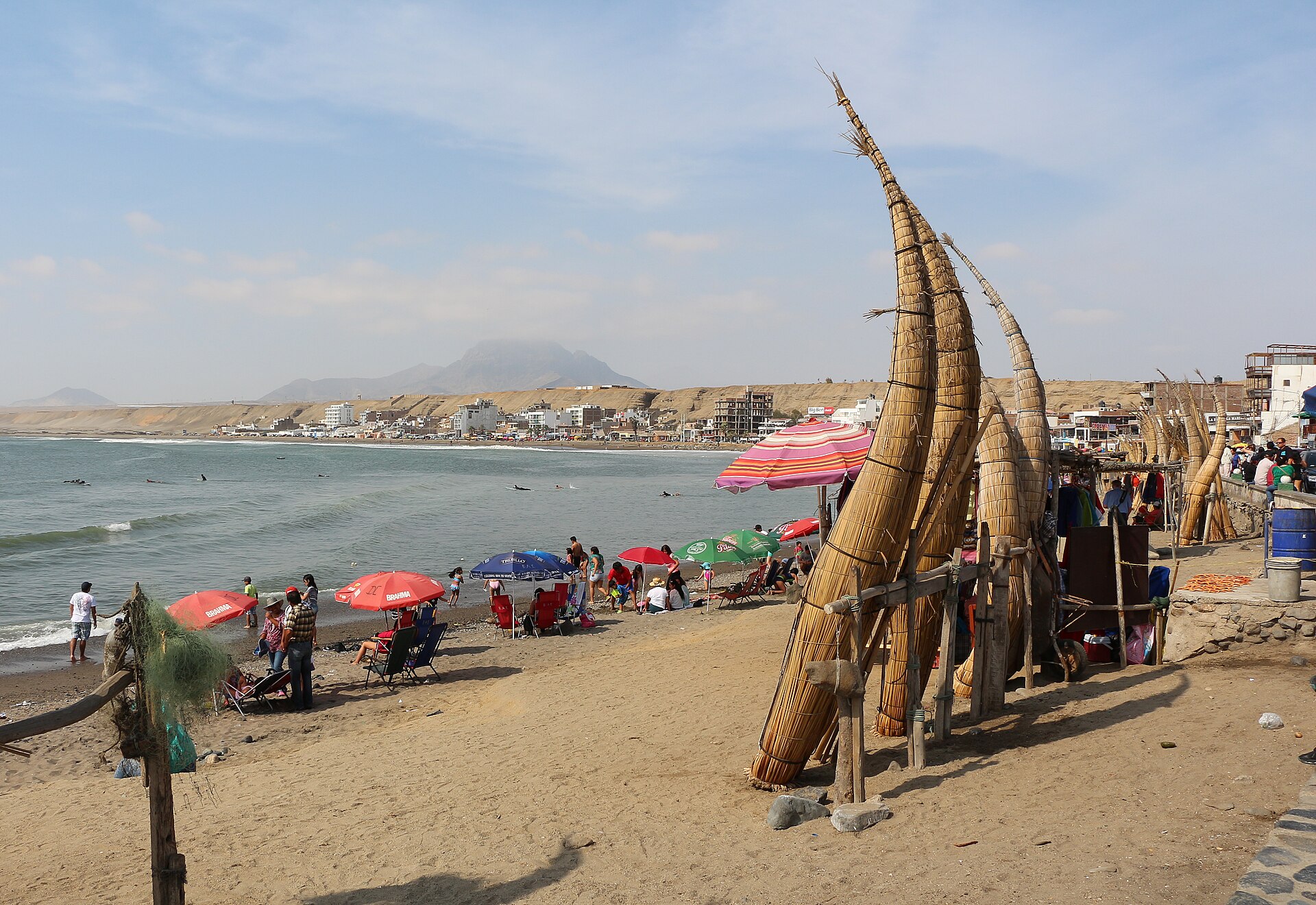
Huanchaco, a seaside district of the province, is known for caballitos de totora, small reed craft. They stand drawn up on its beach, as the photo shows.
Districts, People and Daily Life
The province has 12 districts, among them Trujillo, La Esperanza, El Porvenir, Huanchaco, Víctor Larco Herrera and Alto Trujillo. The municipality’s investment report gives its area as 1,769 square kilometres, with 97.7% of people in urban areas.
Alto Trujillo became a district in December 2022 and voted for its first local authorities on 4 October 2026. Before the census, the municipality projected 87,632 residents there for 2025.
The same report projected 359,982 people for Trujillo district in 2025. The census counted about 298,000, so the projection ran roughly one fifth above the count.
The next figures are for the whole La Libertad Region, because INEI had not published city detail in the sources checked. Women are 50.9% of residents, 24.2% are aged 0 to 14 and 14.4% are 60 or older.
Life expectancy at birth in the region is 79 years. In the census, 63.5% call themselves mestizo (mixed Indigenous and European descent), 18.3% white and 15.2% Black or Afro-Peruvian.
Immigrants to the region come mostly from Cajamarca (27.0%) and Lima Metropolitana (24.3%). Among people who left, 34.4% went to Lima Metropolitana and 13.5% to Cajamarca.
The census found 779,355 private households in La Libertad, and 12.1% were unoccupied. In 74.3% of homes water comes from the public network inside the home, 69.6% have public sewerage and 70.4% have internet.
The regional illiteracy rate is 5.7%, against 5.1% nationally. Health insurance covers 93.9% of residents, mostly through SIS, the state Comprehensive Health Insurance (65.7%), or EsSalud, the social-security insurer (26.3%).
Trade, Farm Exports and Footwear
The province holds 70,143 business establishments, which is 67.0% of the region’s total. Of these, 66% are wholesale or retail traders and 10% are lodging and food services, the municipality’s report says.
The province produces 51.1% of the region’s value added outside agriculture, and the report calls commerce and services the largest part. Bank credit in the province grew 5.9% a year from 2016 to 2024, and deposits grew 10.9%.
Farm exports depend on Chavimochic, an irrigation project that brings river water to the desert coast of La Libertad. The municipality links asparagus and artichoke exports to it.
The project’s agency says about 28,000 hectares are irrigated for small and medium farmers and 26,000 hectares are high-tech agro-industry. Its main canal totals 284 kilometres across three stages.
The third stage would add 63,000 hectares and 150,000 potential jobs, the agriculture ministry said in July 2024. Planned investment is US$750 million, and the minister said works would start in October 2025.
A trade ministry regional report put mining shipments from the region at about US$3.5 billion in the year to June 2025. Gold made up 43% and blueberries 19% of first-half 2025 shipments.
Monetary poverty in La Libertad was 31.6% in 2023, above the national 29.0%, in INEI data cited by the women’s ministry. The municipal development plan names footwear workshops in El Porvenir, La Esperanza and Florencia de Mora as major employers.
That plan uses 2007 data, so current footwear job numbers are not known. Readers should check recent local figures before relying on it.
Who Governs Trujillo
Mario Reyna Rodríguez became mayor of Trujillo province in November 2024, when the electoral jury declared Arturo Fernández’s seat vacant. He took leave from 4 September 2026 to run again for Alianza para el Progreso, a national party.
The province has a council of regidores, or councillors, who share decisions with the mayor. The municipality’s multiannual investment report lists S/372.8 million (US$107.6 million) across 119 projects, with 8.6% executed.
Peru held regional and municipal elections on 4 October 2026, and 14 candidates ran for mayor of Trujillo province. In the national electoral office’s count, Roy Charlie Arbaiza Corcuera of the Patriotic Party of Peru led with about 26.6%.
Robert de la Cruz of Podemos Perú, a national party, was second with about 17.4%. Arbaiza is the projected winner, as no formal proclamation was confirmed, and his term would cover 2027 to 2030.
For regional governor, Aldo Mariños of Somos Perú led with 24.79% and Elías Rodríguez Zavaleta of Podemos Perú had 24.49%. That was the count on 6 October, when 99.165% of tally sheets were processed.
No ticket reached the 30% of valid votes needed to win outright. The National Jury of Elections set 6 December 2026 for governor runoffs where needed, though the final pairing was not confirmed.
Keiko Fujimori, Peru’s president, swore in her first cabinet on 28 July 2026 under Luis Galarreta Velarde. César Astudillo Salcedo runs the interior ministry, which oversees the national police.
Security and the State of Emergency
The government extended a state of emergency against crime in the provinces of Trujillo, Virú and Chepén. Decree 109-2026-PCM added 60 days from 25 July 2026, which would run to about 22 September.
Pataz, a gold-mining province in the same region, has a separate emergency that decree 113-2026-PCM of 24 July 2026 extended. No later extension for Trujillo was found.
The regional crime-victim rate was 25.0%, against 24.4% for Peru, in data the municipality cites. Only 30.4% of police stations in the region were in good condition, close to the 28.8% national figure.
The US State Department rates Peru Level 2, exercise increased caution, as of 3 September 2026. It cites crime, unrest, kidnapping and terrorism and says criminal groups sometimes set up roadblocks outside Lima.
Infrastructure, Water and Transport
In La Libertad, 91.8% of people have water access, against 89.2% nationally, and 81.3% have sanitation, against 74.4%. Water runs 11.8 hours a day on average, against 17.3 hours nationally.
Only 14.8% of people in the region have chlorinated water, against 25.4% nationally. An older municipal plan found a water deficit of 714 litres a second in the metropolitan area, based on 2012 data.
The province’s national roads total 105 kilometres and all are paved, while departmental roads cover 56 kilometres and only 21.9% are paved. Most daily trips are short, about 4 kilometres, the municipality’s mobility plan says.
The municipality has six underground parking projects at idea stage, worth S/123.1 million (US$35.5 million) in total as of 30 June 2025. The largest, at the Mansiche sports complex, would hold 557 cars.
Salaverry port lies 12 kilometres from the city, and Carlos Martínez de Pinillos airport in Huanchaco has a 3,024-metre runway. The older municipal plan says the airport offers domestic flights to Lima.
The same plan warns that El Niño rains can make the Moche River and main ravines overflow. Check local conditions in the rainy season.
What It Means for US Readers
Americans should read the State Department’s Level 2 advisory for Peru, which cites crime, unrest, kidnapping and terrorism. Check the Trujillo, Virú and Chepén emergency decree before travelling.
Visitors can see Chan Chan, the Chimú adobe city, and Huanchaco’s beach near the city. Entry rules and ticket prices were not checked for this guide.
Investors should watch Chavimochic III, since 63,000 new hectares would expand farm exports, and the 6 December governor runoff. The projected mayor would take the local seat for 2027 to 2030 and set the pace for mobility projects.
For national context, read the Peru security and crime explainer and the Peru politics guide. The Peru economy guide covers the national business landscape.
What Is Not Known
The 2025 census population of the province of Trujillo and of the city’s urban area was not published in the sources checked. INEI said only that the province exceeds one million people.
The municipality’s own 2025 projection of 1,223,977 people for the province was not used as a census figure. Its report also gives two different shares for commerce and services in the local economy.
No formal proclamation of the winners in Trujillo and La Libertad was confirmed, and the final governor count was not seen. Who holds the mayor’s seat today, and any emergency extension after the 60 days from 25 July 2026, were also not confirmed.
The electoral office’s results site could not be read directly, so vote shares come from its counts as relayed. Homicide, extortion and robbery rates for the city were not found in primary sources.
Bus fares and rents were not checked and are left out. Whether Chavimochic III works have started was also not confirmed.
Frequently Asked Questions
What is Trujillo known for?
Trujillo is the capital of Peru’s La Libertad Region and a trading hub on the northern coast. Nearby are Chan Chan, an adobe city of the Chimú, and the beach town of Huanchaco.
How many people live in Trujillo?
INEI’s 2025 census counted about 298,000 people in the Trujillo district and said the province exceeds one million. The region of La Libertad had 2,056,445 residents.
Who is the mayor of Trujillo?
Mario Reyna Rodríguez became mayor in November 2024 and took leave in September 2026 to run again. In the October 2026 count Roy Charlie Arbaiza Corcuera led, with no proclamation confirmed.
Is Trujillo safe for visitors?
The government extended an emergency against crime in the provinces of Trujillo, Virú and Chepén from 25 July 2026. The State Department rates Peru Level 2, exercise increased caution, as of 3 September 2026.
What is Chavimochic?
Chavimochic is an irrigation project that brings river water to the desert coast of La Libertad, with a 284-kilometre main canal. Its third stage would add 63,000 hectares.
What does Trujillo export?
The region’s largest exports are gold and blueberries, at 43% and 19% of shipments in the first half of 2025. Asparagus and artichoke exports depend on Chavimochic irrigation.
Who runs La Libertad Region?
A regional governor leads the region, and a runoff on 6 December 2026 was expected. Aldo Mariños of Somos Perú and Elías Rodríguez Zavaleta of Podemos Perú led the first count.
Sources: INEI, Censos Nacionales 2025 provincial and district results (10 July 2026); INEI, La Libertad 2025 census results (13 August 2026); Municipalidad Provincial de Trujillo, multiannual investment report 2025-2028 (via the finance ministry); Peru national electoral office, Elecciones Regionales y Municipales 2026; National Jury of Elections, plenary agreement of 7 October 2026 on the regional runoff date; Presidency of Peru, emergency extension (23 July 2026); Presidency of the Council of Ministers, Decree 113-2026-PCM; Presidency of Peru, cabinet sworn in (28 July 2026); Ministry of Agrarian Development, Chavimochic III (20 July 2024); Proyecto Especial Chavimochic (3 September 2026); Municipalidad Provincial de Trujillo, Local Concerted Development Plan 2017-2030; Ministry of Women and Vulnerable Populations, La Libertad population indicators (INEI data, 2023); Ministry of Foreign Trade and Tourism, regional trade report (published 20 August 2025); Central Reserve Bank of Peru, interbank exchange rate series (30 October 2026); US State Department, travel advisories data feed, Peru Level 2 (3 September 2026).
This article was produced by The Rio Times’ automated newsroom system. How we use AI · Report an error · Editorial responsibility: Matthias Camenzind, Editor-in-Chief
Expat Guide to Peru
What The Rio Times publishes for foreigners who live in or move to Peru.
Start here
- Arequipa City Guide, Government, Projects and Safety
- Lima Rent for Foreigners in 2026 Averages US$979 a Month
- Peru Education and Healthcare Explained
- Peru’s New Crime Command and What It Means for Visitors
City guides
Coming up in Peru
- Freen Sarocha Returns to Lima: 'Velvet Dream' Concert on November 5, 2026 — Tickets on Sale Monday 5 Nov
- Taemin in Peru: SHINee Soloist Plays Lima’s Arena Monumental on 6 November, Tickets from S/240 6 Nov
- Myriam Hernández in Lima on November 6, 2026 6 Nov
- Camilo Plays Arequipa, Peru, on 8 November 2026 8 Nov
Understand Peru