Peru Political Instability Explained: Nine Presidents Since 2016 and Why They Fell
GUIDES · PERU
Key Facts
- —The country Peru, a copper-exporting Andean republic of about 34 million people and one of South America’s steadiest economies.
- —What it is A decade-long clash between presidents and Congress. Peru has had nine presidents since July 2016, and Keiko Fujimori is the ninth.
- —The numbers Congress removed three presidents by “vacancy” and ousted a fourth by censure. Two more resigned. Only interim leaders finished their mandates.
- —Why it matters Political turnover has not broken the economy. Output grew 3.13 percent from January to July 2026, INEI reports.
- —The catch The removal clause, “permanent moral incapacity”, has never been defined. Any president lacking a blocking minority in Congress is exposed.
- —What to watch The 4 October 2026 local elections, a censure motion against the interior minister, and the vote on Fujimori’s request for 120 days of decree powers.
Peru political instability explained: why the country has changed president eight times in ten years, how Congress removes leaders, and why the economy keeps growing anyway.
Peru political instability is the defining feature of the country’s recent history. Between July 2016 and July 2026, nine people held the presidency. For investors, travellers and residents, the useful question is not who governs, but how the system decides who survives.
Nine presidents in ten years: the full list
The list below runs from the last full-term election in 2016 to the present. Dates are those on which each president took office and left it.
| President | In office | How it ended |
|---|---|---|
| Pedro Pablo Kuczynski | 28 Jul 2016 – 23 Mar 2018 | Resigned before a second removal vote. |
| Martín Vizcarra | 23 Mar 2018 – 9 Nov 2020 | Removed by Congress (vacancy). |
| Manuel Merino | 10 Nov 2020 – 15 Nov 2020 | Resigned after five days. |
| Francisco Sagasti | 17 Nov 2020 – 28 Jul 2021 | Interim term ended on schedule. |
| Pedro Castillo | 28 Jul 2021 – 7 Dec 2022 | Removed by Congress (vacancy). |
| Dina Boluarte | 7 Dec 2022 – 10 Oct 2025 | Removed by Congress (vacancy). |
| José Jerí | 10 Oct 2025 – 17 Feb 2026 | Censured as head of Congress. |
| José María Balcázar | 18 Feb 2026 – 28 Jul 2026 | Interim term ended on schedule. |
| Keiko Fujimori | 28 Jul 2026 – (term to 2031) | In office. |
Three of the nine won a general election: Kuczynski, Castillo and Fujimori. The other six reached the palace through the line of succession or a vote inside Congress.
No elected president in this period completed a term before Fujimori. The only two who left on schedule, Francisco Sagasti and José María Balcázar, were caretakers chosen by Congress.
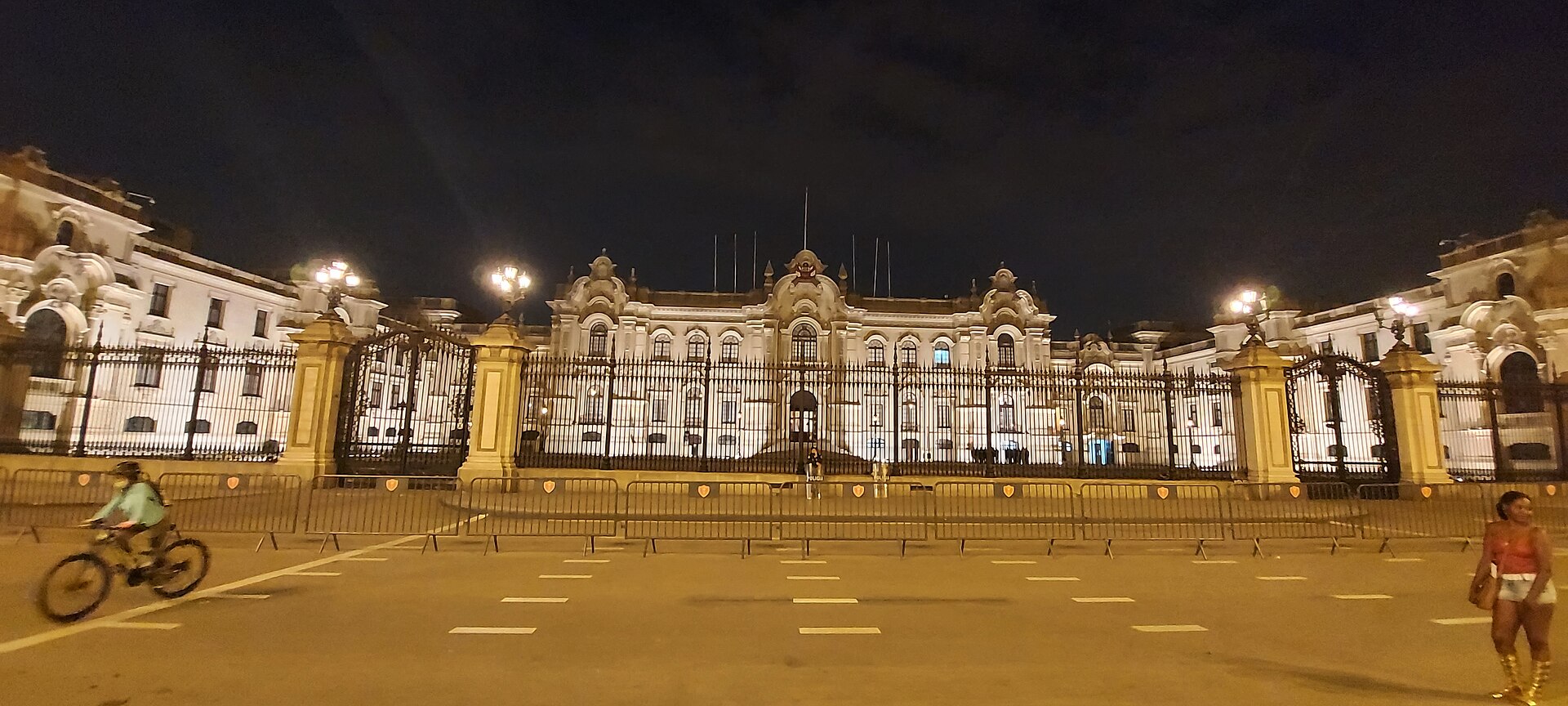
Fujimori’s inauguration on 28 July 2026 was therefore the eighth change of office holder in ten years. Her own term runs to 2031.
How each president fell
Kuczynski and Vizcarra (2016–2020)
Pedro Pablo Kuczynski, a former banker, won in 2016 by a narrow margin over Keiko Fujimori. Her party then controlled Congress, and relations were hostile from the start.
On 21 December 2017 he survived a first removal vote over payments linked to the Brazilian builder Odebrecht, which he denied were improper. The motion drew 78 votes, short of the 87 required.
He announced his resignation on 21 March 2018, days before a second vote, after videos appeared to show allies offering favours to legislators. Congress accepted it and his vice president, Martín Vizcarra, was sworn in on 23 March.
Vizcarra dissolved Congress on 30 September 2019, arguing it had in effect refused his government a vote of confidence. A new Congress was elected on 26 January 2020.
That Congress removed him on 9 November 2020 by 105 votes to 19, with 4 abstentions. It cited allegations that he took bribes as a regional governor, which he denied.
A court later convicted him of bribery in that case and sentenced him to 14 years in prison. Vizcarra rejects the verdict, and his appeal is pending.
Merino, Sagasti and Castillo (2020–2022)
The head of Congress, Manuel Merino, took over on 10 November 2020. Street protests followed, two young protesters were killed in Lima, and he resigned on 15 November.
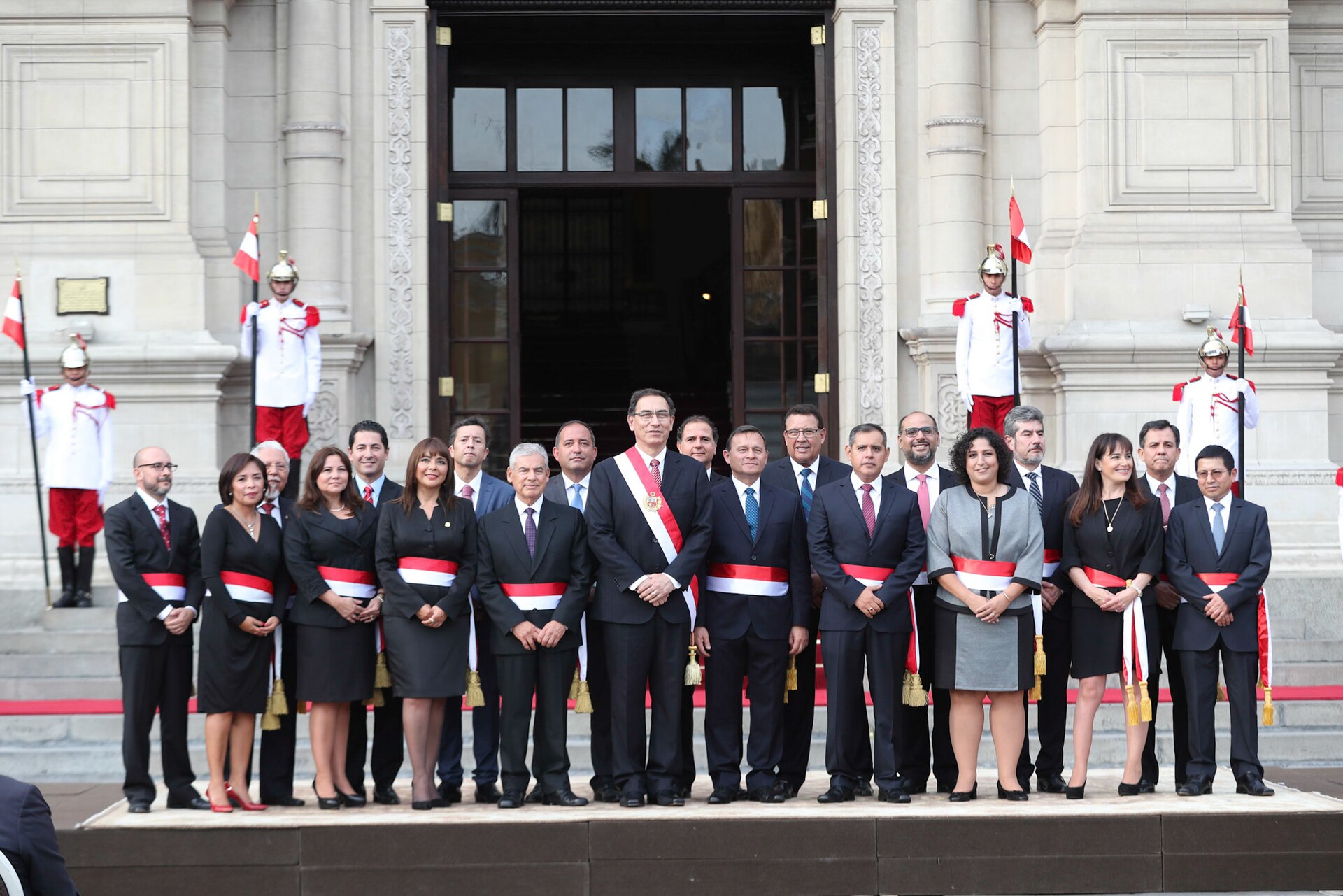
Congress then chose Francisco Sagasti, a centrist legislator, who took office on 17 November. He governed through the pandemic and handed over on 28 July 2021.
Pedro Castillo, a rural schoolteacher and union leader, won the 2021 runoff against Fujimori. He survived earlier removal attempts but faced constant clashes with Congress.
On 7 December 2022 he announced he would dissolve Congress and rule by decree. Institutions called it an attempted coup. Congress removed him the same day by 101 votes to 6, with 10 abstentions, and he was detained. He was later sentenced to 11 years for conspiracy to commit rebellion and is challenging the verdict.
Boluarte, Jerí and Balcázar (2022–2026)
Vice President Dina Boluarte succeeded Castillo on 7 December 2022. Deadly protests in the south marked her first months, and her approval ratings stayed very low.
Congress removed her for “permanent moral incapacity” in an overnight session on 9 and 10 October 2025. The vote was 122 in favour, none against, with rising crime cited as the main failing.
José Jerí, the head of Congress from Somos Perú, took over on 10 October 2025. He was censured on 17 February 2026 by 75 votes to 24, with 3 abstentions.
The censure followed the so-called Chifagate scandal over undisclosed meetings with Chinese businessmen. Legislators alleged misconduct and influence-peddling, which Jerí denied. He was removed as head of Congress, which ended his presidency.
On 18 February 2026 Congress elected José María Balcázar, an 83-year-old lawyer and former judge elected on the leftist Perú Libre ticket in 2021. He won with 64 votes and ran the country until the 28 July handover.
Why Peru keeps removing presidents
The central tool is Article 113 of the constitution. It lets Congress declare the presidency vacant for “permanent moral incapacity”. The phrase is not defined anywhere in the text.
In practice it has become a political judgement rather than a medical or criminal one. Legislators have used it over corruption allegations, crime, and a failed attempt to close Congress.
The threshold is two-thirds of the legal number of legislators. Under the old 130-seat single chamber that meant 87 votes, the figure every removal vote since 2017 has been measured against.
Weak parties make the tool easy to reach. Peruvian parties tend to be personal vehicles that rarely survive their founders, so presidents seldom command stable blocs in Congress.
The president has a counter-weapon: dissolving Congress after it censures or refuses confidence to two cabinets. Since 2026 only the Chamber of Deputies can be dissolved. Vizcarra used this in 2019; Castillo tried to act without it in 2022 and fell within hours.
The 2026 reset: two chambers again
Peru returned to a two-chamber Congress in July 2026, for the first time since the 1990s. The change came through constitutional reform Law 31988, promulgated on 20 March 2024.
The new Congress has at least 60 senators and 130 deputies, both elected for five years. The reform also restored immediate re-election for legislators, which a 2018 referendum had banned.
The Chamber of Deputies accuses senior officials, including the president, before the Senate. The president cannot dissolve the Senate, only the Chamber of Deputies, and only after two cabinets are censured or refused confidence.
Rules published on 14 November 2025 set out how a vacancy now works. A motion needs signatures from 30 percent of deputies and admission by 40 percent of those eligible to vote.
Removal then requires two-thirds of the legal number of deputies, followed by two-thirds of the legal number of senators. In the Senate that means at least 40 of 60 votes.
The second chamber raises the bar. A determined minority of 21 senators can now block a removal that deputies have approved.
The 2026 elections and the new balance of power
The first round on 12 April 2026 drew more than 30 presidential candidates. Keiko Fujimori of Fuerza Popular led with 17.19 percent, ahead of the leftist Roberto Sánchez on 12.04 percent.
The runoff on 7 June was extremely close. Fujimori won 9,223,396 votes to 9,173,755, a margin of 49,641, or 50.1 percent to 49.9 percent.
The national election jury, the JNE, proclaimed her president-elect on 3 July after Sánchez contested the count. She took office on 28 July 2026 as the first woman elected president of Peru.
Her party won 22 of the 60 Senate seats and 41 of the 130 deputy seats. Its ally Renovación Popular took 8 senators, so the two together hold half the Senate.
That arithmetic matters more than any single policy. With 30 friendly senators, Fujimori holds far more than the 21 needed to block a removal, provided the alliance holds.
Why the economy has held up
Peru’s most striking trait is that political turmoil has not produced economic collapse. The finance ministry counts 28 consecutive months of economic expansion through July 2026.
The statistics office, INEI, reported output growth of 3.56 percent in July 2026 and 3.13 percent for January to July. Construction and commerce led the July figure.
The central bank, the BCRP, is constitutionally autonomous and has kept its technical leadership through every change of president. It has held its reference rate at 4.25 percent through 2026.
Mining gives the state a steady flow of dollars. Peru is one of the world’s largest copper producers, and big mines operate under long-term contracts that outlast any single government.
The cost shows up elsewhere. Frequent turnover of ministers slows public investment, delays reforms and leaves regions without stable security policy, a gap most Peruvians feel through rising crime.
Winners, losers and the risks ahead
Congress is the clear institutional winner of the past decade. It has shown it can remove presidents at will, and ministers know a censure motion is always one scandal away.
Voters are the main losers. Many Peruvians report deep distrust of both branches, and very low approval ratings have followed presidents and Congress alike.
The main risk for Fujimori is not immediate removal but gridlock. As of 28 September 2026, a draft opinion of the Deputies’ Constitution Committee recommended rejecting her request for 120 days of decree powers covering 66 measures.
Opposition deputies have also filed a motion to censure Interior Minister César Astudillo Salcedo over rising killings. Censure needs 66 of 130 votes, and the sponsors held 64 seats between them when it was filed.
The next test is the 4 October 2026 regional and municipal vote. More than 26.3 million voters will elect governors, mayors and councillors, the first verdict on a government two months old.
What this means for foreigners
For visitors, the day-to-day effect of a change of president is usually small. Airports, banks, visas and tourist sites have kept working through every transition since 2016.
Protests are the practical risk. Transitions in 2020 and 2022 brought large demonstrations, road blockades in the south and deaths. Travellers should follow local news around any removal vote.
For investors, the lesson of the decade is to separate the technical state from the political one. The central bank and big mining contracts have been stable; ministries, permits and public works have not.
Connected Coverage
Peru Explained: The Country, Its Politics, Its Economy and What to Watch
Peru Election 2026: Keiko Fujimori Wins Runoff and Takes Office
Peru Legislative Powers: Committee Draft Urges Rejecting Fujimori’s 120-Day Request
Peru’s Opposition Moves to Oust the Minister in Charge of Its Police
Peru’s Economy: Mining, the Sol, Political Noise and the State of Play
What Is Not Known
How the two-chamber vacancy procedure will work under pressure. It has never been used, and the first real case will test the new rules and their interpretation.
Whether Fujimori’s alliance with Renovación Popular will hold in the Senate. Its value as a shield depends on party discipline, which has been weak in Peru for decades.
Whether Congress will ever define “permanent moral incapacity” in law. Proposals to narrow it have circulated for years without being adopted.
Sources: Presidential dates and removal votes from the Congress of the Republic and Peruvian media records. Constitutional rules from Law 31988 and the bicameral regulations; election results from ONPE and the JNE; output data from INEI; the policy rate from the BCRP. All accessed 28 September 2026.
- Congress of the Republic — vacancy of Martín Vizcarra, 9 November 2020.
- El Búho — Congress removes Pedro Castillo, 7 December 2022.
- El Búho — Boluarte removed, José Jerí sworn in, October 2025.
- CIDOB — profile of José María Balcázar, Jerí censure vote.
- El Comercio — Law 31988 and the return to two chambers.
- Law 31988 — text of the constitutional reform.
- Expreso — bicameral rules on presidential vacancy.
- Andina — INEI output data for July 2026.
- El Peruano — finance ministry on 28 months of expansion.
- Revista Economía — BCRP holds its rate at 4.25 percent.
- 2026 Peruvian general election — ONPE results and seat totals.
Frequently Asked Questions
How many presidents has Peru had since 2016?
Nine. Pedro Pablo Kuczynski, Martín Vizcarra, Manuel Merino, Francisco Sagasti, Pedro Castillo, Dina Boluarte, José Jerí, José María Balcázar and Keiko Fujimori, who took office on 28 July 2026.
Who is the president of Peru in 2026?
Keiko Fujimori of Fuerza Popular. She won the runoff of 7 June 2026 by 49,641 votes and took office on 28 July 2026 for a term that runs to 2031.
What does permanent moral incapacity mean in Peru?
It is the constitutional ground Congress uses to declare the presidency vacant. The constitution never defines it, so in practice it has become a political judgement used over corruption allegations, crime and a failed attempt to close Congress.
How does Congress remove a president under the new two-chamber system?
A motion starts in the Chamber of Deputies and needs two-thirds of the legal number of deputies to pass. The Senate must then approve it with two-thirds of its legal number, at least 40 of 60 senators.
Why has Peru’s economy kept growing despite the turmoil?
An autonomous central bank, long-term mining contracts and a technical civil service have carried on through every change of president. INEI reported growth of 3.13 percent from January to July 2026.
Is it safe to travel to Peru during political crises?
Airports, banks and tourist sites have kept working through every transition since 2016. The practical risk is protests and road blockades, so travellers should follow local news around any removal vote.
This article was produced by The Rio Times’ automated newsroom system. How we use AI · Report an error
Read More from The Rio Times