Zambia Election Result Hands Hichilema a Second Term Outright

ZAMBIA · POLITICS
Key Facts
—Declared: Electoral Commission of Zambia chairperson Mwangala Zaloumis announced the result in the early hours of Tuesday 18 August. Polling took place on Thursday 13 August.
—The count: Hichilema took 2,965,326 votes against Brian Mundubile’s 1,856,217, 60.49 percent of valid votes to 37.87 percent. Fourteen candidates were nominated, though the commission ruled one of them ineligible on the eve of the poll.
—Turnout: About 57 percent of 8,786,300 registered voters, on the commission’s final figures, down from 70.61 percent in 2021.
—A disrupted week: Eleven people, several of them senior opposition figures, were arrested on election night in a raid involving an exchange of gunfire. Counting was suspended on Friday 14 August over reported violence and stolen ballot papers, then resumed.
—The challenge: Mundubile, of the National Reconciliation Party for Unity and Prosperity, says results forms may have been interfered with and wants an independent investigation. Zambia’s constitution allows seven days from the declaration to petition the Constitutional Court.
—The market: Kwacha-denominated government bonds had returned about 36 percent in US dollar terms as of late July, on Bloomberg’s figures. The kwacha itself is up about 20 percent against the dollar this year, on Bloomberg’s figures as of late July.
—Copper: Output reached about 890,000 tonnes in 2025, short of the government’s own one-million-tonne target. The official strategy aims at three million tonnes by 2031.
—The gap: Zambia’s US$1.7 billion extended credit facility closed with its sixth and final review on 27 January 2026. Lusaka wants a successor programme, and none has been agreed.
The Zambia election result is settled: the electoral commission declared President Hakainde Hichilema the winner in the early hours of Tuesday, with about 60 percent of the vote and no runoff required. What is not settled is the opposition’s response, or the copper arithmetic on which the next five years depend.
What the Zambia election result actually says
Hichilema needed more than half the vote to avoid a second round, and he got it. The commission put him on 2,965,326 votes, or about 60 percent, against 1,856,217 for Brian Mundubile.
That is a wider margin than 2021, when he first unseated the late Edgar Lungu. It also arrives with a caveat worth stating plainly.
The commission declared the result after completing the count across all 226 constituencies, and described the figures as final.
Turnout was about 57 percent of 8,786,300 registered voters. Fourteen candidates were nominated, one was ruled ineligible on the eve of the poll, and no one else came close. Turnout fell sharply: 57.23 percent against 70.61 percent in 2021.
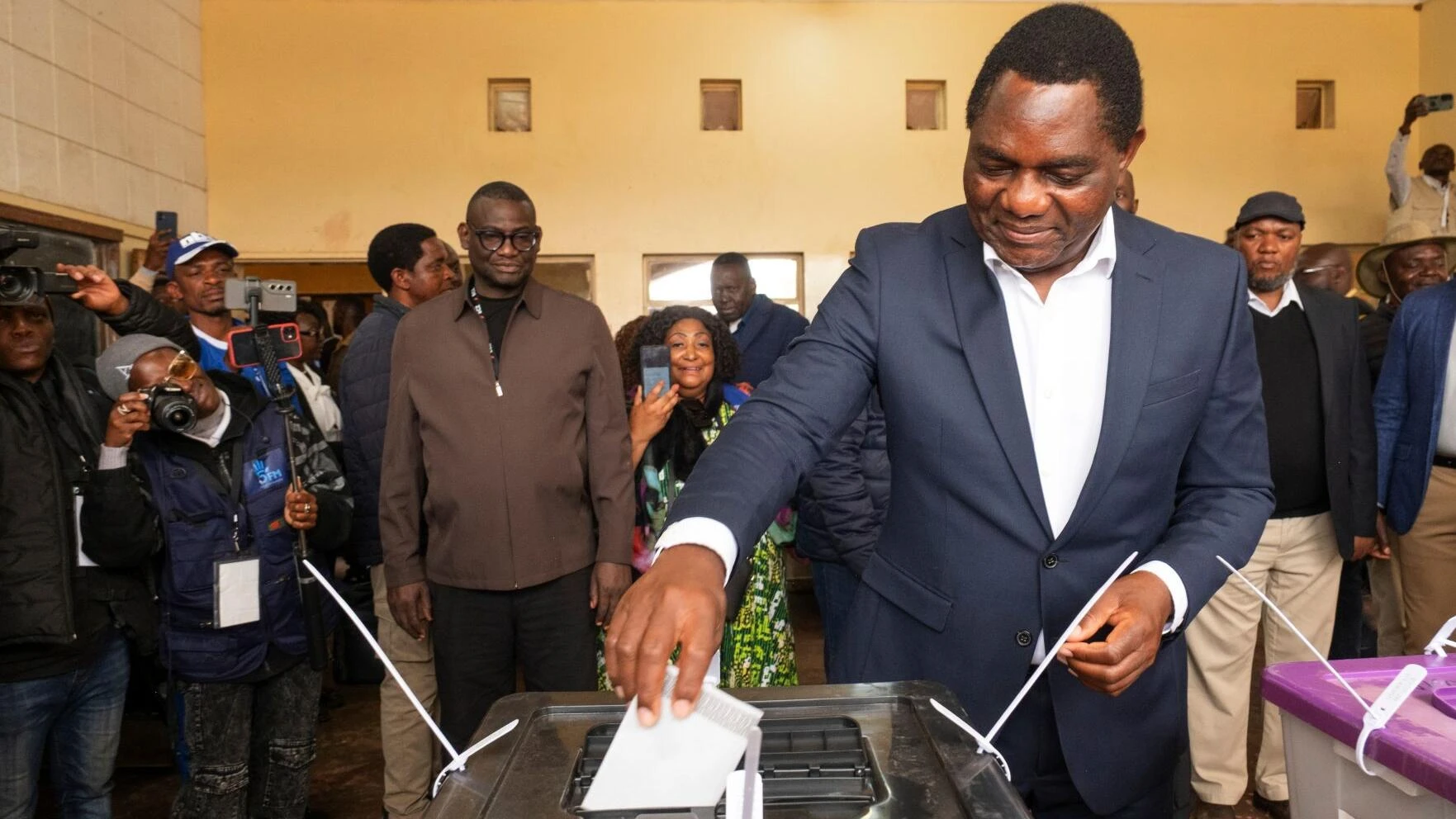
A count that was interrupted, and an opposition that has not conceded
The week was not calm. On election night, eleven people including several senior opposition figures were arrested in a raid that involved an exchange of gunfire, an incident widely reported at the time. The government said the raid targeted militia activity and that those held were found with military-grade weapons; the opposition rejects that account.
The next day the commission suspended counting altogether, citing reported violence and stolen ballot papers, before resuming.
Mundubile has since said publicly that results forms may have been interfered with, and has asked for an independent investigation. His Tonse-Pamodzi Alliance said on 18 August that it is going to the Constitutional Court, though no petition had been filed at the time of writing.
Zambia’s constitution gives a losing candidate seven days from the declaration to bring a challenge, and requires the Constitutional Court to hear the petition within fourteen days of filing. That clock started this week.
For anyone watching from outside, the useful thing is not the rhetoric but the calendar. A petition filed inside the window would put a judicial deadline on the political story; silence would close it.
Why the bond market has been watching Lusaka
Zambia has been one of the more rewarding places to have been invested this year, and the reason is often reported imprecisely. It is the local-currency market that has produced the returns.
Kwacha-denominated government bonds had earned roughly 36 percent in US dollar terms as of late July, on Bloomberg’s numbers, a figure that combines a strong coupon with a strengthening currency.
The kwacha is up about 20 percent against the dollar this year, on Bloomberg’s figures as of late July. It briefly topped global currency rankings early in 2026 before slipping behind the Russian rouble by mid-year.
Zambia’s restructured hard-currency debt is a separate story with its own path. The country completed the mandatory exchange of its US$3 billion of outstanding Eurobonds on 12 June 2024, with bondholders forgoing about US$840 million.
None of that is a reward for the election itself. It is a reward for the direction of travel since the default, and the election result mainly removes a reason to sell.
Copper is the promise, and the shortfall is the problem
Everything in Zambia’s investment case eventually returns to copper. The government’s stated strategy is three million tonnes of annual production by 2031, a target set out by the ministry of mines and mineral development.
Actual output in 2025 was about 890,000 tonnes. That was growth of roughly 8 percent, and it was also a clear miss against the interim target of one million tonnes.
The gap matters because the 2031 number is the basis on which Zambia is being lent money, courted by mining investors and discussed as a future supplier to the energy transition. Missing the first waypoint by more than 10 percent is a data point, not a crisis, but it is a data point.
What closes the gap is new tonnage from projects rather than incremental gains at existing mines. That, in turn, depends on power, on rail capacity to the Atlantic, and on a tax regime investors believe will still be there in a decade.
The missing programme, and what to watch next
Zambia does not currently have an International Monetary Fund programme. The 38-month extended credit facility, approved in August 2022 and eventually worth about US$1.7 billion, completed its sixth and final review on 27 January 2026 and then expired.
The finance ministry has said it wants a successor arrangement. Nothing has been approved, and a new programme would be negotiated by a government that has just been handed a fresh mandate and, with it, fresh spending expectations.
That is the tension worth holding onto. A decisive win removes political risk and adds fiscal risk at the same moment.
The three things to watch over the next fortnight are simple. Whether Mundubile files inside the seven-day window, whether the commission publishes a fully certified final count, and whether Lusaka opens formal talks with the Fund.
Background: Chile Inflation Holds Flat in June but Annual Rate Climbs.
Frequently Asked Questions
Who won Zambia’s 2026 presidential election?
The Electoral Commission of Zambia declared Hakainde Hichilema the winner with 2,965,326 votes, about 60 percent of the total. Brian Mundubile finished second on 1,856,217.
Was a runoff needed in Zambia?
No. Hichilema cleared the more-than-half-of-valid-votes threshold the constitution requires, so no second round is held.
Has the opposition accepted the result?
Brian Mundubile has publicly alleged that results forms may have been interfered with and has called for an independent investigation. He had not filed a court petition at the time the result was declared.
What has happened to Zambia’s IMF programme?
The US$1.7 billion extended credit facility ended after its sixth and final review on 27 January 2026. Zambia has said it wants a successor arrangement, but none has been agreed.
Connected Coverage
Zambia went into this vote with its debt restructuring largely behind it, a story we set out in our look at the US$13 billion recovery the election was testing. The copper ambition behind the mandate depends on getting metal to the coast, which is the subject of Zambia’s bet on a western railway. Both sit inside our continuing pillar, Africa: The New Scramble.
This article was produced by The Rio Times’ automated newsroom system. How we use AI · Report an error · Editorial responsibility: Matthias Camenzind, Editor-in-Chief
In depth