What Is América Móvil? Carlos Slim’s Telecom Giant, Its 414 Million Lines and the Risks

COMPANIES · MEXICO
Key Facts
- —The country Mexico, Latin America’s second-largest economy and the United States’ biggest trading partner. América Móvil is its largest private telecoms group and is listed in Mexico City and New York.
- —What it is The parent of Telcel and Telmex in Mexico, Claro across Latin America and A1 in Austria and Eastern Europe. It operates in 23 countries.
- —Size Revenue of 241 billion pesos (about US$13.4 billion) and net income of 24.3 billion pesos (about US$1.35 billion) in the second quarter of 2026. It had 414.5 million access lines at the end of June.
- —Ownership Controlled by the family of Carlos Slim Helú. Daniel Hajj Aboumrad has been chief executive since 2000; Carlos Slim Domit chairs the board.
- —Why it matters For millions of people from Tijuana to Buenos Aires, the phone or broadband bill goes to a Slim company. It leads its region in mobile, fixed-line, broadband and pay TV customers.
- —The catch Mexico’s regulators treat it as a “preponderant” operator with special rules. A new telecoms law in 2025 replaced its regulators with agencies tied closer to the federal government.
América Móvil explained: who owns Carlos Slim’s telecoms empire, how it earns its money, what the latest quarter shows and where the regulatory risk sits.
If you have used a mobile phone in Mexico, Brazil, Colombia or much of Central America, you have probably paid América Móvil. It grew from one Mexican landline monopoly into a network of 414 million customer lines. It still shapes prices, coverage and competition across the region.
What the company does
América Móvil sells connectivity. It runs mobile networks, fixed telephone lines, home broadband and pay TV, plus data and cloud services for companies and governments. Its customers range from a prepaid user in rural Guatemala to a multinational bank in São Paulo.
The brands differ by country. In Mexico the mobile arm is Telcel and the fixed-line arm is Telmex, the former state monopoly privatised in 1990. Almost everywhere else in Latin America the brand is Claro. In Austria and six Central and Eastern European countries it operates as A1, through a 61 percent stake in Telekom Austria.
The company was created in 2000, when Telmex spun off its wireless operations in Mexico and abroad. It then bought its way across the continent. Today it reports operations in 16 countries in the Americas and seven in Central and Eastern Europe. It also holds 57 percent of EuroTeleSites, a mast company spun out of Telekom Austria in 2023.

At the end of June 2026 América Móvil had 334.3 million mobile subscribers, 149.8 million of them on monthly contracts. On the fixed side it counted 37.8 million broadband connections, 13.9 million pay TV units and 28.4 million landlines. That adds up to 414.5 million access lines.
Mexico and Brazil are the two pillars. Telcel had 84.5 million mobile subscribers in June; Claro in Brazil had 92.3 million, of which 61.2 million were contract customers. Colombia followed with 40.9 million mobile lines and Argentina with 26.4 million. The company says Mexico and Brazil together hold more than half of its customer connections.
How it makes money
Most revenue comes from recurring service fees rather than handset sales. In the second quarter of 2026, service revenue was 205.9 billion pesos, about US$11.4 billion, out of a total of 241.1 billion. Equipment sales brought in 33.4 billion pesos, about US$1.9 billion. Peso figures here are converted at the late-September 2026 rate of about 18.02 pesos to the US dollar.
The growth engine is the contract customer. Postpaid mobile revenue rose 7.2 percent in the quarter at constant exchange rates, against 5.3 percent for prepaid. The company added 3.5 million postpaid subscribers in three months, 1.5 million of them in Brazil. At the same time it lost a net 3.7 million prepaid lines, as Colombia and Argentina cleaned up their customer lists.
Fixed broadband is the second engine. América Móvil connected 531,000 new broadband homes and businesses in the quarter, 170,000 of them in Mexico. Broadband revenue grew 5.4 percent. Old copper landlines keep shrinking, which is why Telmex’s service revenue was roughly flat even as its broadband business grew.
The model is capital-hungry. Towers, fibre and spectrum must be paid for before customers arrive. In the first half of 2026 the group spent 48.1 billion pesos, about US$2.7 billion, on capital investment. The pay-off is a thick margin: earnings before interest, tax, depreciation and amortisation (EBITDA) were 39.8 percent of revenue in the quarter.
Live Company IntelligenceAmerica Movil SAB de CV ADR — the full investor dossier
Wall Street view
Valuation & profitability
Price & risk
$19.4752-wk high
$28.12
Revenue trend · 6y
Ownership
Dividend
The numbers: second quarter of 2026
The latest reported period is the second quarter of 2026, published on 21 July. Revenue rose 3.1 percent from a year earlier to 241.1 billion pesos, about US$13.4 billion. At constant exchange rates, which strip out currency swings, service revenue grew 5.1 percent. The stronger peso shrank the value of foreign earnings when translated back.
EBITDA rose 3.8 percent to 95.9 billion pesos, about US$5.3 billion. Without a one-off charge linked to a regulatory fine on Telmex, it would have risen 6.7 percent at constant rates. Operating profit climbed 9.5 percent to 51.8 billion pesos, about US$2.9 billion.
Net income was 24.3 billion pesos, about US$1.35 billion, up 9.2 percent. For the first half of the year net income reached 47.7 billion pesos, about US$2.6 billion, 16.5 percent more than a year earlier. Net debt, excluding leases, stood at 402 billion pesos, about US$22.3 billion. That equals 1.31 times a year’s earnings on the company’s own leverage measure.
In Mexico, revenue grew 3.2 percent to 86.9 billion pesos, about US$4.8 billion. Mobile service revenue rose 6.6 percent. In Brazil, revenue grew 5.4 percent to R$13.5 billion, about US$2.6 billion, with an EBITDA margin of 44 percent. Colombia was the standout: revenue up 5.8 percent and EBITDA up 12.5 percent. Postpaid revenue there rose 10.2 percent, which the company credits to its 5G network.
For context, full-year 2025 revenue was 943.6 billion pesos, about US$52 billion. Net profit attributable to shareholders was 82.8 billion pesos, about US$4.6 billion. The group employed 177,711 people at the end of 2025, 84,767 of them in Mexico.
Ownership and governance
Carlos Slim Helú bought control of Telmex when Mexico privatised it in 1990, and América Móvil grew out of it. According to the 2025 annual report, the Slim family may be deemed to control the company and can elect a majority of the board.
The stakes break down as follows, as of 31 March 2026. A family trust held 29.5 percent of the shares. Control Empresarial de Capitales, a holding company the family may be deemed to control, held 18.1 percent. Family members held another 22.9 percent directly, including 8.6 percent owned by Carlos Slim Helú himself. Together that is roughly 70 percent.
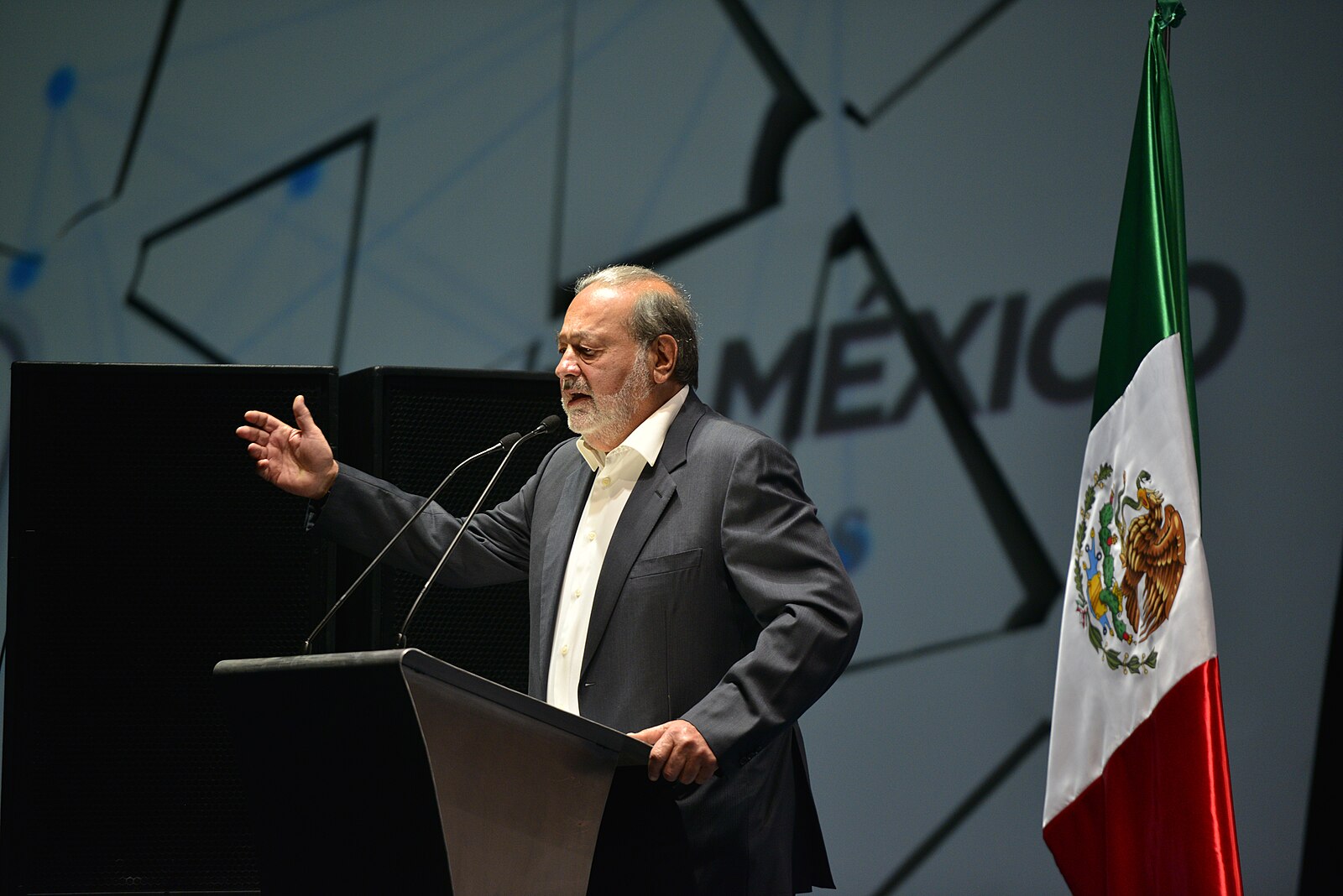
Management is a family affair. Daniel Hajj Aboumrad, born in 1966, has been chief executive since 2000; he is Carlos Slim Helú’s son-in-law. The chairman is Carlos Slim Domit, born in 1967, and his brother Patrick Slim Domit is co-chairman. The chief financial officer, Carlos José García Moreno Elizondo, has held the post since 2001.
The shares trade in Mexico City under the ticker AMX B. In New York they trade under AMX as American depositary shares, each worth 20 B shares. The company buys back its own shares regularly: 4.6 billion pesos, about US$255 million, in the first half of 2026. The annual report warns that the family’s interests may diverge from those of other investors. The group also does business with other Slim companies.
Why it matters for the region
Scale is the first reason. América Móvil says it ranks first in Latin America in mobile, fixed-line, broadband and pay TV by number of connections. In Mexico and Brazil it holds the largest market share by the same measure. Its pricing and investment choices therefore set the benchmark for rivals.
Infrastructure is the second. At the end of 2025 its 5G networks covered close to 60 percent of the population in Mexico and Brazil. In Colombia Claro had taken 5G to 78 cities and towns by mid-2026. Where it builds fibre and towers, the digital economy follows, from mobile banking to online shopping.

It keeps expanding. On 21 July 2026 it agreed to buy WOW Peru from Liberty Latin America and Narvik Capital Partners. WOW runs a fibre network in regions outside Lima. The deal needs approval from Peru’s competition authority. In July 2025 it bought out the remaining shares of Claro Chile, taking full ownership.
For foreign investors, América Móvil is one of the most liquid ways to own Latin American consumer demand. For foreign residents, it is often the default phone and internet provider. Anyone moving to Mexico will very likely deal with Telcel or Telmex in the first week.
Risks
Regulation in Mexico is the biggest risk, and the company says so. Since 2014 regulators have classed the group as the “preponderant economic agent”, because it serves more than half of Mexican customers. That triggers asymmetric rules on wholesale access, infrastructure sharing and retail prices that apply to it alone.
The rulebook changed in 2025. A constitutional reform dissolved the independent Federal Telecommunications Institute in October 2025 and the competition authority with it. Their powers passed to the Telecommunications Regulatory Commission, part of the government’s digital transformation agency, and to a new National Antitrust Commission. The annual report says these bodies are expected to be more aligned with the government and able to impose larger sanctions.
Currency is the second risk. América Móvil reports in pesos but earns in reais, euros, Colombian pesos and more. When the peso strengthens, as it did against the dollar and euro over the past year, foreign earnings shrink on translation. Argentina adds hyperinflation accounting to the mix.
Competition and politics are the third. Brazil saw heavy promotional activity in the second quarter, according to the company. Telecoms prices are politically sensitive everywhere the group operates. Spectrum costs can also bite: Mexico’s 2026 spectrum programme is still being designed.
What to watch
Third-quarter results are the next checkpoint. Last year they came out on 14 October, and a mid-October release is the usual pattern. Watch postpaid net additions in Brazil, broadband growth at Telmex and whether Mexican EBITDA recovers once the one-off fine drops out.
Mobile line registration in Mexico is the second. The regulator extended the deadline for registering mobile lines. Cut-off dates run from 15 August to 31 December 2026, by the number’s last digit. Prepaid customers who miss their date will have service suspended until they register. How many lines Telcel loses, and how many come back, will show in the fourth-quarter figures.
Then there is regulation. The antitrust commission can impose or modify asymmetric rules on the preponderant operator, and the rules may be reviewed every two years. The design of Mexico’s 2026 spectrum auctions, and the WOW Peru approval, are further items to follow. MarketScreener lists the next ex-dividend date as 10 November 2026, at 0.27 pesos a share, about US$0.015.
Connected Coverage
Mexico Explained: The Country, Its Politics, Its Economy and What to Watch
Who Is Claudia Sheinbaum? Mexico’s President Explained: Her Path, Her Policies and What to Watch
Carlos Slim Reignites Mexico’s Labor Debate With 12-Hour Shift Plan
What Is Pemex? Mexico’s State Oil Giant, Its US$77.5 Billion Debt and Why It Matters
What Is Mercado Libre? Latin America’s Online Shopping and Fintech Giant in 2026
Sources: Company figures from América Móvil’s quarterly reports and its 2025 annual report to the US Securities and Exchange Commission; regulatory structure from the same annual report. All accessed 22 September 2026.
- América Móvil — second quarter 2026 financial and operating report, 21 July 2026
- América Móvil — annual report on Form 20-F for 2025, filed with the US SEC
- América Móvil — third quarter 2025 report, 14 October 2025
- Xataka México — the CRT’s 2026 spectrum tender programme, 29 May 2026
- MarketScreener — América Móvil corporate calendar
- ExchangeRate-API — US dollar reference rates, late September 2026
What Is Not Known
The size of the Telmex fine. The second-quarter report says a one-off charge tied to a regulatory fine held Mexican EBITDA growth to 0.6 percent instead of 4.3 percent. The report does not give the amount of the fine or say which authority imposed it.
How the new regulators will behave. The Telecommunications Regulatory Commission and the National Antitrust Commission have held their powers only since late 2025. Whether they tighten, loosen or simply keep the asymmetric rules on the preponderant operator has not been tested in a full review.
How many Mexican lines the registration drive will cost. Deadlines run to 31 December 2026, and suspended prepaid lines can be restored once registered. Neither the company nor the regulator has published an estimate of net losses.
How control will pass between generations. The family holds roughly 70 percent of the shares, and the next generation already chairs the board. The company’s filings do not set out how the family’s holdings will be passed on.
More: Mexico news in English, every day from The Rio Times.
Frequently Asked Questions
Who owns América Móvil?
The family of Carlos Slim Helú controls it. As of 31 March 2026 a family trust held 29.5 percent of the shares, Control Empresarial de Capitales held 18.1 percent and family members held 22.9 percent directly, including 8.6 percent owned by Carlos Slim Helú. Together that is roughly 70 percent.
Who is the CEO of América Móvil?
Daniel Hajj Aboumrad, chief executive since 2000 and Carlos Slim Helú’s son-in-law. Carlos Slim Domit chairs the board and Patrick Slim Domit is co-chairman.
Are Telcel, Telmex and Claro the same company?
Yes. Telcel (mobile) and Telmex (fixed line) are América Móvil’s Mexican subsidiaries, and Claro is its brand in most other Latin American countries. In Austria and Eastern Europe it operates as A1 through a 61 percent stake in Telekom Austria.
How big is América Móvil?
At the end of June 2026 it had 414.5 million access lines, including 334.3 million mobile subscribers. Second-quarter 2026 revenue was 241.1 billion pesos, about US$13.4 billion, and net income was 24.3 billion pesos, about US$1.35 billion.
Why is América Móvil regulated differently in Mexico?
Since 2014 Mexican regulators have classed it as the preponderant economic agent in telecoms because it serves more than half of Mexican customers. That brings special rules on wholesale access, infrastructure sharing and retail prices that apply only to it.
When does América Móvil report next?
Third-quarter 2026 results are expected in mid-October, following the pattern of last year, when third-quarter figures came out on 14 October 2025.
This article was produced by The Rio Times’ automated newsroom system. How we use AI · Report an error · Editorial responsibility: Matthias Camenzind, Editor-in-Chief
In depth
LatAm Markets: Live Signals → — real-time movers, turnover leaders and FX across Latin America.