US Fuel Exports to Cuba Hit a Record 3.2 Million Barrels in July 2026
ECONOMY · CUBA
Key Facts
- —The country Cuba, a Caribbean one-party state, has suffered repeated nationwide blackouts in 2026 amid a shortage of imported fuel.
- —What happened The United States exported a record 3.222 million barrels of petroleum products to Cuba in July 2026, the most in EIA monthly data going back to 2017 (released 30 September).
- —The numbers July was 4.1 times June’s 778,000 barrels; diesel made up 2.654 million barrels (EIA). US goods exports to Cuba reached US$148.9 million in July (Census Bureau).
- —What it means for you More buses and state vehicles are visible in Havana, 14ymedio reported on 30 September. US rules allow fuel sales only to Cuba’s private sector.
- —Still open Who bought and stored the fuel, after state oil firm Cupet was sanctioned in June, and whether August shipments hold up.
US fuel exports to Cuba reached a record 3.22 million barrels in July 2026, the most since the US series began in 2017. That is more than four times June’s volume and almost double the first half of 2026 combined.
The Energy Information Administration (EIA), the statistics arm of the US Department of Energy, published the monthly figures on 30 September. Separate Census Bureau data show total US goods exports to Cuba reached US$148.9 million in July.

Diesel Makes Up Most of the July Shipments
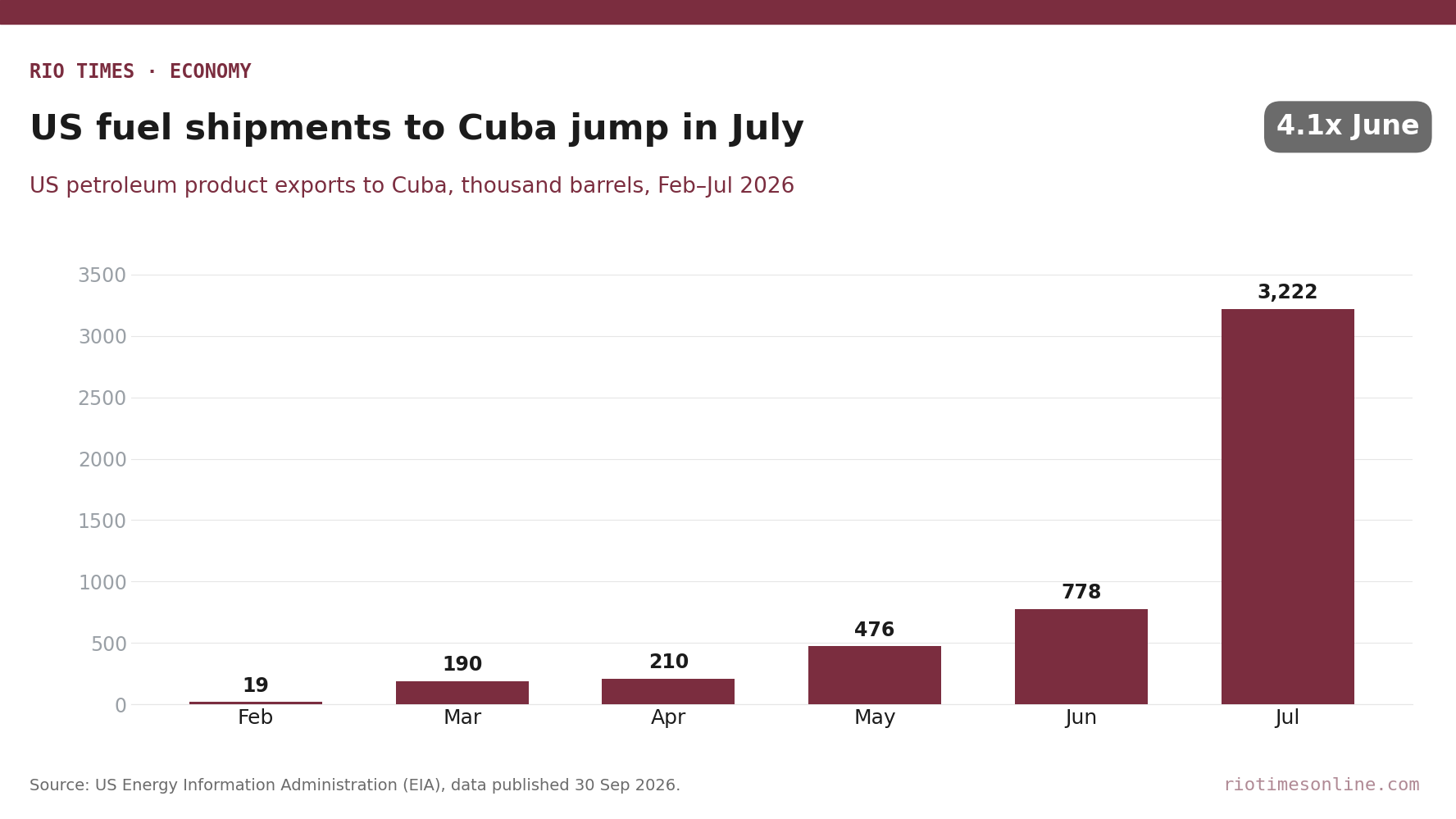
Of the July total, 2.654 million barrels were diesel and 554,000 were gasoline, 14ymedio reported from the EIA tables. The EIA diesel series confirms the 2.654 million figure, up from 648,000 barrels in June.
Diesel powers trucks, buses, farm machinery and the generators many Cubans rely on during blackouts. It made up about 82 percent of the July volume.
US fuel exports built up through the year. EIA figures show 19,000 barrels in February, 476,000 in May and 778,000 in June.
Larger Than Venezuela’s Shipments in the Chávez Years
14ymedio, an independent news site based in Havana, compared July with Cuba’s past suppliers. It found no month in the last decade when Venezuela, Russia or Mexico alone sent more than 3.22 million barrels.
Even in 2016, Venezuela’s roughly 90,000 barrels a day came to about 2.7 million a month, the site said. Much of that was crude oil that Cuba had to refine itself, while the US cargoes are finished fuels.
That historical comparison is 14ymedio’s and has not been independently confirmed. It does put earlier deliveries in context, such as the Russian tanker that brought Cuba its first oil in three months in March with about 730,000 barrels of crude.
A Trade That Runs Almost One Way
Census Bureau tables show US goods exports to Cuba of US$674 million from January to July 2026. US imports from Cuba over the same months were just US$0.5 million.
The seven-month export total is 61.8 percent above the US$416.5 million of January to July 2025. 14ymedio said July was the highest monthly figure since the Census Bureau began recording this trade in 1992.
In July alone, Cuban purchases of US fuels and related products came to US$61.1 million, 14ymedio reported. The site also said the United States is now Cuba’s largest supplier, ahead of Spain and China.
Sanctions, Storage and a Political Dispute
These cargoes are meant for private buyers, as Washington allows fuel sales solely to the island’s private sector. The state oil company Cupet was added to the US sanctions list in June, 14ymedio noted.
Energy expert Jorge Piñón asked who besides the state firms Cupet or Cimex could store 3.2 million barrels in one month. A US company, Vanguard Energy, had planned to use Cupet tanks, but suspended that project after the sanctions.
The Cuban government tells a different story. On 23 September President Miguel Díaz-Canel said on his radio programme that no fuel ship had arrived in nine months.
Foreign Trade Minister Óscar Pérez-Oliva Fraga has criticised the US policy of selling fuel to private firms, saying it builds dependence. Meanwhile shortages persist, as the recent coverage of Havana’s fuel squeeze shows.
What Is Not Yet Known
The published data do not show who in Cuba bought the fuel or where it was stored. Nor do they show how much reached buses, power plants or homes rather than private resellers.
August data on US fuel exports have not yet been published. It is also unclear whether the June sanctions on Cupet will slow shipments in the coming months.
Sources: US Energy Information Administration, exports by destination (total petroleum products and distillate fuel oil), data to July 2026, published 30 September 2026; US Census Bureau, Trade in Goods with Cuba, 2025 and 2026 monthly tables; 14ymedio, “El combustible de EE UU a Cuba ya supera a la Venezuela de Chávez”, 30 September 2026.
LatAm Markets: Live Signals → — real-time movers, turnover leaders and FX across Latin America.
Read More from The Rio Times