GUIDES · SURINAME
Key Facts
- —Country A South American republic of 163,820 square kilometres on the Atlantic coast, independent from the Netherlands since 25 November 1975. It has ten districts, and Paramaribo is the capital.
- —Population 541,638 usual residents in the 2012 census, the latest count published. Estimates put 2025 at 639,850, and a census taken from October 2024 had no published results as of 26 October 2026.
- —Age The median age was 28.6 years in 2025. Children under 15 were 25.3 percent of residents and people aged 65 or older were 8.2 percent.
- —Where people live About 66 percent live in urban areas. Paramaribo and neighbouring Wanica held 66.3 percent of all residents in 2012, while the interior district of Sipaliwini, nearly 80 percent of the land, had 37,065.
- —Ethnic groups Hindustani 27.4 percent, Maroon 21.7, Creole 15.7, Javanese 13.7 and mixed 13.4 in the 2012 census. Indigenous peoples were 3.8 percent and Chinese 1.5 percent, and no group is a majority.
- —Languages and faith Dutch is the official language and was the most spoken at home in 49.7 percent of households in 2012. Christians were 48.4 percent of residents, Hindus 22.3 percent and Muslims 13.9 percent.
- —Diaspora 370,281 people of Surinamese origin lived in the Netherlands on 1 January 2026, about 58 percent of the number living in Suriname. Money sent home reached US$176.1 million in 2025, or 3.9 percent of GDP.
Suriname has about 640,000 people, and no single ethnic group is a majority. In the last published count, from 2012, the largest were the Hindustani at 27.4 percent and the Maroons at 21.7 percent.
A new census was counted from October 2024, but its results were not on the statistics office website on 26 October 2026. Until they appear, this guide sets the 2012 count beside UN and World Bank estimates and Dutch figures on the diaspora.

How Many People Live in Suriname
The latest published count is the census of 13 August 2012, which found 541,638 usual residents. That was 9.9 percent more than the 492,829 counted in 2004, or about 1.19 percent a year.
The statistics office, the Algemeen Bureau voor de Statistiek (ABS), also counted 564,454 people who were present on census night, including 27,609 visitors. Almost all of its tables use the smaller usual-resident total, which includes 4,793 residents who were away that night.
- 2004 census: 492,829 usual residents.
- 2012 census: 541,638 usual residents, of whom 270,629 were men and 271,009 women.
- Mid-2022 estimate (ABS): 624,900.
- 2025 estimate (World Bank and UN): 639,850.
- 2050 projection (UN medium variant): 733,904.
For later years the ABS Statistical Yearbook gives a mid-2022 population of 624,900. The World Bank series shows 623,164 for 2022, 634,431 for 2024 and 639,850 for 2025, with growth of 0.85 percent in the latest year.
The UN Population Division’s 2024 revision has the same 639,850 for 2025 and projects 733,904 for 2050. Growth would slow to 0.26 percent a year by then, adding roughly 94,000 people over 25 years.
The 2024 census, the first in twelve years, was set by a law of 9 October 2024 with a census moment of 14 October 2024. Its first enumeration round ran from 14 October to 22 December 2024, and a second round began on 8 February 2025, Parbode reported.
The census cost US$7 million, Parbode reported in March 2025, with a loan from the Inter-American Development Bank covering 75 percent and the Surinamese government 25 percent. In June 2026 the Surinamese Herald reported Finance and Planning Minister Adelien Wijnerman as expecting the final report at the end of September, yet the ABS census page still listed only the 2004 and 2012 results on 26 October.
Age, Births and Life Expectancy
In 2025, 25.3 percent of Surinamese were under 15 and 8.2 percent were 65 or older, World Bank data show. In the United States the shares were 17.1 percent and 18.4 percent.
The UN puts the median age at 28.6 years in 2025 and expects it to reach 35.8 by 2050. Life expectancy at birth was 73.8 years in 2024, the World Bank shows.
The fertility rate was 2.23 births per woman in 2024, and the UN medium variant has 2.21 for 2025. Behind the average lie large differences between groups: the 2012 census report gives 2004 rates of 4.47 children per Maroon woman, 2.26 per Creole woman, 2.15 per Javanese woman and 1.78 per Hindustani woman.
The age structure differs just as sharply. Children under 15 were 40.5 percent of Maroons and 38.3 percent of people of mixed origin in 2012, but only 20.5 percent of Hindustani and 19.4 percent of Javanese.
At the other end, 14.6 percent of Creoles and 12.8 percent of Javanese were 60 or older, against 9.6 percent of Hindustani and 6.8 percent of Maroons. The shares are calculated from the ABS table of ethnic group by age.
Where People Live: Capital, Coast and Forest
Suriname’s people are concentrated on the coast around the capital. In 2012, 240,924 lived in the Paramaribo district and 118,222 in neighbouring Wanica, together 66.3 percent of the total.
- Paramaribo: 240,924 residents, or 1,323.8 per square kilometre.
- Wanica: 118,222 residents.
- Sipaliwini (interior): 37,065 residents on 130,567 square kilometres, or 0.3 per square kilometre.
- Nickerie: 34,233. Commewijne: 31,420. Para: 24,700.
- Marowijne: 18,294. Saramacca: 17,480. Brokopondo: 15,909. Coronie: 3,391.
Sipaliwini, the southern interior district, covers almost 80 percent of the land but held only 37,065 residents in 2012. The national density was 3.3 people per square kilometre.
The ABS mid-2022 estimates split the country into three zones: 411,800 people in urban areas, 123,500 in the rural coastal belt and 89,600 in the rural interior. That is 65.9, 19.8 and 14.3 percent of the 624,900 total.
The interior is much younger than the city: 38.6 percent of its residents were under 15 in 2022, against 23.3 percent in the urban zone. The World Bank puts the urban share of the whole country at 65.8 percent in 2025.
Suriname’s Ethnic Groups by the Numbers
The 2012 census recorded the group that each person gave for themselves, and no group was a majority. The groups are listed below with their 2012 counts and the change since 2004:
- Hindustani: 148,443 (27.4 percent), up 9.9 percent. Descendants of immigrants who arrived from 1873, when the ship Lalla Rookh landed on 5 June.
- Maroons: 117,567 (21.7 percent), up 62.0 percent. Descendants of Africans who escaped slavery and founded communities in the interior.
- Creoles: 84,933 (15.7 percent), down 2.6 percent.
- Javanese: 73,975 (13.7 percent), up 2.9 percent. Suriname marked 136 years of Javanese immigration in August 2026.
- Mixed: 72,340 (13.4 percent), up 17.6 percent.
- Others: 40,985 (7.6 percent), including 20,344 Indigenous people, 7,885 Chinese, 3,923 Afro-Surinamese and 1,667 Caucasian.
- Unknown: 3,395 (0.6 percent).
Two of these numbers need care. The Maroon count rose 62.0 percent in eight years, which the ABS ties partly to very high fertility and partly to many Maroons who gave no ethnicity in 2004, and it thinks the fall in the Creole count most likely reflects Creoles who now call themselves mixed.
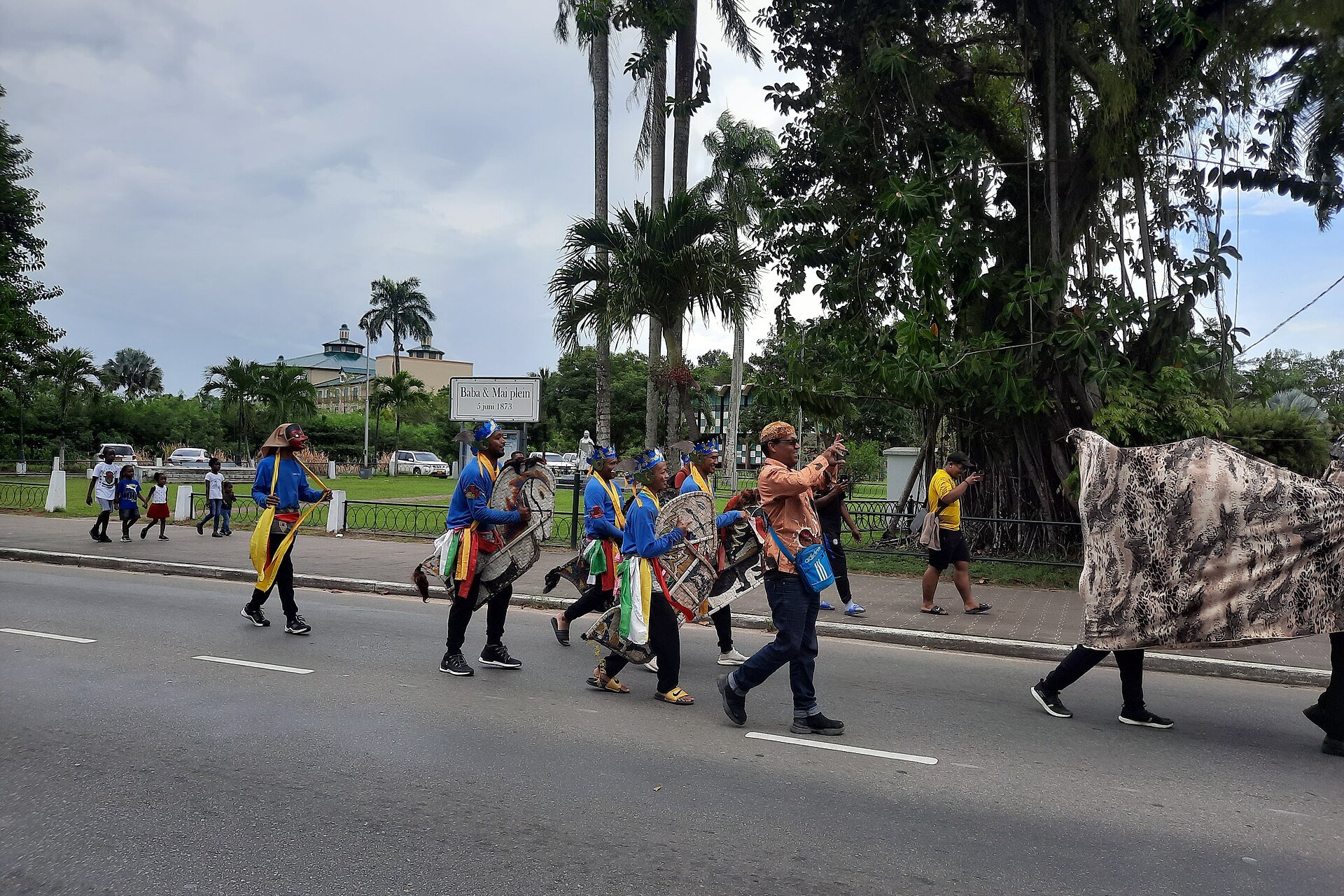
In 2004 some 32,579 people, or 6.6 percent, gave no ethnic group, against 3,395 in 2012, so part of every group’s growth is better recording. The ABS also warned of “category jumping”, meaning people who change the group they report from one census to the next.
Maroons and Indigenous Peoples of the Interior
Maroons descend from Africans who escaped slavery and set up autonomous communities in the interior. The Inter-American Court of Human Rights counted six distinct Maroon groups in Suriname, among them the Saramaka, who are estimated at 25,000 to 34,000 people in 63 communities.
Maroon communities were hit hard by Suriname’s internal conflict of the 1980s. The Court recorded that at least 200 civilians, mostly Maroon villagers, were killed in army operations in 1986 and 1987, and that about 15,000 people fled to Paramaribo and 8,500 to French Guiana.
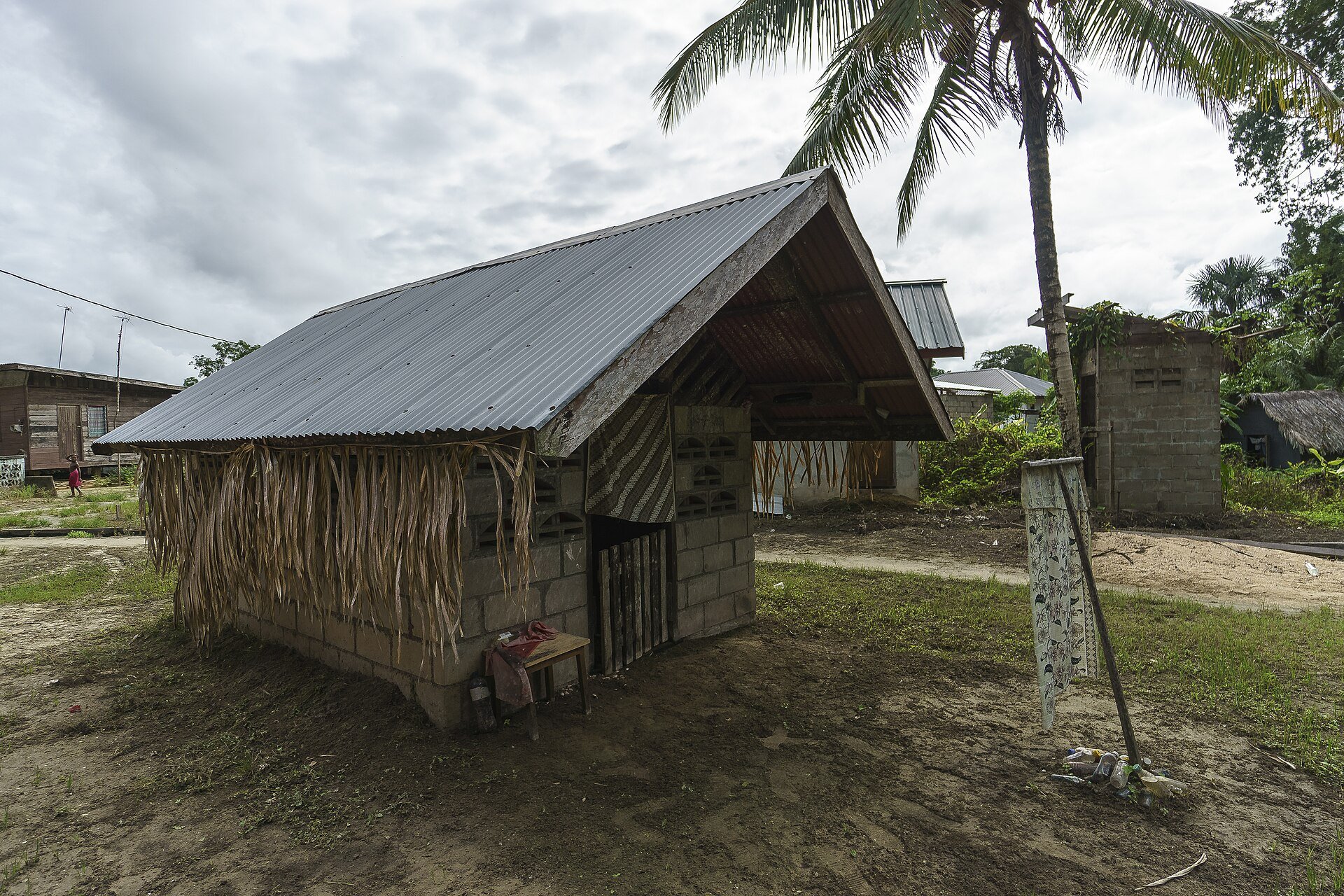
The Court said most of the displaced were Maroons, more than one third of that ethnic group’s total population. In the Moiwana case, decided in 2005, it found that state agents and collaborators killed at least 39 community members in the N’djuka village of Moiwana on 29 November 1986.
The 2012 census counted 20,344 Indigenous people, or 3.8 percent of residents, and 28.1 percent of them were under 15. Among them are the Kaliña and Lokono of the Lower Marowijne River, where the Court identified eight communities in a 2015 case.
In 2007 the Court ordered Suriname to delimit, demarcate and grant collective title over the Saramaka territory, finding that the legal framework merely grants a privilege to use land. In 2015 it found violations of the Kaliña and Lokono peoples’ rights to legal personality and collective property.
The constitution of 1987, as amended in 1992, does not mention Indigenous or Maroon peoples by name. Its Article 41 says that natural resources belong to the nation.
Languages and Faiths
Dutch is the official language, and in the 2012 census it was the most spoken language in 49.7 percent of the 140,367 households. Maroon languages followed at 15.5 percent, Sarnami at 14.1 percent, Sranan Tongo at 8.4 percent and Javanese at 3.9 percent.
Sranan Tongo was the leading second language, at 35.7 percent of households, followed by Dutch at 24.1 percent. The census counts Saramaccan, Aucan and Paramaccan as Maroon languages, and 17.9 percent of households reported no second language.
The ABS yearbook names Sranan Tongo, Javanese, Hindi and English among the other languages spoken. These counts are for households, not individuals, and they predate the 2024 census.
Christians were 48.4 percent of residents in 2012, Hindus 22.3 percent, Muslims 13.9 percent, and other faiths or none 12.3 percent. The largest single denomination was the Roman Catholic Church with 117,261 members, or 21.6 percent, ahead of Sanatan Hindus at 18.0 percent.
Two Christian groups, Volle Evangelie (Full Gospel) and the E.B.G., had about 11.2 percent each. Among smaller groups, Winti was 1.8 percent, Jehovah’s Witnesses 1.2 percent and Javanisme 0.8 percent, and 7.5 percent said they had no religion.
Migration: The Netherlands, Guyana, Brazil and China
Suriname’s diaspora is concentrated in the Netherlands. Statistics Netherlands (CBS) counted 370,281 residents with Suriname as their country of origin on 1 January 2026, or 2.04 percent of the 18.13 million people in the country.
CBS gives people born abroad their own birth country and Dutch-born people the birth country of their parents, the mother’s first. Of the 370,281, some 189,318 were born in the Netherlands and 180,963 abroad.
By city, Amsterdam had 61,885 people of Surinamese origin, Rotterdam 51,570, The Hague 42,567 and Almere 26,989. Against the 2022 total of 361,632, the group grew by about 8,600 in four years.
The UN counts by birthplace rather than origin: its 2024 estimate is 258,026 Suriname-born people living abroad, of whom 177,165 were in the Netherlands. Foreign-born residents of Suriname numbered 51,902, led by Guyana at 14,720, Brazil at 6,044, China at 5,913 and the Netherlands at 3,774.
The 2012 census counted 35,040 residents born abroad, or 6.5 percent, and 18,287 returning emigrants. By nationality, 505,245 residents (93.3 percent) held Surinamese nationality, 10,248 Dutch, 8,278 Guyanese, 5,027 Brazilian and 3,758 Chinese.
The ABS wrote that the numbers of Brazilians and Chinese in Suriname must be much larger, and it partly explained the gap by 3,660 Brazilian and 2,397 Chinese visitors who were present on census night. Emigrants recorded in the census went mostly to the Netherlands, 67.2 percent of 2,241, but the ABS cautioned that a census is a poor tool for measuring emigration.
The World Bank records US$176.1 million in personal remittances received in 2025, or 3.9 percent of GDP. Its estimate of net migration for the same year is a net outflow of 967 people.
How the Groups Live Together
Article 8 of the constitution bars discrimination on grounds of birth, sex, race, language, religion, origin, education, political conviction, economic position or social circumstances. Public commemorations mark each community’s history through the year: Hindustani immigration on 5 June, Keti Koti on 1 July, Javanese immigration and the Day of the Indigenous Peoples in August, Maroons’ Day on 10 October and Chinese immigration in October.
At the Hindustani commemoration in June 2026, President Jennifer Simons said that “what we must take care of is how we go on together”. National Assembly chair Ashwin Adhin told the same event that Suriname knows no ethnic groups, only culture groups, while the 2012 census still tabulated the population by ethnic group.
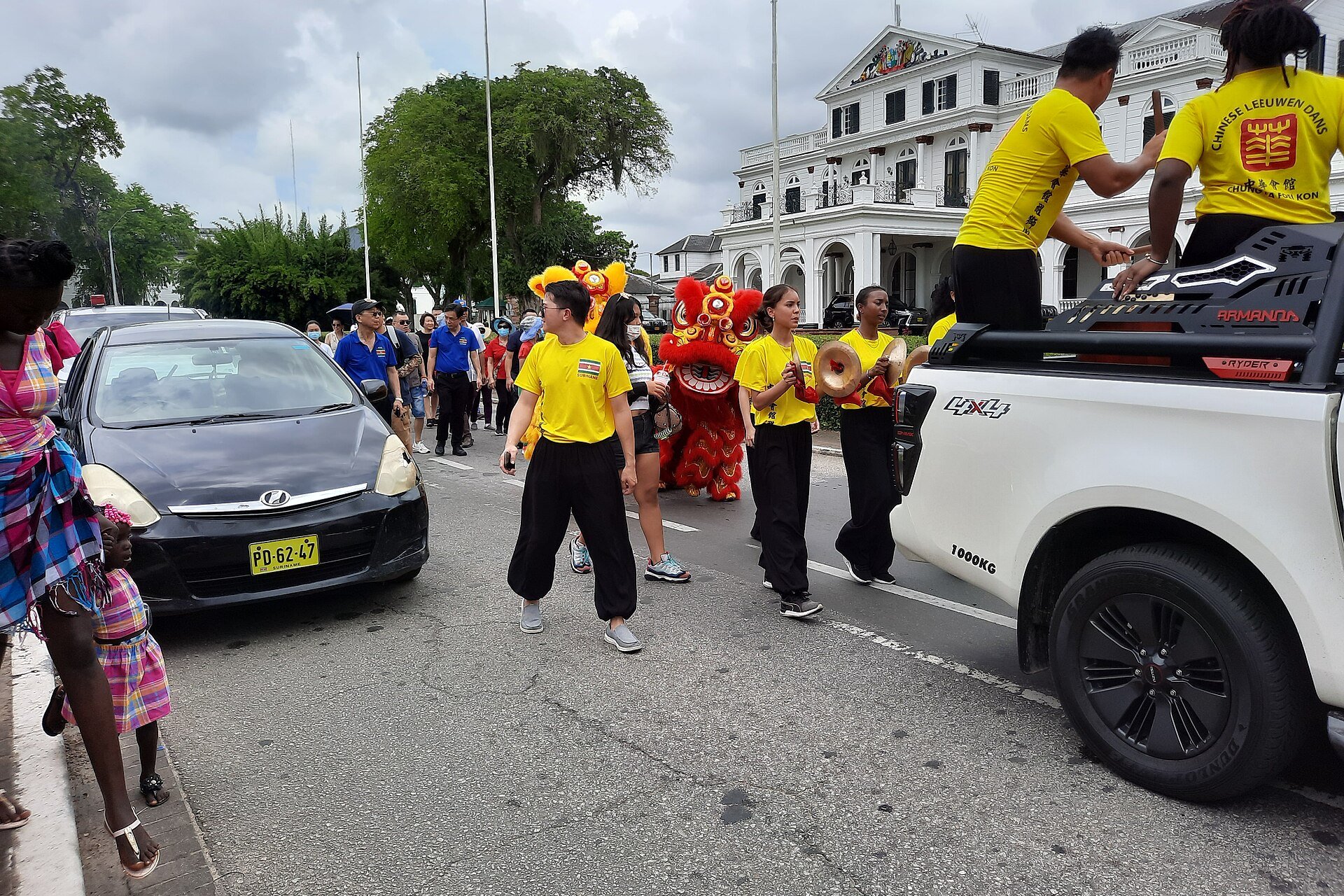
On the Day of the Indigenous Peoples, 9 August 2026, Simons said that a society in which different population groups live side by side is “not self-evident everywhere in the world; it is a great good”. She added that Indigenous peoples lived on Surinamese soil before colonialism, slavery and contract labour.
On Maroons’ Day, 10 October 2026, Simons said that “without unity Suriname will not exist” and called on the population groups to share responsibility for the future. Leo Atomang, chair of Stichting 10 oktober 1760, said Maroons must bundle their efforts and “are not there yet” on unity.
The National Assembly for 2025 to 2030, described in the Suriname politics guide, has 51 seats: the National Democratic Party (NDP) 18, the Progressive Reform Party (VHP) 17, the General Liberation and Development Party (ABOP) 6, the National Party of Suriname (NPS) 6, Pertjajah Luhur (PL) 2 and two parties with one seat each. At the 80th anniversary of the NPS, reported by the Herald on 1 October 2026, PL chairman Paul Somohardjo described the NPS as a party that does not represent just one population group.
Land is the sharpest open question between the state and the interior. Regional Development Minister Miquella Huur wants a land rights conference held in 2027, and the Herald’s headline of 11 October 2026 said Maroon land rights are still not regulated.
The Herald reported on 1 September 2026 that the Association of Indigenous Village Heads in Suriname (VIDS) had asked the government not to promulgate the Law on the Protection of Living Areas. On 7 September 2026 it reported Captain Sergio Jubithana of Hollandse Kamp as saying that the amended text, which would set a five-kilometre protection zone around villages, gives insufficient protection to the collective land rights of Indigenous and tribal peoples.
What It Means for US Readers
- Travellers: the State Department advisory page lists Suriname at Level 1, “Exercise normal precautions”. US citizens need an e-visa before travel and a passport valid for six months, and Dutch is the official language.
- Investors and employers: Suriname is a market of about 640,000 people, two thirds of them urban. The interior, where 38.6 percent of residents were under 15 in 2022, is the youngest part of the country and the part where land rights are least settled.
- Diaspora and expats: the Surinamese abroad live mainly in the Netherlands, not the United States. Of emigrants recorded in the 2012 census, 67.2 percent went to the Netherlands and 6.3 percent to the United States.
- Policy watchers: three items to track are the publication of the 2024 census, the fate of the Law on the Protection of Living Areas, and the proposed land rights conference in 2027.
Connected Coverage
More from the Suriname section
Suriname Explained 2026: The Oil Hope, the Dutch Legacy, the Economy and What to Watch
Suriname Politics Explained, Who Holds Power in 2026
Suriname Culture, the Key Figures to Know in 2026
Who Runs Suriname’s Economy, the Key Players in 2026
What Is Not Known
- The result of the 2024 census. The finance minister was reported in June 2026 as expecting the final report at the end of September, and the ABS website showed no population total or ethnic breakdown from it on 26 October.
- The current ethnic mix. The latest group counts are from 2012, and the ABS warned that many Maroons gave no group in 2004 and that some Creoles now call themselves mixed.
- How many Brazilians, Chinese and Guyanese live in Suriname. The ABS wrote that the Brazilian and Chinese numbers must be much larger than the census recorded.
- The size of the Surinamese community in the United States. The US Census Bureau’s American Community Survey table of place of birth (B05006) has no Suriname line, so no US figure is given here.
- Whether the Law on the Protection of Living Areas has taken effect. The Herald wrote on 7 September 2026 that the National Assembly passed it in 2017 but it was never promulgated, and that the government’s amendments were still proposals.
More country population guides: Kenya population, Mexico population, Colombia population.
Frequently Asked Questions
What is the population of Suriname?
The last published census, in 2012, counted 541,638 usual residents. The World Bank and the UN estimate 639,850 for 2025.
What is the largest ethnic group in Suriname?
Hindustani, with 148,443 people or 27.4 percent in the 2012 census. Maroons followed at 21.7 percent, Creoles at 15.7 percent and Javanese at 13.7 percent.
What languages are spoken in Suriname?
Dutch is the official language and was the most spoken at home, in 49.7 percent of households in 2012. Sranan Tongo is the main second language, and Maroon languages and Sarnami follow.
What religion are most people in Suriname?
Christian, at 48.4 percent in the 2012 census. Hindus were 22.3 percent and Muslims 13.9 percent.
How many Surinamese live in the Netherlands?
Statistics Netherlands counted 370,281 people of Surinamese origin on 1 January 2026, of whom 189,318 were born in the Netherlands. That is about 58 percent of the number living in Suriname.
Where do most people in Suriname live?
On the coast: Paramaribo and Wanica held 66.3 percent of residents in 2012. The interior district of Sipaliwini has almost 80 percent of the land and 37,065 people.
Who are the Maroons?
Maroons descend from Africans who escaped slavery and built communities in the interior, and they were 21.7 percent of residents in 2012. The Inter-American Court counted six distinct Maroon groups, among them the Saramaka.
Sources: ABS, Census 2012 Volume I (Dutch), hosted by UN Statistics Division, https://unstats.un.org/unsd/demographic/sources/census/wphc/Suriname/SUR-Census2012-vol1.pdf; ABS, Census 2012 Volume III (households and language), https://unstats.un.org/unsd/demographic-social/census/documents/Suriname/SUR-Census2012-vol3.pdf; ABS, census page, https://statistics-suriname.org/census/; ABS, Statistical Yearbook 2020, 2021 and 2022, https://statistics-suriname.org/wp-content/uploads/2024/01/Statistisch-Jaarboek-Statistical-Yearbook-2020-2021-2022-dec-2023.pdf; World Bank, Suriname data, https://data.worldbank.org/country/SR; UN DESA Population Division, World Population Prospects 2024, https://population.un.org/wpp/; UN DESA, International Migrant Stock 2024, https://www.un.org/development/desa/pd/content/international-migrant-stock; Statistics Netherlands (CBS), table 85458NED, https://opendata.cbs.nl/ODataApi/odata/85458NED; CBS, definition of herkomstland, https://www.cbs.nl/nl-nl/onze-diensten/methoden/begrippen/herkomstland; Inter-American Court, Moiwana Community v. Suriname (2005), https://www.corteidh.or.cr/docs/casos/articulos/seriec_124_ing.pdf; Inter-American Court, Saramaka People v. Suriname (2007), https://www.corteidh.or.cr/docs/casos/articulos/seriec_172_ing.pdf; Inter-American Court, Kaliña and Lokono Peoples v. Suriname (2015), https://www.corteidh.or.cr/docs/casos/articulos/seriec_309_ing.pdf; Constitution of Suriname, https://www.dna.sr/media/vyjchhar/grondwet-suriname.pdf; National Assembly, members 2025 to 2030, https://www.dna.sr/politiek-college/leden-2025-2030/; Parbode, first census round, https://www.parbode.com/eerste-ronde-van-de-census-moeizaam-verlopen/; Suriname Herald, census results delayed, 22 June 2026, https://www.srherald.com/suriname/2026/06/22/resultaten-volkstelling-blijven-uit-door-financiering-wetgeving-en-technische-verwerking/; Suriname Herald, Hindustani immigration commemoration, 6 June 2026, https://www.srherald.com/suriname/2026/06/06/simons-bij-hindostaanse-immigratieherdenking-waarvoor-we-moeten-zorgen-is-hoe-we-samen-verder-gaan/; Suriname Herald, Day of the Indigenous Peoples, 9 August 2026, https://www.srherald.com/suriname/2026/08/09/simons-bescherming-inheemse-leefgebieden-en-cultuur-van-nationaal-belang/; Suriname Herald, Javanese immigration, 10 August 2026, https://www.srherald.com/suriname/2026/08/10/javaanse-immigratie-en-dag-der-inheemsen-trekken-veel-publiek-in-paramaribo/; Suriname Herald, Chinese immigration commemoration, 20 October 2025, https://www.srherald.com/suriname/2025/10/20/china-en-suriname-benadrukken-hechte-vriendschapsband-tijdens-herdenking-immigratie/; Suriname Herald, Maroons’ Day, 10 and 11 October 2026, https://www.srherald.com/suriname/2026/10/11/dag-der-marrons-groots-gevierd-maar-volgens-atomang-ontbreekt-nog-echte-eenheid/; Suriname Herald, Maroon land rights, 11 October 2026, https://www.srherald.com/suriname/2026/10/11/grondenrechten-marrons-nog-altijd-niet-geregeld-minister-huur-wil-conferentie-in-2027/; Suriname Herald, Law on the Protection of Living Areas, 7 September 2026, https://www.srherald.com/suriname/2026/09/07/jubithana-aangepaste-wet-bescherming-woon-en-leefgebieden-schiet-tekort-voor-collectieve-rechten/; US State Department, Suriname travel advisory, https://travel.state.gov/content/travel/en/traveladvisories/traveladvisories/suriname-travel-advisory.html. All accessed 26 October 2026.
This article was produced by The Rio Times’ automated newsroom system. How we use AI · Report an error · Editorial responsibility: Matthias Camenzind, Editor-in-Chief
Expat Guide to Suriname
What The Rio Times publishes for foreigners who live in or move to Suriname.
Start here
- Suriname Bank Account for Foreigners 2026: Banks, Documents and Dollars
- Taxes in Suriname for Expats: Rates, Residency and the Guilder Question
- Healthcare in Suriname for Expats: Paramaribo Hospitals, Insurance and the Dutch Link
- Suriname Visa and Residency 2026, Fees, Permits, Timelines
Understand Suriname