Geerlings-Simons Takes Charge of Suriname Economy as TotalEnergies Prepares 2028 Oil
Economy · Suriname
—The stakes. Suriname’s first female president Jennifer Geerlings-Simons must govern the gap between a completed debt restructuring and first oil from the US$10.5 billion GranMorgu project.
—The date. TotalEnergies expects first oil from Block 58 in 2028, with the majority of net income flowing to the Surinamese state after production starts.
—The rules. In December 2024 Suriname passed legislation strengthening the Savings and Stabilization Fund Suriname and introducing debt and spending fiscal rules before oil revenue arrives.
—The context. Gold remains Suriname’s dominant export while bauxite stays historically significant as the economy shifts toward a petroleum future.
—The risk. IMF technical documents show the country is using rules-based fiscal policy to avoid the resource curse that has trapped other small petrostates.
Suriname is running its most important experiment in economic discipline before the oil money begins. The president who took office in July 2025 inherits a country where the legal architecture for petroleum wealth was already laid in December 2024. What happens between now and first oil in 2028 will determine whether the US$10.5 billion GranMorgu project becomes a stabilising force or a governance burden.
A First Female President Inherits a Fiscal Turning Point
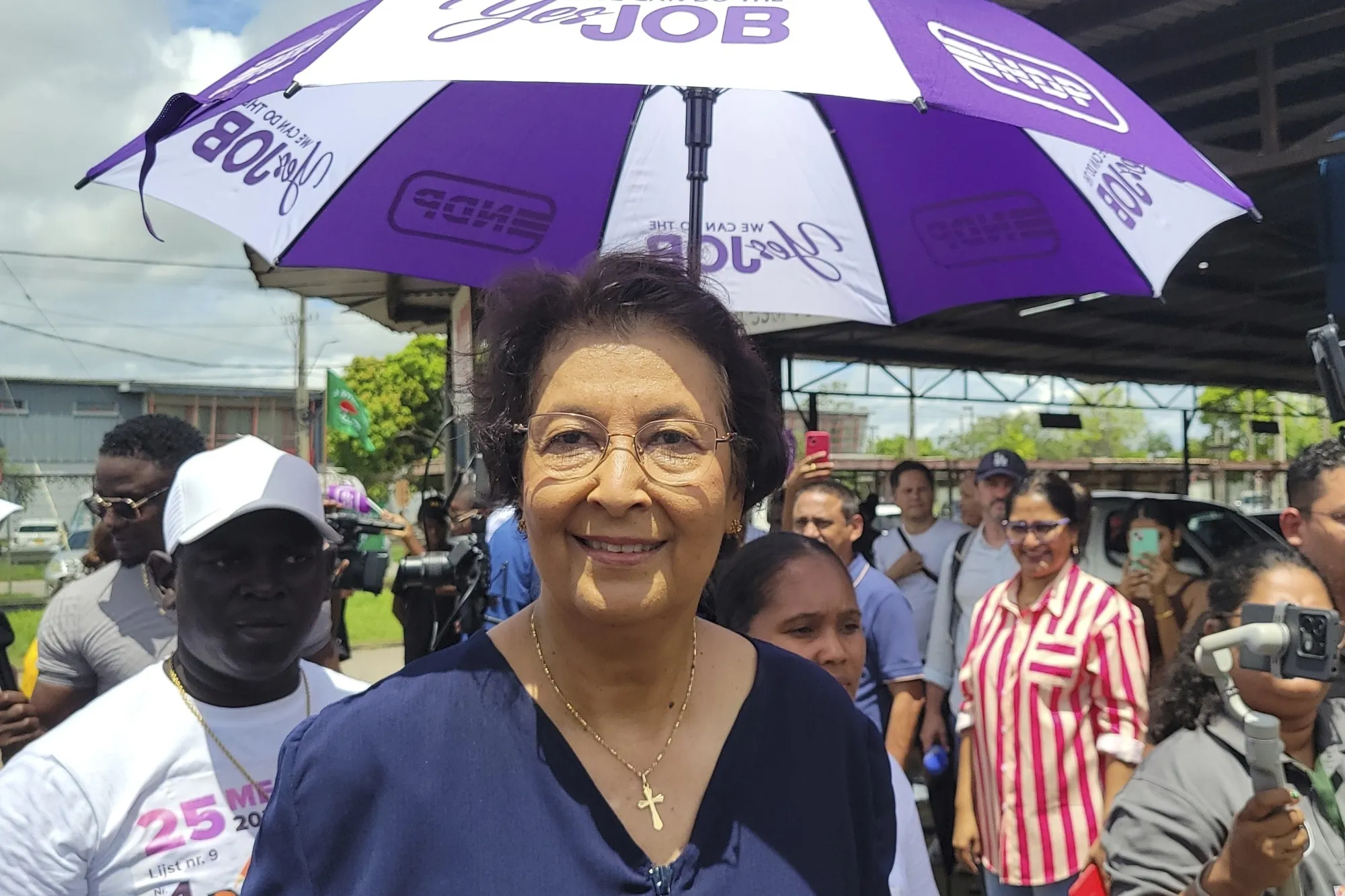
Jennifer Geerlings-Simons became Suriname’s president on 16 July 2025 after being elected by the National Assembly on 6 July 2025.
She is the country’s first female president and leads the National Democratic Party, known locally as the NDP.
The former physician and long-serving parliamentarian previously chaired the National Assembly and leads the NDP, the party Desi Bouterse founded.
International IDEA notes she secured the required two-thirds majority in the National Assembly and ran without opposition following coalition negotiations.
Her presidency begins in the shadow of an extensive debt restructuring under an IMF Extended Fund Facility started in 2021.
GranMorgu: The US$10.5 Billion Anchor
TotalEnergies operates the GranMorgu development in offshore Block 58 with partners APA Corporation and Staatsolie, Suriname’s state oil company.
The final investment decision for GranMorgu carries a total investment estimated at around US$10.5 billion.
Staatsolie states that construction and installation will take approximately four years, meaning first oil will be produced in 2028 at the earliest.
TotalEnergies confirms first oil is expected in 2028 from the Block 58 development.
Staatsolie projects that after production starts from 2028, the majority of the net income will go to the state of Suriname.
The Savings and Stabilization Fund Suriname
The Savings and Stabilization Fund Suriname, known as the SSFS, is the sovereign vehicle designed to receive petroleum income.
The IMF reports that in December 2024 Suriname passed legislation to strengthen the fiscal framework, introduce fiscal rules, and revamp the SSFS.
Under the new law, the totality of mineral government revenue will be received by the SSFS.
All mineral revenues are to be deposited directly in the SSFS and managed independently under enhanced transparency and corporate governance requirements.
This means the rules were not being written in 2026, but their operationalisation remains a live task for the Geerlings-Simons administration.
Fiscal Rules Written Before the Oil Arrives
The December 2024 legislation introduced two binding fiscal rules for Suriname.
The first is a target for public debt net of assets in the SSFS to be reached by the end of each five-year period.
The second sets annual primary expenditure limits consistent with achieving that debt target.
Every five years the government must set numerical values for these rules in a Financial Five-Year Plan, or FFYP, submitted to the National Assembly.
Annual budgets must align with the FFYP, which also defines the limit of transfers from the SSFS to the central government.
The Aftermath of Debt Restructuring
Suriname is emerging from an extensive debt restructuring process conducted under an IMF Extended Fund Facility started in 2021.
A major external bond exchange was completed in November 2023 as part of that restructuring.
IMF staff reports from April 2025 document the December 2024 legislation under the Extended Fund Facility.
The fiscal rules tie future oil windfalls to debt reduction rather than immediate spending expansion.
Gold and Bauxite: The Old Export Base
Gold remains the dominant export for Suriname as the petroleum era approaches.
Bauxite holds historical significance for the country’s export profile even as oil dominates policy discussion.
Recent IMF and technical documents focus more on the coming oil era and fiscal consolidation than on bauxite expansion.
The shift in analytical attention reflects the scale of GranMorgu relative to the existing extractive sector.
Suriname’s resource-curse risk management is therefore layered onto an economy already dependent on mining exports.
Staatsolie’s Role as State Gatekeeper
Staatsolie is Suriname’s state oil company and a partner in the Block 58 GranMorgu development.
The company announced the final investment decision alongside TotalEnergies and APA Corporation.
Staatsolie’s public statements emphasise that the state will receive the majority of net income after first oil in 2028.
The company functions as the commercial interface between international operators and the sovereign wealth fund architecture.
Its statements frame first oil in 2028 as the earliest possible date, signalling caution about schedule risk.
Avoiding the Resource Curse Through Rules
The IMF’s technical focus on Suriname centres on resource-curse avoidance via rules-based fiscal policy.
Depositing all mineral revenues directly into the SSFS is designed to prevent discretionary spending of oil income.
The independent management requirements aim to shield the fund from short-term political pressure.
The debt and expenditure limits mean oil wealth cannot finance unbudgeted recurrent spending during the pre-2028 phase.
This legal sequencing, rules passed in December 2024 and implemented through 2028, is the country’s core defence against the resource curse.
What Foreign Investors Should Watch Before 2028
Foreign investors should monitor whether the first Financial Five-Year Plan under the new rules passes the National Assembly with credible numerical targets.
The alignment of annual budgets with the FFYP will signal whether the Geerlings-Simons government honours the December 2024 framework.
The pace of SSFS operationalisation, including its independent management and transparency disclosures, matters before any oil revenue arrives.
The long-term debt target of 60 percent of GDP by 2035 provides a benchmark for judging fiscal policy discipline.
The construction and installation phase for GranMorgu runs for approximately four years, meaning the pre-oil governance window is finite and observable.
The 2026 Execution Window
The next two years will test whether Suriname can turn project plans into physical infrastructure. In May 2026, industry reports placed overall GranMorgu progress at roughly 25 to 50 percent, with FPSO construction notably advanced. By late July 2026,
That timetable means a visible shift from paperwork to offshore work is already happening. OilNow reported in June 2026 that GranMorgu has moved beyond post-FID planning and that offshore installation activities should begin in 2026. A separate Reuters report said TotalEnergies confirmed a new drilling campaign in Suriname for the following year, keeping first oil in 2028 intact.
For outsiders, the most useful number to track is the 220,000 barrels per day FPSO capacity, because it defines the revenue ramp. With the US$10.5 billion project now in the execution phase, delays in FPSO delivery, subsea installation, or drilling would push first oil later and alter the fiscal projections showing public debt falling to about 62 percent of GDP by 2028. This is the real countdown.
A Small Petrostate’s Governance Countdown
Suriname has the unusual advantage of having passed its core oil-revenue governance legislation before first oil production.
The December 2024 laws mean the sovereign fund and fiscal rules already exist when the Geerlings-Simons administration takes office.
The political test is whether implementation matches the legal text written under IMF supervision.
If the FFYP process and SSFS independence hold, Suriname could become a rare small-state example of petroleum governance discipline.
If transfers from the SSFS to the central government are loosened before 2028, the resource-curse defence weakens at precisely the moment oil income nears.
The Big Picture
Latest developments
- Marrakech International Film Festival: Dates, Tickets and Guide — 24 September 2026
- Festival Internacional del Globo León: Dates, Tickets and Guide — 24 September 2026
- Internet and SIM Cards in Brazil: Providers, Prices, Coverage — 24 September 2026
- Costa Rica Pet Import Rules: Two Veterinary Deadlines, No Rabies Blood Test, Few Owners Need a Permit — 23 September 2026
This article was produced by The Rio Times’ automated newsroom system. How we use AI · Report an error · Editorial responsibility: Matthias Camenzind, Editor-in-Chief