Suriname Bank Account for Foreigners 2026: Banks, Documents and Dollars
GUIDES · SURINAME
Key Facts
- —What it is A practical guide to opening a Suriname bank account as a foreigner, resident or not, in Surinamese dollars, US dollars or euros.
- —Who it’s for Expats moving to Paramaribo, oil-sector contractors, retirees, property buyers and people of Surinamese descent living abroad.
- —What it costs Little. Current accounts cost about US$0.55 to US$3 a month, and first deposits start at 100 units of the account’s currency.
- —Why it matters Most savings in Suriname are held in foreign currency. Central bank data put the share at 72.5 percent of deposits in July 2026.
- —The catch Paperwork, not price. Non-residents need a reference from their home bank, proof of income and proof of address, and US citizens need tax forms.
A Suriname bank account is cheap to run and easy to hold in US dollars. The hard part is proving who you are, where you live and where your money comes from.
Opening a Suriname bank account as a foreigner is possible at the main commercial banks, in local currency, US dollars or euros. Fees are low. What decides success is whether you count as a resident and how well you document your income.
The rate every figure in this guide uses
The local currency is the Surinamese dollar, written SRD. It floats against the US dollar. The Central Bank of Suriname (CBvS) publishes daily average rates. On 25 September 2026 its non-cash rates were 37.567 SRD to buy and 37.846 SRD to sell one US dollar.
This guide converts at 37.7 SRD to the dollar, the midpoint of those two rates. As a yardstick, SRD 1,000 is about US$27. The euro traded at about US$1.14 on the same central bank table.
The rate matters because bank fees are set in three currencies. A fee fixed in SRD gets cheaper in dollar terms when the SRD weakens. A fee fixed in US dollars does not.
Which banks open accounts for foreigners
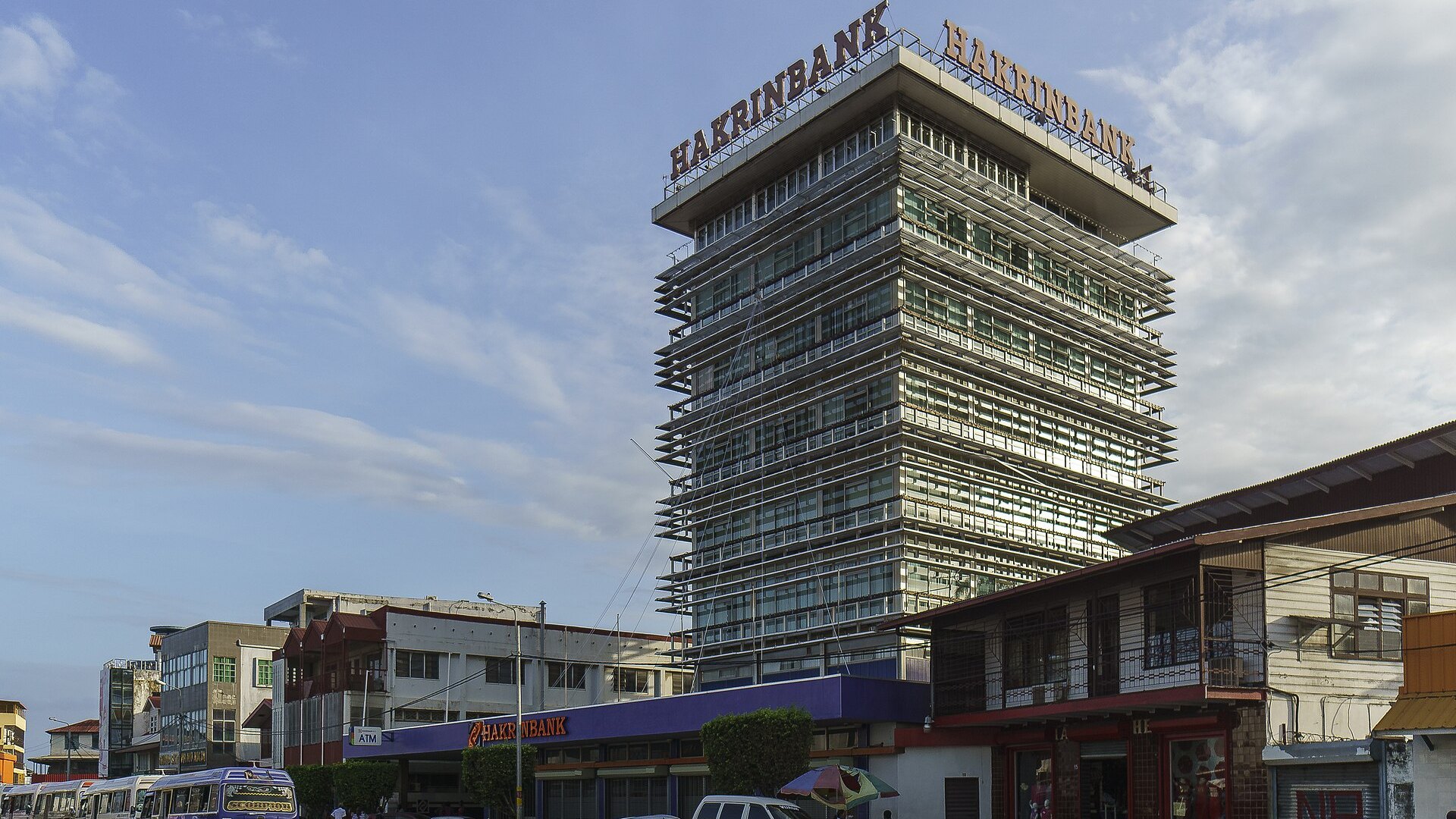
Suriname has a small group of commercial banks, all supervised by the central bank. The best-known names are De Surinaamsche Bank (DSB), Hakrinbank, Finabank and Republic Bank Suriname. Southern Commercial Bank and Godo also serve private customers.
Republic Bank Suriname belongs to the Republic Bank group of Trinidad and Tobago. The other main banks are Surinamese. Our company profiles of De Surinaamsche Bank and Hakrinbank cover their ownership and results.
Four of these banks publish a separate document list for non-residents: DSB, Hakrinbank, Finabank and Republic Bank. That is the practical signal that they will consider a foreigner who lives abroad. Acceptance is still decided case by case by each bank’s compliance team.
All four offer accounts in SRD, US dollars and euros. You do not need to pick one. Many foreigners hold a US dollar account for savings and incoming transfers, plus an SRD account for daily bills.
Resident or non-resident: the question that decides everything
Surinamese banks sort customers into residents and non-residents, known in Dutch as ingezetenen and niet-ingezetenen. In practice, a foreign resident is someone registered in Suriname, usually with a residence permit and a local address.
Residents get the simpler products. DSB’s online “Instaprekening” opens in about five working days, but it requires a Surinamese electronic ID card. It is an SRD account with deposits capped at SRD 30,000 a month (about US$796).
Republic Bank’s Basic SRD Account is also for residents only, for people earning up to SRD 123,000 a year (about US$3,263). Neither product is open to a visitor on a passport.
Non-residents face a fuller file. That does not mean they are refused. It means the bank must satisfy itself about identity, address and the source of money without local records to check against.
Our Suriname visa and residency guide explains how a foreigner obtains a permit. If you plan to stay, it is often easier to open the account after the permit arrives.
The documents you will need
The lists below come from each bank’s own website, checked on 28 September 2026. They cover private accounts for non-residents. Bring originals and copies, and expect the bank to ask for more.
| Bank | What non-residents must provide |
|---|---|
| DSB | Valid passport (mandatory) plus a second ID from the home country or a PSA document; bank reference letter; proof of assets; employer’s declaration; proof of address such as a municipal register extract; email and mobile number; US tax forms W-9 or W-8BEN if there are US links |
| Hakrinbank | Signed application form; valid passport or other accepted ID; employer’s declaration no older than one month, or other proof of income; a reference from the foreign bank where you hold an account |
| Republic Bank | Two forms of ID; reference letter or statements from your foreign bank, no older than six months; employer’s or pension declaration no older than one month, plus recent pay slips; proof of address no older than three months |
| Finabank | Application form; valid passport; proof of income such as pay slips, a pension statement or contracts; reference letter or latest statement from your home bank; W-8 and W-9 forms and a tax number for US nationals; a Finabank current account |
A few terms need explaining. The PSA document is issued to Persons of Surinamese Origin, a status for people of Surinamese descent with foreign nationality. An employer’s declaration, or werkgeversverklaring, is a signed letter confirming your job and pay.
For residents, banks often ask for an extract from the Central Bureau for Civil Affairs (CBB), the civil register. Hakrinbank also wants the employer’s registration number at the Chamber of Commerce, known as the KKF.
The reference letter is the item that most often holds foreigners up. Ask your home bank for a signed letter on headed paper confirming how long you have been a customer. Get it before you travel.
The US dollar reality
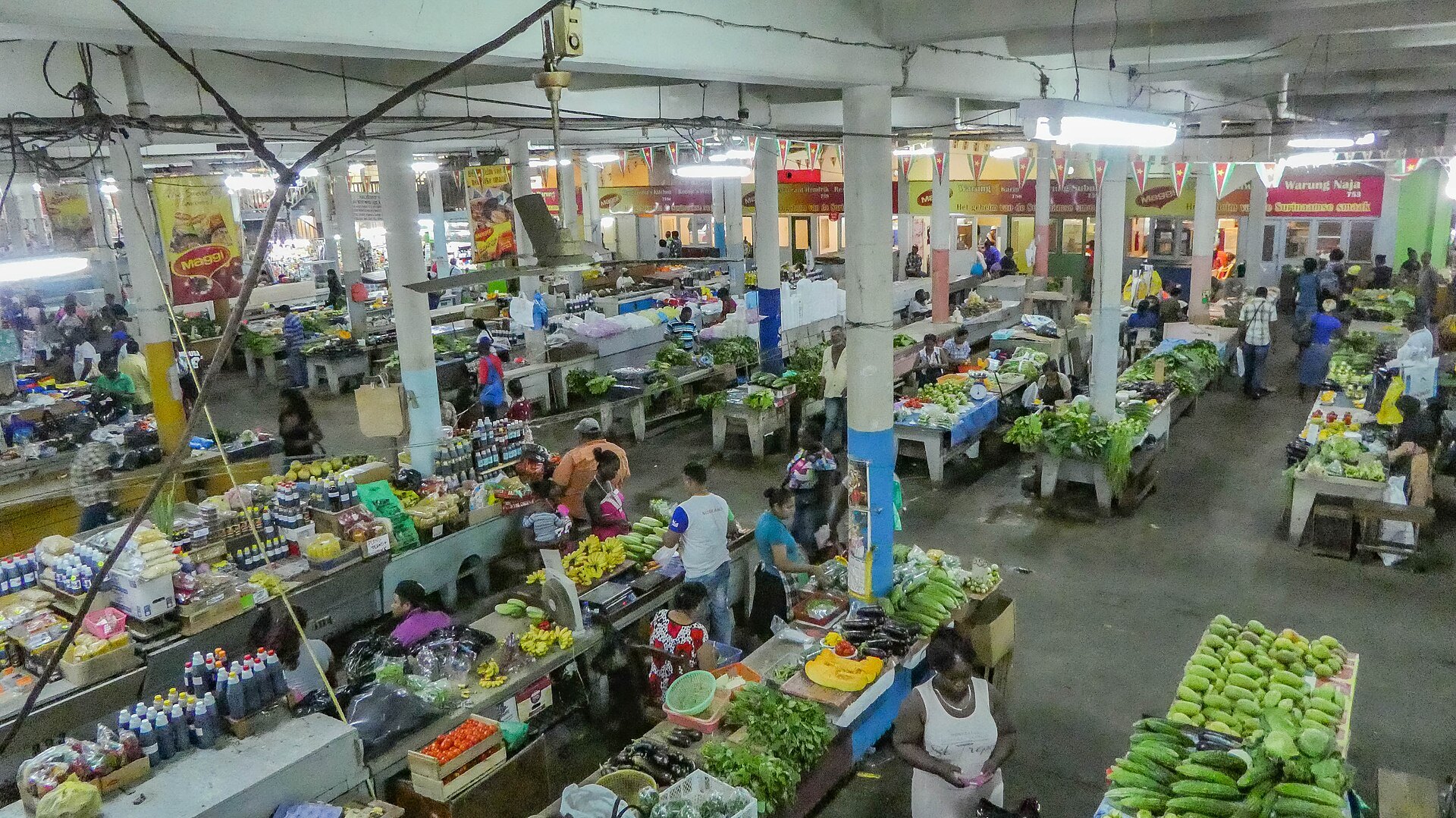
Suriname is heavily dollarised. That means people save and borrow in foreign currency rather than their own. Central bank data show 72.5 percent of bank deposits were in foreign currency in July 2026. Foreign-currency loans made up 55.1 percent of credit to the private sector.
The reason is simple. The SRD traded at 7.52 to the US dollar before September 2020 and now trades near 37.7. Anyone who kept savings in SRD since then lost about four-fifths of their dollar value.
For a foreigner this has three consequences. First, you can hold and receive US dollars or euros without converting them. Second, rents, cars and property are often priced in dollars, so a dollar account pays them directly.
Third, daily life still runs in SRD. Supermarkets, taxis and utility bills are paid in local currency, and bank cards linked to SRD accounts work in local cash machines. Most people therefore run two accounts side by side.
What dollarisation does not mean: the US dollar is not legal tender, and a shop may refuse it. Banks also convert at their own buying and selling rates, which differ from the central bank’s published average.
What a Suriname bank account costs
Bank fees in Suriname are low by international standards. The table shows current account charges from the banks’ published tariff pages. Hakrinbank’s list dates from 1 February 2025 and its fees exclude 10 percent value-added tax (VAT).
| Charge | DSB | Hakrinbank |
|---|---|---|
| SRD current account, per month | SRD 25 (about US$0.66) | SRD 20 (about US$0.53), plus VAT |
| US dollar current account, per month | US$3.00 | US$1.50, plus VAT |
| Euro current account, per month | €3.00 (about US$3.42) | €1.25 (about US$1.43), plus VAT |
| First deposit | Required within one month of opening | 100 units in each currency: SRD 100 (about US$2.65), US$100 or €100 (about US$114) |
Other banks set similar levels. Republic Bank asks for a first deposit of SRD 25 (about US$0.66), US$50 or €50 (about US$57) on a chequing account. Its savings accounts need 100 units of the chosen currency.
Finabank charges non-residents more to start. A savings account needs a first deposit of SRD 200 (about US$5.31), US$200 or €200 (about US$228), against 100 units for residents. It also requires a Finabank current account alongside.
Cash machines carry small charges. Since 1 August 2026, Hakrinbank charges its customers SRD 17.60 (about US$0.47) per withdrawal at other banks’ machines. At its own machines the fee stays at SRD 11 (about US$0.29).
Watch the dormancy rules. DSB treats an account as dormant after 36 months without use and closes it after 48 months, charging SRD 250 (about US$6.63). Reactivation costs SRD 50 (about US$1.33) a month, or US$2.50 on a dollar or euro account.
Paper statements sent abroad also cost more. Hakrinbank charges US$3.00 plus VAT for each paper statement on a dollar account posted to a foreign address. Online banking avoids that.
What your savings earn
Interest on dollar savings is close to zero. Finabank quoted 0.20 percent on US dollar savings and 3 percent on SRD savings in September 2026. Republic Bank listed 0.25 percent on its foreign-currency savings account.
Fixed-term deposits pay more. Finabank quoted 3.75 to 4 percent a year on US dollar deposits of six months to three years. The minimum is US$1,000. SRD deposits paid 7 to 10 percent, with a minimum of SRD 5,000 (about US$133).
Compare those SRD rates with inflation of 8.9 percent in July 2026 and with the currency risk. A 10 percent SRD deposit can still lose money in dollar terms if the SRD weakens. The bank’s quoted rates are indicative and fixed on the day you sign.
Cash, source of funds and the US$10,000 rule
Banks will ask where your money comes from, and they will ask in writing. DSB publishes a source-of-wealth form. Expect questions about your job, your savings and the purpose of any large transfer.
This is not personal suspicion. Suriname is monitored by the Caribbean Financial Action Task Force (CFATF), the regional anti-money-laundering body. It upgraded several of Suriname’s ratings in October 2025, but foreign correspondent banks still watch Surinamese banks closely.
Correspondent banks are the foreign banks that move dollars and euros for Surinamese lenders. If they are unhappy, transfers slow down or get rejected. That is why a Surinamese bank may question a transfer that would pass unnoticed at home.
Do not plan to fund the account with a suitcase of cash. Taking US$10,000 or more, or its equivalent, in or out of Suriname without permission is an economic offence. The Public Prosecutor’s Office warned in August 2025 that declaring it on the arrival form does not make it legal.
US citizens and green-card holders face one more step. The US Foreign Account Tax Compliance Act (FATCA) makes foreign banks identify American account holders. They must report them to US tax authorities. DSB and Finabank therefore ask for IRS forms W-9 or W-8BEN and a US tax number.
Opening an account for a company
A business account needs a local registration first. DSB and Hakrinbank both ask for an extract from the Surinamese Chamber of Commerce no older than one month. They also want company statutes and financial figures.
Foreign companies and branches face the longest list. DSB requires every foreign document to be legalised with an apostille, the international stamp that certifies a public document. It also asks for the parent company’s shareholder and beneficial-owner registers and its latest annual report.
DSB’s list for foreign companies also includes approval from Suriname’s Foreign Exchange Commission, the body that oversees foreign-currency transactions. Each director and signatory who lives abroad must supply a passport, proof of address, an employer’s declaration and a bank reference.
The order that works
1. Decide your status. If a residence permit is coming, wait for it. Resident files are simpler and some products are open only to residents.
2. Collect documents at home. Get the bank reference letter, recent pay slips or a pension statement, and a recent utility bill or address extract. US persons should prepare a W-9 and their tax number.
3. Choose two banks. Contact both before travelling and ask for the current checklist and tariff sheet in writing. Rules change, and branches apply them with some discretion.
4. Apply by the bank’s route. DSB takes current-account applications through an online form, while other banks work mainly through branches. Make the first deposit on time: DSB gives you one month.
5. Test a transfer. Send a small amount from your home bank before moving larger sums. Check which intermediary banks it passes through and what they deduct.
What this means for you
A Suriname bank account is worth having if you live, work or own property in the country. It is cheap to keep, it holds US dollars, and it saves the cost of repeated international card payments.
It is not a place to park savings for a return. Dollar interest is close to zero, SRD interest barely keeps pace with inflation, and the currency can fall. For most foreigners the account is a working tool, not an investment.
Plan for the paperwork, not the fees. A missing reference letter or an outdated employer’s declaration costs more time than any charge in the tariff list. Read our guides to taxes in Suriname and buying property before moving larger sums.
Connected Coverage
Suriname Visa and Residency 2026: Entry Fees, Permits and Timelines
Taxes in Suriname for Expats: Rates, Residency and the Guilder Question
Cost of Living in Suriname 2026: What Expats Pay
Buying Property in Suriname as a Foreigner: Land Titles, Paramaribo Prices and the Rules
Healthcare in Suriname for Expats: Paramaribo Hospitals, Insurance and the Dutch Link
Sources: Account rules and fees come from the banks’ own websites and tariff lists; exchange rates and deposit data from the Centrale Bank van Suriname; the cash rule from the Public Prosecutor’s Office as reported locally; anti-money-laundering ratings from the CFATF. All accessed 28 September 2026.
- Centrale Bank van Suriname — weighted average exchange rates, 25 September 2026
- Centrale Bank van Suriname — dollarisation ratios, July 2026
- De Surinaamsche Bank — current account requirements and fees
- De Surinaamsche Bank — Instaprekening for residents
- De Surinaamsche Bank — requirements for business accounts, February 2025
- Hakrinbank — requirements for SRD, USD and EUR accounts
- Hakrinbank — retail tariff list from 1 February 2025
- Hakrinbank — ATM fees from 1 August 2026
- Republic Bank Suriname — foreign savings account and requirements
- Republic Bank Suriname — Basic SRD Account
- Finabank — savings and deposit conditions and rates
- Suriname Herald — Public Prosecutor on the US$10,000 cash limit
- CFATF — Suriname re-rating, 13 October 2025
- Suriname Herald — inflation at 8.9 percent in July 2026
What Is Not Known
How often non-residents are refused. No bank publishes approval rates, and each compliance team decides case by case. A complete file improves the odds but guarantees nothing.
Whether every bank accepts physical US dollar cash. Policies on depositing banknotes vary by bank and branch and are rarely published. Ask in writing before bringing cash to deposit.
Whether the published fees are current everywhere. Hakrinbank’s general tariff list dates from February 2025, and some banks update fees by notice rather than a new list. Ask for the current tariff sheet when you open.
Where the Surinamese dollar goes next. SRD fees and balances change in dollar value with the rate. It has traded between about 37 and 38 to the US dollar for most of 2026.
Frequently Asked Questions
Can a foreigner open a bank account in Suriname without living there?
Yes, at banks that accept non-residents, such as De Surinaamsche Bank, Hakrinbank, Finabank and Republic Bank Suriname. You apply with a passport, a reference letter from your home bank, proof of income and proof of address. Each bank decides case by case.
Can I hold US dollars in a Suriname bank account?
Yes. The main banks offer current and savings accounts in US dollars and euros as well as Surinamese dollars. Central bank data show 72.5 percent of deposits were held in foreign currency in July 2026.
How much does a bank account in Suriname cost?
Very little. DSB charges SRD 25 a month, about US$0.66, for an SRD current account and US$3 for a dollar account. Hakrinbank charges SRD 20, about US$0.53, or US$1.50 a month, plus 10 percent VAT.
What is the US$10,000 cash rule in Suriname?
Taking US$10,000 or more in cash, or the equivalent, into or out of Suriname without permission is an economic offence. The Public Prosecutor’s Office says declaring the money on the arrival form does not make it legal. The cash can be seized.
Do Americans need extra forms to open a bank account in Suriname?
Yes. Because of the US FATCA law, Surinamese banks report American account holders to US tax authorities. DSB and Finabank ask US persons for IRS forms such as the W-9 and a US tax identification number.
This article was produced by The Rio Times’ automated newsroom system. How we use AI · Report an error
Read More from The Rio Times
Rotate for Best Experience
This report is optimized for landscape viewing. Rotate your phone for the full experience.
You've reached your free article limit
Subscribe to The Rio Times for unlimited access to expert analysis, market intelligence, and daily briefings on Latin America.