JUSTICE · CUBA
Key Facts
- The country Cuba, a one-party state. Every account of this case traces back to state media: Tribuna de La Habana, Cubadebate and the news agency Prensa Latina.
- What happened On 2 October 2026 state media reported that Cuba’s Supreme People’s Court upheld sabotage sentences of 15 to 20 years for four men over a transformer oil theft.
- The numbers 140 litres of oil taken from a Havana dairy substation; losses of 10.27 million pesos (about US$13,000 at the informal rate, per EFE), court figures via Cubadebate, 2 October.
- What it means for you Stealing from the power grid is prosecuted in Cuba as a crime against state security, with prison terms that can match those for violent offences.
- Still open The trial date, the defence’s arguments and any independent account of the case have not been published.
This story is part of our coverage of the Cuba US tensions. Who backs Havana, the blackouts, the embargo vote and what it means for travellers are in our dossier.
In a Cuba power sabotage case from Havana, the country’s Supreme People’s Court has upheld prison terms of 15 to 20 years for four men. They were caught stealing 140 litres of oil from an electrical transformer at the city’s main dairy plant.
The account comes entirely from Cuban state media. Cubadebate published the ruling on 2 October 2026, citing the court, and the state news agency Prensa Latina repeated it the same morning.
The Havana paper Tribuna de La Habana had reported the sentences a day earlier.
What the court says happened
According to the court summary, the men entered the substation of the Havana Dairy Complex at night. One of them worked as a security guard at the plant.
They drained the transformer and filled seven 20-litre drums with insulating oil, intending to sell it. Other members of the plant’s security team stopped them as they tried to leave.
Transformer oil cools and insulates the equipment that steps down grid voltage. Without it, the unit cannot run, and the court says the plant’s production stopped completely.
Sentences of 15 to 20 years
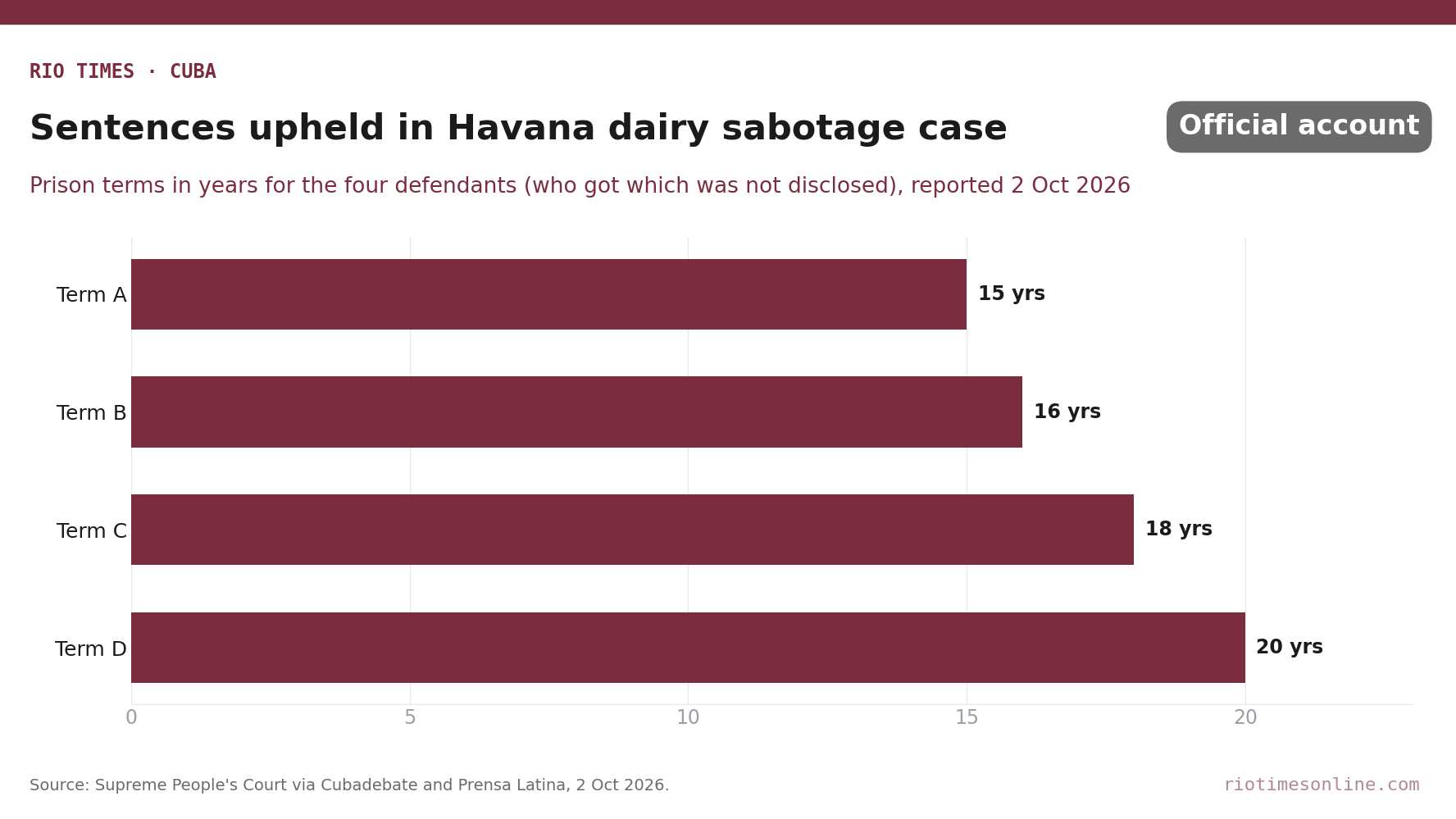
The four defendants, Noerlis Agüero Aguirre, Yoel Noel Ortiz Fontes, Andy Travieso Salazar and Ramón David Cruz Grajales, received terms of 15, 16, 18 and 20 years. The court said the terms reflected each man’s role and the economic harm caused.
The court note did not say who got which term. Diario de Cuba reported 20 years for Cruz Grajales and 18 for Agüero Aguirre.
CubitaNOW gave Agüero Aguirre 15, so the split is not officially confirmed. They were convicted of sabotage under Articles 125 and 126 of the Penal Code.
The court cited three aggravating factors: more than three participants, darkness and a profit motive. Only Agüero Aguirre appealed.
The court’s chamber for crimes against state security rejected that appeal and confirmed the original ruling. Additional penalties include loss of civic rights, a ban on leaving the country, confiscation of property and payment for the damage caused.
The former guard is also barred from working as a security agent, Diario de Cuba reported. The file is case 7 of 2026.
It was first tried by the state security chamber of Havana’s Provincial People’s Court, according to the court note cited by CubitaNOW.
Why Havana treats it as Cuba power sabotage
The court put the losses at 10.27 million Cuban pesos (about US$12,800) in goods meant for the ration basket and school snacks. EFE put that at about US$13,000 at the informal rate on 2 October.
At the central bank’s rate of 693 per dollar, it is about US$14,800. Replacing the oil and repairing the transformer cost a further 81,591.24 pesos (about US$100 at the informal rate).
Cubadebate and Diario de Cuba both reported the repair bill. Cubadebate said the trial was meant to be exemplary, linking it to the island’s energy shortage, which the government blames on the US embargo.
Cuba has suffered repeated grid failures this year, including an eighth nationwide blackout in September.Supply remains thin.
The state grid operator warned of a 2,000 MW shortfall at peak in September and every damaged transformer adds to the strain.
Two readings of the verdict
For the government, the ruling in this Cuba power sabotage case shows that theft from a fragile grid will be punished hard. Here, the court says, one theft halted a plant that supplies food for the ration system.
The case also shows how widely the sabotage charge is applied. A theft of oil was tried as a crime against state security, and the defendants’ side has not been heard publicly.
What Is Not Yet Known
State media did not give the date of the trial or of the appeal hearing. No statement from the defence has been published.
Cubadebate said its summary was generated with artificial intelligence and checked by a journalist. The independent outlet 14ymedio covered the case on 1 October, but only by relaying the state paper’s account.
Diario de Cuba and EFE relayed the court note on 2 October; no independent source has confirmed the facts.
More: Cuba news in English, every day from The Rio Times.
Sources: Cubadebate, “Tribunal Supremo ratifica condenas de hasta 20 años por sabotaje al sistema eléctrico en Lácteo de La Habana”, 2 October 2026, citing the Supreme People’s Court; Prensa Latina, “Ratifican condenas contra implicados en sabotaje eléctrico en Cuba”, 2 October 2026; Diario de Cuba, 2 October 2026; EFE via swissinfo, 2 October 2026; CubitaNOW, citing the Supreme People’s Court; Central Bank of Cuba official exchange rate, 2 October 2026; 14ymedio, 1 October 2026, citing Tribuna de La Habana.
This article was produced by The Rio Times’ automated AI newsroom. Editorial responsibility: Matthias Camenzind, Publisher and Editor-in-Chief. The Rio Times also runs Ask Rio Times, which answers from 100,000+ of our own articles, the daily Latin America Power Map, and prediction-market odds on elections and markets.. How we use AI · Report an error
Cuba and the United States
- What Is Going On Between Cuba and the United States?
- What Is Going On Between Cuba and the United States?
- Can Americans Still Travel to Cuba in 2026?
- Who Runs Cuba in 2026? Raúl Castro and the US Murder Charge