Key Facts
- Copper miners fell hard on Friday: Southern Copper (SCCO) dropped 7.42% to US$177.53, a three-month low, while Freeport-McMoRan (FCX) lost 5.55% to US$62.47; both are widely held in US portfolios.
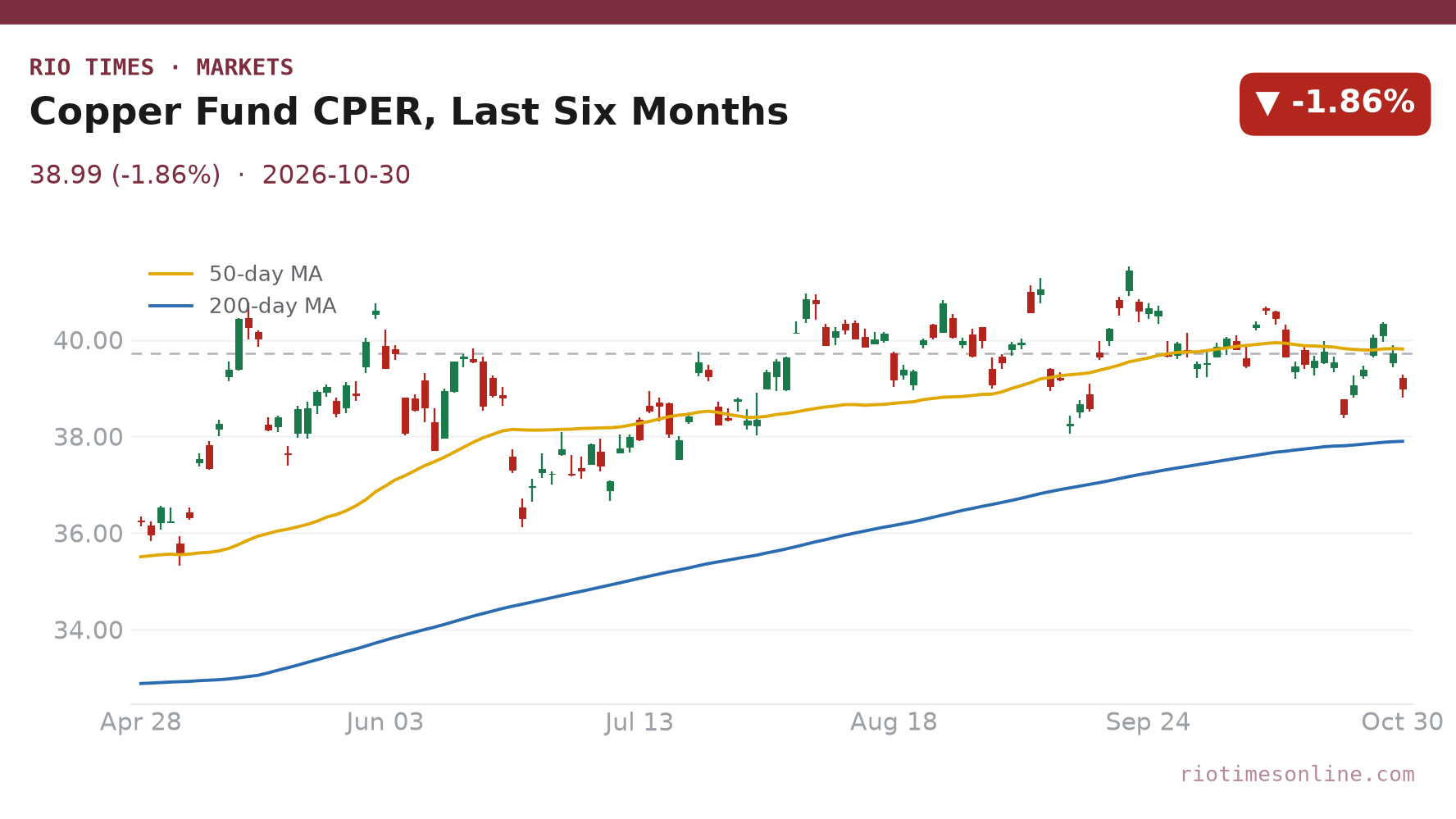
- The copper-tracking CPER fund fell 1.86% to US$38.99, its second straight loss, leaving it 5.9% below its 22 September high of US$41.43.
- The metal fell far less than the shares: CPER lost 1.86% while Southern Copper (SCCO) fell about four times as much, 7.42%.
- The trigger was a tech-led sell-off: the Nasdaq fell 2.86%, the S&P 500 fell 1.82% and investors cut risk.
- Supply stayed tight: Chile’s statistics institute said September output fell 15.1% from a year earlier to 387,870 tonnes; July to September was the weakest quarter of 2026 so far.
- For US investors: CPER and the miners’ New York shares are the easiest ways to trade copper, and they swing far more than the metal itself.
Today’s Focus
Copper stocks had their worst session in weeks on Friday. Southern Copper (SCCO) fell 7.42% to US$177.53 and Freeport-McMoRan (FCX) fell 5.55% to US$62.47, both their lowest closes in at least three months.
The metal itself fell far less, which tells you what happened. The CPER fund, which tracks copper futures, lost 1.86% to US$38.99, so the miners’ shares carried the panic more than the metal.
The trigger was a stock-market rout, not a copper problem. The Nasdaq fell 2.86% and the S&P 500 fell 1.82%, and chipmaker Intel’s near-30% plunge spread a mood of caution that hit cyclical assets such as industrial metals.
The supply story points the other way. Chile, the world’s top producer, saw September output fall 15.1% from a year earlier, and its copper commission raised its 2027 price forecast on the same day.
What matters today. Copper is being sold with the rest of the market rather than for its own reasons, so a calmer stock market is the likeliest cure and the first big tests are the US election on Tuesday 3 November and the Fed meeting on 8 and 9 December.
01 The Session in One Read
The metal ended October with a bruising Friday. The CPER copper fund fell 1.86%, but the shares of the companies that dig the metal fell several times as much.
That gap is the story. When investors rush for cash they sell the shares that rose most and carry the most risk, and Southern Copper and Freeport-McMoRan are both widely held in US portfolios as a way to bet on copper.
For a US reader the practical point is that the funds and shares are not the metal. CPER holds copper futures contracts rather than physical copper, and the miners add the risks of mines, taxes and stock-market mood on top.
The best-supported reading ranks three causes: the tech-led stock sell-off, higher interest-rate expectations after the Federal Reserve held at 3.75% to 4.00% while two officials voted to raise, and heavy selling of high-priced miners. Physical signals still point to tightness, with Chile’s output down and its copper commission raising its price outlook, so we put medium confidence on the macro explanation.
The variable to watch is the stock market, because miners have sold off together with technology shares. If the S&P 500 stops falling and the VIX fear gauge, which closed at 19.42 after a 12.91% jump, settles, the pressure on the miners should ease first.
02 The Board
The board shows the copper fund CPER at US$38.99, down 1.86%, Southern Copper (SCCO) at US$177.53, down 7.42%, and Freeport-McMoRan (FCX) at US$62.47, down 5.55%. The two miners fell about three to four times as much as the fund.
Both miners are now 19.2% and 21.8% below their 25 August highs of US$219.70 and US$79.91. CPER is only 5.9% below its 22 September high of US$41.43, which shows how much of the damage is in the shares rather than the metal.
| Asset | Level | Change |
|---|---|---|
| Copper (CPER tracker) | US$38.99 | -1.86% |
| Southern Copper | US$177.53 | -7.42% |
| Freeport-McMoRan | US$62.47 | -5.55% |
Source: RT close, 2026-10-30. Where a commodity has no spot feed, an exchange-traded tracker or leading producer is shown as a labelled proxy.
Live Market IntelligenceThe live market board
Rio Times · Live Market Intelligence
Latin America — Cross-Market Board
| Instrument | Last | Change | YoY | Prev. | High | Low | Volume |
|---|---|---|---|---|---|---|---|
| IBOV | 167,921.80 | -0.75% | +19.56% | 169,186.42 | 178,526 | 175,157 | — |
| IPSA | 10,253.96 | -2.76% | — | 10,545.26 | 10,722 | 10,633 | — |
| IPC MEX | 69,705.03 | -0.12% | +12.74% | 69,787.41 | 70,008 | 69,383 | 49,372,306 |
| MERVAL | 92,079 | -2.59% | +12.65% | 2,859,051 | — | — | — |
| COLCAP | 2,490.92 | +0.04% | — | — | — | — | — |
| USD/BRL | 5.34 | -1.32% | -0.84% | 5.42 | 5.42 | 5.30 | — |
| EUR/BRL | 5.95 | +7.53% | -4.87% | 5.54 | 6.04 | 5.92 | — |
| USD/MXN | 18.69 | +0.62% | +1.45% | 18.57 | 18.69 | 18.54 | — |
| USD/CLP | 983.47 | -0.57% | +5.64% | 989.13 | 991.87 | 979.07 | — |
| USD/COP | 3,149 | +3.06% | -18.02% | 3,056 | 3,173 | 3,111 | — |
| USD/PEN | 3.45 | +0.17% | +3.85% | 3.44 | 3.45 | 3.44 | — |
| USD/ARS | 1,537 | -0.28% | +3.77% | 1,541 | 1,541 | 1,537 | — |
| USD/UYU | 40.21 | +3.57% | +2.29% | 38.83 | 40.21 | 40.08 | — |
| USD/PYG | 5,803 | +3.78% | -16.54% | 5,592 | 5,803 | 5,735 | — |
| USD/BOB | 11.97 | +4.93% | +77.92% | 11.41 | 11.97 | 11.82 | — |
| USD/DOP | 60.54 | +1.83% | -4.34% | 59.45 | 61.14 | 59.85 | — |
| USD/CRC | 451.24 | +2.13% | -7.80% | 441.83 | 451.40 | 450.04 | — |
| USD/GTQ | 7.64 | +3.23% | +2.18% | 7.40 | 7.64 | 7.64 | — |
03 Why It Moved
The first and heaviest cause is the equity sell-off. The Nasdaq fell 2.86%, chipmaker Intel fell almost 30%, and investors cut risk, which pulled industrial metals down with stocks.
The second cause is the cost of money. The Federal Reserve held its rate at 3.75% to 4.00% on Wednesday 28 October, two officials voted for an immediate increase, and Polymarket, a prediction market, gives 70% to at least one more hike this year (US$1.24 million traded, 30 October, 7:48 pm ET).
The third cause is the miners’ own positioning, and here the evidence is thinner. We found no company announcement that explains a 7.42% fall in Southern Copper, so the best-supported reading is that heavily owned, high-priced producer shares were sold harder than the metal.
Two signals conflict with a bearish story. Supply is still tight, with Chile’s output down 15.1% in September, and Chile’s copper commission raised its 2027 price forecast to US$5.95 a pound from US$5.10 on Friday.
The honest summary is that the sell-off is about risk appetite and interest rates, while the physical market is still tight. We rate that reading at medium confidence because the dollar index slipped only 0.07% and the 10-year Treasury yield stayed at 4.93%, so the usual macro drivers explain part of the move rather than all of it.
04 The Trend Behind It
This is a pullback inside a high-priced market, not a collapse. The CPER fund reached its 12-month high of US$41.43 on 22 September and has since given back 5.9%.
CPER is 1.34% lower over 20 sessions and 4.3% lower over 60 sessions, yet it is still 27.7% above its 12-month low of US$30.53 from 4 November 2025. The miners have fallen much harder, with 13.63% off Southern Copper (SCCO) and 13.28% off Freeport-McMoRan (FCX) over 20 sessions.
Our own price history since 2007 gives a base rate, not a forecast. After earlier 20-session falls as large as that of Southern Copper (SCCO), the shares were higher 20 sessions later in 26 of 40 cases (65%), with a median gain of 2.6% and a worst case of a 43.4% further fall.
For Freeport-McMoRan the record is similar. After earlier falls as large as its own, the shares were higher 20 sessions later in 39 of 68 cases (57%), with a median gain of 2.2%, a worst case of a 41.7% further fall and a best case of an 87.8% gain.
05 What It Means for Latin America
Chile is the world’s largest copper producer, and its supply is shrinking even as prices stay high. September output of 387,870 tonnes helped make July to September the weakest quarter of 2026 so far, as our report on Chile’s September copper output explains, and the national statistics institute blames a temporary suspension at one large company and lower ore grades.
Chile’s copper commission, Cochilco, sees the price averaging US$6.18 a pound in 2026 and has lifted its 2027 forecast to US$5.95 from US$5.10, as we reported in our story on Chile’s higher copper price outlook. That is why a risk-off day in New York does not change the plan in Santiago, where budgets rest on the multi-year price rather than one session.
Peru, another top producer, is exposed through its mines and through Southern Copper’s Tía María project, a large new mine it is developing. Lower share prices make it more expensive for such companies to raise money for new mines, a delay that would keep the metal tight in later years.
For Mexico, Southern Copper’s parent Grupo México is the local link, and Brazilian investors see copper as a rival to iron ore for the attention of global miners. In each case the rule is the same: the share price moves on world markets, while the revenue that reaches governments depends on the metal.
06 The Names to Watch
Southern Copper (SCCO) is the purest Latin American play, with mines in Peru and Mexico. It is the stock to watch because it fell 7.42% on Friday, its third losing session in a row, and sits 19.2% below its August high.
Freeport-McMoRan is the broadest gauge of global copper sentiment, with big mines in the Americas and Indonesia. It closed at its lowest in at least three months, and a close back above Thursday’s US$66.14 would be the first sign of relief.
07 What Would End It
The selling should end when stocks steady and the Fed stops sounding hawkish. For the fund, the practical markers are Thursday’s close of US$39.73 as the first level to reclaim and the September high of US$41.43 as the ceiling, while a further slide below Friday’s US$38.99 would extend the damage.
The dated tests are close. The US midterm elections are on Tuesday 3 November, the October jobs report is due on Friday 6 November, and the Fed meets on 8 and 9 December.
The tightness underneath is visible in the official numbers: Chile’s output fell 15.1% in September, and its copper commission still expects prices above US$5.90 a pound next year. That is why the likeliest ending to the sell-off is a calmer stock market, not a change in the metal.
What Prediction Markets Say
On Polymarket, a prediction market, traders put the chance of at least one more Federal Reserve rate increase in 2026 at 70.0%. About US$1.24 million has been traded on this market, as of 30 October 2026, 7:48 pm ET.
Prices on prediction markets are bets, not polls or forecasts by officials. They move within minutes of every inflation report and Fed comment.
Why we show this: prediction markets turn real-money bets into a live probability that moves within minutes of the news, which is why investors, campaigns and newsrooms in the United States now follow them closely. We show them next to polls and official results, never instead of them.
08 What to watch
- US midterm elections, Tuesday 3 November: The result shapes tariff, tax and spending policy, and a clear outcome could calm the stock market that dragged miners down.
- US jobs report, Friday 6 November: Strong hiring would add to rate-hike bets and weigh on cyclical metals, while a soft number would help copper miners.
- Federal Reserve, 8 and 9 December: The meeting decides whether the hike that Polymarket prices at 70% arrives, which matters for every borrowing-heavy mining project.
- Chile’s output and the US tariff question: Another weak monthly Chilean output figure would support prices, while any decision to widen US tariffs on refined copper would move miners sharply.
Frequently Asked Questions
Why did copper stocks fall so much on Friday?
A tech-led stock sell-off and rate worries hit risk appetite, and investors sold the best-owned miners hardest. Southern Copper (SCCO) fell 7.42% and Freeport-McMoRan (FCX) 5.55%, far more than the metal.
Is copper in short supply?
Signs point to tight supply. Chile’s September output fell 15.1% from a year earlier to 387,870 tonnes, and Chile’s copper commission raised its 2027 price forecast to US$5.95 a pound.
What is CPER?
CPER is an exchange-traded fund that holds copper futures contracts. It tracks the futures market, not the price of physical copper in a warehouse.
What could lift copper stocks again?
A steadier stock market and a Fed that signals no December hike would help most. Thursday’s closes of US$191.75 for Southern Copper and US$66.14 for Freeport-McMoRan are the first levels to reclaim.
Market data: The Rio Times
Primary sources: Chile National Statistics Institute (INE) (30 October); Cochilco (30 October); Federal Reserve FOMC statements (28 October); Polymarket.
This article was produced by The Rio Times’ automated newsroom system. How we use AI · Report an error · Editorial responsibility: Matthias Camenzind, Editor-in-Chief
LatAm Markets: Live Signals → — real-time movers, turnover leaders and FX across Latin America.
Copper in Latin America
- Copper in Latin America 2026: Mines, Prices and Politics
- Chile’s State Copper Giant Codelco Explained
- Peru Copper Mining Explained: Output, Big Mines, Exports and Risks in 2026
- Peru Natural Resources Explained 2026