
PERU · NATURAL RESOURCES
Key Facts
- —The country An Andean nation of 34.2 million people, per the 2025 census.
- —The metals Third in world copper output, second in silver and zinc.
- —The money Mining earned US$62.7 billion in 2025, two thirds of exports.
- —Beyond mines Camisea gas, anchovy fishmeal, Amazon forests and fresh fruit exports.
- —Who profits Mostly foreign miners, the treasury and producing regions.
- —The cost Illegal gold mining strips Amazon forest and spreads mercury into rivers.
Metals pay most of Peru’s bills abroad, while gas, fish, fruit and forests complete a resource map with heavy costs.
Peru resources start with copper, gold, silver and zinc, but the country also sells gas, fishmeal, fruit and coffee abroad. Mining alone brought in US$62.7 billion of exports in 2025, about two thirds of the total, by central bank figures.
That makes Peru one of the main suppliers of the metals behind US power grids, electric cars and electronics. This guide explains what Peru holds on land and at sea, who extracts it, who profits and what it costs.
Peru Resources at a Glance
Peru is a country of 34.2 million people, according to the 2025 national census by INEI, the national statistics institute. Its territory runs from a dry Pacific coast over the Andes to the Amazon basin.
Each of those three zones holds a different kind of wealth. The coast has fish, farms and ports, the Andes hold the metals, and the Amazon holds forests, gas and oil.
Peru sold US$94.0 billion of goods abroad in 2025, says the Banco Central de Reserva del Perú (BCRP), the central bank. Mining products made up US$62.7 billion of that, or 67 percent.
The share has grown in 2026 as metal prices climbed. From January to August, mining exports reached US$57.5 billion out of US$77.4 billion, or 74 percent.
Oil and natural gas added US$3.3 billion in 2025, and fish products about US$4.65 billion. Farm goods, led by fresh fruit, brought in about US$14.5 billion.
Active mining and exploration sites cover only about 1.5 percent of Peru’s territory, says MINEM, the Ministry of Energy and Mines. Their weight in exports, taxes and jobs is far larger, as Rio Times coverage of Peru’s booming mining exports has shown.
Copper, Silver and Zinc Lead the Metals
Copper is Peru’s biggest earner. MINEM recorded output of 2,769,794 tonnes in 2025, a record and 1.2 percent above 2024.
The US Geological Survey (USGS) ranks Peru third in world copper output in 2025, behind Chile and the Democratic Republic of Congo. It puts Peru’s copper reserves at 85 million tonnes, close to a tenth of the world total.
Three operators each mined just under 15 percent of the national total in 2025. They were Southern Peru Copper, Las Bambas and Cerro Verde, MINEM data show.
Southern Peru belongs to Southern Copper, which is controlled by the Mexican conglomerate Grupo México and listed in New York. Las Bambas, in Apurímac, is run by MMG, a Hong Kong-listed miner controlled by the Chinese state group China Minmetals.
Cerro Verde, near the city of Arequipa, is majority-owned by Freeport-McMoRan of Phoenix, Arizona. Quellaveco, in Moquegua, is run by the London-listed Anglo American with Japan’s Mitsubishi as partner.
Most of the metal leaves as concentrate, a powder of crushed and processed ore, rather than as refined copper. The USGS estimates Peru refined only about 340,000 tonnes at home in 2025.
Copper exports earned US$28.9 billion in 2025, the central bank reports, nearly a third of all goods Peru sold abroad. The industry’s history and big mines are covered in the Rio Times guide to Peru copper mining.
Silver is the second metal story. MINEM recorded 3,762 tonnes of silver in 2025, and the USGS ranks Peru second in the world, behind Mexico.
The USGS also credits Peru with the world’s largest silver reserves, about 110,000 tonnes. Antamina, Buenaventura and Chinalco Perú were the top three silver producers in 2025.
Zinc output rose 18.6 percent to 1.51 million tonnes in 2025, says MINEM. The USGS ranks Peru second after China, and Antamina alone mined about a third of the national total.
Antamina, in the Áncash highlands, is jointly owned by the global miners BHP and Glencore with two smaller partners. Peru also ranks among the leading producers of tin, molybdenum and lead, by USGS estimates.
Gold, Formal Mines and an Informal Rush
Gold is Peru’s second export after copper. Shipments were worth US$23.3 billion in 2025 and US$21.6 billion in just the first eight months of 2026, central bank data show.
MINEM counted 108.9 tonnes of gold output in 2025, slightly below 2024. Its figure includes estimates for artisanal miners in regions such as Madre de Dios and Puno.
La Libertad, Cajamarca and Arequipa produced almost three quarters of the recorded total. The largest single producer was Yanacocha, in Cajamarca, run by the US company Newmont.
Then there is a gap. By central bank data, Peru exported about 6.7 million troy ounces of gold in 2025, roughly 210 tonnes.
That is nearly twice the output MINEM recorded for the year. The official figures do not show where the difference comes from.
Much small-scale gold mining happens outside the formal system. Two hotspots are Pataz province in La Libertad and the Amazon region of Madre de Dios.
A temporary register, known as Reinfo, lets small miners keep working while they seek formal status. Its renewal has been fought over repeatedly in Congress.
Oil and Gas, From Camisea to the Northern Jungle
Peru’s most valuable energy resource is natural gas from Camisea, a group of fields in the Amazon lowlands of the Cusco region. Pipelines carry the gas over the Andes to Lima and to a liquefaction plant south of the capital.
The gas supplies much of Peru’s electricity and household fuel, and part is shipped abroad as liquefied natural gas. Natural gas exports earned US$1.4 billion in 2025, central bank data show.
Crude oil is a smaller business. Exports of crude and refined products came to 28.5 million barrels in 2025, worth US$1.9 billion.
The main oil fields lie in the northern Amazon region of Loreto and on the north-west coast around Piura and Talara. Perupetro, a state agency, signs the exploration and production contracts with private operators.
Petroperú, the state oil company, runs the Talara refinery and the pipeline that carries Amazon crude to the coast. It has needed repeated financial support from the government in recent years.
Farmland and Fruit Exports
Peru’s Pacific coast is a desert, with almost no rain in most years. Yet river water from the Andes and large irrigation schemes have turned parts of it into export farms.
Projects such as Chavimochic in La Libertad and Olmos in Lambayeque opened new land to private growers. They grow blueberries, grapes, avocados, asparagus and citrus for markets abroad.
Non-traditional farm exports, mostly fresh and processed food, reached US$12.6 billion in 2025, the central bank says. Traditional crops, led by coffee, added US$1.9 billion.
Growth has slowed in 2026. Non-traditional farm exports rose 1.9 percent from January to August, to US$7.2 billion.
In the highlands, most farming is small-scale, with potatoes, maize, quinoa and livestock. Coffee and cacao grow on the eastern Andean slopes that face the Amazon.

Water, Forests and the Anchovy
Water is Peru’s quiet constraint. Most people and most export farms sit on the arid coast, while most rain falls on the Amazon side of the Andes.
Coastal rivers depend on Andean rain and on glaciers that have been shrinking for decades. Mines, farms and towns often compete for the same valley’s water, a frequent source of local disputes.
The Amazon rainforest covers more than half of Peru’s land area. MINAM, the environment ministry, tracks forest loss through its Geobosques satellite monitoring system.
Forest is lost mainly to small-scale farming, coca growing, illegal logging and illegal gold mining. Commercial wood is a minor export, with wood and paper goods worth US$276 million in 2025.
At sea, the cold Humboldt Current supports a huge fishery for the Peruvian anchovy, or anchoveta. Most of the catch is ground into fishmeal and fish oil for fish farms and animal feed.
Fishmeal exports earned US$1.86 billion in 2025 on 1.27 million tonnes shipped, central bank data show. Fish oil added about US$520 million.
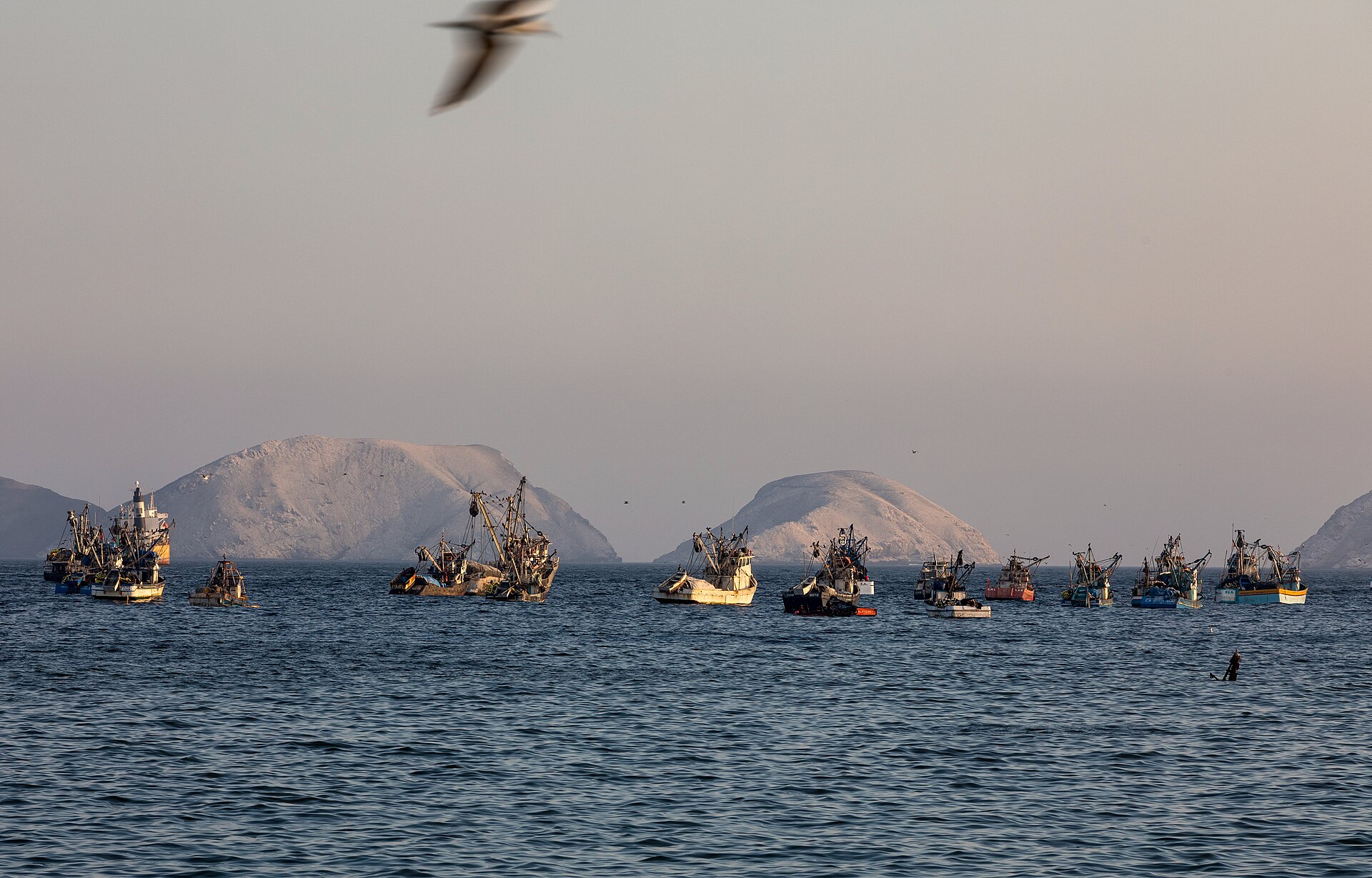
The catch swings with ocean temperatures, so quotas change sharply. The Ministry of Production set 1.91 million tonnes for the first 2026 north-central season, against 3 million in 2025.
Traditional fishing exports fell 27 percent from January to August 2026, to US$1.4 billion, central bank data show.
Who Extracts and Who Profits
Under Peru’s constitution, natural resources belong to the nation, and the state grants concessions to companies. Big mining is led by foreign groups, alongside a few Peruvian firms.
Buenaventura, a Peruvian gold and silver miner, trades on the New York Stock Exchange. Compañía Minera Poderosa, a Peruvian gold producer in Pataz, ranked second in gold output in 2025 by MINEM data.
Mining investment reached US$6.23 billion in 2025, up 24.3 percent, MINEM reports. Its official list counts 65 future mines and expansions worth about US$63 billion.
The sector employed 276,765 people directly in December 2025. The annual average, above 264,000 direct jobs, was the highest on record, the ministry says.
The state collects corporate income tax, royalties and other levies. Half of the income tax that miners pay returns to producing regions and towns as the canon minero, a revenue-sharing transfer.
In 2025 mining transfers to regions and towns exceeded S/10 billion (about US$2.9 billion), MINEM reports. Conversions use the rate of 9 October 2026, S/3.44 per US dollar.
The canon accounted for S/6.99 billion (about US$2.0 billion) and royalties for S/2.69 billion (about US$780 million). How well regions spend that money is a long-running debate in Peru.
The bankers, families and companies behind these flows are profiled in the Rio Times guide to who runs Peru’s economy. The outside investors are covered in foreign powers and investors in Peru.
The Environmental and Social Cost
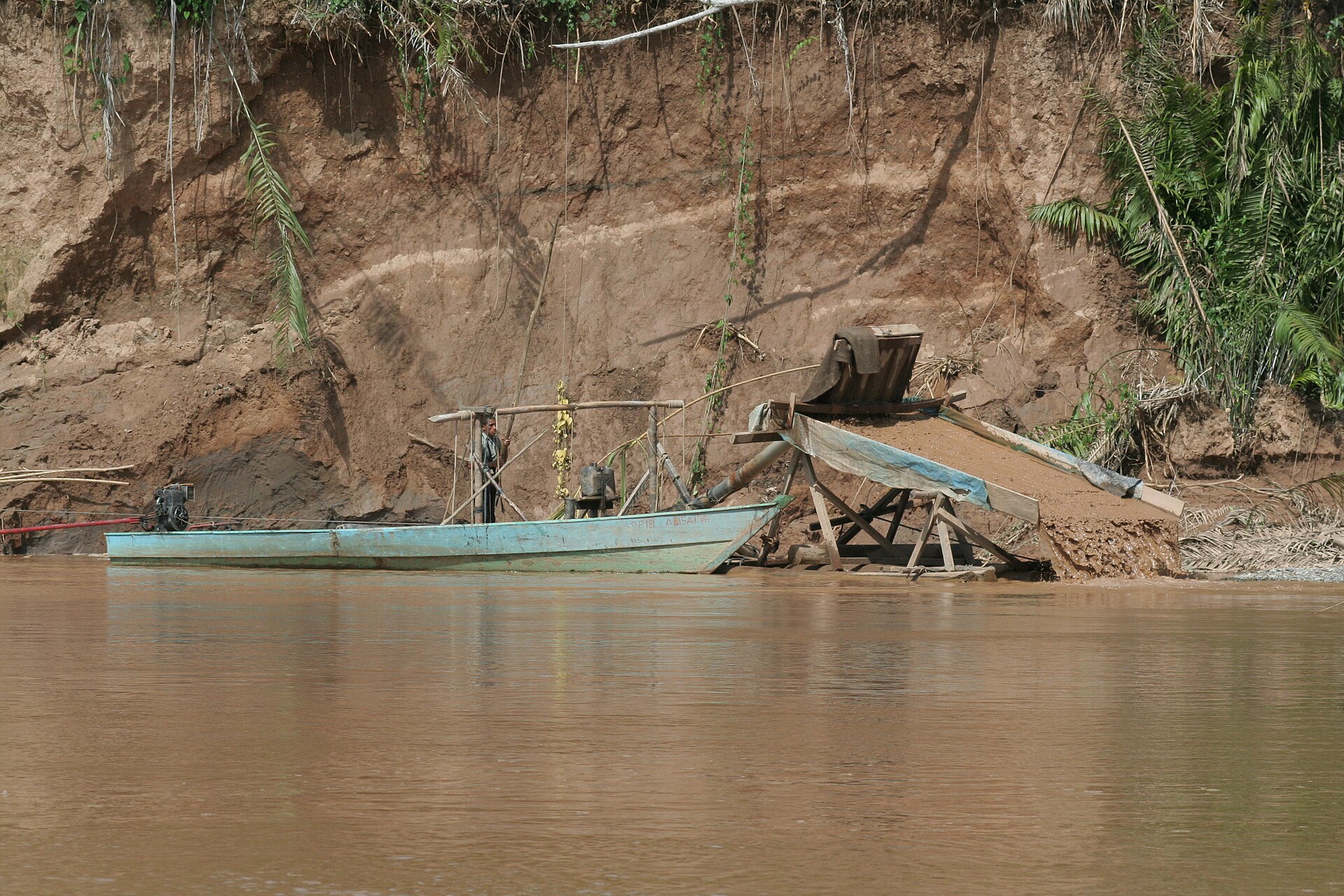
Illegal gold mining causes some of the most visible damage. In Madre de Dios, dredges and pumps have stripped riverbanks and forest, and miners use mercury to bind the gold.
Mercury enters rivers and fish and can harm the people who eat them. Peruvian authorities have run repeated police and military operations against illegal mining camps.
In Pataz, a gold district in La Libertad, illegal mining has been tied to violence. Thirteen kidnapped contract workers from a gold mine there were found murdered in May 2025.
Big formal mines face different conflicts, over water, land, pollution and a share of the profits. The Defensoría del Pueblo, Peru’s ombudsman, lists socio-environmental disputes as the largest category of social conflict.
Las Bambas has faced repeated road blockades by communities along its ore-transport route. Southern Copper’s Tía María project in Arequipa was delayed for years by local opposition.
Oil has its own record of spills. In January 2022 crude spilled into the sea at the La Pampilla refinery near Lima, run by Spain’s Repsol.
Older mines left a legacy too. La Oroya, a smelter town in Junín, became known for heavy lead pollution before its smelter shut in 2009.
A company owned by former workers restarted part of the complex in October 2023, Forbes Perú reported. Its zinc circuit was the first section to resume.
What It Means for US Readers
Several companies that mine in Peru trade on US exchanges, including Southern Copper, Freeport-McMoRan, Newmont and Buenaventura. Peruvian strikes, permits and taxes can therefore move US portfolios.
Peru’s copper feeds the global supply behind power grids, data centres and electric cars. Its fruit fills US supermarket shelves during the northern winter.
The US-Peru Trade Promotion Agreement, in force since 2009, removed most tariffs on trade between the two countries. China is also a major buyer and investor, a rivalry set out in the Rio Times guide to Peru geopolitics.
For travellers, mining conflicts can mean road blockades in the southern Andes, including routes in Cusco and Apurímac. Visitors to Madre de Dios should use licensed tour operators and stay away from mining zones.
Monthly output data, such as the July 2026 copper report, show how quickly the picture changes. Broader news is on the Rio Times Peru page.
What Is Not Known
It is not known how much of Peru’s gold exports come from illegal mines. Official statistics show the gap between recorded output and exports, but not its sources.
Complete official oil output figures for 2026 could not be confirmed. The size of the second 2026 anchovy season was also not confirmed.
It is unclear how long high copper and gold prices will last, and with them the record mining income of 2026. Future rules for small miners remain under debate in Congress.
Frequently Asked Questions
What are Peru’s main natural resources?
Copper, gold, silver and zinc lead, followed by natural gas, oil, fishmeal, fruit and Amazon forests. Mining made up about two thirds of goods exports in 2025.
Is Peru the world’s largest copper producer?
No. The USGS ranks Peru third in 2025, behind Chile and the Democratic Republic of Congo, with about 2.7 million tonnes.
Who owns Peru’s biggest mines?
Mostly foreign groups, including Grupo Mexico, Freeport-McMoRan, China’s MMG, Anglo American, BHP, Glencore and Newmont. Peruvian firms such as Buenaventura and Poderosa also play a large role.
How much does Peru earn from mining?
Mining exports reached US$62.7 billion in 2025, by central bank data. Mining transfers to regions and towns exceeded S/10 billion, about US$2.9 billion.
What is the canon minero?
It is the half of mining income tax that the state sends to producing regions and municipalities. It reached S/6.99 billion, about US$2.0 billion, in 2025.
What is the biggest environmental problem linked to Peru’s resources?
Illegal gold mining in the Amazon, which clears forest and releases mercury into rivers, is among the most serious. Water disputes around big mines and oil spills are other recurring problems.
Can US investors gain exposure to Peru’s resources?
Yes, several miners active in Peru are listed in New York, including Southern Copper, Freeport-McMoRan, Newmont and Buenaventura. Prices and Peruvian politics make these holdings volatile, and this is not investment advice.
Sources: Ministry of Energy and Mines (MINEM), Boletín Estadístico Minero, December 2025; Banco Central de Reserva del Perú, trade statistics 2025–2026; USGS Mineral Commodity Summaries 2026: copper, silver, zinc, gold; INEI 2025 census, via Andina; MINAM Geobosques; Ministry of Production anchovy quota, via Infobae Perú; Defensoría del Pueblo (all accessed 9 October 2026).
This article was produced by The Rio Times’ automated newsroom system. How we use AI · Report an error · Editorial responsibility: Matthias Camenzind, Editor-in-Chief