Mexico Stocks Fall 0.12% as Peso Gains | Mexico Market Report, Oct 30
Key Facts
- Mexico’s S&P/BMV IPC stock index fell 0.12% to 69,705 points on Friday, its first loss in two sessions, and ended the week 0.25% lower.
- The dollar fell 0.51% to 18.77 pesos, a day after it reached its highest close in 12 months.
- Consumer shares led while miners lagged: retailer Walmart de México rose 3.42%, bakery Grupo Bimbo 4.22%, copper miner Grupo México lost 4.01%.
- For US investors: the iShares MSCI Mexico ETF (EWW), a US-listed Mexico fund, ended unchanged at US$74.47.
- Prediction markets: Polymarket, a prediction market, puts 83.5% on no change in Mexico’s interest rate in November, as of 30 October 2026, 7:11 pm ET.
Today’s Focus
Mexico’s S&P/BMV IPC fell 0.12% to 69,705 points on Friday 30 October, a small move on a day when Wall Street sold off hard. The S&P 500, the main US index, lost 1.82%, the Nasdaq, the tech-heavy index, lost 2.86%, and the main indexes of Chile (IPSA) and Brazil (Ibovespa) lost 2.76% and 0.75%.
The dollar fell 0.51% to 18.77 pesos, a day after it reached its highest close in 12 months. It helped that INEGI, Mexico’s statistics office, estimated third-quarter growth of 0.9% from the second quarter, above the 0.7% forecast, and 3.2% from a year earlier, above the 2.5% forecast.
Mexico’s index holds few technology stocks, so it escaped most of the US sell-off that followed results and spending plans from Intel, the chipmaker, and Amazon, the online retailer and cloud provider, and consumer names such as retailer Walmart de México and bakery group Grupo Bimbo rose. The drag came from miners, as Grupo México, the copper miner, lost 4.01% and Peñoles, the silver and gold producer, 3.50% on a day when gold fell 2.00%.
What matters today. For a US investor, Mexico acted as a shelter in Latin America this week, and the next tests are the US midterm elections on Tuesday 3 November and the central bank’s rate decision on Thursday 5 November.

01 The session in one read
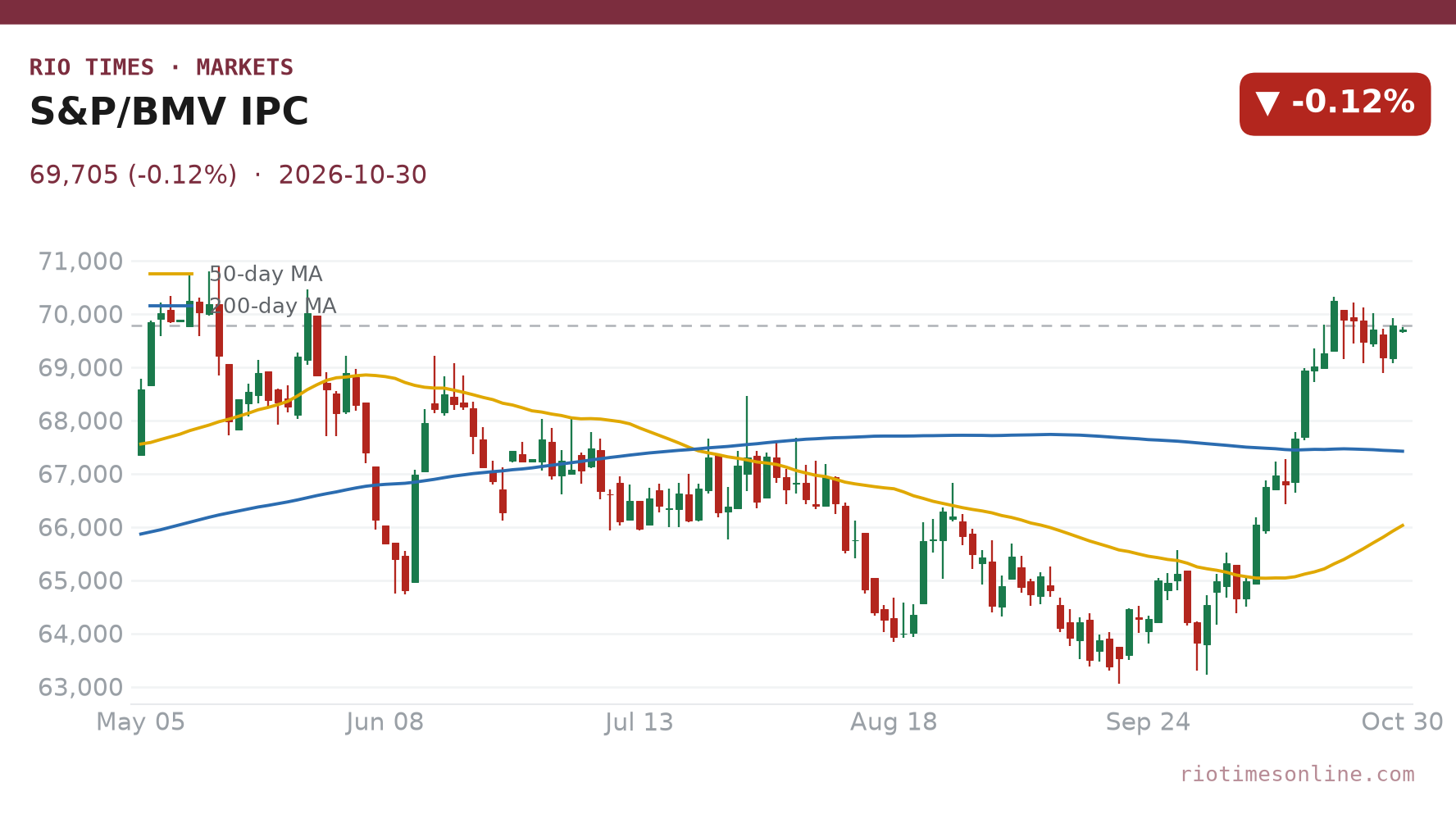
The S&P/BMV IPC closed at 69,705 points on Friday 30 October, down 0.12%, and ended the week 0.25% below its 23 October close. It is still up 8.02% over 20 sessions and 5.0% over 60 sessions, and it sits 2.6% below its 12-month high of 71,601 from 11 February.
Over the past 12 months the benchmark has ranged between 61,672 on 20 November 2025 and 71,601, so it stands 13.0% above its low. This week its daily closes held between 69,182 on Wednesday and 69,787 on Thursday, a band of less than 1%.
The peso moved against the regional trend: the dollar fell 0.51% against it, while the dollar rose 1.12% against Brazil’s real, 1.83% against Colombia’s peso and 0.52% against Chile’s peso. The global dollar index slipped only 0.07%, so the peso’s strength was local and not a world-wide dollar decline.
We rank the causes by weight: the first, with medium confidence, is Mexico’s low exposure to the US technology sell-off, shown by the Mexican benchmark falling 0.12% while the Nasdaq fell 2.86%. The second, also medium, is the growth beat and the peso’s strength, and the third, which we rate low, is weaker metal prices that weighed on Grupo México and Peñoles.
The variable to watch is the dollar: it stands at 18.77 pesos after rising 3.36% in 20 sessions, and a close above 18.87 would end the calm. The next scheduled test is the central bank’s decision on Thursday 5 November, where Polymarket traders see no change at 83.5%.
02 The day’s numbers
| Measure | Level | Change | Read |
|---|---|---|---|
| S&P/BMV IPC | 69,705 | −0.12% | Mild fall, week lower |
| USD/MXN | 18.7720 | −0.51% | Peso stronger |
| S&P 500 | 7,580 | −1.82% | Wall Street sold off |
| Nasdaq | 25,437 | −2.86% | Tech shares led the fall |
| VIX volatility | 19.42 | +12.91% | Fear gauge jumped |
| US dollar index | 101.96 | −0.07% | Global dollar steady |
The peso’s gain came on a day when fear rose, which is unusual for an emerging-market currency. It suggests that investors read Mexico’s growth data and its 6.50% policy rate as a reason to hold pesos.
The US 10-year Treasury yield, the benchmark price of dollar borrowing, held near 4.93%, so the US shock arrived through share prices and not through higher yields. The VIX, Wall Street’s fear gauge, rose 12.91% to 19.42. Rio Times · Live Market Intelligence
Live Market IntelligenceMexico — Live Market Board
Mexico — Live Market Board
Instrument Last Change YoY Prev. High Low Volume
IPC MEX
69,705.03
-0.12%
+12.74%
69,787.41
70,008
69,383
49,372,306
USD/MXN
18.69
+0.62%
+1.45%
18.57
18.69
18.54
—
WALMEX
49.53
-1.51%
-19.45%
50.29
50.54
49.44
2,069,310
GMEXICO
231.81
+1.57%
+50.31%
228.22
233.41
228.50
1,952,754
FEMSA
232.97
+0.18%
+32.20%
232.54
234.49
230.40
277,092
CEMEX
19.60
+3.48%
+14.42%
18.94
19.63
18.95
9,927,197
GFNORTE
214.68
+0.29%
+24.39%
214.07
215.30
212.24
5,714,524
BIMBO
64.27
+1.56%
+3.36%
63.28
64.60
62.11
988,269
TELEVISA
8.33
-1.77%
-9.16%
8.48
8.52
8.31
1,277,288
AMX
22.47
-0.27%
+7.56%
22.53
22.74
22.39
7,217,012
GAP
418.59
+0.34%
+5.26%
417.18
423.09
413.53
190,130
ASUR
249.54
-1.02%
-18.40%
252.11
253.66
248.64
24,784
OMA
229.76
+0.06%
-3.04%
229.62
231.99
227.86
119,261
KOF
213.92
-0.39%
+31.99%
214.75
216.94
211.01
518,660
GRUMA
245.16
-0.93%
-22.90%
247.46
248.39
245.00
101,929
KIMBER
37.80
+0.13%
+7.64%
37.75
38.38
37.80
2,154,177
AMX ADR
24.01
-0.70%
+5.59%
24.18
24.37
23.99
1,024,581
03 Why it moved — low tech exposure, stronger growth and weak miners
The first cause is Mexico’s low exposure to the US technology sell-off. The S&P 500 fell 1.82% and the Nasdaq 2.86% after results and spending plans from Intel and Amazon raised doubts about the payback on artificial-intelligence investment, but the Mexican benchmark holds few technology stocks and fell only 0.12%.
The second cause is the growth data. INEGI estimated on Friday that the GDP growth rate for the third quarter was 0.9% from the second quarter, above the 0.7% forecast and below 1.4% in the second quarter, and 3.2% from a year earlier, above the 2.5% forecast and up from 2.1% in the second quarter.
Services grew 1.1% and industry 0.8% from the second quarter, while farming fell 0.4%. Growth in the first nine months was 1.9% above the same period of 2025.
That matters for stocks and the peso because faster growth supports company sales and tends to make it harder for Banxico, the central bank, to cut its 6.50% policy rate quickly. A high rate helps the peso, because it pays investors to hold pesos instead of dollars, and it hurts borrowers such as retailers and homebuilders that carry debt.
The public finances gave a quieter signal. Hacienda, the finance ministry, reported on Friday that the public-sector fiscal balance for January to September was a deficit of 968.5 billion pesos (about US$52 billion), which it described as below the programmed path.
The government keeps its full-year deficit target of 4.1% of GDP, the size of the economy. It puts public debt at 52.6% of GDP, or 19.55 trillion pesos (about US$1.04 trillion), and expects about 54% by the end of the year.
Companies explain the rest. Walmart de México, the largest retailer, gained 3.42% and Grupo Bimbo, the bakery group, 4.22%, both consumer names that sell mainly at home, so they did not depend on US technology.
Femsa, owner of the OXXO convenience stores, gained 1.20%, América Móvil, the telecom carrier, 1.36%, and Grupo Aeroportuario del Pacífico, the airport operator, 2.02%. These gains offset losses in banks and cement, where Banorte, a large bank, lost 0.51% and Cemex, the cement group, 1.17%.
The drag came from miners. Grupo México, the copper miner, lost 4.01% and Peñoles, the silver and gold producer, lost 3.50% on a day when gold fell 2.00% to US$3,928 an ounce, which fits a sell-off across assets, although neither company gave a reason for its fall.
04 The day’s movers
| Driver | Level / Move | Change | Note |
|---|---|---|---|
| Grupo Bimbo (BIMBOA) | Bakery group | +4.22% | Home-demand name |
| Walmart de México (WALMEX) | Largest retailer | +3.42% | Sells mainly at home |
| Grupo Aeroportuario del Pacífico (GAPB) | Airport operator | +2.02% | Travel demand |
| América Móvil (AMXB) | Telecom carrier | +1.36% | Defensive income |
| Femsa (FEMSAUBD) | Convenience stores | +1.20% | Home-demand name |
| Banorte (GFNORTEO) | Bank | −0.51% | Small fall with rates |
| Cemex (CEMEXCPO) | Cement group | −1.17% | US shares fell 1.20% |
| Peñoles (PE&OLES) | Silver and gold miner | −3.50% | Gold fell 2.00% |
| Grupo México (GMEXICOB) | Copper miner | −4.01% | Metal-price sensitive |
The pattern is clear: stocks tied to Mexican consumers and travel rose, while miners, a bank and the cement group fell. This is the signature of a day driven by metals and global risk, not by a Mexico-specific shock.
In New York the iShares MSCI Mexico ETF (EWW), which holds Mexican shares priced in dollars, ended unchanged at US$74.47 because the peso’s strength offset the small local fall. América Móvil’s US shares gained 1.45% to US$24.48, those of Coca-Cola Femsa, the bottler, 0.16% to US$115.68, and Cemex’s lost 1.20% to US$10.70.
05 The regional scoreboard
| Index | Country | Change |
|---|---|---|
| S&P/BMV IPC | Mexico | −0.12% |
| Ibovespa | Brazil | −0.75% |
| IPSA | Chile | −2.76% |
| COLCAP | Colombia | +0.04% |
Chile’s IPSA fell 2.76%, the steepest drop of the markets we can verify, while Brazil’s Ibovespa fell 0.75% and Colombia’s main index, the COLCAP, edged up 0.04%. We have no verified Friday close for Argentina’s Merval, so the table shows no figure.
The dollar fell 0.51% against the Mexican peso and 0.29% against the Argentine peso, while the dollar rose 1.12% against Brazil’s real, 1.83% against Colombia’s peso and 0.52% against Chile’s peso. That makes Mexico’s currency strength among the clearest in a region that mostly weakened, which points to local support such as growth data and a policy rate of 6.50%.
06 The technical picture
The benchmark closed at 69,705, inside a narrow band, with weekly closes between 69,182 on Wednesday 28 October and 69,787 on Thursday 29 October. The nearest support is that Wednesday close of 69,182 and then 67,663 from 15 October, while the nearest resistance is the 70,250 close of 21 October and then the 12-month high of 71,601.
RT’s own price history since 2007 holds 33 earlier cases of a 20-session gain at least as large as this one, which is 8.0%. In 16 of them (48%) the index was higher 20 sessions later, but the median result was a 0.4% decline, the worst a 12.9% decline and the best a 13.5% gain, and history is not a forecast.
For a US investor the gain is smaller than it looks: the benchmark rose 8.02% in 20 sessions but the dollar also rose 3.36% against the peso, which leaves a gain of about 4.5% in dollars. Over 60 sessions the benchmark is up 5.0% while the dollar rose 9.6% against the peso, a loss of about 4% in dollar terms.
The dollar closed at 18.77 pesos, 0.5% below its 12-month high of 18.87 from 29 October and 11.2% above its 12-month low of 16.89 from 4 September. A close above 18.87 would set a new 12-month low for the peso.
What Prediction Markets Say
On Polymarket, a prediction market, traders put the chance that Banxico leaves its benchmark interest rate unchanged at its November meeting at 83.5%. They see a 16.6% chance of a cut of 0.25 percentage points.
Each of the other outcomes, a larger cut or any rise, is priced at 0.1%, and about US$165,500 has been traded on this market, as of 30 October 2026, 7:11 pm ET. Prices on prediction markets are bets, not polls or forecasts by officials.
Why we show this: prediction markets turn real-money bets into a live probability that moves within minutes of the news, which is why investors, campaigns and newsrooms in the United States now follow them closely. We show them next to polls and official results, never instead of them.
07 What to watch
- Monday 2 November: The Mexican stock exchange is closed for Day of the Dead (All Souls’ Day), so the next session is Tuesday 3 November, the day of the US midterm elections.
- Tuesday 3 and Wednesday 4 November: Business confidence for October (forecast 48.2, previous 48.0) and the S&P Global manufacturing PMI (forecast 50.1, previous 50.3) come on Tuesday, and consumer confidence (forecast 45.0, previous 45.1) on Wednesday; weak readings would test the growth story.
- Banxico, Thursday 5 November: The central bank decides on its 6.50% policy rate; Polymarket traders see no change as most likely at 83.5%, and a cut would reduce the peso’s appeal to investors who earn interest on it.
- The dollar at 18.87 pesos and the benchmark at 69,182: A dollar close above 18.87 pesos would end the peso’s calm, and a benchmark close below 69,182 would show that buyers have lost control of this week’s range.
Background: Mexico Stocks Rise 0.87% as Peso Falls 1.2%.
Background: Mexican Store Giant Femsa Profit Jumps 81%.
Frequently Asked Questions
Why did Mexican stocks fall only 0.12% on Friday 30 October?
Mexico’s benchmark holds few technology stocks, so it escaped most of the US sell-off, and consumer names such as Walmart de México rose. Miners such as Grupo México lost ground as gold fell 2.00%.
Did the Mexican peso strengthen on Friday?
Yes. The dollar fell 0.51% to 18.77 pesos after INEGI estimated third-quarter growth of 0.9%, above the 0.7% forecast.
What do Friday’s official data show about Mexico’s economy?
INEGI, the statistics office, estimates growth of 0.9% from the second quarter and 3.2% from a year earlier. Hacienda, the finance ministry, reports a public-sector deficit of 968.5 billion pesos (about US$52 billion) for January to September.
What happens next for Mexican interest rates?
Banxico, Mexico’s central bank, decides on its 6.50% policy rate on Thursday 5 November. Polymarket, a prediction market, shows put 83.5% on no change, as of 30 October 2026, 7:11 pm ET.
Market data: The Rio Times; exchange figures from BMV
Primary sources: INEGI GDP estimate (30 October); Hacienda public finance reports (30 October); Banco de México; Polymarket. Related coverage: Mexico Economy Grows 0.9% in Third Quarter; Mexico Deficit Hits US$52B, Below Plan.
This article was produced by The Rio Times’ automated newsroom system. How we use AI · Report an error · Editorial responsibility: Matthias Camenzind, Editor-in-Chief
In depth
LatAm Markets: Live Signals → — real-time movers, turnover leaders and FX across Latin America.
Get The Rio Times delivered to your inbox — market intelligence, daily briefs, and breaking analysis across Latin America.
Start for US$1