Brazil Stocks Fall 0.75% as Dollar Surges | Brazil Market Report, Oct 30
Key Facts
- Brazil’s main stock index, the Ibovespa, fell 0.75% to 167,922 points on Friday, its fifth straight loss and 18.12% below its 23 October close.
- The real weakened 1.12% to R$5.44 per US dollar, its weakest close since 30 December 2025, as the repricing after the election went on.
- Exporters held up while home-demand stocks fell: Vale, the iron-ore miner, rose 3.28%, while B3, the stock exchange itself, lost 5.42%.
- For US investors: the iShares MSCI Brazil ETF (EWZ), a US-listed Brazil fund, lost 2.05% to US$32.46.
- Prediction markets: Polymarket, a prediction market, puts 76.2% on an unchanged Brazilian interest rate in November, as of 30 October 2026, 6:19 pm ET.
Today’s Focus
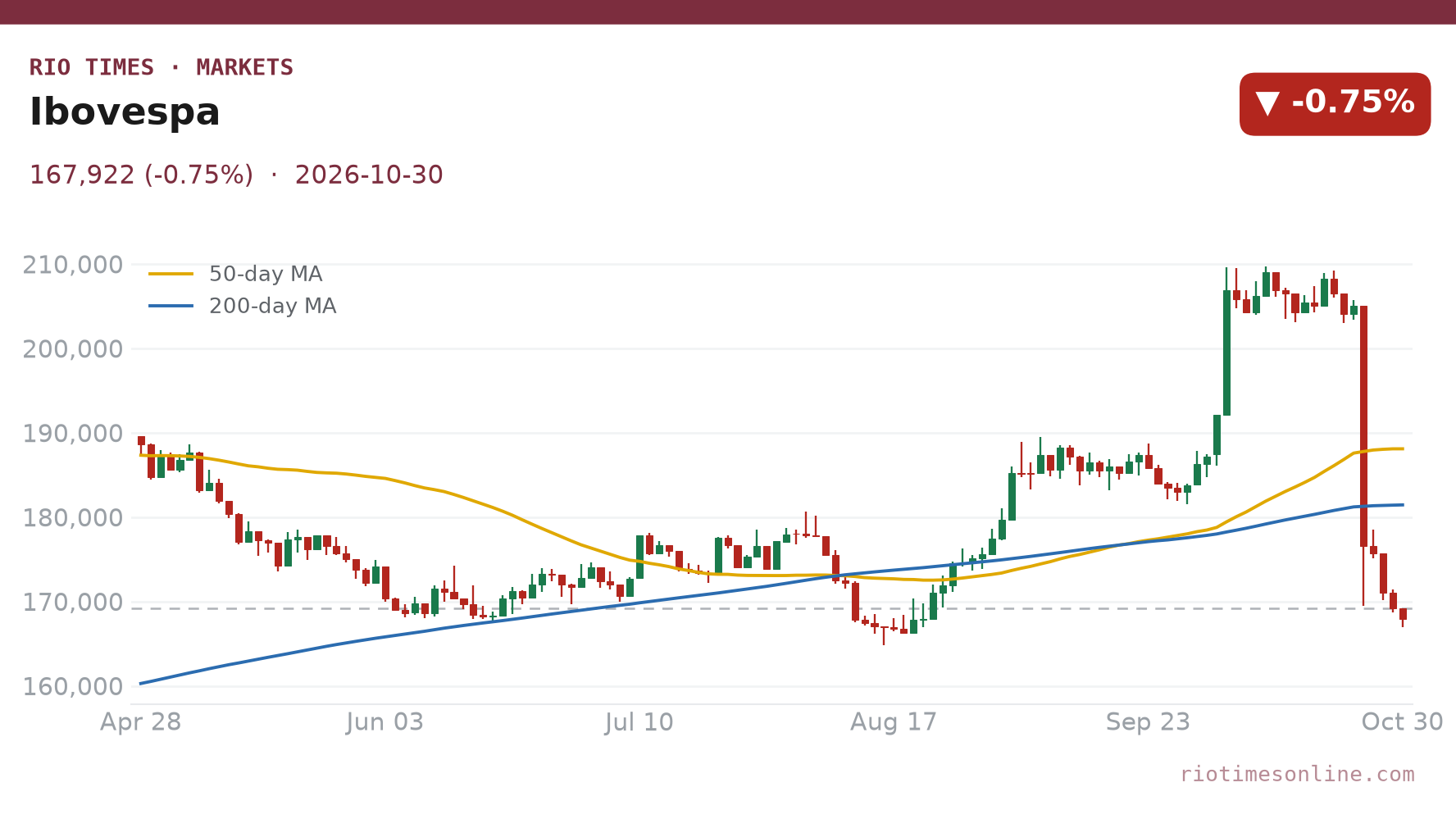
Brazil’s main stock index, the Ibovespa, fell 0.75% to 167,922 points on Friday 30 October, its fifth lower close in a row. It is the lowest close since 19 August and the index ended the week 18.12% below its 23 October close, the last session before the presidential runoff.
The real weakened 1.12% to 5.44 per US dollar, its weakest close since 30 December 2025. The main cause is a repricing of Brazil after President Luiz Inácio Lula da Silva’s re-election on 25 October, which ended bets on a change of government and on tighter public spending.
Wall Street made the day worse: the S&P 500, the main US stock index, fell 1.82% and the Nasdaq, the tech-heavy index, fell 2.86% after results from Intel, the chipmaker, and Amazon, the online retailer and cloud provider, raised doubts about the cost of artificial-intelligence spending. Brazil fell less than the Nasdaq because it had already lost 17.5% in the four sessions before, measured from its 23 October close.
What matters today. For a US investor, Brazil is trading as one fiscal bet, with shares, the real and interest rates falling together, and the next test is the central bank’s rate decision on Wednesday 4 November.

01 The session in one read
The Ibovespa closed at 167,922 points on Friday 30 October, down 0.75% from 169,186 on Thursday. The slide began on Monday 26 October with a 13.88% plunge and has not paused since, so the index ended the week 18.12% below its 23 October close, its worst week since March 2020.
October as a whole cost the index 9.88%, its worst month since June 2022, although it is still 4.22% higher than at the end of 2025. From its 12-month high of 209,067 on 9 October the index has lost 19.7%.
The dollar gained 9.31% against the real over the five sessions since 23 October. The global dollar index moved only 0.15% in the same period, so the weakness is Brazilian and not a world-wide dollar rally.
We rank the causes by weight, with high confidence in the first one. The first is a fiscal repricing after the election, shown by the real, shares and interest-rate futures all moving against Brazil while the US dollar index slipped 0.07%.
The second cause is the US technology sell-off, which we rate medium, and the third is foreign selling that feeds on both. The variable to watch is whether the government signals spending discipline before the central bank decides on interest rates on 4 November.
02 The day’s numbers
| Measure | Level | Change | Read |
|---|---|---|---|
| Ibovespa | 167,922 | −0.75% | Fifth straight loss |
| USD/BRL | 5.4410 | +1.12% | Real weakest since December |
| S&P 500 | 7,580 | −1.82% | Wall Street sold off |
| Nasdaq | 25,437 | −2.86% | Tech shares led the fall |
| VIX volatility | 19.42 | +12.91% | Fear gauge jumped |
| US dollar index | 101.96 | −0.07% | Global dollar steady |
The real’s 1.12% slide came on a day when the US dollar index barely moved, so the cause is local risk and not US monetary policy. That is why the fall reads as a verdict on Brazilian public finances.
The US 10-year Treasury yield, the benchmark price of dollar borrowing, stayed near 4.93%, so the US shock arrived through share prices and not through higher yields. The VIX, Wall Street’s fear gauge, jumped 12.91% to 19.42. Rio Times · Live Market Intelligence
Live Market IntelligenceBrazil — Live Market Board
Brazil — Live Market Board
Instrument Last Change YoY Prev. High Low Volume
IBOV
167,921.80
-0.75%
+19.56%
169,186.42
178,526
175,157
—
USD/BRL
5.34
-1.32%
-0.84%
5.42
5.42
5.30
—
SELIC
13.75%
—
—
—
—
—
PETR4
53.31
-1.06%
+77.70%
53.88
53.70
52.83
43,239,500
VALE3
62.88
-2.33%
+1.98%
64.38
64.43
62.80
24,652,300
ITUB4
41.42
-0.67%
+11.30%
41.70
42.60
41.15
28,160,700
BBDC4
15.69
-1.63%
-13.88%
15.95
16.30
15.67
65,766,400
BBAS3
17.59
+0.69%
-15.59%
17.47
18.31
17.51
67,844,600
B3SA3
15.27
+1.33%
+21.71%
15.07
15.78
15.20
75,282,000
ABEV3
15.40
+0.20%
+26.75%
15.37
15.68
15.31
27,307,400
WEGE3
45.78
+2.81%
+10.06%
44.53
47.08
45.06
9,823,200
PRIO3
69.21
-2.71%
+87.14%
71.14
70.98
69.15
6,663,200
SUZB3
47.14
-0.55%
-3.79%
47.40
47.84
46.10
7,151,800
RENT3
31.14
-1.67%
-20.73%
31.67
32.68
31.02
19,092,400
AZZA3
16.72
+1.15%
-42.24%
16.53
17.42
16.72
4,875,400
CSNA3
4.76
-4.99%
-47.09%
5.01
5.14
4.76
14,327,900
GGBR4
24.87
-2.28%
+36.28%
25.45
26.20
24.79
7,507,900
ENEV3
26.79
+0.45%
+49.78%
26.67
27.35
26.30
12,263,000
03 Why it moved — a fiscal repricing, a tech shock and foreign selling
The main cause is the election result. Many investors had bet on a change of government and on tighter public spending, and Lula’s re-election on 25 October unwound that trade.
Since the vote the government has given no signal of fiscal restraint, and investors are still waiting for its economic plan and its choice of ministers. That uncertainty is why the real, shares and interest rates are all falling together.
The cost shows in B3’s interest-rate futures, where the contract for January 2028 rose to 14.49%. That is well above the Selic, the central bank’s benchmark rate, which stands at 13.75%.
Brazil’s September budget balance, reported by the central bank on Thursday, was a nominal deficit of US$20.8 billion (R$113.0 billion), deeper than the forecast of US$18.4 billion (R$100 billion). The nominal figure includes interest, which cost US$19.8 billion (R$107.5 billion) in the month.
Excluding interest the public sector ran a small primary deficit of US$1.0 billion (R$5.5 billion), so the strain comes from the cost of the debt and not from day-to-day spending. Over 12 months the nominal deficit reached 9.51% of GDP, the size of the economy.
IBGE, the national statistics office, reported unemployment of 5.2% in the three months to September, matching forecasts and the lowest rate for that period since its series began in 2012. A tight job market supports wages and spending, which makes it harder for the central bank to cut interest rates quickly.
B3 data show net foreign selling of about US$1.4 billion (almost R$7.6 billion) in the secondary market over the first three sessions of the week. Foreigners tend to sell first when the real is falling, because a weaker currency cuts the dollar value of their shares.
On Wall Street the S&P 500 fell 1.82% to 7,580 and the Nasdaq 2.86% to 25,437, after results and spending plans from Intel and Amazon raised doubts about the cost and payback of artificial-intelligence investment. Gold also fell 2.00% to US$3,928 an ounce, a sign that investors sold across assets and not only technology.
Exporters were the shelter. Vale, the iron-ore miner, rose 3.28% to US$11.40 (R$62.02) even though its third-quarter profit fell about 53% to US$1.25 billion, because a fall was widely expected after lower iron-ore prices and higher transport costs.
Petrobras, the state-controlled oil company, gained 0.98% as oil edged up. Both companies earn dollars, so a weaker real raises the value of their income in reais.
04 The day’s movers
| Driver | Level / Move | Change | Note |
|---|---|---|---|
| B3 (B3SA3) | Stock exchange operator | −5.42% | Earnings track trading activity |
| CSN (CSNA3) | Steel and mining | −8.49% | Sharpest fall among big names |
| BTG Pactual (BPAC11) | Investment bank | −4.66% | Sensitive to rates and markets |
| Lojas Renner (LREN3) | Fashion retailer | −4.26% | Hurt by higher rates |
| Localiza (RENT3) | Car rental | −4.06% | Debt-heavy, rate-sensitive |
| Itaú (ITUB4) | Largest private bank | −2.15% | Banks fell with the curve |
| Vale (VALE3) | Iron-ore miner | +3.28% | Dollar earner |
| Petrobras (PETR4) | State-controlled oil company | +0.98% | Oil edged up |
| PRIO (PRIO3) | Independent oil producer | +1.45% | Dollar earner |
The pattern is clear: companies that earn dollars or depend on commodity prices rose, while the exchange, an investment bank, retailers, a car-rental group and the banks fell. This is the signature of a fiscal scare, because a weaker real helps exporters and higher interest rates hurt borrowers and consumer spending.
In New York the iShares MSCI Brazil ETF (EWZ), which holds Brazilian shares priced in dollars, fell 2.05% to US$32.46, more than the Ibovespa because it also carries the real’s fall. Itaú’s New York shares lost 3.26% to US$7.13 and those of Bradesco, another large private bank, 3.04% to US$2.55, while Vale’s rose 1.88% to US$11.39 and Petrobras’s 0.68% to US$22.05.
05 The regional scoreboard
| Index | Country | Change |
|---|---|---|
| Ibovespa | Brazil | −0.75% |
| IPC | Mexico | −0.12% |
| IPSA | Chile | −2.76% |
| COLCAP | Colombia | +0.04% |
Chile’s main index, the IPSA, fell 2.76%, the steepest drop of the markets we can verify, while Mexico’s IPC slipped 0.12% and Colombia’s COLCAP edged up 0.04%. We have no verified Friday close for Argentina’s Merval, so the table shows a dash.
Currencies split too: the Mexican peso gained 0.51% against the dollar, while the Colombian peso lost 1.83% and the Chilean peso 0.52%. Brazil’s 1.12% fall in the real therefore sits in the middle of a mixed regional picture and points to a home-made cause.
06 The technical picture
The session’s low was 167,008 and the close, at 167,922, sat near the bottom of that range, so sellers kept control all day. The index now stands 19.7% below its 12-month high of 209,067 from 9 October and 14.3% above its 12-month low of 146,969 from 27 October 2025.
The nearest support is the 160,539 close of 2 January, the lowest close of 2026 so far, and the nearest resistance is Thursday’s 169,186 and then Wednesday’s 171,006. A close above 169,186 would be the first sign that buyers are returning.
RT’s own price history since 2007 holds 22 earlier cases of a 20-session fall at least as large as this one, which is 10.3%. In 10 of them (45%) the index was higher 20 sessions later, but the median result was a 0.7% decline and the worst a 24.5% decline, and history is not a forecast.
The dollar closed 2.7% below its 12-month high of 5.59 reais from 22 December 2025. A close above that level would set a new 12-month low for the real.
What Prediction Markets Say
On Polymarket, a prediction market, traders put the chance that Brazil’s central bank leaves its benchmark interest rate, the Selic, unchanged at its November meeting at 76.2%. They see a 22.5% chance of a cut of 0.25 percentage points.
A rise of 0.25 points is priced at 0.4%, and about US$121,000 has been traded on this market, as of 30 October 2026, 6:19 pm ET. Prices on prediction markets are bets, not polls or forecasts by officials.
Why we show this: prediction markets turn real-money bets into a live probability that moves within minutes of the news, which is why investors, campaigns and newsrooms in the United States now follow them closely. We show them next to polls and official results, never instead of them.
07 What to watch
- Monday 2 November: B3 is closed for All Souls’ Day, so the next test comes on Tuesday 3 November, the day of the US midterm elections.
- Copom, Wednesday 4 November: The central bank’s rate committee decides on the Selic, now 13.75%; Polymarket traders see no change as most likely, and a cut would ease pressure on borrowers.
- Government signals on spending: A statement on spending rules or the naming of a finance team would be the first sign the repricing is ending, while silence leaves the real exposed to a test of 5.59.
- Index levels: A close below 160,539 would break the 2026 low, and a close back above 169,186 would be the first sign that buyers are returning.
Background: Brazil Stocks Fall 1.06% as Bradesco Drops.
Background: Brazil Stocks Fall 2.68% as Banks Slide.
Frequently Asked Questions
Why did the Ibovespa fall on Friday 30 October?
The index fell 0.75% as investors kept repricing Brazil after Lula’s re-election as Brazil’s president, with no sign yet of fiscal restraint. A US technology sell-off and foreign selling added to the pressure.
How bad was the week for Brazilian stocks?
The Ibovespa ended the week 18.12% below its 23 October close, its worst week since March 2020. October as a whole fell 9.88%, the worst month since June 2022.
Did the Brazilian real weaken on Friday?
Yes. The dollar rose 1.12% to 5.44 reais, the weakest close for the real since 30 December 2025.
What happens next for Brazilian interest rates?
The central bank’s committee, Copom, decides on the Selic, now 13.75%, on Wednesday 4 November. Polymarket, a prediction market, shows 76.2% on no change, as of 30 October 2026, 6:19 pm ET.
Market data: The Rio Times; exchange figures from B3
Primary sources: Banco Central do Brasil fiscal statistics (29 October); IBGE national household survey (30 October); B3 market data; Polymarket.
This article was produced by The Rio Times’ automated newsroom system. How we use AI · Report an error · Editorial responsibility: Matthias Camenzind, Editor-in-Chief
LatAm Markets: Live Signals → — real-time movers, turnover leaders and FX across Latin America.
Brazil runoff, Sunday, October 25: Brazil runoff date. Latest: Brazil runoff polls, Flávio 51%, Lula 49%.
Get The Rio Times delivered to your inbox — market intelligence, daily briefs, and breaking analysis across Latin America.
Start for US$1