
Published Friday, 30 October, 5:08 p.m. ET · Source: B3, Banco Central do Brasil, market data
Key Facts
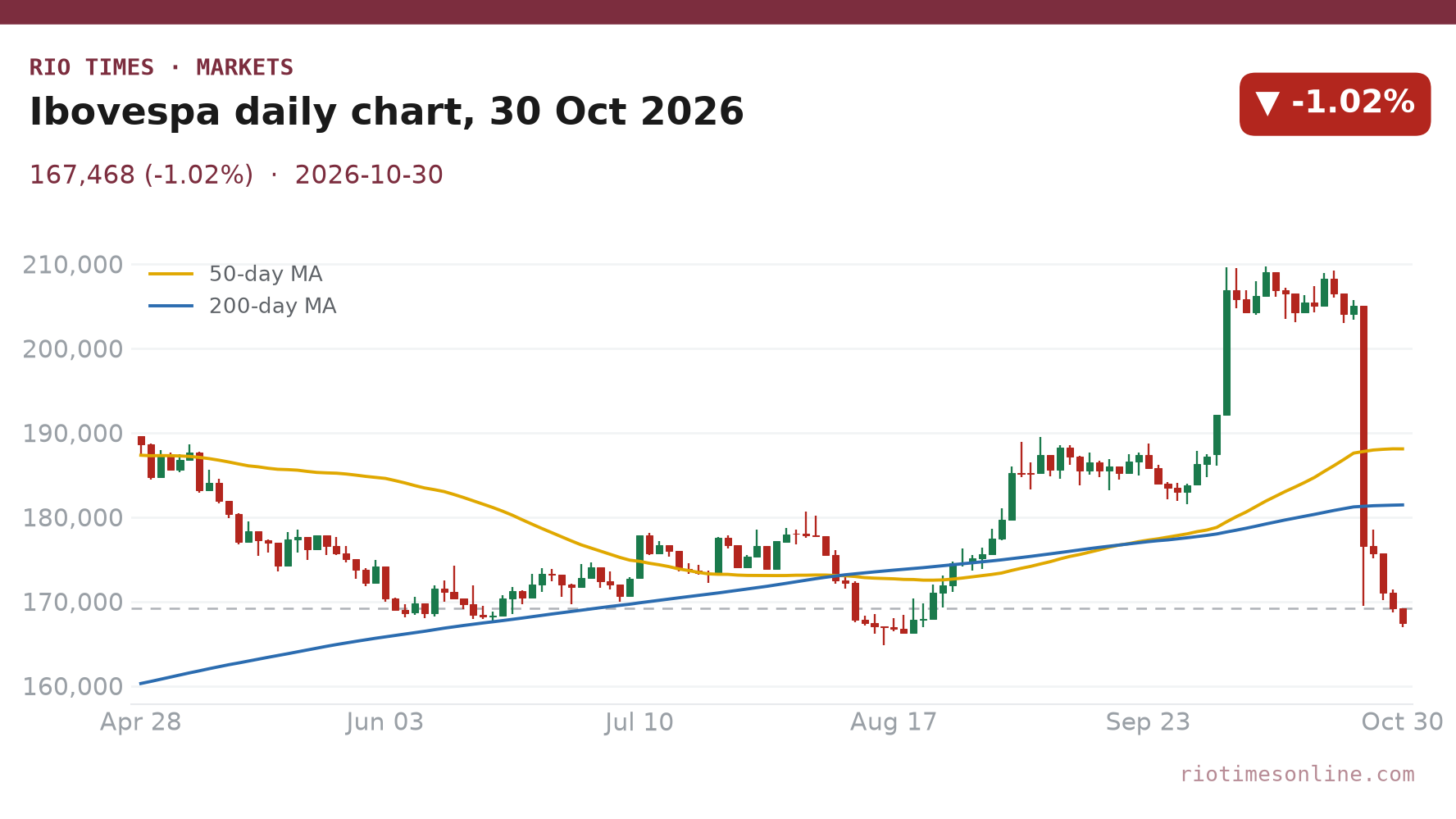
- The week. In the week to 30 October, Brazil’s Ibovespa stock index fell 18.3% to about 167,500 points, its worst week since March 2020.
- The currency. The US dollar rose nearly 10% against the Brazilian real, to roughly R$5.46.
- Your portfolio. EWZ, the iShares MSCI Brazil fund listed in the US, lost 23.8% in the same five sessions.
- Next. Brazil’s central bank announces its interest-rate decision on Wednesday 4 November, around 4:30 p.m. ET.
- Prediction markets. Polymarket, a prediction market, puts “no change” at the 4 November rate decision at 75.8% (30 October, 5:03 p.m. ET).
Investors spent the week after Lula’s reelection selling first and asking questions later. The Ibovespa, the benchmark index of Brazil’s biggest listed companies, ended the week to 30 October at about 167,500 points, down 18.3%.
That is the worst week for Brazilian stocks since March 2020, when the pandemic first hit, and the third-worst since 2000 by weekly closes. The Brazilian real, the national currency, lost about 9% against the US dollar over the same five sessions.
President Luiz Inácio Lula da Silva won a new term in the 25 October runoff, and markets opened on Monday in shock. Analysts say investors worry the next government will spend and borrow more, which would weigh on the wider Brazil economy.
How Bad Was the Week?
Most of the damage came on Monday 26 October, when the Ibovespa fell 13.88% to 176,608 points and a circuit breaker, the exchange’s emergency pause, stopped trading. The dollar jumped more than 8% against the real that day.
There was no bounce. The index fell again on Tuesday, Wednesday, Thursday and Friday, five straight losing sessions.
Ibovespa Closes, 26–30 October
- Monday: 176,608
- Tuesday: 175,710
- Wednesday: 171,006
- Thursday: 169,186
- Friday: about 167,500
The index ended the week almost 20% below its 208,296 close of 20 October. Only two weeks since 2000 were worse: 6 October 2008, in the financial crisis (down 20.0%), and 16 March 2020, at the start of the pandemic (down 18.9%).
Why Did Investors Run?
The sell-off is about money, not the vote itself. Analysts point to doubts about how the next government will manage spending and public debt.
That is why Brazilian stocks and the real fell together.When worry about debt rises, the real weakens and long-term interest rates climb together.That hurts stocks, because borrowing gets dearer and profits in reais are worth less in dollars.
In Plain English
- Ibovespa: the main index of Brazil’s biggest listed companies, traded on the B3 exchange in São Paulo.
- Real: Brazil’s currency. A weaker real means one US dollar buys more of it.
- Selic: Brazil’s central-bank interest rate, now 13.75% a year.
- Circuit breaker: an automatic pause in trading when prices fall too fast.
Live Market IntelligenceBrazil — Live Market Board
Rio Times · Live Market Intelligence
Brazil — Live Market Board
-1.02%
167,468.14
-1.02%
69,787.41
+0.87%
10,253.96
-2.76%
2,848,945
—
2,490.92
+0.04%
| Instrument | Last | Change | YoY | Prev. | High | Low | Volume |
|---|---|---|---|---|---|---|---|
| IBOV | 167,468.14 | -1.02% | +19.56% | 169,186.42 | 178,526 | 175,157 | — |
| USD/BRL | 5.34 | -1.32% | -0.84% | 5.42 | 5.42 | 5.30 | — |
| SELIC | 13.75% | — | — | — | — | — | |
| PETR4 | 53.31 | -1.06% | +77.70% | 53.88 | 53.70 | 52.83 | 43,239,500 |
| VALE3 | 62.88 | -2.33% | +1.98% | 64.38 | 64.43 | 62.80 | 24,652,300 |
| ITUB4 | 41.42 | -0.67% | +11.30% | 41.70 | 42.60 | 41.15 | 28,160,700 |
| BBDC4 | 15.69 | -1.63% | -13.88% | 15.95 | 16.30 | 15.67 | 65,766,400 |
| BBAS3 | 17.59 | +0.69% | -15.59% | 17.47 | 18.31 | 17.51 | 67,844,600 |
| B3SA3 | 15.27 | +1.33% | +21.71% | 15.07 | 15.78 | 15.20 | 75,282,000 |
| ABEV3 | 15.40 | +0.20% | +26.75% | 15.37 | 15.68 | 15.31 | 27,307,400 |
| WEGE3 | 45.78 | +2.81% | +10.06% | 44.53 | 47.08 | 45.06 | 9,823,200 |
| PRIO3 | 69.21 | -2.71% | +87.14% | 71.14 | 70.98 | 69.15 | 6,663,200 |
| SUZB3 | 47.14 | -0.55% | -3.79% | 47.40 | 47.84 | 46.10 | 7,151,800 |
| RENT3 | 31.14 | -1.67% | -20.73% | 31.67 | 32.68 | 31.02 | 19,092,400 |
| AZZA3 | 16.72 | +1.15% | -42.24% | 16.53 | 17.42 | 16.72 | 4,875,400 |
| CSNA3 | 4.76 | -4.99% | -47.09% | 5.01 | 5.14 | 4.76 | 14,327,900 |
| GGBR4 | 24.87 | -2.28% | +36.28% | 25.45 | 26.20 | 24.79 | 7,507,900 |
| ENEV3 | 26.79 | +0.45% | +49.78% | 26.67 | 27.35 | 26.30 | 12,263,000 |
What It Means for US Readers
Dollar investors took a double hit. EWZ, the US-listed fund that tracks Brazilian stocks, fell 23.8% in the week, because it loses on both the index and the weaker real.
As a rule, exporters paid in dollars gain from a weaker real, since their revenue in reais rises. Companies with dollar debt and households that buy imported goods usually lose.
For travellers and expats paid in dollars, US$1 now buys about R$5.46, against about R$4.98 a week earlier. That is roughly 10% more, though prices in reais have not fallen.
What Comes Next for Brazil’s Markets
The next test is Wednesday 4 November, around 4:30 p.m. ET, when the central bank’s rate committee, known as Copom, announces its interest-rate decision. The Selic, the benchmark rate, stands at 13.75% a year, and traders on Polymarket expect no change.
A close above Monday’s 176,608 would be the first sign the index is stabilising. A slide toward 160,000 would show the sell-off feeding on itself.
What is not known: who will run economic policy, and whether the new government will cap spending. Until then, expect large swings in both directions.
What Prediction Markets Say
- Polymarket, a prediction market where users bet real money, on the central bank’s November decision (market title “Bank of Brazil decision in November?”): no change 75.8%, 25 basis-point cut 23.0%, 25 basis-point rise 0.4% (US$121,476 traded).
Prices as of 5:03 p.m. ET, 30 October 2026. Prices are bets, not polls; Kalshi is regulated in the US by the CFTC.
Why we show this: prediction markets turn real-money bets into a live probability that moves within minutes of the news, which is why investors, campaigns and newsrooms in the United States now follow them closely. We show them next to polls and official results, never instead of them.
Background: Brazil Election Polls Missed Lula’s 51.8% Win.
Background: Brazil Tax Reform 2026 Replaces Five Taxes With Two VATs.
Sources
B3, Ibovespa index · Banco Central do Brasil, Copom · Polymarket, November rate decision market · RT, market data
This article was produced by The Rio Times’ automated newsroom system. How we use AI · Report an error · Editorial responsibility: Matthias Camenzind, Editor-in-Chief
Brazil runoff, Sunday, October 25: Brazil runoff date. Latest: Brazil runoff polls, Flávio 51%, Lula 49%.
Frequently Asked Questions
How much did Brazil’s stock market fall this week?
The Ibovespa fell 18.3% in the week to 30 October 2026, closing at about 167,500 points. It is the worst week since March 2020.
Why did Brazil’s real weaken after the election?
Investors worry about spending and debt under the new government, so they sold Brazilian assets and bought dollars. The dollar rose nearly 10% against the real in the week.