Chile Stocks Fall 2.76% on Wall Street Rout | Chile Market Report, Oct 30
Key Facts
- Chile’s main stock index, the IPSA, fell 2.76% to 10,254 points on Friday, its third straight loss and the lowest close in at least three months.
- The Chilean peso weakened 0.52% to 993.37 per US dollar, close to its 12-month low against the dollar set on 23 October.
- Airline, retail and lithium shares led the fall: LATAM lost 7.19%, retailer Cencosud 5.13%, lithium miner SQM-B 4.82%; utility Enel Américas rose 1.63%.
- For US investors: the iShares MSCI Chile ETF (ECH), a US-listed Chile fund, lost 2.20% to US$34.73.
- Prediction markets: Polymarket, a prediction market, puts 70.0% on another US Federal Reserve rate rise in 2026, as of 30 October, 7:12 pm ET.
Today’s Focus
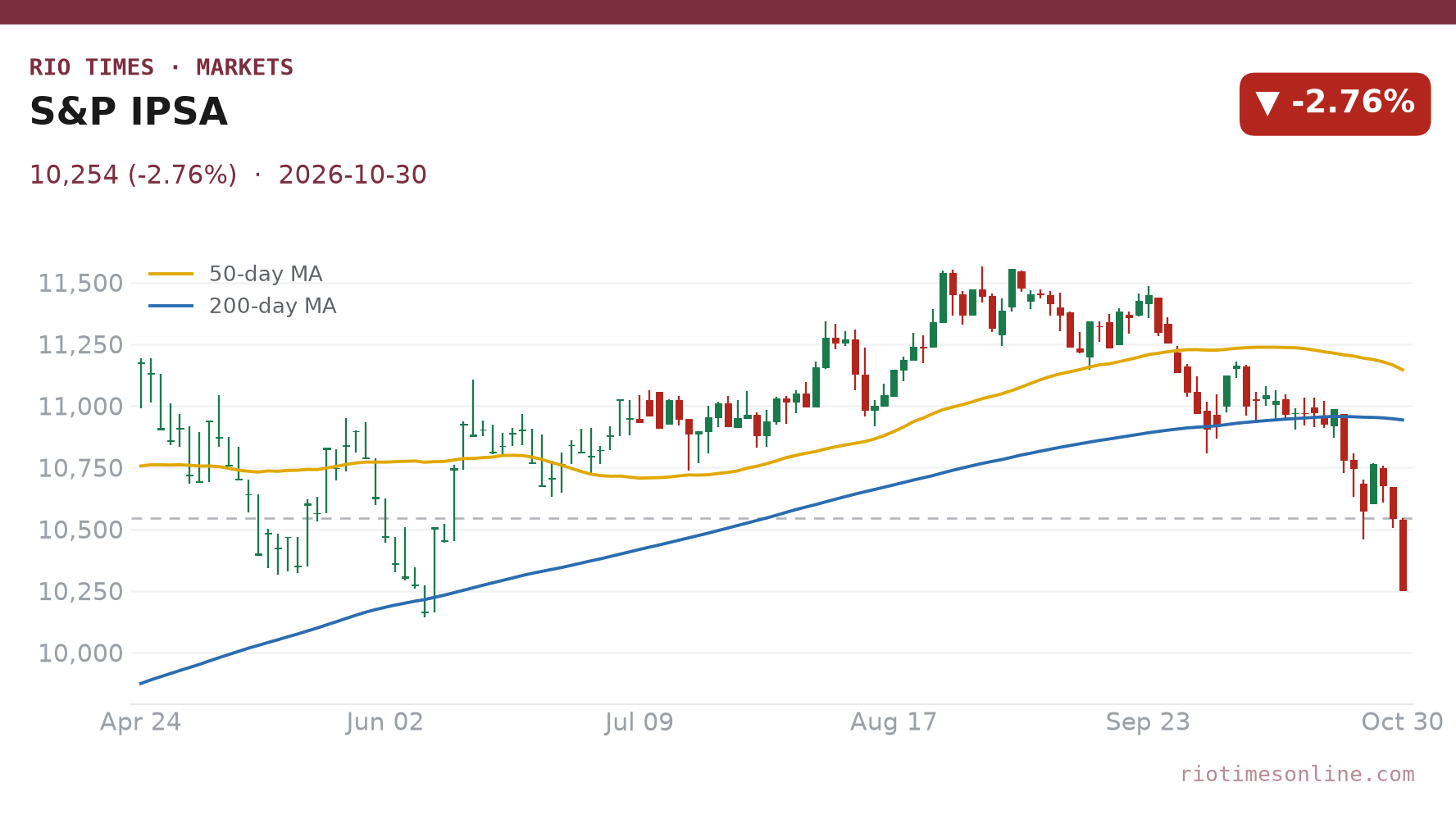
Chile’s main stock index, the IPSA, fell 2.76% to 10,254 points on Friday 30 October, its third lower close in a row. It was the lowest close in at least three months and a bigger fall than in Brazil, Mexico or Colombia.
The peso weakened 0.52% to 993.37 per US dollar, close to its 12-month low of 995.39 pesos per dollar from 23 October. The main cause was a global sell-off led by US technology shares, after results from Intel, the chipmaker, and Amazon, the online retailer and cloud provider, raised doubts about the cost of artificial-intelligence spending and pulled the S&P 500, the main US stock index, down 1.82%.
Chile’s airline LATAM, its large retailers and its lithium producer fell hardest, while September copper output dropped 15.1% from a year earlier. The decline in gold of 2.00% on the same day showed that investors were selling across assets.
What matters today. For a US investor, Chile is trading as a copper and risk-appetite market, with the ECH fund down 2.20%, and the next tests are Monday’s activity data and the US midterm elections on Tuesday 3 November.

01 The session in one read
The IPSA closed at 10,254 points on Friday 30 October, down 2.76% on the session. It has now fallen 4.58% over five sessions and 6.00% over 20 sessions, and it has closed lower three days in a row.
The index sits 11.8% below its 12-month high of 11,628 from 28 January and 11.1% above its 12-month low of 9,232 from 28 October 2025. Over 60 sessions the decline reaches 8.1%, so the weakness is a trend and not a one-day shock.
The peso lost 0.52% on the day, and the dollar has gained 8.8% against it over 60 sessions. The dollar closed 0.2% below its 12-month high of 995.39 pesos, so a new high would mean a new low for the peso.
We rank the causes by weight, with high confidence in the first one. The first is the global sell-off in technology shares, shown by the S&P 500 falling 1.82%, the VIX jumping 12.91% and gold falling 2.00% on the same day.
The second cause is weak Chilean copper output, which we rate medium, and the third is a regional move away from Latin American assets after Brazil’s sell-off, which we rate low. The variable to watch is Monday’s Economic Activity index for September, which the RT economic calendar forecasts at a fall of 2%.
02 The day’s numbers
| Measure | Level | Change | Read |
|---|---|---|---|
| IPSA | 10,254 | −2.76% | Third straight loss |
| USD/CLP | 993.37 | +0.52% | Peso near its weakest |
| S&P 500 | 7,580 | −1.82% | Wall Street sold off |
| Nasdaq | 25,437 | −2.86% | Tech shares led the fall |
| VIX volatility | 19.42 | +12.91% | Fear gauge jumped |
| Gold (US$/oz) | 3,928 | −2.00% | Sold with shares |
| US dollar index | 101.96 | −0.07% | Global dollar steady |
The peso’s 0.52% slide came while the US dollar index fell 0.07%, so the pressure on Chile’s currency was regional and not a broad dollar rally. That matters because a weaker peso raises the cost of imported fuel and goods for Chilean households.
The US 10-year Treasury yield, the benchmark price of dollar borrowing, stayed near 4.93%, so the US shock arrived through share prices and not through higher yields. The VIX, Wall Street’s fear gauge, jumped 12.91% to 19.42. Rio Times · Live Market Intelligence
Live Market IntelligenceChile — Live Market Board
Chile — Live Market Board
Instrument Last Change YoY Prev. High Low Volume
IPSA
10,253.96
-2.76%
—
10,545.26
10,722
10,633
—
USD/CLP
983.47
-0.57%
+5.64%
989.13
991.87
979.07
—
COPPER
6.65
+2.24%
+29.44%
6.51
6.66
6.54
37,751
SQM-B
59,350
+5.00%
+41.63%
56,525
59,500
56,800
139,333
COPEC
6,587
+1.26%
-0.72%
6,505
6,678
6,523
651,577
BSANTANDER
78.27
+0.22%
+18.23%
78.10
79.08
78.04
29,319,739
FALABELLA
6,537
+0.57%
+12.38%
6,500
6,569
6,451
521,197
ENELAM
83.60
-0.61%
-7.37%
84.11
85.95
83.33
17,436,403
CENCOSUD
1,818
-0.12%
-37.29%
1,820
1,836
1,810
1,172,754
CMPC
935.00
-0.52%
-28.63%
939.90
939.76
933.04
507,661
BANCO CHILE
192.44
+0.90%
+20.05%
190.73
192.99
190.73
16,978,917
LATAM AIR
22.04
+2.04%
+4.75%
21.60
22.20
21.81
859,178,133
SOUTHERN COPPER
192.19
+3.32%
+50.65%
186.01
193.86
185.75
649,631
03 Why it moved — a tech sell-off, weak copper output and regional caution
The main cause was Wall Street. The S&P 500 fell 1.82% to 7,580 and the Nasdaq, the tech-heavy index, fell 2.86% to 25,437, after results from Intel, the chipmaker, and Amazon, the online retailer and cloud provider, raised doubts about the cost and payback of artificial-intelligence spending.
Gold also fell 2.00% to US$3,928 an ounce, a sign that investors sold across assets and not only technology. Chile is an open, export-driven market, so it usually falls when global risk appetite falls.
The second cause is copper, Chile’s main export. Copper Production for September fell 15.1% from a year earlier to 387,870 tonnes, according to INE, the national statistics office, in line with the 15% fall in the RT economic calendar forecast (see <a href=”https://www.riotimesonline.com/chile-copper-output-september-2026-worst-quarter/”>Chile Copper Output Falls 15% in September</a>).
It was the third monthly drop in a row, after declines of 7.2% in July and 11.7% in August. INE pointed to a temporary stoppage at one large company and lower ore grades at several mines, which means less export income for the country and tighter copper supply for buyers.
Industrial Production fell 2.7% from a year earlier, against a forecast rise of 1.9%, because mining output fell 8.7% and subtracted 3.7 percentage points from the total. Manufacturing Production rose 2.0%, below the 3.0% forecast, led by a 12.5% jump in drinks as more bottled wine was sold to foreign buyers (see <a href=”https://www.riotimesonline.com/chile-industry-retail-september-2026/”>Chile Industry Falls, Shops Beat Forecasts</a>).
Retail Sales beat forecasts: retail activity rose 4.4% from a year earlier against a forecast of 3.6%, and 1.0% from August after a forecast fall of 0.3%. Online and mail sales rose 20.3%, so consumers kept spending even as mining output shrank.
Strong shops and weak mines mean the home economy was not the problem on Friday, which is why the fall in retail shares reads as a market-wide risk move and not a verdict on shoppers. The weak copper data hurts Chile’s export income but helps the case for higher copper prices.
On the price side, Cochilco, the state copper commission, raised its 2027 average copper forecast to US$5.95 a pound from US$5.10 and put the 2026 average at US$6.18 (see <a href=”https://www.riotimesonline.com/chile-cochilco-raises-copper-price-forecast-us5-95-2027″>Cochilco’s new copper forecast</a>). It expects only small refined-copper surpluses of 144,000 tonnes in 2026 and 215,000 tonnes in 2027, because mine output is responding only weakly to demand.
Regional caution added to the move. Brazil’s post-election sell-off, with the real down 1.12% on the same day, kept buyers wary of Latin American assets, but this is the cause we trust least because Mexico’s index fell only 0.12% and Colombia’s rose 0.04%.
04 The day’s movers
| Driver | Level / Move | Change | Note |
|---|---|---|---|
| LATAM (LTM) | Regional airline | −7.19% | Sharpest fall among big names |
| Cencosud (CENCOSUD) | Retailer and malls | −5.13% | Debt-heavy retailer |
| SQM-B | Lithium producer | −4.82% | Global risk-off |
| Falabella (FALABELLA) | Department stores and bank | −4.32% | Consumer and rate sensitive |
| Enel Chile (ENELCHILE) | Power utility | −3.33% | Defensive name still fell |
| Banco de Chile (CHILE) | Largest bank by turnover | −3.18% | Banks fell with the market |
| Banco Santander Chile | Bank | −1.95% | Smaller fall than peers |
| Copec (COPEC) | Fuel and forestry group | −1.68% | Oil-linked costs |
| CMPC | Pulp and paper | −0.53% | Dollar earner held up |
| Enel Américas (ENELAM) | Power utility | +1.63% | Best large name |
| ILC | Insurance and finance group | +3.46% | Top gainer of the day |
The pattern is a broad risk sell-off: retailers, the lithium producer, banks and utilities fell, while only a few defensive and dollar-earning names held up. Cencosud and Falabella carry the most debt and home-demand risk, so they react most when interest-rate and growth fears rise.
In New York the iShares MSCI Chile ETF (ECH), which holds Chilean shares priced in dollars, fell 2.20% to US$34.73. SQM’s New York shares lost 3.05% to US$54.65 and Banco de Chile’s lost 4.49% to US$36.55.
05 The regional scoreboard
| Index | Country | Change |
|---|---|---|
| IPSA | Chile | −2.76% |
| Ibovespa | Brazil | −0.75% |
| IPC | Mexico | −0.12% |
| COLCAP | Colombia | +0.04% |
Chile’s IPSA fell 2.76%, a bigger drop than Brazil’s Ibovespa at 0.75% and Mexico’s IPC at 0.12%, while Colombia’s main index, the COLCAP, edged up 0.04%. We have no verified Friday close for Argentina’s Merval, so it is left out of the table.
Currencies split too: the Mexican peso gained 0.51% against the dollar, while the Chilean peso lost 0.52%, the Brazilian real 1.12% and the Colombian peso 1.83%. Chile’s fall therefore combines the global shock with copper and a regional move away from local assets.
06 The technical picture
The IPSA closed at 10,254, its lowest close in at least three months. The nearest hard levels are the 12-month low of 9,232 from 28 October 2025, 11.1% below Friday’s close, and the 12-month high of 11,628 from 28 January.
RT’s own price history since 2007 holds 46 earlier cases of a 20-session fall at least as large as this one, which is 6.0%. In 29 of them (63%) the index was higher 20 sessions later, with a median gain of 3.0%, but the worst result was a 22.6% decline, and history is not a forecast.
The dollar closed 0.2% below its 12-month high of 995.39 pesos from 23 October, and above its 12-month low of 851.67 from 9 February. A close above 995.39 would mark a new 12-month low for the peso.
What Prediction Markets Say
On Polymarket, a prediction market, traders put the chance of another US Federal Reserve interest-rate rise in 2026 at 70.0%. About US$1.2 million has been traded on this market, as of 30 October 2026, 7:12 pm ET.
A higher US interest rate tends to strengthen the dollar against the Chilean peso, which is why we show it here. Prices on prediction markets are bets, not polls or forecasts by officials.
Why we show this: prediction markets turn real-money bets into a live probability that moves within minutes of the news, which is why investors, campaigns and newsrooms in the United States now follow them closely. We show them next to polls and official results, never instead of them.
07 What to watch
- Monday 2 November: Chile publishes the Economic Activity index for September, forecast at a fall of 2% after a fall of 1% in August, and a weaker number would extend the copper-led slowdown. Reformation Day (Saturday 31 October) and All Saints’ Day (Sunday 1 November) fall on the weekend.
- Tuesday 3 and Wednesday 4 November: The US midterm elections on Tuesday could change global risk appetite, which would help or hurt Chile’s export-driven market. On Wednesday the central bank publishes the minutes of its latest rate meeting, and any hint on the rate path matters for borrowers such as Falabella and Cencosud.
- Copper and Codelco: Codelco, the state copper miner, has said its restructuring plan may be delayed until the end of 2026, and any job-cut announcement would add to supply worries. A rebound in copper output toward the 434,000 tonnes a month that Cochilco’s full-year projection needs in the fourth quarter would be the first sign the production slump is ending.
- Index and peso levels: A close below the 12-month low of 9,232 would break the year’s range, and a close back above 11,628 would end the downtrend. A dollar close below 993.37 pesos would be the first sign that the peso is stabilising.
Background: Chile Stocks Fall 1.25% as SQM Drops 3.3%.
Background: Chile Stocks Slip 0.82% as LATAM Falls 8.7%.
Frequently Asked Questions
Why did Chilean stocks fall on Friday 30 October?
The IPSA fell 2.76% as a US technology sell-off hit global shares, and weak copper output added to the pressure. Falling gold and wary regional buyers also weighed.
How did copper output do in September?
Copper production fell 15.1% from a year earlier to 387,870 tonnes, its third monthly drop in a row. INE, the statistics office, cited a temporary stoppage at one large company and lower ore grades.
Did the Chilean peso weaken on Friday?
Yes. The dollar rose 0.52% to 993.37 pesos, close to its 12-month high of 995.39 pesos set on 23 October.
What happens next for Chile’s economy?
The Economic Activity index for September is due on Monday 2 November, with a forecast fall of 2%. The central bank publishes its rate-meeting minutes on Wednesday 4 November.
Market data: The Rio Times; exchange figures from Bolsa de Santiago
Primary sources: Instituto Nacional de Estadísticas (INE) Chile (30 October); Cochilco (30 October); Bolsa de Santiago market data; Polymarket.
This article was produced by The Rio Times’ automated newsroom system. How we use AI · Report an error · Editorial responsibility: Matthias Camenzind, Editor-in-Chief
LatAm Markets: Live Signals → — real-time movers, turnover leaders and FX across Latin America.
Get The Rio Times delivered to your inbox — market intelligence, daily briefs, and breaking analysis across Latin America.
Start for US$1