Bitcoin Slides Toward US$77,000 After Binance Hack
Key Facts
- Bitcoin closed Friday at US$77,192, down 0.75%, after a sharp drop on Thursday; the week’s loss from the 23 October close was 4.79%.
- Ethereum closed at US$2,210, down 1.74%, its lowest close in at least three months and 7.28% below last Friday.
- XRP and Solana last settled on Thursday: XRP at US$1.23 and Solana at US$95.49, down 6.75% and 6.66% on the day.
- The trigger was a theft of about US$6.3 billion at Binance, a major crypto exchange, the largest on record; Binance says it will cover all losses.
- A stock sell-off added to the pressure: on Friday the tech-heavy Nasdaq index fell 2.86% and the broad S&P 500 index lost 1.82%.
- For US investors: the IBIT fund, a US-listed holder of the original coin, fell 5.14% to US$43.36, and shares of Coinbase, a US crypto exchange, lost 10.62%.
Today’s Focus
A weekly loss of 4.79% left bitcoin at US$77,192 on Friday, after a fall of 0.75% on the day. Most of the damage came on Thursday, when the price lost 4.30% as news of a US$6.3 billion theft at Binance, the world’s largest crypto exchange, spread.
Hourly prices show the break clearly: bitcoin traded at US$80,746 at 19:00 UTC on Thursday, US$78,771 at 20:00 UTC and US$77,788 at 23:00 UTC. TRM Labs, a blockchain-analysis firm, says the money began leaving Binance wallets at 20:05 UTC and that a second wave followed around 23:05 UTC.
Friday added a second shock from Wall Street, where the Nasdaq fell 2.86% and the S&P 500 lost 1.82%, its worst day since June. Crypto now trades like a high-risk tech stock, so a falling Nasdaq pulls it down even when the news from the crypto industry is not new.
Ethereum and the smaller coins fell further than bitcoin, which is normal when investors cut risk: Ethereum closed at its lowest in at least three months. Solana and XRP have no Friday close in our records yet, so their figures here are Thursday’s.
What matters today. Bitcoin needs to hold above US$76,418, Friday’s low, and Binance needs to reopen withdrawals on schedule; a break of either would extend the slide.
01 The Week in One Read
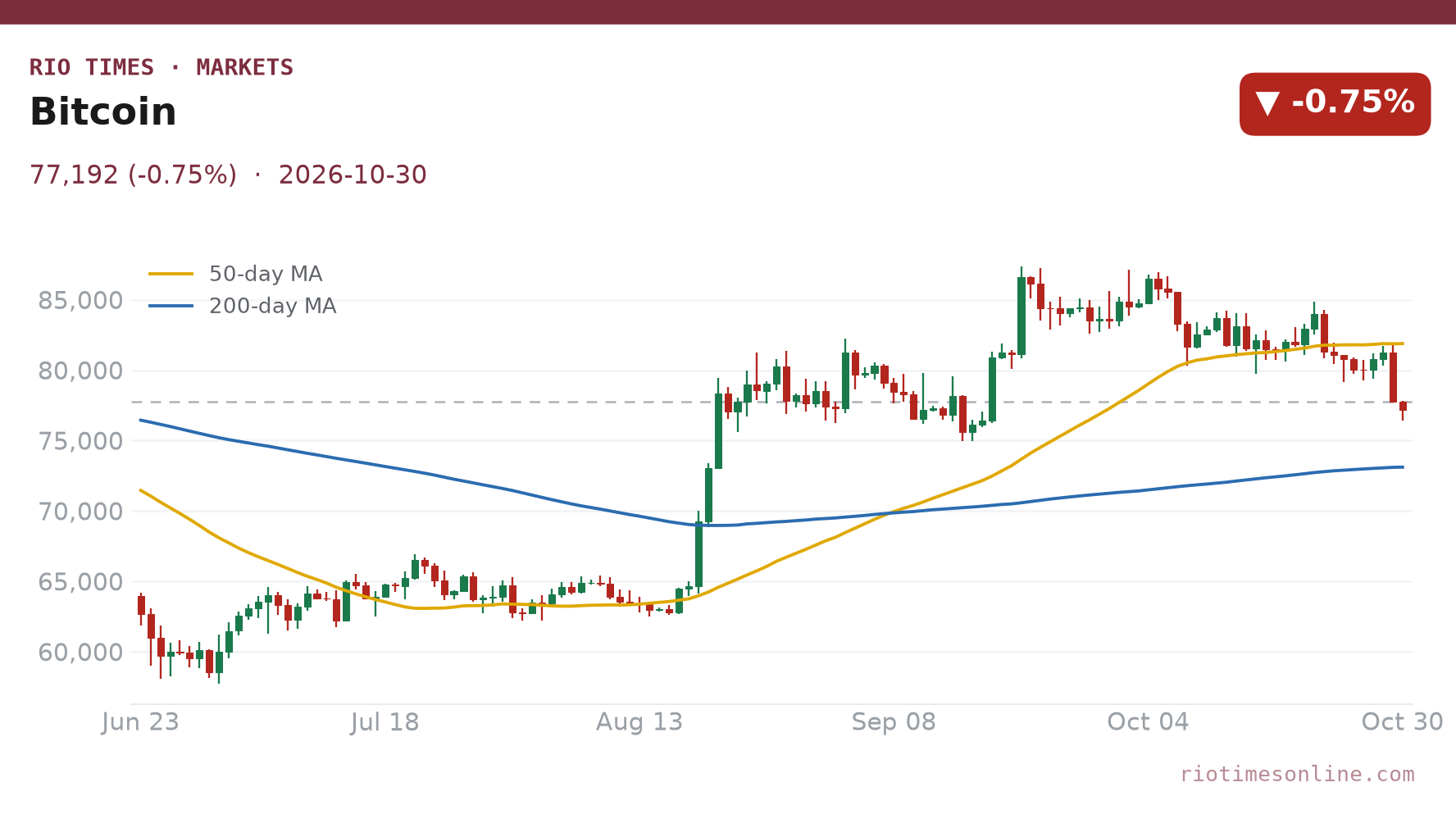
Bitcoin ended the week at US$77,192, its lowest close in a month and 10.9% below its 12-month high of US$86,603 on 21 September. A week earlier it had closed at US$81,074, so the week’s loss was 4.79%.
The week was quiet until Thursday evening, when the theft at Binance broke a range of US$79,000 to US$81,000 that had held since 24 October. After that, a second shock arrived on Friday, when a sell-off in US technology shares sent investors toward cash.
For US readers the practical point is that crypto no longer moves on its own news. It reacts to the same fear that moves the Nasdaq, and on Friday the two fell together.
We rank three causes: the Binance theft, which hit confidence on Thursday; the equity sell-off, which hit risk appetite on Friday; and a Federal Reserve that has not ruled out another rate rise. Confidence is medium because the timing of Thursday’s fall matches the theft, but the stock rout and the Fed worry arrived at the same time and cannot be separated.
The variable to watch is Binance itself: whether withdrawals reopen as promised and whether the roughly US$2.4 billion that TRM Labs says issuers cannot freeze starts to move. A flood of stolen coins sold into the market would be the clearest new reason for further selling.
02 The Board
The board shows bitcoin at US$77,192, down 0.75%, and Ethereum at US$2,210, down 1.74%. The last closes on record for the two smaller coins are from Thursday: Solana at US$95.49 (down 6.66%) and, separately, XRP at US$1.23 (down 6.75%).
The US-listed proxies fell harder than the coins on Friday. The IBIT fund closed at US$43.36 (down 5.14%), the ETHA fund, a US-listed fund for the second-largest coin, at US$50.42 (down 4.47%), Strategy, a software company with a large crypto treasury, at US$130.51 (down 7.84%) and Coinbase at US$143.54 (down 10.62%).
| Asset | Level | Change |
|---|---|---|
| Bitcoin | US$77,192 | -0.75% |
| Ethereum | US$2,210 | -1.74% |
| Solana | US$95.49 | -6.66% |
| XRP | US$1.2349 | -6.75% |
Source: RT close, 2026-10-30. Where a commodity has no spot feed, an exchange-traded tracker or leading producer is shown as a labelled proxy. Last settled close of Solana, XRP: 2026-10-29.
Live Market IntelligenceThe live market board
Rio Times · Live Market Intelligence
Latin America — Cross-Market Board
| Instrument | Last | Change | YoY | Prev. | High | Low | Volume |
|---|---|---|---|---|---|---|---|
| IBOV | 167,921.80 | -0.75% | +19.56% | 169,186.42 | 178,526 | 175,157 | — |
| IPSA | 10,253.96 | -2.76% | — | 10,545.26 | 10,722 | 10,633 | — |
| IPC MEX | 69,705.03 | -0.12% | +12.74% | 69,787.41 | 70,008 | 69,383 | 49,372,306 |
| MERVAL | 92,079 | -2.59% | +12.65% | 2,859,051 | — | — | — |
| COLCAP | 2,490.92 | +0.04% | — | — | — | — | — |
| USD/BRL | 5.34 | -1.32% | -0.84% | 5.42 | 5.42 | 5.30 | — |
| EUR/BRL | 5.95 | +7.53% | -4.87% | 5.54 | 6.04 | 5.92 | — |
| USD/MXN | 18.69 | +0.62% | +1.45% | 18.57 | 18.69 | 18.54 | — |
| USD/CLP | 983.47 | -0.57% | +5.64% | 989.13 | 991.87 | 979.07 | — |
| USD/COP | 3,149 | +3.06% | -18.02% | 3,056 | 3,173 | 3,111 | — |
| USD/PEN | 3.45 | +0.17% | +3.85% | 3.44 | 3.45 | 3.44 | — |
| USD/ARS | 1,537 | -0.28% | +3.77% | 1,541 | 1,541 | 1,537 | — |
| USD/UYU | 40.21 | +3.57% | +2.29% | 38.83 | 40.21 | 40.08 | — |
| USD/PYG | 5,803 | +3.78% | -16.54% | 5,592 | 5,803 | 5,735 | — |
| USD/BOB | 11.97 | +4.93% | +77.92% | 11.41 | 11.97 | 11.82 | — |
| USD/DOP | 60.54 | +1.83% | -4.34% | 59.45 | 61.14 | 59.85 | — |
| USD/CRC | 451.24 | +2.13% | -7.80% | 441.83 | 451.40 | 450.04 | — |
| USD/GTQ | 7.64 | +3.23% | +2.18% | 7.40 | 7.64 | 7.64 | — |
03 Why It Moved
The first and heaviest cause is the Binance theft. Hackers took about US$6.3 billion on Thursday 29 October, which Binance estimates and TRM Labs puts at US$6.36 billion, and Binance paused withdrawals on several networks as a precaution.
Binance says user funds are safe and that it will cover all losses from company funds and its SAFU reserve, a fund set aside for such events. TRM Labs says about US$2.7 billion was frozen by 00:30 UTC on Friday, mostly stablecoins frozen by their issuers, while about US$2.4 billion sits in assets that issuers cannot freeze.
The second cause is the stock market. The Nasdaq fell 2.86% and the S&P 500 1.82% on Friday after Intel’s weak guidance and Amazon’s heavy AI spending plans, and the VIX, a gauge of expected stock swings, rose 12.91% to 19.42, which pushed investors to cut their riskiest holdings first.
The third cause is the Federal Reserve, the US central bank: it held its rate at 3.75% to 4.00% on Wednesday 28 October, two officials voted for an immediate rise, and Polymarket, a prediction market, gives 71.5% to another rise this year. A higher rate makes coins that pay no interest less attractive.
Friday’s data added to the rate story, because the Employment Cost Index, a quarterly gauge of US labour costs, rose 0.8% in the third quarter, according to the Bureau of Labor Statistics, the US statistics agency. Wages rose 0.7% and benefits 0.9%, which gives rate-rise bets more support, while the Chicago PMI factory survey and the Baker Hughes oil rig count, also due that day, had no confirmed reading when we closed.
One signal conflicts with the story: the dollar index slipped 0.07% and the 10-year Treasury yield held at 4.93%, so the usual dollar-and-yields explanation covers little of the fall. Our confidence in the theft as the lead cause is medium: the fall began in the hour of the first outflows, but we cannot prove how much of it was forced selling by funds and how much was fear.
04 The Trend Behind It
This is a deepening slide, not a new one. The 20-session loss is 6.90% for the largest coin, against 11.72% for the second-largest, Ethereum.
Ethereum, Solana and XRP all closed at their lowest in at least three months. Solana sits 21.8% below its September high and XRP 21.4% below, so the smaller coins have fallen about twice as far from their peaks as the largest coin has.
Our own price history since 2010 gives a base rate, not a forecast. After earlier falls as large as bitcoin’s 20-session drop, it was higher 20 sessions later in 60 of 130 cases (46%), with a median change of minus 1.8%, a worst case of minus 47.3% and a best case of plus 68.6%.
For Ethereum the odds are similar. After earlier falls as large as its own, it was higher 20 sessions later in 40 of 84 cases (48%), with a median change of minus 1.2%.
05 What It Means for Latin America
Latin American savers use crypto mostly as a way to hold dollars, through dollar-pegged tokens called stablecoins, and as a cheap way to send money home. A hack at an exchange that many of them use raises the risk that withdrawals are delayed just when they need the money.
Binance has published no breakdown of affected customers by country, so we cannot say how many Latin American accounts are involved. Readers who hold coins on any exchange should know that Binance says user funds are safe, but that a pause on withdrawals can last days.
The price channel is simpler. Where local currencies are weak against the dollar, a US$77,192 bitcoin that is 4.79% cheaper than a week ago looks like a bargain to some buyers, though the base rates above show that falls of this size are followed by gains less than half of the time.
06 The Names to Watch
The first name is Binance, whose co-chief executive Yi He has said that withdrawals should return soon, and whose promised new Proof of Reserves, a public audit of its holdings, will test whether users trust it again. The second is Tether, the issuer of the largest stablecoin, one of the issuers that froze stolen funds.
The US-listed names show how investors are positioning. Coinbase lost 10.62% on Friday and Strategy, which holds bitcoin on its balance sheet, lost 7.84%, both more than bitcoin itself, which tells us that equity investors are selling the most borrowed-money route into crypto first.
07 What Would End It
The selling should end when the stolen funds stop moving and stock markets stabilise. Bitcoin needs to hold Friday’s low of US$76,418 and then reclaim US$80,000, which lies inside the range that broke on Thursday.
Binance said withdrawals should resume by Sunday 1 November, and a clean reopening would remove the main source of fear. The US midterm elections follow on Tuesday 3 November, the jobs report is due on Friday 6 November and the Federal Reserve meets on 8 and 9 December.
What Prediction Markets Say
On Polymarket, a prediction market, traders put the chance that bitcoin falls to US$70,000 at some point in 2026 at 48.5%, and the chance it rises to US$90,000 at 26.5%. About US$80.2 million has been traded on this market, as of 30 October 2026, 8:08 pm ET.
For the Fed, a separate Polymarket market gives 71.5% to another rate rise in 2026. Prices on prediction markets are bets, not polls or forecasts by officials.
Why we show this: prediction markets turn real-money bets into a live probability that moves within minutes of the news, which is why investors, campaigns and newsrooms in the United States now follow them closely. We show them next to polls and official results, never instead of them.
08 What to watch
- Binance withdrawals, Sunday 1 November: A reopening on schedule and a new Proof of Reserves would calm the market, while a delay would suggest the damage is larger than reported.
- US midterm elections, Tuesday 3 November: Voters choose Congress, and traders will judge whether the result changes the budget and rate outlook that crypto depends on.
- US jobs report, Friday 6 November: Strong hiring would add to rate-rise bets and weigh on bitcoin, while a weak report could cool the case for a December increase.
- Bitcoin at US$76,418 and US$80,000: A close below Friday’s low would extend the slide, while a close above US$80,000 would put bitcoin back inside its old range.
Frequently Asked Questions
Why did bitcoin fall this week?
A US$6.3 billion theft at Binance hit confidence on Thursday, and a US stock sell-off added to the pressure on Friday. A weekly loss of 4.79% left bitcoin at US$77,192.
Is my money safe on Binance?
Binance says user funds are safe and that it will cover all losses with company funds. It has paused withdrawals on several networks, so access, not safety, is the near-term issue.
Who was behind the Binance hack?
TRM Labs, a blockchain-analysis firm, attributes it with high confidence to a North Korean hacking unit. Binance has named no suspect, and no government has confirmed the link.
Will bitcoin recover?
Nobody can say. After earlier falls this large, bitcoin was higher 20 sessions later in 46% of cases, so the odds are close to a coin toss.
Market data: The Rio Times
Primary sources: Federal Reserve FOMC statements (28 October); Bureau of Labor Statistics, Employment Cost Index (30 October); Binance and TRM Labs public statements (29 to 30 October); Polymarket.
This article was produced by The Rio Times’ automated newsroom system. How we use AI · Report an error · Editorial responsibility: Matthias Camenzind, Editor-in-Chief
LatAm Markets: Live Signals → — real-time movers, turnover leaders and FX across Latin America.