
PARAGUAY · REGIONS
Paraguay has no provinces. It has 17 departments plus the capital, Asunción, grouped in official statistics into the eastern Oriental region (14 departments) and the western Chaco (3).
Key Facts
- Power Index Paraguay ranks 10th of 14 in The Rio Times Latin America Power Index, with 35.0 points (November 2026 edition).
- Departments 17 departments plus the capital city Asunción, which sits outside them.
- Regions Two statistical regions: Oriental in the east with 14 departments, Chaco in the west with 3.
- Biggest Central is the most populous department, with about 1.88 million people in 2022.
- Chaco About 60% of the national territory, but only a few percent of the people.
- Capital Asunción is an independent municipality, not part of any department.
In Plain English
- Department The first level of regional government below the national one.
- District The second level, called a distrito, equal to a municipality.
- Chaco The western region, large, dry, thinly settled and used for cattle.
- Oriental The eastern region, home to most people and most cities.
- Governor The elected head of a department, chosen for five years.
The Short Answer
Paraguay does not use provinces or states. Its first level of local government is the department, and there are 17 of them.
The Constitution of Paraguay (1992), in Article 156, divides the national territory into departments and municipalities. Both have political, administrative and regulatory autonomy, which means they run many of their own affairs.
Article 157 makes Asunción the capital and the seat of the branches of government. It is a municipality that stands independent of the departments.
INE (Instituto Nacional de Estadística, the national statistics institute) counts 14 departments in the Oriental region and 3 in the Occidental or Chaco region. For daily coverage of all of them, visit our Paraguay news hub.
A district, or distrito, is the second level and equals a municipality. For who holds power at each level, read our guide to the Paraguay power structure explained.
The 17 Departments and Asunción
Here are the 14 Oriental departments, with the departmental capital in brackets, as listed by INE. Most Paraguayans live in this eastern part of the country.
- Concepción (Concepción)
- San Pedro (San Pedro de Ycuamandiyú)
- Cordillera (Caacupé)
- Guairá (Villarrica)
- Caaguazú (Coronel Oviedo)
- Caazapá (Caazapá)
- Itapúa (Encarnación)
- Misiones (San Juan Bautista)
- Paraguarí (Paraguarí)
- Alto Paraná (Ciudad del Este)
- Central (Areguá)
- Ñeembucú (Pilar)
- Amambay (Pedro Juan Caballero)
- Canindeyú (Salto del Guairá)
The Chaco has only 3 departments, listed here with their capitals. They cover most of the land but hold few people.
- Presidente Hayes (Villa Hayes)
- Boquerón (Filadelfia)
- Alto Paraguay (Fuerte Olimpo)
Asunción stands apart as the capital, outside all 17 departments. Each department has its own capital, such as Areguá for Central and Ciudad del Este for Alto Paraná.
Eastern Paraguay: Where Most People Live
The Oriental region holds 14 departments and most of the population. The 2022 census by INE counted about 6.11 million people in the whole country.

Central is the most populous department, with 1,883,927 people. Asunción adds 462,241 more, and the two together hold about 38% of all Paraguayans.
Alto Paraná has 763,702 people. Ñeembucú is far smaller, with 76,719.
Central is the densely settled ring around Asunción, so it holds the largest share of Paraguayans. Its capital is Areguá.
Alto Paraná, Itapúa (capital Encarnación) and Canindeyú are major soybean-growing departments in the east. Soy is a leading export crop for Paraguay.
The Chaco: Big, Empty and Cattle Country
The Chaco, or Occidental region, is the western part of the country, with 3 departments. They are Presidente Hayes, Boquerón and Alto Paraguay.
It covers roughly 60% of the national territory but holds only a few percent of the people. The three departments are far larger in land than in people.
Alto Paraguay is the smallest department, with 17,195 people. Its capital is Fuerte Olimpo.
Chaco at a Glance
- Land Roughly 60% of the national territory.
- Cattle A herd above 6.7 million head, per a 2026 survey.
- Crops About 352,000 hectares cropped.
The Chaco is cattle ranching and large farm country. The Ministry of Agriculture and Livestock (MAG), the farm ministry, counted a herd above 6.7 million head in a 2026 survey.
The same survey puts cropped land there at about 352,000 hectares. A hectare is 10,000 square metres, roughly two and a half acres.
Ciudad del Este and Itaipú
Ciudad del Este is the capital of the Alto Paraná department, not a department itself. It faces the Brazilian city of Foz do Iguaçu across the Friendship Bridge over the Paraná River.
The city is known for its cross-border shopping trade. Its 325,819 residents make up about 43% of the department.
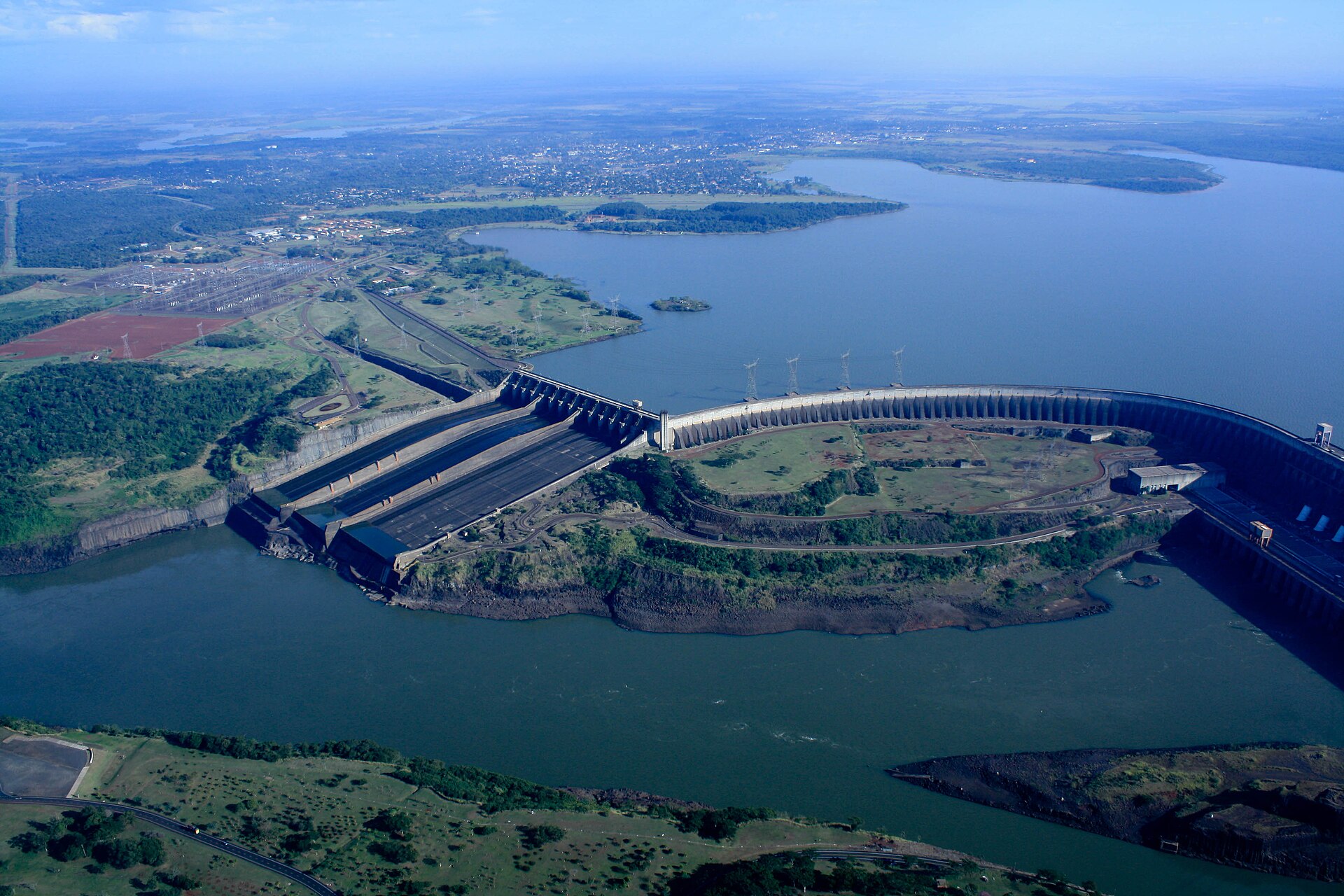
Nearby stands Itaipú, a hydropower dam on the Paraná River on the Brazil border. It has 14,000 megawatts of capacity and 20 generating units.
Itaipú Binacional, the company that runs the dam, says Paraguay and Brazil own it in equal parts. It produced 72.9 million megawatt-hours of electricity in 2025.
The dam sits in the eastern region, in Alto Paraná. Our Itaipú dam explained guide covers it in detail.
What Each Region Earns
The Banco Central del Paraguay, the national central bank, projected growth of about 6% for 2025 in its December 2025 monetary policy report. Behind that figure, each part of the country runs on a different engine.
- Central: the densely settled ring around Asunción.
- Alto Paraná: Itaipú power and the border shopping trade of Ciudad del Este.
- Alto Paraná, Itapúa and Canindeyú: soybean farming.
- The Chaco: cattle ranching and large farms.
Prices in local shops are quoted in guaraní (PYG), the national currency. Any amount in our guides comes with a US$ figure in brackets.
How Paraguay Is Governed
Under Article 161 of the 1992 Constitution, each department is headed by an elected governor. An elected departmental board sits alongside the governor.
Both are chosen at the same time as the national general elections, for five-year terms. Voters therefore choose national and departmental leaders on the same election day.
Municipalities have their own autonomy under Article 156. In INE’s census terms, a district is the second level and equals a municipality.
Asunción, as the capital, is not governed by a department. Article 157 sets it up as a municipality independent of them.
Residency and Investor Angle
Residency in Paraguay is national and is not tied to any department. You apply through the Dirección Nacional de Migraciones, the national immigration directorate.
Rules can change, so check the directorate and the latest guides before you act. Start with our guide to retiring in Paraguay and our guide to investing in Paraguay as a foreigner.
Where you live decides the daily practicalities. Asunción and Central offer services, banks, hospitals and schools.
Alto Paraná and Itapúa suit border trade and farming. The Chaco is remote and sparsely populated, so daily life looks very different from the capital.
What It Means for US Readers
Itaipú power is shared with Brazil, and Paraguay is a soybean and cattle producer. The regional map shows where each activity is based.
Alto Paraná hosts the dam, three eastern departments grow soy, and the Chaco raises cattle. For a US investor, the department name is a first clue to the local economy.
For a US traveller or retiree, the map shows where services are concentrated. Asunción and Central are the practical base for banks, hospitals and schools.
What Is Not Known
The exact current Chaco share of territory and of people differs by source and year. Readers should check the INE tables rather than rely on one round number.
Census coverage was not 100%, so department totals may undercount. The 2022 counts are the latest official picture, not a perfect one.
Borders between regions are administrative lines, not sharp economic ones. A farm in Alto Paraná and a bank in Central can belong to the same supply chain.
Readers planning a move or an investment should treat the labels in this guide as a starting map. Local rules and conditions can differ from one department to the next.
Frequently Asked Questions
Does Paraguay have provinces or states?
No, Paraguay has neither provinces nor states. Its first level of local government is the department, and there are 17 of them plus the capital Asunción.
How many departments does Paraguay have?
Paraguay has 17 departments. Fourteen are in the Oriental region and 3 are in the Chaco, and the capital Asunción stands apart.
What is the Chaco?
The Chaco is the western Occidental region, made up of Presidente Hayes, Boquerón and Alto Paraguay. It covers roughly 60% of the territory but holds only a few percent of the people.
What is the biggest department?
Central is the most populous department, with 1,883,927 people in the 2022 census. Alto Paraguay is the smallest, with 17,195.
Is Ciudad del Este a department?
No, Ciudad del Este is a city and the capital of the Alto Paraná department. It had 325,819 residents in 2022, about 43% of the department.
Do foreigners need to live in a particular region to get residency?
No, residency in Paraguay is national and not tied to a department. You apply through the Dirección Nacional de Migraciones, and rules can change.
Sources: INE Paraguay census 2022; INE glossary; Constitution of Paraguay 1992; Itaipú Binacional; Banco Central del Paraguay; Ministry of Agriculture and Livestock.
This article was produced by The Rio Times’ automated AI newsroom. Editorial responsibility: Matthias Camenzind, Publisher and Editor-in-Chief. The Rio Times also runs Ask Rio Times, which answers from 100,000+ of our own articles, the daily Latin America Power Map, and prediction-market odds on elections and markets.. How we use AI · Report an error
Expat Guide to Paraguay
What The Rio Times publishes for foreigners who live in or move to Paraguay.
Start here
- Asunción Rents by Neighborhood in 2026
- Best Places to Live in Paraguay for Expats 2026, Ranked
- Investing in Paraguay as a Foreigner 2026 — Taxes and Property
- Uruguay vs Paraguay for Expats in 2026: Cheap Living or a Tax Holiday
City guides
Coming up in Paraguay
- What to Do in Asunción in November 2026 26 Nov
- Ed Sheeran in Asunción, Paraguay: First-Ever Show in the Country at La Nueva Olla on November 26, 2026 — FINNEAS Opens 26 Nov
- Gorillaz Asunción Paraguay Concert: Date and Tickets 1 Dec
Understand Paraguay