Dominican Sargassum Plan Targets 150,000 Tonnes

ENVIRONMENT · DOMINICAN REPUBLIC
Key Facts
- —The country The Dominican Republic is the Caribbean’s largest tourism destination, and its beaches are its main draw. Sargassum, a floating brown seaweed, now washes up on both its south and north coasts.
- —What happened At an EU–Caribbean sargassum conference in Cancún on 1–2 October 2026, Environment Minister Paíno Henríquez urged a regional response. “Sargassum knows no borders,” he said.
- —The numbers The country aims to manage 150,000 tonnes of sargassum sustainably by 2027, the ministry said on 2 October. Henríquez told El Universal about 3,000 tonnes arrive daily.
- —What it means for you Nothing changes on the beach yet. Collection crews and floating barriers remain the main defence, and the minister expects a possible new record of arrivals in 2027.
- —Still open A planned agreement with Mexico has not been signed. How many shared processing plants the region needs, where, and who pays, still has to be studied.
The Dominican Republic sargassum strategy now looks beyond its own beaches. At a conference in Cancún this week, Environment Minister Paíno Henríquez said no Caribbean country can handle the seaweed alone.
“Sargassum knows no borders,” he told delegates, according to statements reported by El Nacional and Hoy on 2 October. He set out a national target of 150,000 tonnes managed sustainably by 2027.
What the minister asked for
The fourth EU–Caribbean Global Gateway conference on sargassum ran on 1 and 2 October, drawing 350 delegates from 45 countries and territories. The European Union and Mexico’s environment ministry, Semarnat, organised it with Quintana Roo state.
Henríquez asked for a response built on early warning, coordination and shared research. “We do not have to solve the same problem twenty times in twenty different countries,” he said.
He said the country is moving from cleaning beaches after arrivals to forecasting them with satellite data. He also called for collection methods that avoid stripping sand or harming reefs, mangroves and turtle nesting areas.
A growing mass in the Atlantic
The scale behind the appeal was set out by Quintana Roo’s governor, Mara Lezama, when she opened the meeting on 1 October. She said about 38 million tonnes of sargassum floated in the Atlantic in 2025 and 60 million in 2026.
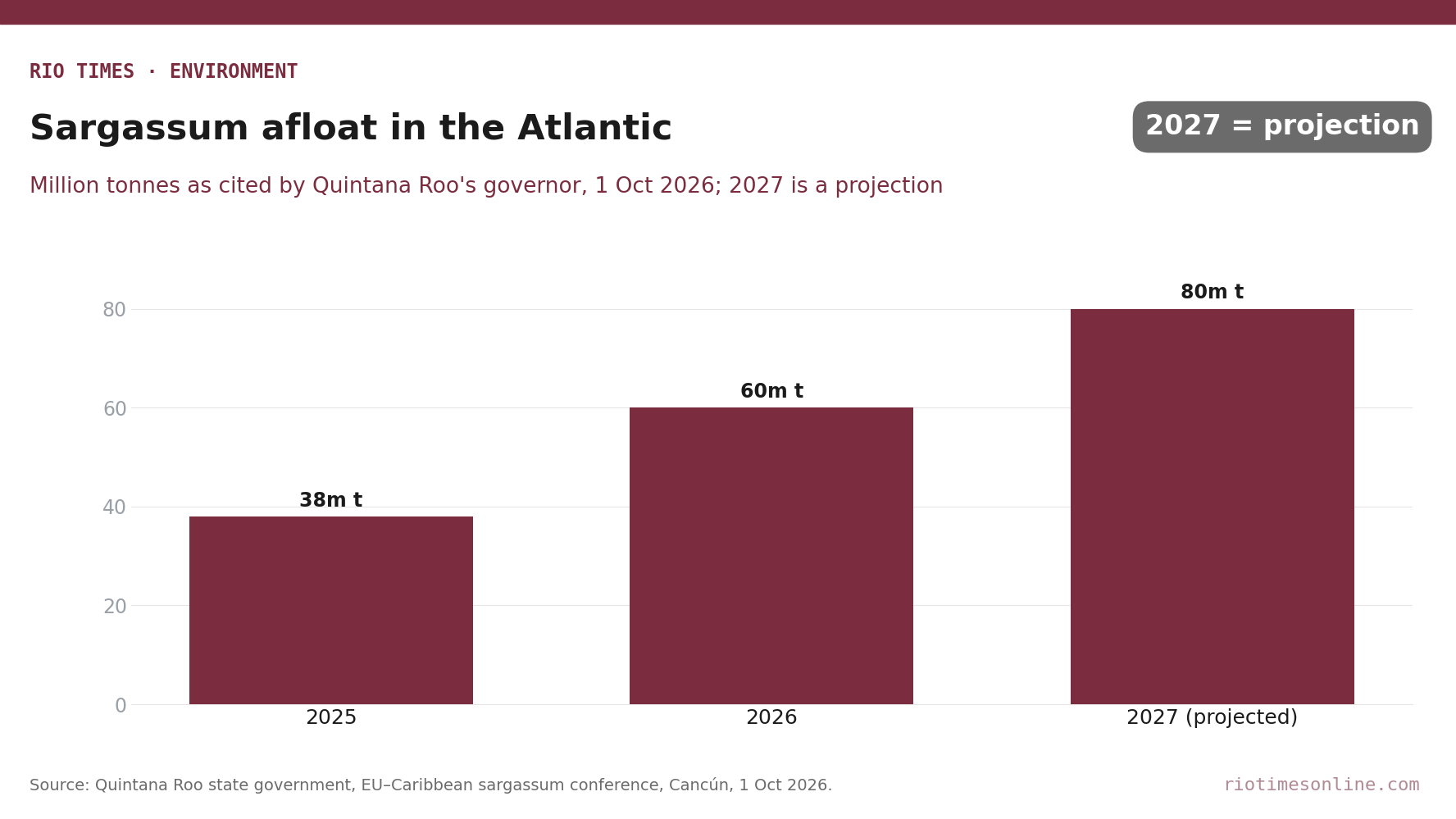
She cited an estimate of about 80 million tonnes for 2027, as reported by El Universal and Vanguardia. Those figures were not checked against satellite records for this report.
Mexico’s Caribbean coast had a record season this year: Sargassum Quintana Roo Record Collides With the Wedding Season. Barbados is also seeking value in the seaweed: Barbados Will Patent Its Sargassum Microbes So the Money Stays on the Island.
What the country already does
Henríquez put figures on the Dominican Republic sargassum burden in an interview with El Universal on 1 October. About 3,000 tonnes arrive each day, he said, collected on more than 100 beaches.
More than 60 kilometres of floating barriers are in place, with 85 kilometres planned for 2027. Public and private spending together tops US$100 million a year; none of these figures was independently confirmed.
With European Union support, the ministry ran an international call for uses of the biomass, Hoy reported. It drew 45 proposals from ten countries, assessed with technical help from the UN Food and Agriculture Organization (FAO).
A deal with Mexico and the cost question
According to El Universal, Mexico and the Dominican Republic are preparing a bilateral deal to share studies and speed up technology tests. The minister said both countries had been assessing similar proposals.
He argued that plants to process the seaweed are too costly for each island to build alone. Shared regional plants could serve several territories, though studies on number, location and funding are still needed.
He named Barbados, Panama, Belize and Honduras as possible later partners. Cost sharing matters for an economy built on its coast: Dominican Republic Tourism Economy 2026: 11.7 Million Visitors, Punta Cana and the Risks.
What Is Not Yet Known
No date has been given for signing the agreement with Mexico, and its cost split is unknown. The ministry has not said how much of the Dominican Republic sargassum target of 150,000 tonnes has been reached.
Henríquez said 2027 could bring a new record but gave no volume. Scientists still debate why the blooms keep growing, with warmer water and river nutrients among the leading explanations.
Sources: El Nacional, 2 October 2026; Hoy, 2 October 2026; El Universal, 1 October 2026; Vanguardia, 1 October 2026.
Editorial responsibility: Matthias Camenzind, Editor-in-Chief · Editorial standards · Report an error