Foreign Powers and Investors in Costa Rica 2026
COSTA RICA · FOREIGN POWERS
Key Facts
- —The country Costa Rica is a Central American country of about 5.3 million people and, since 2021, a member of the OECD, the club of mostly rich economies. The World Bank classed it as a high-income economy in 2025.
- —Investors Foreign direct investment was US$5.12 billion in 2025, and 54.8% of it came from the United States. Free zones took 66.4% of the total.
- —Medical devices Medical devices were 31% of all exports in 2025, worth more than US$10.8 billion. Boston Scientific opened its third Costa Rican plant, in Cartago, in May 2026.
- —Lenders The IMF holds a precautionary credit line of about US$1.5 billion for Costa Rica. The World Bank’s active portfolio is US$1.52 billion across nine operations as of 30 September 2026.
- —Washington A US tariff of 12.5% on certain Costa Rican goods took effect on 24 July 2026, with coffee, pineapple, bananas and orange juice excluded. Costa Rica is also a member of the US-led Shield of the Americas and Pax Silica.
- —Beijing China is Costa Rica’s second-largest trading partner after the United States, with US$5.07 billion in two-way trade in 2025. A free trade agreement has been in force since 1 August 2011.
- —Power Index Costa Rica ranks 9th of 14 in The Rio Times Latin America Power Index, with 36.5 points (October 2026 edition).

Costa Rica foreign investors put US$5.12 billion into the country in 2025, and 54.8% of it came from the United States. This guide names the companies, lenders and governments that matter in October 2026 and what each wants in return.
Most foreign money is reinvested profit of firms already in the country, and medical devices are the largest single export. The United States is at once the largest investor, the largest trading partner and the main security partner, while China, the IMF and the World Bank play narrower roles.
Foreign Money in Numbers
Foreign direct investment reached US$5.12 billion in 2025, the second year in a row above US$5 billion, according to PROCOMER, the state export and investment agency, using central bank data. Reinvested profits made up US$4.33 billion of that, up 26%, while new capital fell 18% to US$895 million.
The free-zone regime took 66.4% of the 2025 total, companies under the ordinary regime 15.2%, tourism 7.5%, real estate 6.9% and finance 3.1%. By origin, the United States supplied 54.8%, Switzerland 19.7%, Mexico 4.7% and Colombia 3.7%.
Exports of goods and services reached US$35.24 billion in 2025, up 11%, and medical devices ranked first at 31% of the total, with more than US$10.8 billion. Of goods exports, North America took US$11.25 billion, Europe US$4.85 billion, Central America US$3.90 billion and Asia US$1.47 billion.
In the first half of 2026 foreign direct investment grew 23.4% to US$2.74 billion, a figure PROCOMER calculated after setting aside a one-off beverage-company acquisition. Including that deal, first-quarter flows alone reached US$4.58 billion, and COMEX, the foreign trade ministry, put the acquisition at close to 2.9% of GDP.
- Companies: Boston Scientific, Medtronic, Intel, Zimmer Biomet, Johnson & Johnson MedTech, Bayer and Newmont run plants or service hubs in Costa Rica.
- Lenders: the IMF, the World Bank and its private-sector arm IFC, the Inter-American Development Bank (IDB) and the Central American Bank for Economic Integration (CABEI).
- Governments: the United States first, then China, the European Union and Israel, with the CPTPP trade bloc next.
- Clubs and pacts: the OECD, the Shield of the Americas and Pax Silica.
- People: Nicaraguan and other migrants, American residents and Costa Ricans abroad.
The Free-Zone Bargain
The bargain rests on Law 7210, which gives approved free-zone firms a 0% income tax rate for eight years inside the Greater Metropolitan Area around San José and 12 years outside it, according to CINDE, the investment promotion coalition. After that the rate is 15% for four to six years and then 30%.
The regime also exempts profit remittances and import taxes, allows 100% foreign ownership and can be renewed for eight more years after a significant reinvestment. Minimum fixed-asset investment runs from US$100,000 to US$2 million depending on location, and PROCOMER administers a system that covered 85 free-zone parks in 2025.
Arianna Arce, acting foreign trade minister, said at the ninth free-zone congress on 22 October 2026 that free zones contribute 15% of GDP and more than 265,000 direct and indirect jobs. CINDE reported in January 2026 that multinationals employ 196,310 people, with net growth of only 3,259 jobs in 2025, and said job creation in services contracted for the first time.
The World Bank notes that gaps persist between the free-zone segment and the rest of the economy, with implications for productivity and wages. On 20 October 2026 COMEX said the electricity harmonisation bill failed to reach the 38 votes needed and called the availability, reliability and cost of electricity decisive for investment.
Medical Devices: Boston Scientific, Medtronic and Others
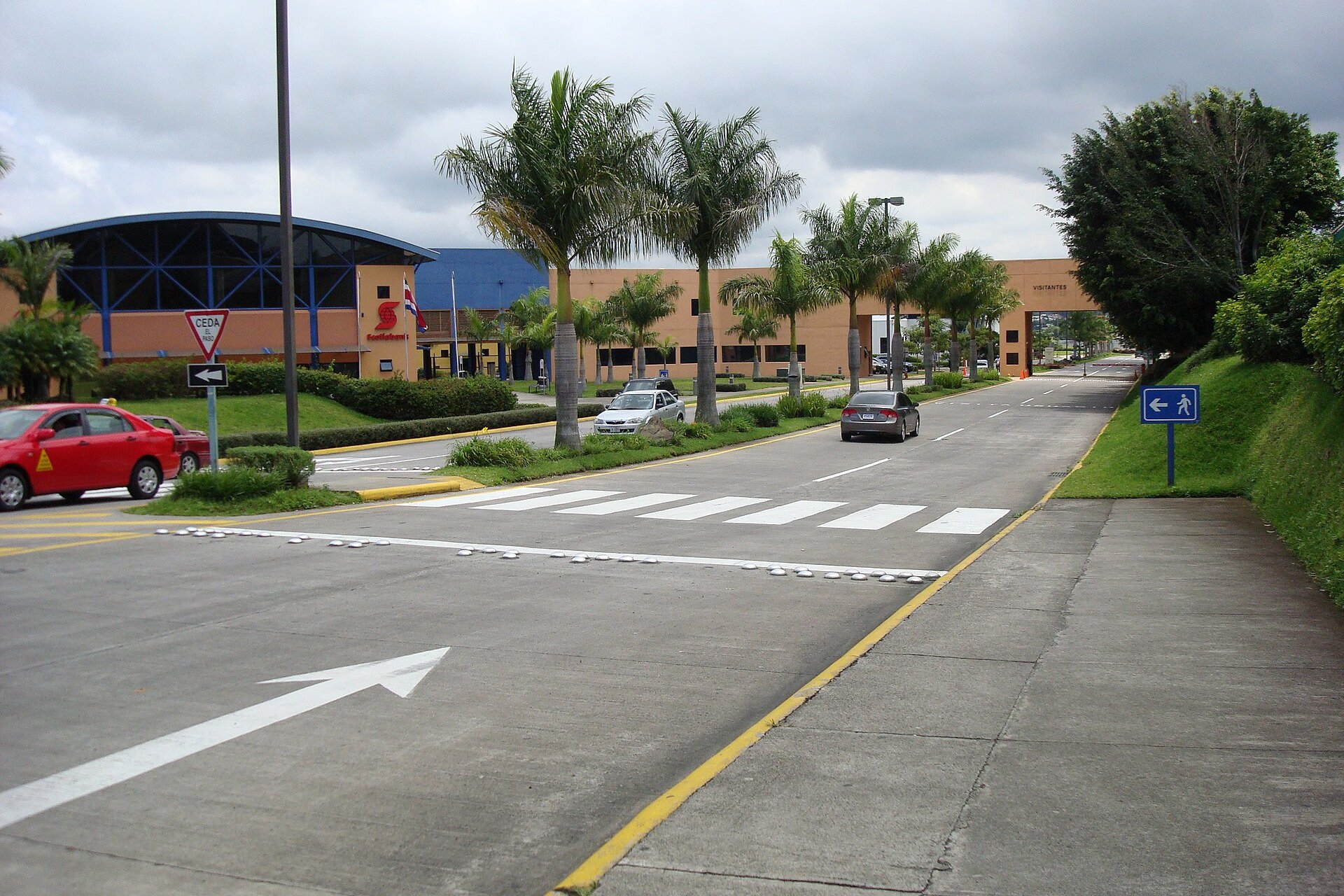
PROCOMER’s 2025 investment report says Insulet will make one of the largest sums recorded for a multinational company in the country. It also names Boston Scientific, Zimmer Biomet, Johnson & Johnson, Thermo Fisher Scientific, Trelleborg, Cretex Medical, Medtronic, Mozarc Medical and Penumbra among projects announced from 2023 to 2025.
Boston Scientific opened its third plant in Cartago on 19 May 2026, adding to its sites in Coyol and Heredia, and COMEX counted 1,000 new jobs in the first phase. Minister Indiana Trejos said the company grew from 17 employees to almost 12,000 direct jobs in a little over two decades, making it the country’s fourth-largest employer.
Medtronic opened a third manufacturing module in the Coyol free zone in November 2022 with a projected investment of US$65 million. Johnson & Johnson MedTech announced a plant in Grecia in September 2023 with 3,000 jobs outside the central metropolitan area, and Zimmer Biomet announced a plant there in August 2025 with about 500 direct jobs by 2033.
CINDE claims that 18 of the world’s 35 largest medical-device multinationals operate in Costa Rica, including Abbott, Edwards Lifesciences, Baxter, Philips and Hologic, and counts more than 62,000 direct jobs in the sector. Those are promotional figures from CINDE’s own sector page, not official statistics.
Outside devices, Germany’s Bayer opened a US$200 million pharmaceutical plant in the Coyol free zone on 6 November 2025 with 300 jobs planned. Newmont, the US gold miner, was welcomed by COMEX on 6 August 2026 for its new Global Delivery Center in a Heredia free zone, which began operating in 2026 and is projected to reach 400 specialist jobs by the end of 2026.
- Boston Scientific: sites in Coyol and Heredia, and since 19 May 2026 a third plant in Cartago.
- Medtronic: third manufacturing module in the Coyol free zone, opened in November 2022.
- Johnson & Johnson MedTech and Zimmer Biomet: plants in Grecia, Alajuela province.
- Bayer: pharmaceutical plant in the Coyol free zone, opened on 6 November 2025.
- Newmont: global delivery center in a Heredia free zone, welcomed by COMEX on 6 August 2026.
Intel and the Chip Push
Intel officially opened its assembly and test plant in San Antonio de Belén in August 2022, as part of celebrating 25 years in Costa Rica, and COMEX put its investment at close to US$1 billion over the previous two years. In July 2021 Intel had raised its planned investment from US$350 million to US$600 million and said it employed more than 2,700 people.
A harder chapter followed: on 11 February 2026 Intel and PROCOMER held a second job fair at Intel’s site in La Ribera de Heredia for company staff in what COMEX called a transition process. More than 20 companies offered over 600 vacancies to more than 300 attendees, after a first fair in November 2025.
Costa Rica joined Pax Silica, a US-led initiative on semiconductors and artificial intelligence, in June 2026, according to COMEX. Then-Foreign Minister Manuel Tovar said the step places Costa Rica closer to its strategic partner, the United States, to generate investment opportunities and economic security.
Secretary of State Marco Rubio described Pax Silica on 15 September 2026 as a way “to drive innovation and secure regional supply chains”. The OECD, which Costa Rica joined in 2021, held the tenth meeting of its informal semiconductor network in San José in April 2026 and presented a study on building the country’s chip ecosystem.
The United States: Trade, Security and Deportees
The United States is both the largest investor and the largest trading partner, so its trade decisions reach Costa Rica first. COMEX announced on 23 July 2026 that a US tariff of 12.5% on certain Costa Rican goods would apply from 24 July, keeping exclusions for coffee, pineapple, bananas and orange juice.
The tariff follows a US Section 301 investigation into forced-labour import bans in 60 economies and replaces a temporary 10% surcharge under Section 122 of the Trade Act of 1974. In comments announced on 7 July 2026, COMEX argued that Costa Rica reinforces rather than replaces US production through regional supply chains.
On 2 July 2026 Trejos met Jeffrey Kessler, the Commerce Under Secretary for Industry and Security, in Washington to present Costa Rica as a reliable supplier of medical devices to North American supply chains. She also spoke to the US-Costa Rica Business Council, which COMEX describes as bringing together several of the main US companies with investments in Costa Rica.
On 16 September 2026 Rubio met Tovar in Washington and welcomed Costa Rica’s role “as a founding member of the Shield of the Americas, the Americas Counter Cartel Coalition, and as a member of Pax Silica”, according to a State Department statement posted by the US embassy. His national-day message of 15 September lists the shared goals: to dismantle criminal organisations, secure critical telecommunications infrastructure, disrupt illegal immigration and bolster border security.
President Laura Fernández dismissed Tovar on 24 September 2026, saying he attended a 22 September Shield of the Americas session, which included US President Donald Trump, without notifying her, while calling the coalition fundamental in the fight against organised crime. Ana Elena Pinto Lizano, a career diplomat and former ambassador to France and Monaco, has served as foreign minister since 15 October 2026.
On 23 March 2026 Kristi Noem, then the outgoing US Homeland Security Secretary and Washington’s special envoy for the Shield of the Americas, and then-President Rodrigo Chaves signed an agreement under which the United States may send up to 25 third-country deportees a week, according to Teletica. Chaves, who now serves as minister of the presidency and of finance, called the deal voluntary and said Costa Rica could refuse anyone under the protocol.
According to Teletica, the first 25 people arrived on 11 April 2026 from Albania, Cameroon, China, Guatemala, Honduras, India, Kenya and Morocco, and under the memorandum the International Organization for Migration pays temporarily for their housing and food. Teletica also noted that human-rights groups had sharply criticised a transfer of about 200 migrants from Asia and Eastern Europe a year earlier, who spent months in a remote shelter near the Panama border.
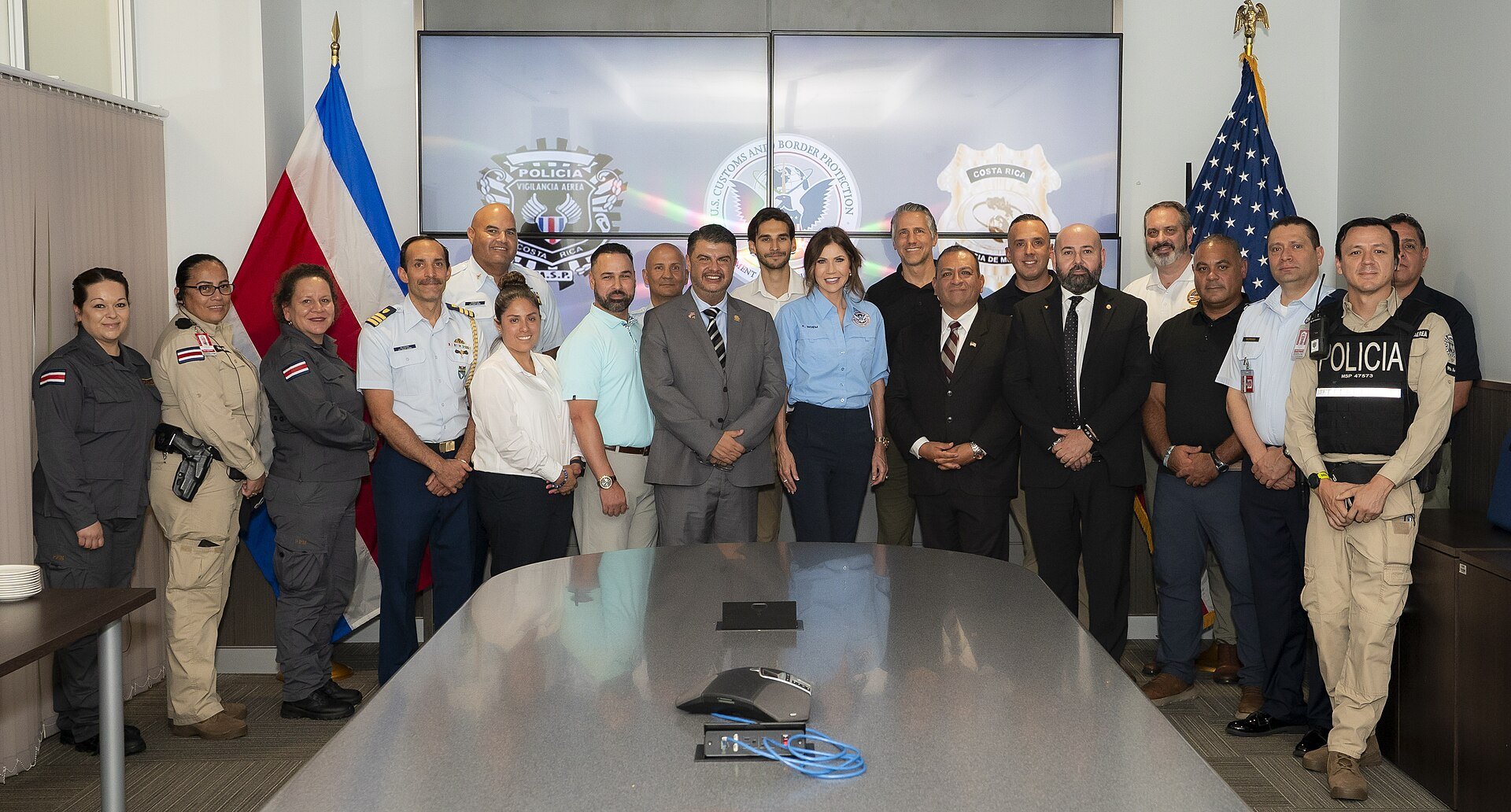
The United States also lists Costa Rica among 23 major drug transit or producing countries in a presidential determination dated 15 September 2026, which adds that presence on the list is not necessarily a reflection of a government’s current counterdrug efforts. The IMF counts worsening domestic crime among the downside risks to Costa Rica’s outlook.
China and the 5G Dispute
China is Costa Rica’s second-largest trading partner after the United States, and a free trade agreement has been in force since 1 August 2011, according to COMEX. Two-way trade grew from US$2.13 billion in 2016 to US$5.07 billion in 2025.
COMEX gives decade growth rates of 28.6% for exports to China and 9.3% for imports, and lists authorised exports including frozen and dehydrated pineapple, beef and pork. Protocols for chicken and farmed white shrimp are under negotiation.
The sharpest dispute is over 5G. Costa Rica adopted a cybersecurity rule in 2023 that bars Chinese vendors such as Huawei and ZTE from its 5G networks, and Rubio praised then-President Chaves for holding firm during a visit on 4 February 2025, according to DPL News.
A European Union delegation and 16 EU member-state embassies backed the rule in February 2024, while China’s embassy said excluding companies by country goes against market rules and fair competition, DPL News reported. A study by the National University, cited by DPL News, estimated that excluding Huawei would need US$1.4 billion in extra 5G investment and delay the roll-out by about four years.
As of February 2025 the rule was partly suspended by a precautionary measure while challenges by Huawei and a utility workers’ federation were pending, and Huawei was still a main equipment supplier to mobile operators. SUTEL, the telecoms regulator, said on 10 September 2026 that Claro and Liberty sell 5G services but the state operator ICE does not yet.
The Shield of the Americas statement of 23 September 2026, issued by 15 governments including Costa Rica, pledges “exploring investment screening mechanisms” and “promoting trusted supplier regulations for digital infrastructure, applied on a non-discriminatory basis”. The State Department’s 2025 investment climate report notes that Costa Rica has no formal screening mechanism for inbound investment beyond anti-money-laundering procedures.
Costa Rica is also widening its trade map: the CPTPP members and Costa Rica announced the substantive conclusion of accession talks on 6 May 2026, and COMEX presented the DEPA digital-economy accession instrument in New Zealand on 17 July 2026. A free trade agreement with Israel was signed in Jerusalem in December 2025, and PROCOMER opened investment offices in Silicon Valley on 17 February 2026 and in Singapore on 17 April 2026.
Lenders: the IMF, the World Bank, the IDB and CABEI
The IMF announced on 29 May 2026 that its Executive Board had concluded Costa Rica’s 2026 Article IV review and the mid-term review of its Flexible Credit Line. The line is worth about US$1.5 billion, or 300% of Costa Rica’s IMF quota, and directors agreed that treating the arrangement as precautionary is appropriate.
The IMF projects growth of 3.6% in 2026 and 3.5% in 2027, after 4.6% in 2025. It sees risks tilted to the downside from heightened global uncertainty, a disorderly AI-led market correction, tighter global financial conditions and worsening domestic crime.
The World Bank’s active portfolio in Costa Rica totalled US$1.52 billion across nine operations on 30 September 2026, and its private-sector arm IFC held a US$406 million portfolio on 31 August 2026 that includes support for the medical-technology sector. In an overview updated on 6 October 2026 the Bank puts central government debt at 60.4% of GDP and the deficit at 3.4%, and says stronger public finances will depend on spending efficiency, tax collection and more predictable external financing.
Teletica reported on 4 March 2026 that CABEI cut interest by 0.15% on all its loans to the government, saving more than US$30 million a year, after talks with then-President-elect Laura Fernández. The cut also covers approved projects not yet under way, such as the Route 1 widening between San José and San Ramón and the electric train for the Greater Metropolitan Area.
Semanario Universidad reported on 10 July 2026 that the Legislative Assembly approved three loans worth US$1.284 billion in May, including US$800 million for a passenger rapid train, without naming the lenders. It also listed pending files for a US$250 million IDB loan for a care programme and a US$150 million IDB and US$200 million World Bank package for education.
The OECD, Migrants and Americans Abroad
Costa Rica concluded its OECD accession on 25 May 2021 and became the organisation’s 38th member and the fourth from Latin America, according to COMEX. The OECD’s March 2025 economic survey names skills shortages as a critical challenge for attracting foreign direct investment.
The UN Population Division counted 628,404 international migrants living in Costa Rica in mid-2024, about two thirds of them Nicaraguans. Its estimates combine foreign-born counts with refugee data, so they can differ from national census figures.
- Nicaragua: 423,401 people in Costa Rica in mid-2024.
- Venezuela: 34,048. Colombia: 30,809.
- United States: 18,354. Panama: 16,546.
- Costa Rica-born people living abroad: 50,982 across all recorded destinations.
The US embassy in San José, led by Ambassador Melinda Hildebrand, holds town halls for American residents. The embassy scheduled sessions in Atenas on 6 October 2026 and in La Fortuna on 22 October 2026 with passport renewals, notarial services and information on voting from abroad in the 2026 midterm elections.
American visitors are the largest group of tourists, at 55% of 2.9 million arrivals in 2024, according to the State Department’s 2025 investment climate report. The same report lists a fiscal deficit, high energy costs and basic infrastructure among the challenges for investors.
What It Means for US Readers
American visitors made up 55% of Costa Rica’s 2.9 million tourist arrivals in 2024, and US citizens living there can use embassy town halls for passport and voting questions. Our guides to safety for foreigners in Costa Rica and residency rules cover the practical side.
Investors in global groups such as Boston Scientific, Medtronic and Newmont carry some Costa Rica exposure, because each runs operations in Costa Rican free zones. Individuals who want to buy property or open a company can start with our guide to investing in Costa Rica as a foreigner.
The 12.5% tariff and the deportation agreement show how US policy reaches Costa Rica directly, and the Shield of the Americas aligns its security policy with Washington. For the wider picture, see our guides to Costa Rica geopolitics, who holds power and the economy’s key players, the Latin America Power Map and our hub for Costa Rica news.
What Is Not Known
The PROCOMER and COMEX releases do not name the beverage company acquired in early 2026, which lifted first-quarter investment to US$4.58 billion, or the investors behind Switzerland’s 19.7% share of 2025 flows. The US share also differs by source and year: the State Department’s 2025 report gives 70% of 2024 inflows, while PROCOMER gives 54.8% for 2025 and 68.9% for the first half of 2026.
Intel’s current headcount and investment plans in Costa Rica are not stated in the COMEX or CINDE releases that mention the company. No amount has been published for the economic aid that Teletica says the United States promised under the March 2026 agreement.
The legal status of the 5G rule after February 2025 is not documented in the cited sources, and the IDB’s current Costa Rica lending is known only through press reports of bills before the Legislative Assembly. None of the cited sources gives a total for grant aid from donors or non-profit groups.
Frequently Asked Questions
Who are the biggest foreign investors in Costa Rica?
The United States supplied 54.8% of foreign direct investment in 2025, followed by Switzerland at 19.7%, Mexico at 4.7% and Colombia at 3.7%, according to PROCOMER. Medical-device makers such as Boston Scientific and Medtronic sit behind the largest export category.
Does Costa Rica have an IMF loan?
Costa Rica has a Flexible Credit Line of about US$1.5 billion, and the IMF said on 29 May 2026 that its board had reviewed it. Directors agreed that treating it as precautionary is appropriate.
Does China have a trade deal with Costa Rica?
Yes, a free trade agreement has been in force since 1 August 2011, and China is Costa Rica’s second-largest trading partner after the United States. Two-way trade reached US$5.07 billion in 2025, according to COMEX.
Is Costa Rica a member of the OECD?
Yes, Costa Rica concluded its accession on 25 May 2021 and became the OECD’s 38th member and the fourth from Latin America. The World Bank classed it as a high-income economy in 2025.
What does the United States want from Costa Rica?
A State Department message of 15 September 2026 names four aims: dismantling criminal organisations, securing telecommunications infrastructure, disrupting illegal immigration and bolstering border security. Costa Rica has joined the Shield of the Americas and Pax Silica.
How many Americans live in Costa Rica?
The United Nations estimated 18,354 US-born residents in mid-2024, out of 628,404 international migrants in total. Nicaraguans were by far the largest group, at 423,401.
Sources: PROCOMER, foreign direct investment 2025, 2026-04-06; PROCOMER, exports 2025, 2026-04-08; PROCOMER, foreign direct investment first half 2026, 2026-10-01; COMEX, CP-3250 US tariffs, 2026-07-23; COMEX, CP-3242 comments to USTR, 2026-07-07; COMEX, CP-3240 Washington meetings, 2026-07-02; COMEX, CP-3236 Pax Silica, 2026-06-25; COMEX, CP-3239 first-quarter investment, 2026-07-01; COMEX, CP-3226 Boston Scientific, 2026-05; COMEX, CP-3201 Intel job fair, 2026-02-11; COMEX, CP-2776 Intel plant, 2022-08; COMEX, CP-2638 Intel investment, 2021-07; COMEX, CP-2815 Medtronic, 2022-11-08; COMEX, CP-2897 Johnson & Johnson MedTech, 2023-09-25; COMEX, CP-3081 Zimmer Biomet, 2025-08-25; COMEX, CP-3091 Bayer, 2025-11-06; COMEX, CP-3255 Newmont, 2026-08-06; COMEX, CP-3271 free-zone congress, 2026-10-22; COMEX, CP-3270 electricity bill, 2026-10-20; COMEX, CP-3222 CPTPP, 2026-05-06; COMEX, CP-3247 DEPA, 2026-07-17; COMEX, CP-3100 Israel agreement, 2025-12; COMEX, CP-3202 PROCOMER Silicon Valley office, 2026-02-17; COMEX, CP-3218 PROCOMER Singapore office, 2026-04-18; COMEX, CP-3220 OECD semiconductor network, 2026-04-22; COMEX, China free trade agreement, 2026; COMEX, OECD accession, 2026; CINDE, free trade zones guide, 2026; CINDE, 2025 results, 2026-01-15; CINDE, medical device manufacturing, 2026; Presidencia, cabinet, 2026-10; Presidencia, dismissal of the foreign minister, 2026-09-24; Presidencia, new foreign minister, 2026-10-05; IMF, Press Release 26/177, 2026-05-29; World Bank, Costa Rica overview, 2026-10-06; OECD, Economic Survey of Costa Rica 2025, 2025-03-11; US embassy San José, Rubio meeting with Tovar, 2026-09-17; US embassy San José, joint statement on hemispheric sovereignty, 2026-09-23; US embassy San José, Atenas town hall, 2026-09-17; US embassy San José, La Fortuna town hall, 2026-09-29; US State Department, Costa Rica National Day, 2026-09-15; US State Department, Presidential Determination FY2027, 2026-09-16; US State Department, 2025 Investment Climate Statement, 2025; SUTEL, 5G network quality, 2026-09-10; UN DESA, International Migrant Stock 2024, 2024; Teletica, US deportation agreement (wire report), 2026-03-23; Teletica, first deportees arrive, 2026-04-11; Teletica, CABEI rate cut, 2026-03-04; Semanario Universidad, new credits, 2026-07-10; DPL News, Rubio and the 5G rule, 2025-02-05; DPL News, EU backs the 5G rule, 2024-02-02.
This article was produced by The Rio Times’ automated newsroom system. How we use AI · Report an error · Editorial responsibility: Matthias Camenzind, Editor-in-Chief
Expat Guide to Costa Rica
What The Rio Times publishes for foreigners who live in or move to Costa Rica.
Start here
- Fer De Lance Snake Facts and Safety Tips
- Best Places to Live in Costa Rica for Expats 2026
- Costa Rica Income Tax Bill Would Charge Residents 15% on Five Kinds of Foreign Investment Income
- Costa Rica Permanent Residency and Citizenship: How the Rules Work
City guides
Coming up in Costa Rica
- Def Leppard Costa Rica Concert Set for 27 October 27 Oct
- Ozuna Plays Costa Rica on 31 October 31 Oct
- Alejandro Sanz Plays Costa Rica on 7 November 2026 7 Nov
- Cazzu Plays Alajuela, Costa Rica, on 12 November 2026 12 Nov
Understand Costa Rica