BRAZIL · SECURITY
Key Facts
- —The country Brazil, Latin America’s largest country, is a federation of 26 states and a federal district, and each state runs its own police forces.
- —Violence in 2025 Brazil recorded 40,775 violent deaths in 2025, or 19.1 per 100,000 people, the lowest rate since the national series began in 2012.
- —Police killings Police killed 6,602 people in 2025, up from 6,237 in 2024 and the highest total since the FBSP’s count began in 2016.
- —The gangs Comando Vermelho (CV) and Primeiro Comando da Capital (PCC) grew out of prisons; the US has listed both as Foreign Terrorist Organizations since 5 June 2026.
- —For visitors The US State Department rates Brazil Level 2, ‘Exercise Increased Caution’, and warns against entering favelas, even on guided tours.
- —Prediction markets Polymarket gives Flávio Bolsonaro an 89% chance of winning the 25 October runoff (10 October, 9:18 a.m. ET). Polymarket puts Flávio Bolsonaro’s chance of winning at 89% and Kalshi at 87% (Lula: 12% and 13%), as of 10 October, 10:00 am ET; prices are bets, not polls.
- —Still open As of 8 October 2026, the Senate had yet to approve an amendment that would write a unified public security system into the Constitution.
Brazil security matters to Americans who travel, invest or trade with Latin America’s largest country, where crime still shapes daily life. In 2025 the violent-death rate fell to its lowest since the national series began in 2012, while police killings hit a record.
Washington now lists Brazil’s two biggest gangs as terrorists, and the 25 October runoff decides Brazil security policy from 2027.

Brazil Security in Numbers, Crime Trends to 2025
The best yearly picture of Brazil security comes from the Brazilian Public Security Forum (FBSP), an independent research group. Its 2026 yearbook compiles 2025 police data from all 26 states and the Federal District.
Brazil counted 40,775 intentional violent deaths in 2025, a category that adds murders, robbery-killings and deaths caused by police. That equals 19.1 per 100,000 people, 8.2% below the 2024 rate and under 20 for the first time in the series.
Murders alone fell 10% to 32,914, a rate of 15.4 per 100,000 people. A national policy, revised in 2021, targets 16 murders per 100,000 by 2027, so Brazil met it two years early.
Not every number improved. Femicides, killings of women classed as a separate crime since October 2024, rose 4% to 1,571 victims in 2025.
Fraud is now the country’s main property crime. Police logged 2,261,055 fraud cases in 2025, about 258 an hour, up 429.8% since 2018.
Street robbery is falling but remains common. About 331,000 mobile phones were taken in robberies in 2025, down 19%, and almost 500,000 more were stolen without violence.
The Gangs, Factions and Militias
Two prison-born factions dominate organised crime and drive much of the Brazil security debate. The Comando Vermelho (Red Command, or CV) began in Rio de Janeiro, the Primeiro Comando da Capital (PCC) in São Paulo.
According to the FBSP, both grew inside overcrowded prisons and now shape crime across the country, with significant reach abroad. They move cocaine from Colombia, Peru and Bolivia and marijuana from Paraguay to Brazilian cities and export ports.
The FBSP describes two main smuggling corridors. The CV dominates the Amazon river route, the Rota do Solimões, while the PCC dominates the inland Rota Caipira.
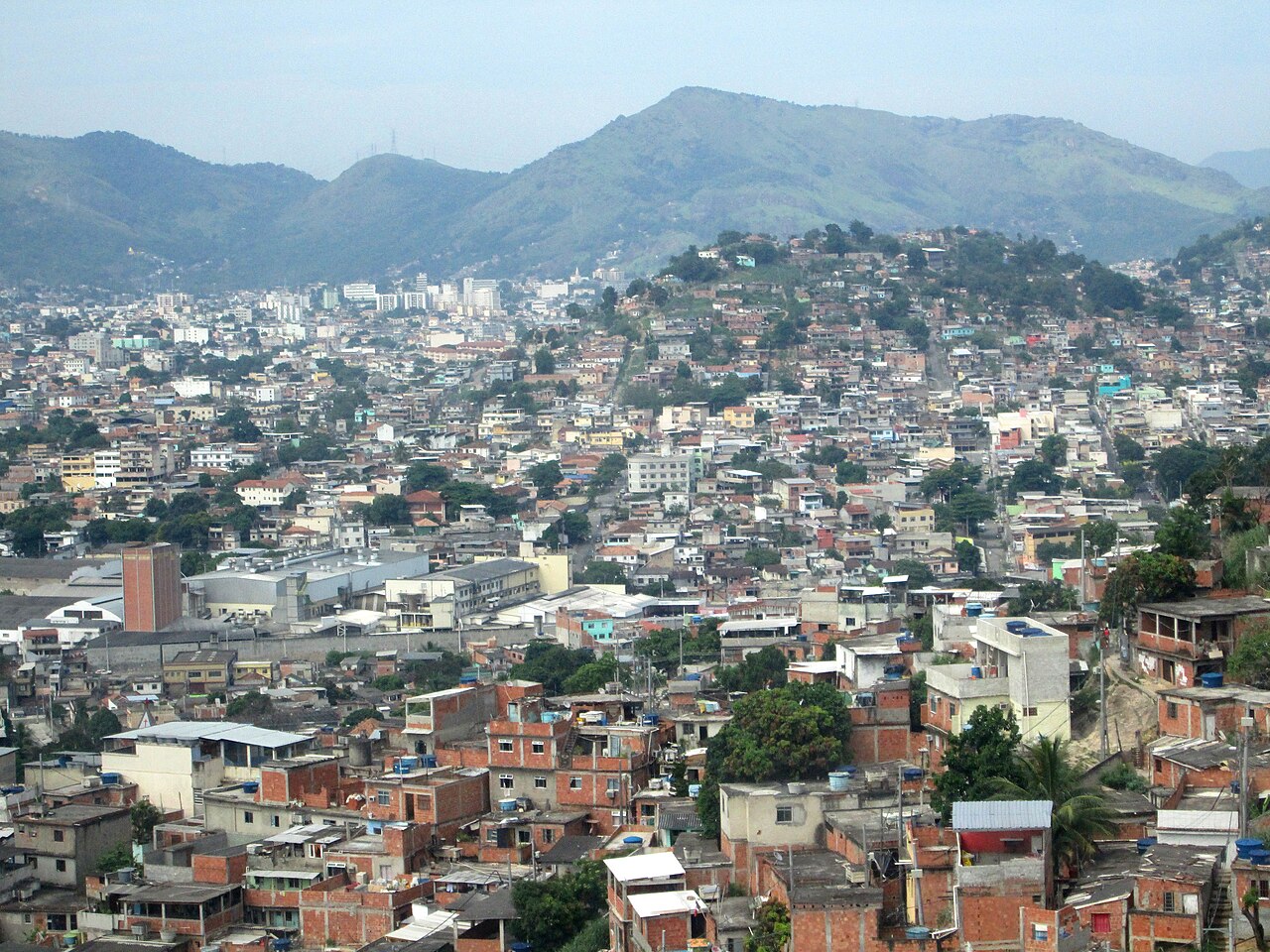
In Greater Rio de Janeiro, a map by Fluminense Federal University and the Fogo Cruzado institute shows how far armed rule reaches. About 4 million people, 34.9% of the metropolitan population, lived under armed control or influence in 2024, Agência Brasil reported.
The CV controlled about 1.6 million people, 47.2% of those under armed rule. Militias, armed paramilitary groups strongest in Rio’s West Zone, held the most ground, 49.4% of the dominated area.
In the Baixada Fluminense suburbs, militias, the CV and a third faction, the Terceiro Comando Puro (TCP), all expanded quickly. According to FBSP research, 41.2% of Brazilians say factions or militias are present in their neighbourhood.
How the Police and Army Are Organised
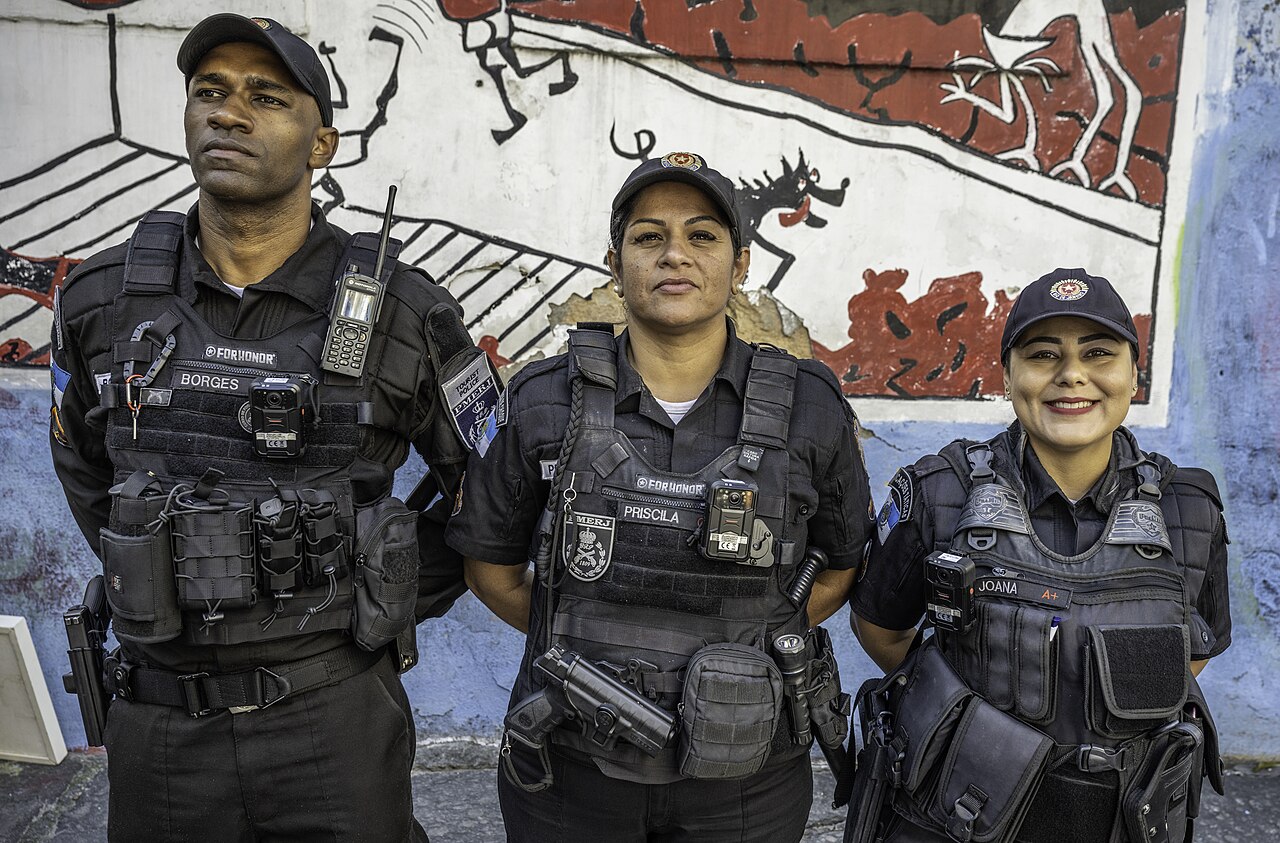
Brazil security forces are split by the 1988 Constitution, whose Article 144 divides policing between federal and state bodies. Most everyday policing is done by the states, not by the federal government in Brasília.
When the Army Steps In
The armed forces take on street policing through a Guarantee of Law and Order operation, known as a GLO. Under Complementary Law 97 of 1999, only the president can order one.
A GLO requires the state’s own forces to be formally declared unavailable or insufficient. Troops then act episodically, in a set area and for a limited time.
Police Killings at a Record
In 2025, officers killed 6,602 people, while 139 police officers were killed on or off duty. One in six violent deaths in Brazil was caused by police, the highest share since 2014.
Bahia recorded the most police killings, 1,570, nearly double São Paulo state’s 835. Rio de Janeiro state followed with 798.
In October 2025, Operation Contenção (Containment) in Rio’s Alemão and Penha favelas was Brazil’s deadliest police raid on record, says the FBSP. By the FBSP’s count, it left 122 dead, five of them security agents.
- Federal Police (Polícia Federal): investigates federal and cross-border crimes, drug trafficking and smuggling, and polices borders, ports and airports.
- Federal Highway Police (PRF): patrols the federal highways.
- Military Police (Polícia Militar): each state’s uniformed patrol force, in charge of street policing and public order. Despite the name, it answers to the state governor.
- Civil Police (Polícia Civil): each state’s investigative force, led by career police chiefs called delegados.
- Penal Police (Polícia Penal): guards federal and state prisons.
Where Crime Is Highest in Brazil
The Brazil security map is uneven, with violence concentrated in the north and northeast. The Northeast recorded 31.6 violent deaths per 100,000 people in 2025, against 12.6 in the Southeast and 11.9 in the South.
The highest state rates were in Amapá (42.5), Bahia (36.8) and Ceará (34.7). All ten deadliest cities with 100,000 or more residents are in the Northeast.
Maranguape in Ceará led with 100.3 per 100,000, more than five times the national rate. The FBSP links the top cities to faction wars over drug routes along key highways.
Six states and the Federal District saw violent deaths rise in 2025, led by Rio Grande do Norte at 19.6%. Rio de Janeiro state rose 2.1% to 3,890 deaths, a rate of 22.6, pushed up partly by police killings.
Phone theft follows a different map. Among large cities, São Luís, Belém and São Paulo had the highest rates of mobile phones taken in 2025.
Safer Areas and Advice for Visitors
The lowest violent-death rates in 2025 were in Santa Catarina (7.6 per 100,000), São Paulo state (7.8) and the Federal District (9.6). Rio Grande do Sul (11.3) and Minas Gerais (12.9) were also well below average.
For visitors, Brazil security depends heavily on place, and state averages hide sharp contrasts. São Paulo city ranks third for phone theft among large cities.
The US State Department advisory, updated on 29 May 2025, rates Brazil Level 2, ‘Exercise Increased Caution’. It names these do-not-travel zones:
Common Risks for Foreigners
The advisory warns that drugs slipped into drinks are common, especially in Rio de Janeiro. It adds that criminals use dating apps and bars to target foreigners before robbing them.
It advises against going to bars or nightclubs alone and tells US government staff not to use municipal buses. With phone theft and scams so common, keeping phones out of sight and refusing unexpected payment requests are simple defences.
- Anywhere within 160 km (100 miles) of Brazil’s land borders, except Foz do Iguaçu and Pantanal national parks.
- Informal housing areas such as favelas, vilas and comunidades, at any time and even on guided tours.
- Brasília’s satellite cities of Ceilândia, Santa Maria, São Sebastião and Paranoá, from 6 p.m. to 6 a.m.
New Laws and the Election Fight Over Crime
Brazil security law tightened with the Anti-Faction Law (Law 15,358), signed by President Luiz Inácio Lula da Silva on 24 March 2026. It defines a faction as three or more people who use violence or threats to control territory.
It creates a new crime of ‘structured social domination’, punishable by 20 to 40 years in prison. Faction leaders must be held in maximum-security prisons and lose access to bail, parole and pardons.
A second reform, the Public Security amendment (PEC 18/2025), was sent by the government and has passed the lower house. It would write the Unified Public Security System into the Constitution and let cities create municipal police.
The Senate’s constitution committee approved its main text on 2 September 2026 but left one proposed change for a later vote. The amendment was still awaiting Senate approval on 8 October, when Lula publicly urged senators to pass it.
The two runoff candidates offer different paths. Lula, of the left-wing Workers’ Party (PT) and in his third term, promises a Ministry of Public Security once the amendment passes.
His rival, Senator Flávio Bolsonaro of the conservative Liberal Party (PL), is the son of former president Jair Bolsonaro. He proposes labelling the CV and PCC as narco-terrorist groups and building five maximum-security prisons, Agência Brasil reported.
Flávio also wants an elite military border force and a lower age of criminal responsibility, 16 instead of 18. In remarks published on 7 October 2026, he said he would bring Brazil into the US-led Shield of the Americas.
What Prediction Markets Say
Prediction markets, where traders place real-money bets on outcomes, favour Flávio Bolsonaro in the 25 October runoff. On Polymarket he carried an 89% chance of winning on 10 October at 9:18 a.m. ET.
Total bets on that market exceeded US$179 million. A separate market on the winning margin gave its best odds, 49%, to a Flávio win by 4 to 8 points.
For Brazil security, the result decides whether the next government follows Lula’s ministry-and-amendment plan or Flávio’s harder line and closer US alignment. The winner takes office on 5 January 2027.
Prediction markets · who wins the runoff
Implied chance of winning Brazil’s presidency on 25 October, from traders’ prices.
Polymarket
Flávio Bolsonaro 88.5% · Lula 11.5% (US$180 million traded)
Kalshi (regulated in the US by the CFTC)
Flávio Bolsonaro 87% · Lula 13%
As of 10 October, 10:00 am ET (15:00 Lisbon), updated every 20 minutes. Prices are bets, not polls, and can move fast.
Why we show this: prediction markets turn real-money bets into a live probability that moves within minutes of the news, which is why investors, campaigns and newsrooms in the United States now follow them closely. We show them next to polls and official results, never instead of them.
What It Means for US Readers
For travellers, the Brazil security risks most likely to matter are phone theft, scams and drugged drinks, not Northeastern faction wars. The State Department’s no-go list covers favelas, border zones and Brasília’s satellite cities at night.
For companies and investors, the US terrorist listing of the CV and PCC carries legal weight. Knowingly giving a designated group ‘material support’ is a US crime.
US banks must hold and report any funds tied to a listed group. Firms paying suppliers, security providers or logistics partners in faction-controlled areas therefore face sharper due-diligence questions.
Non-US members of designated groups are barred from entering the United States. The State Department says the factions’ illicit networks reach ‘across our region and into our country’.
Whether Brasília cooperates more closely with Washington on organised crime will depend partly on the runoff.
What Is Not Known
It is unclear whether the Senate will pass the Public Security amendment before the new president takes office on 5 January 2027. Its fate may hinge on the runoff result.
Full Brazil security data for 2026 will only come with the FBSP’s next yearbook. Whether murders kept falling and police killings kept rising in 2026 is not yet known.
How strictly Washington will enforce the terrorist listings against Brazilian firms, banks or individuals remains open. It is also unknown whether a Flávio government would label the factions as terrorists under Brazilian law.
Frequently Asked Questions
Is Brazil safe for American tourists?
The US State Department rates Brazil Level 2, ‘Exercise Increased Caution’, in its 29 May 2025 update. For Brazil security, common visitor risks include phone theft, scams and drugged drinks, and the advisory says to avoid favelas, border zones and Brasília’s satellite cities at night.
What are the PCC and the Comando Vermelho?
They are Brazil’s two largest criminal factions, both born inside prisons: the Comando Vermelho (CV) in Rio de Janeiro and the Primeiro Comando da Capital (PCC) in São Paulo. They dominate drug-trafficking routes, and the US listed both as Foreign Terrorist Organizations on 5 June 2026.
Which parts of Brazil are safest?
By violent-death rate in 2025, the safest were Santa Catarina (7.6 per 100,000), São Paulo state (7.8) and the Federal District (9.6), according to the FBSP. The national rate was 19.1, and the Northeast was the most violent region.
Is Rio de Janeiro dangerous?
Rio de Janeiro state recorded 22.6 violent deaths per 100,000 people in 2025, above the national rate of 19.1. About 4 million people in Greater Rio lived under armed control or influence in 2024, and the US advisory warns of drink drugging in the city.
What is the difference between Brazil’s military police and civil police?
Both are state forces under the governor. The military police patrol the streets and keep public order, while the civil police, led by career chiefs called delegados, investigate crimes.
Can Brazil’s army police the streets?
Normally through a Guarantee of Law and Order operation (GLO), which the president alone can order. Troops act only after state forces are declared insufficient, in a set area and for a limited time.
How will the 2026 election affect Brazil security?
The 25 October runoff decides who takes office on 5 January 2027. Lula promises a Ministry of Public Security, while Flávio Bolsonaro proposes labelling factions as narco-terrorists and joining the US-led Shield of the Americas.
Sources: FBSP, Anuário Brasileiro de Segurança Pública 2026, 2026-07; US State Department, Brazil Travel Advisory, 2025-05-29; US State Department, Terrorist Designation of CV and PCC, 2026-05-28; US State Department, Foreign Terrorist Organizations list, 2026-10-10; Constitution of Brazil, Articles 77, 82, 142 and 144, 2026-10-10; Complementary Law 97/1999, Article 15, 2026-10-10; Agência Senado, Anti-Faction Law in force, 2026-03-25; Agência Brasil, Senate committee approves security amendment, 2026-09-02; Agência Brasil, Flávio and Lula security proposals, 2026-10-09; Agência Brasil, armed control in Greater Rio (GENI/UFF and Fogo Cruzado), 2025-12-04; TSE, first-round presidential result, 2026-10-05; Agência Senado, runoff between Flávio Bolsonaro and Lula, 2026-10-04; Correio Braziliense, Lula urges Senate vote on security amendment, 2026-10-08; Jornal do Comércio, Flávio Bolsonaro on the Shield of the Americas, 2026-10-07.
This article was produced by The Rio Times’ automated newsroom system. How we use AI · Report an error · Editorial responsibility: Matthias Camenzind, Editor-in-Chief
Rotate for Best Experience
This report is optimized for landscape viewing. Rotate your phone for the full experience.
You've reached your free article limit
Subscribe to The Rio Times for unlimited access to our news, expat and nomad guides and market intelligence on Latin America and Africa.