Where in Brazil Is Safe, Affordable and Rising?
Santa Catarina’s industrial cities come closest on the data, but every city on the short list carries a named gap, from flood exposure to missing price records.

Brazil Analysis
Brazil has many safe cities but few that are also growing: of 336 cities above 100,000 people, 63 recorded 10 or fewer homicides per 100,000 residents in 2024, and only 12 of those grew 2% a year or faster. That screen uses the Atlas da Violência, a homicide study by the federal research institute Ipea and the Brazilian Public Security Forum, and census counts from IBGE, Brazil’s statistics institute, and it leaves four finalists, Joinville, Blumenau, Jaraguá do Sul and Campina Grande, each with a gap in the data.
Brazil’s homicide rate has fallen by a third in a decade, from 30.2 per 100,000 residents in 2014 to 20.1 in 2024 on health-ministry records, according to the Atlas da Violência 2026 (Ipea and the Brazilian Public Security Forum, FBSP). The fall began in 2018, and the Atlas puts the 2024 rate at 23.4 once it estimates killings that health records left unclassified.
Key Facts
- Screen. 63 of 336 large cities recorded 10 or fewer homicides per 100,000; few also grow fast.
- Finalists. Joinville, Blumenau, Jaraguá do Sul, Campina Grande; Goiânia passes with a caveat.
- Prices. Joinville asks R$8,458 per m² (about US$1,422) against R$10,065 nationally (about US$1,692).
- As of. 23 November 2026
Santa Catarina’s industrial cities come closest on the data, but every city on the short list carries a named gap, from flood exposure to missing price records.
The Atlas’s authors warn that the improvement is partly a data problem, in a passage translated from Portuguese: “a large share of this reduction is due to the worsening quality of health data, in which many homicides stopped being classified as such” (Atlas 2026, chapter 1). Violent deaths of undetermined cause rose by 3,311 cases, or 23.8%, in 2024, so one year of one source is thin evidence for any single city.
The same Atlas shows how unevenly the risk is spread: “On average, the rate of the 20 most violent municipalities was about 64.7 homicides per 100,000 inhabitants, while that of the 20 least violent was around 4.9” (translated from Portuguese). That is a gap of about 13.2 times between the extremes.
Safe cities are easy to find, but growth is the scarce attribute: only 12 of the 63 cities at or below 10 grew 2% a year or faster between the 2010 and 2022 censuses, by Rio Times calculation from the Atlas table and IBGE counts (table 4714, table 202). All twelve are in Santa Catarina or São Paulo state.
Palhoça (4.1% a year), Camboriú (4.3%), Brusque, Florianópolis and Jaraguá do Sul (2.05%) are among the twelve, mostly coastal and commuter towns, while the safest inland cities barely grow: Santa Bárbara d’Oeste (3.2 homicides per 100,000) and Lavras (3.6) expanded by only 0.15% to 1.1% a year. The fastest growers, such as Senador Canedo, an industrial suburb of Goiânia, and farming or mining hubs such as Luís Eduardo Magalhães, Parauapebas, Sinop and Sorriso, have Atlas rates of 26.4 to 62.8.
Famous Growth Stories Fail on Price, Safety or Momentum
Price removes the best-known winners, even though Florianópolis (Atlas rate 9.7) and Balneário Camboriú (9.4) are safe. In the FipeZAP index for October 2026, built by the Fipe research institute from listings on the Brazilian property portals Zap and Viva Real, Florianópolis asks R$13,690 per square metre (about US$2,301) and Balneário Camboriú R$15,325 (about US$2,576), converted at R$5.95 per US$1, the 20 November 2026 close.
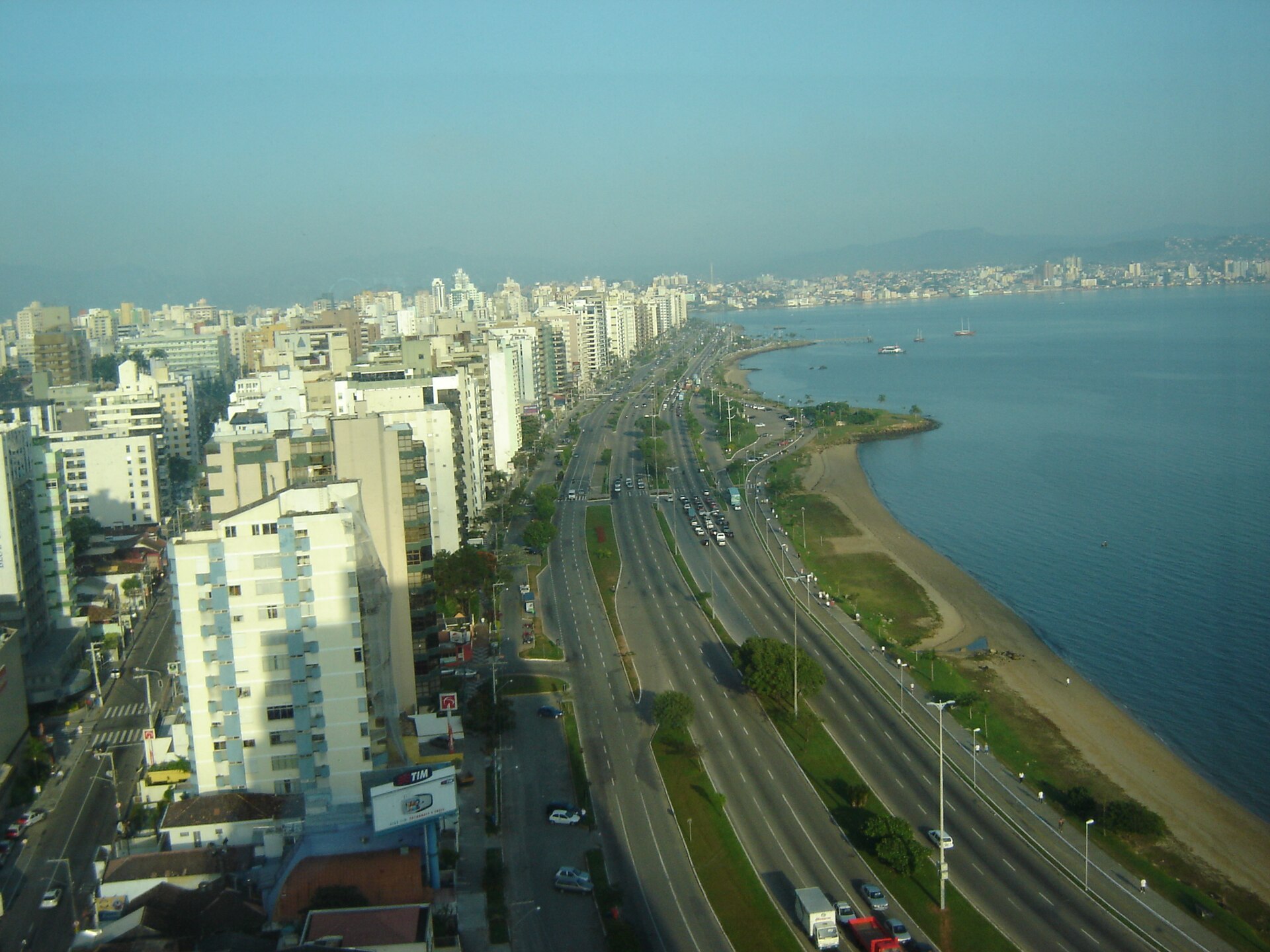
Vitória asks R$15,938 (about US$2,679) and also fails on safety, with an Atlas rate of 30.0. The national asking price is R$10,065 (about US$1,692), up 5.44% in 12 months against inflation of 4.82%, according to the same FipeZAP report.
Safety removes the Northeast capitals, where the Atlas 2024 rates are Salvador 52.7, Maceió 45.9, Recife 45.5 and Fortaleza 42.2 per 100,000. Momentum removes Rio Grande do Sul, where IBGE’s 2026 population estimate shows 0.00% growth against 1.54% for Santa Catarina (table 6579).
Neither cheap nor moving describes Curitiba, where asking prices of R$11,716 per square metre (about US$1,969) rose only 0.22% in the 12 months to October 2026 (FipeZAP). Pelotas, in Rio Grande do Sul, is the cheapest city in the index at R$4,739 (about US$797), and its asking rents fell 2.61% in 12 months (FipeZAP rent report).
Joinville and Blumenau Lead, Jaraguá do Sul Is Unpriced
| City | Homicides per 100,000 (rate, year, source) | Asking price per m² (FipeZAP, Oct 2026) | Verdict |
|---|---|---|---|
| Brazil (reference) | 23.4 (2024, Atlas, estimated) | R$10,065 (about US$1,692) | Benchmark |
| Joinville (SC) | 8.1 (2024, Atlas) | R$8,458 (about US$1,422) | Most data of the four |
| Blumenau (SC) | 5.8 (2024, Atlas) | R$8,232 (about US$1,384) | Low rate, flood risk |
| Jaraguá do Sul (SC) | 2.0 (2024, Atlas) | No FipeZAP series | Safest, least verifiable |
| Campina Grande (PB) | 8.2 (2024, Atlas) | No FipeZAP series | Unproven |
| Goiânia (GO) | 14.7 (2024, Atlas) | R$8,531 (about US$1,434) | Passes with a caveat |
| Anápolis (GO) | 7.9 (2024, Atlas); 17.0 (2025, MySide, a real-estate guide) | No FipeZAP series | Unproven |
| Goiana (PE) | None, city too small for the Atlas | No FipeZAP series | Not ready |
Joinville has the most data of the four finalists: its city hall (the Prefeitura) reports that robberies fell from 933 in 2023 to 476 in 2025 and vehicle thefts from 1,249 to 668, the only city-level property-crime series found for any finalist (Prefeitura de Joinville, figures for January to December 2025). Its Atlas homicide rate is 8.1 per 100,000 for 2024, above Blumenau’s and Jaraguá do Sul’s but well below the Atlas’s national estimate of 23.4.
FipeZAP shows Joinville’s asking prices up 5.32% in the 12 months to October 2026, cooled from 15.3% in the 12 months to October 2024 (FipeZAP sales report, October 2026, and October 2024). Asking rents average R$38.47 per square metre (about US$6.47), up 4.01% in 12 months, with a gross yield (annual rent as a share of price) of 5.36% (FipeZAP rent report, October 2026).
The catch is water, because central neighbourhoods flooded on 21 February 2026 after 108 mm of rain by 06:00, according to the city’s damage declaration. No street-level flood map for Joinville was found, so the exposure of individual districts remains unmeasured.
Blumenau’s Atlas rate of 5.8 per 100,000 in 2024 rests on 22 estimated killings in a city of 380,597 people, so one extra death moves it by about 0.3 points. Asking prices of R$8,232 per square metre (about US$1,384) rose 8.65% in 12 months to October 2026 (FipeZAP).
Blumenau’s catch is the Itajaí-Açu river: an official flood starts at 8 metres, and at 12 metres about 10,171 properties and 38,548 people are affected, according to a civil-defence table published by NSC Total, a regional newspaper. The table rests on a flood survey from 2011 and 2012, so the exposure it shows may have changed.
Jaraguá do Sul has the lowest Atlas rate of all 336 cities, 2.0 per 100,000 in 2024, but that rests on four estimated killings in a city of 195,753 people. A 95% statistical interval around four killings runs from about 0.6 to 5.2 per 100,000, which overlaps Blumenau’s range of about 3.6 to 8.8, so its claim to be Brazil’s safest large city cannot be separated from Blumenau’s (Rio Times calculation).
No FipeZAP price series covers Jaraguá do Sul, so its prices cannot be compared with Joinville’s or Blumenau’s on any index. The same gap applies to Campina Grande, Anápolis and Goiana, none of which is in the 56-city FipeZAP panel.
Campina Grande Is Unproven and Goiânia Passes With a Caveat
Campina Grande, in the north-eastern state of Paraíba, has an Atlas rate of 8.2 for 2024, well below the national estimate of 23.4. The city has no FipeZAP series, so its prices cannot be set against Joinville’s or Blumenau’s.
Mean monthly household income per person was R$1,373 (about US$231) in Campina Grande at the 2022 census, against R$2,261 (about US$380) in Joinville (IBGE table 10295). Receipts of the municipal property-transfer tax, the only transaction-side measure found, fell 21.4% from R$25.5 million to R$20.1 million (about US$3.4 million) in 2025, while Joinville’s reached R$119.2 million (about US$20 million), according to Brazil’s Treasury municipal accounts database (2024, 2025).
Goiânia, the capital of Goiás, passes with a caveat: its Atlas rate was 14.7 in 2024, below the median of 20.2 for large cities and down from 50.5 in 2014 (see the full ranking of Brazil’s safest and most dangerous capitals). FipeZAP shows R$8,531 per square metre (about US$1,434), up 6.34% in 12 months, with asking rents at R$44.26 (about US$7.44) per square metre.
On FipeZAP’s figures Goiânia is 19% dearer than Cuiabá (R$7,193, about US$1,209) and 29% dearer than Campo Grande (R$6,609, about US$1,111), two cheaper capitals. It is a mature capital that is recovering, not an emerging one.
Anápolis, also in Goiás, is unproven because the Atlas gives 7.9 for 2024 while MySide, a real-estate company’s guide, gives 17.0 for 2025 (MySide Anuário 2026), a gap too wide to be explained by method alone. Goiana, in Pernambuco, is not ready: with 81,055 residents at the 2022 census it is too small for the Atlas and FBSP city tables, so no homicide rate or price series exists.
Goiana’s draw is the carmaker Stellantis’s R$13 billion (about US$2.2 billion) investment plan for 2025 to 2030, reported by the newspaper Diário de Pernambuco. Pernambuco, the state around it, recorded a violent-death rate of about 33 per 100,000 in 2025, among the highest of Brazil’s states (FBSP Anuário 2026, the Forum’s yearbook).
What the Data Cannot Show
FipeZAP covers 56 cities for sales and 36 for rent and uses asking prices from online listings, so it shows what sellers hope for and not what buyers pay (FipeZAP report). The only transaction-side figure found for the four finalists is municipal property-transfer tax, which blends volume, declared values and local discounts.
MySide, a real-estate company’s guide that fills many gaps, differs from official figures by a factor of two or more in places: Anápolis is 7.9 in the Atlas and 17.0 in MySide, and Campina Grande is 8.2 against 12.0. Maringá reads 15.0 in the Atlas against 11.9 in MySide, so the gaps run in both directions, and the Atlas’s lowest rates rest on only a handful of killings.
No source offers city-level theft or burglary counts except Joinville’s city hall, so petty-crime risk cannot be compared across the finalists. Evidence on things to do rests on festival counts and tourism boards, because no independent rating of restaurants or nightlife was found for any of the four.
The next dated checkpoint is FipeZAP’s November 2026 report, which updates asking prices for its 56 sales cities. Still missing are a second year of Atlas data, price records for the cities FipeZAP does not cover and property-crime counts for the finalists.
Frequently Asked Questions
Which city in Brazil is the safest?
On the Atlas da Violência 2026 table, Jaraguá do Sul has the lowest homicide rate of all large cities, but Blumenau cannot be statistically separated from it. Both rates rest on very small counts of killings.
Is Goiânia safe to live in?
Goiânia sits in the lower half of Brazil’s large cities by homicide rate, which has fallen sharply over a decade. Its asking prices are below the national figure among the cities FipeZAP tracks.
Where in Brazil is safe, affordable and growing?
No city passes every test without a caveat. Joinville has the most data of the four finalists, Blumenau carries flood exposure, and Campina Grande remains unproven.
Expat Guide to Brazil
What The Rio Times publishes for foreigners who live in or move to Brazil.
Start here
- Florianópolis Rents by Neighborhood in 2026
- São Paulo Rents by Neighborhood in 2026
- Rio de Janeiro Rents by Neighborhood in 2026
- Brazil Taxes Nomads After 184 Days
City guides
Rio de Janeiro, São Paulo, Florianópolis, Salvador, Belo Horizonte, Fortaleza, Curitiba, Porto Alegre, Brasília
Coming up in Brazil
- Loyle Carner Plays a 1,110-Ticket Club 24 Nov
- Natal em Blumenau 2026: Dates, Parades and Visitor Guide 26 Nov
- Tricky São Paulo Concert on 26 November 26 Nov
- Groundation Concert in Rio de Janeiro on 27 November 27 Nov
Understand Brazil
Sources
Atlas da Violência 2026, Ipea and FBSP (2024 data) · FipeZAP sales report, October 2026 · FipeZAP sales report, October 2024 · FipeZAP rent report, October 2026 · IBGE Census 2022, table 4714 · IBGE Census 2010, table 202 · IBGE population estimates, table 6579 · IBGE Census 2022 income, table 10295 · FBSP Anuário 2026 (state rates) · Prefeitura de Joinville, crime figures 2023 to 2025 · Prefeitura de Joinville, damage declaration of 21 February 2026 · Tesouro Nacional SICONFI, 2025 accounts · MySide Anuário 2026 · Blumenau civil-defence flood table, via NSC Total · Diário de Pernambuco, 2026
This article was produced by The Rio Times’ automated AI newsroom. Editorial responsibility: Matthias Camenzind, Publisher and Editor-in-Chief. The Rio Times also runs Ask Rio Times, which answers from 100,000+ of our own articles, the daily Latin America Power Map, and prediction-market odds on elections and markets.. How we use AI · Report an error
Connected Coverage
Brazil news · Brazil’s safest and most dangerous capitals · Best places to live in Brazil for expats · Oktoberfest Blumenau guide · Expat cities
Brazil runoff, Sunday, October 25: Brazil runoff: date, poll closing times and when results start. Latest: Brazil runoff polls, Flávio 51%, Lula 49%.