Rio’s Armed Group Map Put 1.6 Million People Under One Faction
Security · Brazil
—The stakes. Territorial control by armed groups defines daily risk in Rio de Janeiro for residents, expats and investors.
Runoff · Sunday, 25 October
Brazil Runoff 2026: Lula vs Flávio
Date, polls, debates, odds and how the runoff works, updated every day.
Read our Brazil election 2026 runoff guide →
Brazil runoff polls · Polymarket and Kalshi odds · When results come · Brazil election poll data (CSV)
Prediction markets · who wins the runoff
Implied chance of winning Brazil’s presidency on 25 October, from traders’ prices.
Polymarket
Flávio Bolsonaro 79.8% · Lula 20% (US$194 million traded)
Kalshi (regulated in the US by the CFTC)
Flávio Bolsonaro 79% · Lula 22%
As of 24 October, 6:40 am ET (11:40 Lisbon), updated every 20 minutes. Prices are bets, not polls, and can move fast.
Why we show this: prediction markets turn real-money bets into a live probability that moves within minutes of the news, which is why investors, campaigns and newsrooms in the United States now follow them closely. We show them next to polls and official results, never instead of them.
—The map. The Geni/UFF and Fogo Cruzado study, published in December 2025, maps armed control from 2007 through 2024 across the metropolitan region.
—The factions. Comando Vermelho holds the largest population under control, militias hold the most territory, and TCP acts as a third force.
—The operations. The October 2025 Operation Contencao in Penha and Alemao became the most lethal police action in Rio’s history.
—The data. Homicides fell to a 34-year low in 2024 while police killings and territorial disputes rose sharply in 2025.
Rio de Janeiro’s security map is no longer a question of isolated favela violence but of institutionalised territorial rule. Understanding who controls each block now determines where residents, expats and investors can safely move.
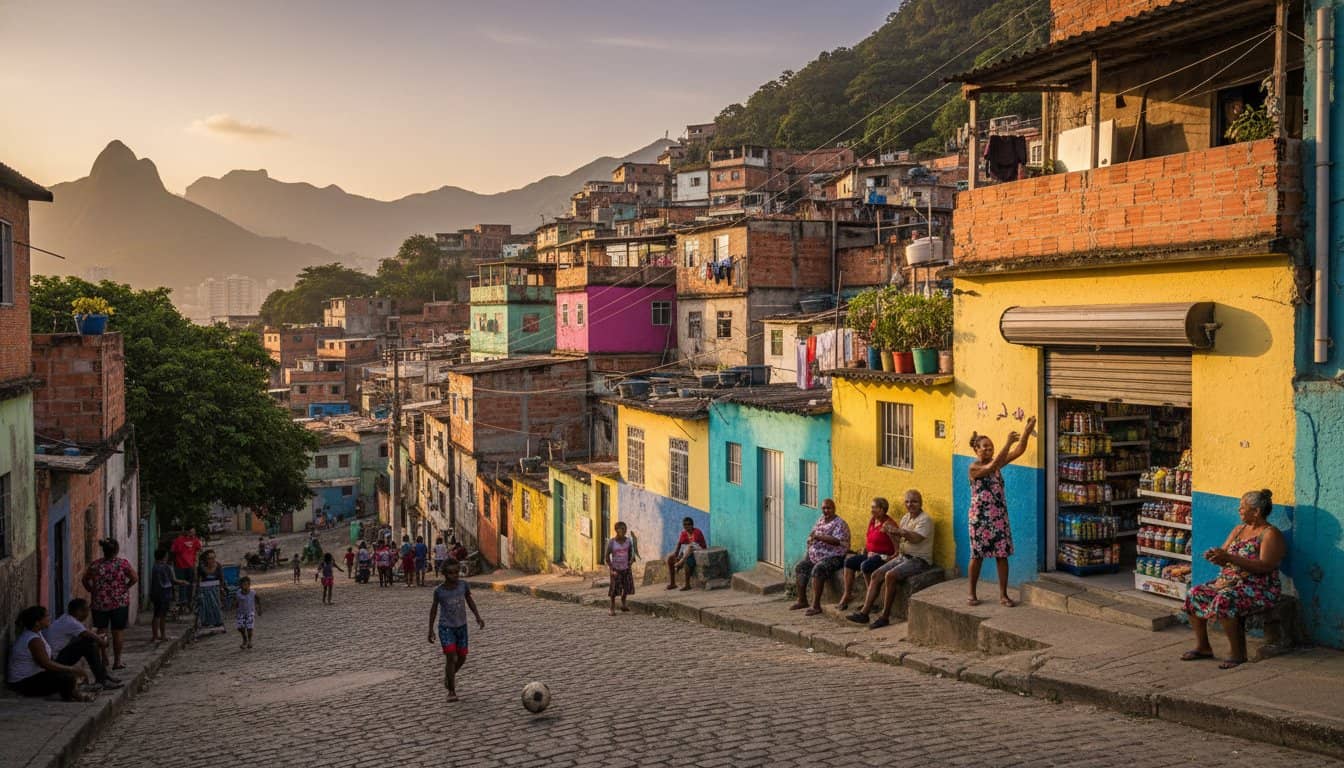
The 2025 map that redefined the city
The Mapa Historico dos Grupos Armados do Rio de Janeiro, released on 19 November 2025, is the most authoritative territorial study of the city’s armed groups.
Produced by Geni/UFF and Instituto Fogo Cruzado, it traces control from 2007 through 2024 using population and territorial metrics.
The timing matters. The series ends in 2024, so it predates the October 2025 operation in Penha and Alemao and the further sweep across some thirty communities in August this year.
No remapping of territorial shares has been published since. Anyone reading these numbers as a picture of today is reading them wrong.
The study divides armed domination into three categories: Comando Vermelho, milicias and Terceiro Comando Puro.
It distinguishes between effective control and control or influence, a split that matters for understanding daily risk.
Effective control means a group has stable, exclusive presence and regulates local life systematically.
Comando Vermelho: the demographic hegemon
Comando Vermelho, or CV, is Rio’s largest drug-trafficking faction and holds the biggest population share under armed rule.
As of 2024, CV held 1.6 million residents under effective control, or 47.2 percent of the population living under consolidated armed control.
Another 1.7 million residents lived under CV control or influence, representing 44.7 percent of the total population in that category.
CV consolidated 150 square kilometres of territory, equal to 47.5 percent of all territory with consolidated armed control.
Between 2007 and 2024, CV’s population control grew by 30.9 percent, concentrated in Leste Fluminense, Centro, Zona Sul and Zona Norte complexes.
Milicias: territorial retrenchment after expansion
Milicias are paramilitary mafia-style groups that dominate peripheral areas, the West Zone and Baixada Fluminense.
They combine armed control with extortion of transport, gas, cable, real estate and local businesses.
As of 2024, militias still controlled 201 square kilometres under control or influence, almost half of all area under armed group activity.
The map shows militias have been in territorial retreat since 2020 after years of expansion.
Despite losing ground, militias remain a daily reality in many outlying neighbourhoods where they tax residents and influence local politics.
Terceiro Comando Puro: the third force
Terceiro Comando Puro, known as TCP, is described in the study as the third force of Rio’s criminal underworld.
TCP controlled 11.28 percent of the population under control or influence in 2024.
Its territorial share was smaller, at 7.8 percent of armed domination area.
TCP’s role is growing in disputed areas of Zona Norte and Baixada Fluminense.
This fragmentation creates zones where CV, TCP and militias contest control block by block.
How territorial control actually works
Armed groups in Rio do not merely sell drugs. They regulate movement, commerce, construction and even personal conduct within their zones.
Effective control means no rival faction operates inside the territory and the group’s authority is stable.
Control or influence covers areas where the group exerts strong power but faces intermittent disputes or weaker presence.
Fogo Cruzado recorded 275 armed confrontations linked to territorial disputes in Greater Rio during 2025.
Those disputes left 180 people shot, a 26 percent increase from 218 shootings tied to territorial fights in 2024.
Operation Contencao: the deadliest ever
Operation Contencao began on Tuesday 28 October 2025 in the Penha and Alemao favela complexes in Zona Norte.
The stated objective was to capture criminal leaders and contain Comando Vermelho’s territorial expansion.
Agencia Brasil reported at least 64 dead: 60 civilians and 4 military police officers.
That toll represented about one-fifth of all deaths in Rio police operations in 2025, which totalled 353 at that point.
CNN Brasil and O Globo confirmed the record, surpassing the 28 dead of the Jacarezinho operation in 2021.
The higher death tolls in comparative data
G1 reported the Alemao and Penha mega-operation resulted in 121 deaths, identifying 4 police officers and 117 suspects.
O Globo reported a toll of 122 dead, noting it was 700 percent greater than the national daily average of police lethality.
Brazil recorded an average of 17 deaths per day from police interventions in 2024.
The discrepancy between 64 and 121 dead stems from early official counts versus later consolidated data.
Either figure makes this the most lethal operation in Rio’s recorded history.
Police lethality and territorial violence in 2025
Institute of Public Security data show 797 people died from police intervention in Rio during 2025, up 13 percent on 2024.
That was a 13 percent increase from 703 deaths in 2024.
Brasil247 reported police lethality surged 133 percent in some periods of 2025.
Territorial violence and disputes between factions and militias intensified across the year.
This combination of rising police killings and factional disputes defines the current security crisis.
Long-term trend: homicides at a 34-year low
Rio recorded fewer than 3,000 homicide victims in 2024 for the first time in 34 years.
The Instituto de Seguranca Publica, or ISP, confirmed the milestone based on official crime data.
Lethal violence and homicide numbers showed a downward trend even as vehicle and cellphone robberies rose.
This long decline predates the 2025 spike in police killings and territorial shootings.
The contrast between falling homicides and rising police lethality is the central tension in Rio’s security debate.
What residents, expats and visitors need to know
Territorial control is more important than municipal boundaries for understanding safety in Rio.
Zona Sul and Centro have significant CV presence in specific pockets, though these areas remain heavily policed.
The West Zone and Baixada Fluminense carry the highest militia risk, with extortion and armed checkpoints.
Zona Norte complexes such as Alemao and Penha are the principal flashpoints for mega-operations and mass casualties.
Expats and investors should monitor Geni/UFF and Fogo Cruzado maps before choosing residential or commercial locations, because control can shift after a single operation.
The Deadly Gap Between Warrants And Casualties
Operação Contenção was not built for 122 deaths. Officials planned it over 60 days inside an investigation that lasted about one year. The goal was to stop Comando Vermelho advances and execute 100 arrest warrants plus 180 search and seizure warrants. About 2,500 Civil and Military Police officers were sent into the Alemão and Penha complexes on 28 October 2025, starting around 5 a.m. The operation lasted roughly 14 hours. Yet the final casualty list drifted far from the judicial targets that justified the action.
The Rio Public Prosecutor’s Office said only 5 of the dead were among the people named in warrants. The state government released a slightly higher figure, saying only 15 of the dead were judicial targets. The gap is enormous. Of the 122 dead, 117 were civilians, most identified by authorities as Comando Vermelho members, and 5 were police officers. Another 17 people were injured, including 13 security agents and 4 civilians. Police made 99 arrests, but only 17 were by judicial warrant. The other 82 arrests happened in flagrante, including 9 adolescents.
That gap helps explain why the Inter-American Commission on Human Rights called the operation the most lethal in Brazil’s recent history. The CIDH asked for reparations and an investigation into the deaths and reports of inhuman treatment. The operation also changed the city’s violence pattern. Between 28 October 2025 and 28 January 2026, the metropolitan region recorded 329 people killed by gunfire. That was a 44.2 percent increase compared to the three months before the operation. Police actions produced 200 of the 520 shootouts in that period, and those police-related incidents caused 210 deaths, or 68.8 percent of all gunfire deaths.
More: Brazil news, every day from The Rio Times.
Policies that measurably reduced killings
The ISP data showing fewer than 3,000 homicides in 2024 reflects sustained public security and social policies over several years.
Declining lethal violence coincided with territorial stabilisation in some areas before the 2025 escalation.
No single policy is credited in the research with the reduction, but the data clearly show homicide decline outpacing police lethality trends until 2024.
The 2025 surge in police killings and territorial disputes suggests that enforcement-heavy strategies reversed some gains.
For real reductions to hold, Rio will need to address the underlying territorial rule that makes mega-operations so lethal.
Connected Coverage
Brazil’s Financial Morning Call for Tuesday, September 8, 2026
The Big Picture
Latest developments
- Bolsonaro Camp Asks Court to Bar Lula — 21 October 2026
- Mendonça to Rule on Lula Bank Records Plea — 21 October 2026
- Brazil Stocks Sit 0.4% Below Record as WEG Reports — 21 October 2026
- Helbor Board Backs Bid to Leave Stock Market — 20 October 2026
This article was produced by The Rio Times’ automated newsroom system. How we use AI · Report an error · Editorial responsibility: Matthias Camenzind, Editor-in-Chief
The Rio de Janeiro Guide
What The Rio Times publishes for foreigners in Rio de Janeiro, Brazil.
This month
Coming up in Rio de Janeiro
- Black Pantera Opens Brazil Tour at Rio's Circo Voador on 24 October 24 Oct
- Mondial de la Bière in Rio de Janeiro, Brazil: 1,500 Beers at Pier Mauá, October 29–November 1 29 Oct
- Maro Plays Circo Voador in Rio de Janeiro on 3 November 3 Nov
- Hayley Williams in Brazil: Paramore's Voice Solo in Rio on November 9 and São Paulo on November 12–13 9 Nov
Living in Rio de Janeiro
- Rio Carnival 2027 Parade Schedule With Dates and Tickets
- Réveillon Copacabana 2027: New Year's Eve in Rio — Fireworks, Traditions and Guide
- Rio vs São Paulo Safety for Expats, District by District
- Rock in Rio 2026: What Travelers and Expats Need to Know
Nightlife
Understand Brazil