
BRAZIL MARKETS · CURRENCY
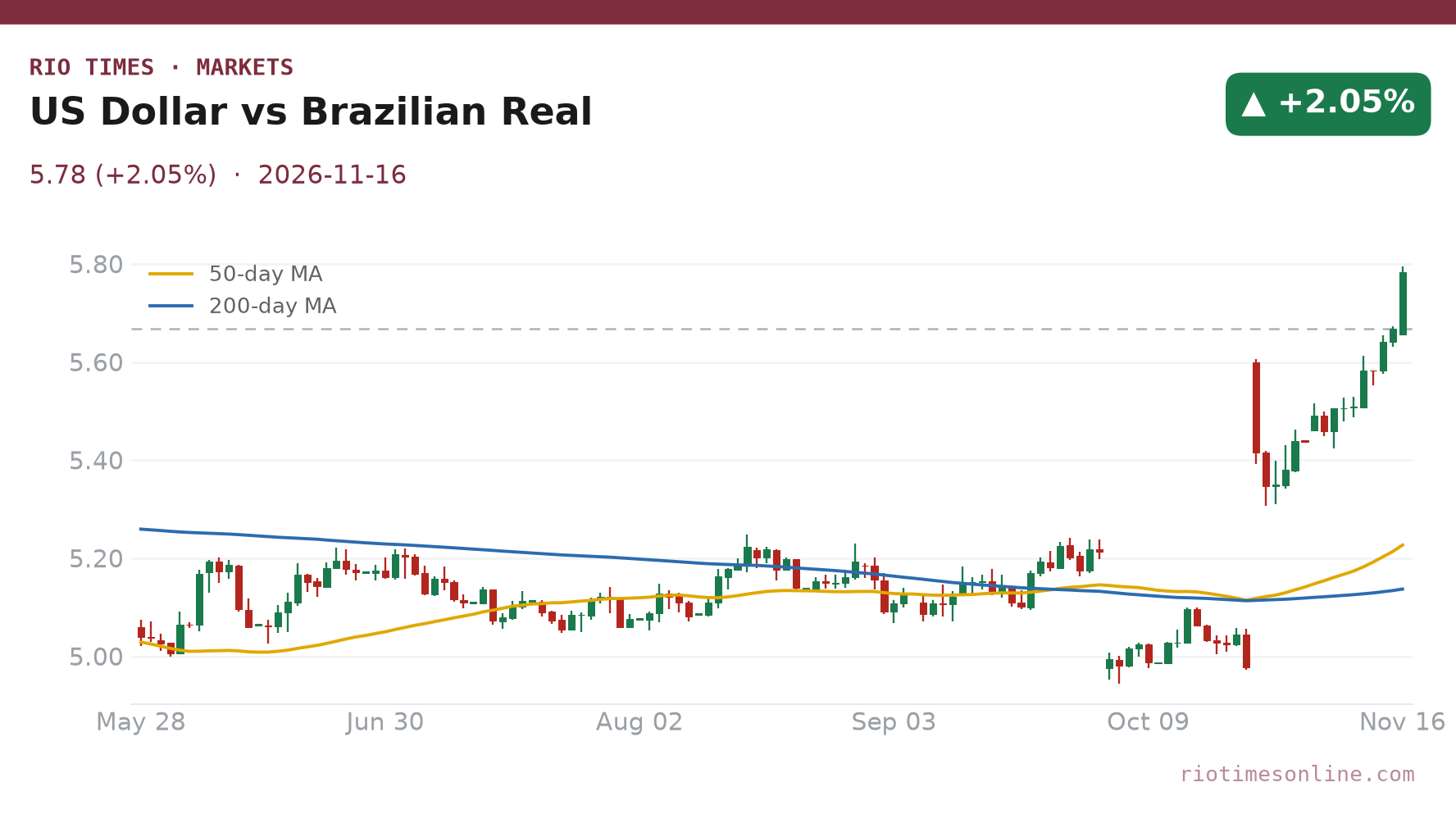
Brazil’s currency has been sliding for three weeks, and none of 19 other major currencies we checked is even close. The real has lost 13.9% against the US dollar since voters re-elected President Luiz Inácio Lula da Silva in the runoff on Sunday 25 October, a result that matters for Brazil’s economy and its investors.
On Monday 16 November the dollar closed at R$5.78 (about US$0.17 per real), the real’s weakest close in at least 12 months. For a US investor in Brazilian stocks or bonds, that is a 14% cut in value before any share price moves.
Key Facts
- The move Real lost 13.9% against the dollar since 25 October, most of 20 currencies.
- The level Dollar closed at R$5.78 on 16 November, the real’s weakest in 12 months.
- The forecast Central bank’s Focus survey expects R$5.40 by year-end, up from R$5.13 a month ago.
- The rest Only India’s rupee, Mexico’s peso and China’s yuan gained; 17 of 20 fell.
- Prediction markets Polymarket, a betting market, prices no change in Brazil’s December rate decision at 80.5%.
Brazil’s real is the clear loser among the world’s big currencies since the election, and the market’s own year-end forecast is already out of date.
How the Real Stacks Up Against 19 Other Currencies
We compared the dollar value of 20 widely traded currencies between the close on Friday 23 October, the last before the vote, and the close on Monday 16 November. The real fell 13.9%, more than three times the next worst, the Australian dollar at 4.3%.
New Zealand’s dollar and Norway’s krone each lost about 3.5%, and South Africa’s rand lost 2.3%. The euro fell 1.8%.
Only three currencies rose: India’s rupee by 1.1%, Mexico’s peso by 0.8% and China’s yuan by 0.1%. The other 17 fell, so the dollar is strong everywhere, but Brazil is the extreme case.
Why Is the Real Falling Faster Than the Rest?
Part of the fall is a stronger dollar worldwide, since 17 of the 20 currencies lost ground. Brazilian assets also sold off on Monday 16 November, when São Paulo’s Ibovespa stock index fell 1.83% and the S&P 500 in New York fell 1.92%.
Brazil’s central bank held its benchmark interest rate, the Selic, at 13.75% on 4 November. That high rate has not stopped the slide.
How Far Can the Dollar Rise?
No one can name a ceiling, and forecasters are chasing the market. The central bank’s weekly Focus survey of about 120 banks and funds showed a median year-end forecast of R$5.40 per dollar on 13 November, up from R$5.13 on 16 October.
The dollar already trades about 7% above that forecast. It closed at R$5.77 on Tuesday 17 November, and the central bank’s PTAX reference rate, an average of the day’s trading, was R$5.7851.
The 2027 forecast is R$5.45. That implies analysts expect the real to stay weak rather than snap back.
What It Means for US Readers
A US investor in Brazilian assets has lost about 14% to the currency alone since 23 October. The winners are Brazilian exporters of soy, iron ore and oil, who earn dollars, and US visitors, whose dollars now buy about 16% more reais.
The losers are Brazilian importers and companies that borrowed in dollars. A weaker real also lifts the price of imported goods in Brazil, which keeps pressure on inflation.
What Prediction Markets Say
Polymarket, an online market where users bet real money on outcomes, prices no change in the central bank’s December Selic decision at 80.5%, with US$110,904 traded (4:22 p.m. ET, 17 November). It gives a 25-basis-point cut 5.9% and a rise of any size about 4.5%.
Why we show this: prediction markets turn real-money bets into a live probability that moves within minutes of the news, which is why investors, campaigns and newsrooms in the United States now follow them closely. We show them next to polls and official results, never instead of them.
What Is Not Known
What is driving Brazil’s fall beyond the global dollar rally is not known, and no official source puts a number on it. We found no central bank announcement of dollar sales as of 4:30 p.m. ET on Tuesday.
What to Watch Next
Brazil’s mid-month inflation reading, known as IPCA-15, arrives on Thursday 26 November at 7:00 a.m. ET, and third-quarter GDP follows on Wednesday 2 December at 7:00 a.m. ET. The Copom committee, the central bank’s rate-setting panel, decides on the Selic on Wednesday 9 December in the evening, Brasília time.
A dollar that stays above the R$5.40 Focus forecast into December would confirm the survey needs another upgrade. A move back below R$5.40 would suggest the post-election shock is fading.
See also our reports on the real’s 2% fall on Monday and the Brazil market close.
Frequently Asked Questions
Why is the Brazilian real falling?
The dollar is strong worldwide, with 17 of 20 major currencies down since 23 October, but the real has fallen furthest at 13.9%. The exact mix of Brazilian causes is not known.
How far could the dollar rise against the real?
No one knows. The central bank’s Focus survey expects R$5.40 by year-end, but the dollar already trades near R$5.77, so the survey is behind the market.
Sources: Banco Central do Brasil, Focus survey and PTAX rate; Banco Central do Brasil, Copom meeting calendar; RT currency data (euro: EURUSD), closes of 23 October, 16 and 17 November 2026; IBGE release calendar; Polymarket (accessed 17 November 2026, 4:22 p.m. ET).
This article was produced by The Rio Times’ automated AI newsroom. Editorial responsibility: Matthias Camenzind, Publisher and Editor-in-Chief. The Rio Times also runs Ask Rio Times, which answers from 100,000+ of our own articles, the daily Latin America Power Map, and prediction-market odds on elections and markets.. How we use AI · Report an error
LatAm Markets: Live Signals → — real-time movers, turnover leaders and FX across Latin America.
Brazil runoff, Sunday, October 25: Brazil runoff date. Latest: Brazil runoff polls, Flávio 51%, Lula 49%.