Brazil Stocks Fall 1.8% as Real Hits a Low | Brazil Market Report, Nov 16
Key Facts
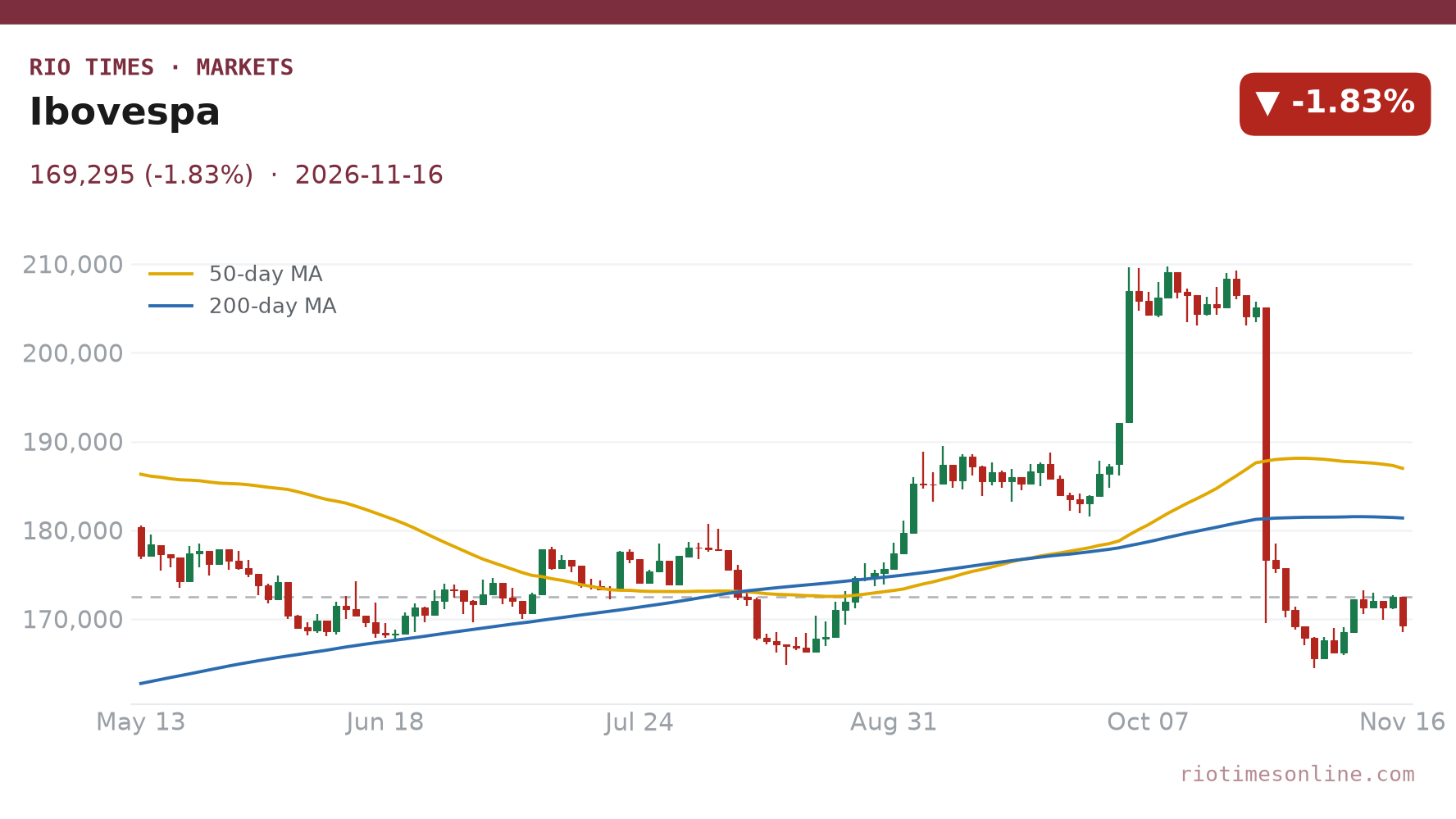
- Ibovespa: Brazil’s main stock index fell 1.83% to 169,295, 19.0% below its 9 October peak.
- Real: The US dollar rose 2.05% to 5.7839 reais, the real’s weakest close in at least 12 months.
- US-listed Brazil: Vale’s New York shares fell 6.8%, Petrobras 5.7% and Itaú 5.3% as Wall Street slid.
- Wall Street: The S&P 500 fell 1.92% and the VIX fear gauge jumped 18.70% to 22.91.
- Next: US retail sales on 17 November (consensus +0.2%) test the 5.14% ten-year Treasury yield.
- Prediction markets: Polymarket, a real-money prediction market, prices no change in the Central Bank of Brazil’s December decision on its Selic benchmark rate at 84.0% (US$98,709 traded, 9:10 p.m. ET, 16 November).
Today’s Focus
Brazilian assets took a double hit on Monday. The Ibovespa, the benchmark index of the São Paulo stock exchange, fell 1.83% to 169,295, while the US dollar rose 2.05% to 5.7839 reais.
The dollar’s level is the headline: it is the highest close in at least 12 months. Over 20 sessions the dollar is up 14.91% against the real, and the Ibovespa is down 17.59% over the same stretch.
We could not confirm a single trigger for Monday’s move. The pattern points to Brazil-specific worry: the real fell about two per cent while the US dollar index rose only 0.21%.
The index is still 9.4% above its 12-month low of 154,770, set on 21 November 2025. But it is 19.0% below its 9 October peak of 209,067, so the damage from the past month is deep.
What matters today. For anyone holding Brazilian shares or reais, the question is no longer one bad day but whether the dollar keeps climbing against the real.
01 The session in one read
Brazil’s stock market had its roughest day in a while. The Ibovespa fell 1.83% to 169,295, and the real slid at the same moment.
The dollar rose 2.05% to 5.7839 reais, the weakest the real has closed in at least 12 months. Shares and the currency falling together is the classic sign that overseas money is heading for the exit.
The cause looks mostly local, although no single trigger is confirmed.
Wall Street’s bad day, with the S&P 500 down 1.92%, made the mood darker. But the Brazilian move was far bigger than a global shrug would explain.
The evidence points to Brazil-specific pressure as the main driver, although no single trigger is confirmed. The US dollar index rose only 0.21%, yet the real lost about two per cent, and Mexico’s peso actually firmed, so a broad dollar surge cannot be the whole story.
Wall Street’s slide and cheaper oil added to the pressure. The variable to watch is whether the dollar holds above 5.78 reais in the coming sessions.
02 The day’s numbers
| Measure | Level | Change | Read |
|---|---|---|---|
| Ibovespa | 169,295 | −1.83% | Brazil’s main stock index; one down session in a row |
| Session range | — | — | High and low not in today’s scan |
| US dollar vs real | 5.7839 | +2.05% | Highest close in at least 12 months |
| Ibovespa 12-month high | 209,067 (9 October) | −19.0% | Index sits this far below its peak |
| Ibovespa 12-month low | 154,770 (21 November 2025) | +9.4% | Index sits this far above its floor |
| Dollar 12-month low | 4.89 (11 May 2026) | +18.3% | Dollar is this much dearer than its low |
Read the table as a story of distance. The index has fallen 17.59% over 20 sessions from where it stood a month ago, yet over 60 sessions it is still up 0.9%, so the damage is concentrated in recent weeks.
The currency tells the sharper story. The dollar is up 5.00% against the real over five sessions and 12.2% over 60, and today’s close is the highest of the past year. Rio Times · Live Market Intelligence
Live Market IntelligenceBrazil — Live Market Board
Brazil — Live Market Board
Instrument Last Change YoY Prev. High Low Volume
IBOV
169,295.41
-1.83%
+7.84%
172,457.76
—
—
—
USD/BRL
5.78
+2.05%
+9.22%
5.67
5.79
5.78
—
SELIC
13.75%
—
—
—
—
—
PETR4
44.02
-2.83%
+33.88%
45.30
45.39
43.65
30,506,700
VALE3
60.70
-4.41%
-6.93%
63.50
62.95
60.70
22,600,000
ITUB4
41.30
-2.29%
+5.56%
42.27
42.30
41.04
15,671,600
BBDC4
14.23
-2.00%
-26.35%
14.52
14.52
14.11
37,732,200
BBAS3
14.95
-0.99%
-33.56%
15.10
15.14
14.57
70,779,600
B3SA3
14.81
-0.54%
+4.59%
14.89
14.84
14.53
24,177,300
ABEV3
15.87
+0.51%
+15.33%
15.79
15.97
15.69
27,761,200
WEGE3
50.40
-1.77%
+14.62%
51.31
50.82
50.30
5,440,500
PRIO3
62.63
-1.06%
+57.16%
63.30
63.47
62.14
3,707,600
SUZB3
55.50
+1.33%
+14.43%
54.77
55.94
54.50
5,552,900
RENT3
29.31
-2.53%
-32.11%
30.07
29.51
28.92
13,462,200
AZZA3
16.14
+1.45%
-44.42%
15.91
16.14
15.79
4,687,800
CSNA3
3.68
-1.08%
-55.93%
3.72
3.78
3.60
27,831,000
GGBR4
24.60
-0.53%
+31.55%
24.73
24.81
24.30
5,208,900
ENEV3
26.40
-1.53%
+36.15%
26.81
26.90
26.19
9,790,700
03 Why it moved — a Brazil-specific slide on a bad global day
Cause one, and the heaviest: a Brazil-specific discount. We could not confirm a single trigger for Monday.
The real fell about two per cent while the US dollar index rose only 0.21%, and Mexico’s peso firmed (USD/MXN down 0.18%), which points to a problem at home rather than a global dollar surge. Confidence is medium.
Cause two: Wall Street’s slide spread south. US-listed Brazilian shares fell harder than the Ibovespa because they also carry the real’s fall: the Brazil ETF EWZ lost 4.03%, Vale 6.77%, Petrobras 5.67% and Itaú 5.31%. Confidence is medium to high.
Cause three: the global mood turned sour, and oil fell. The Nasdaq lost 2.49%, the VIX rose 18.70% to 22.91, and an oil fund (USO) lost 3.81%, which weighs on Petrobras, the state-controlled oil giant. Confidence is medium.
Domestic data was not the culprit. The central bank’s IBC-BR index, a monthly gauge of economic activity, came in at −0.2% for September against a consensus of −0.3%, and the IGP-10 inflation reading, a price index watched by the central bank and markets, was 0.76 against 0.8 expected (previous 1.76).
US data added to the gloom: the New York Empire State manufacturing index fell to 7.8 in November against a consensus of 18 and 25.5 in October (RT economic calendar). US borrowing costs remain a background pressure. The 10-year Treasury yield stood at 5.138% after rising 24 basis points over five sessions, though it was a basis point lower on the day.
04 The day’s movers
| Driver | Level / Move | Change | Note |
|---|---|---|---|
| US dollar vs real | 5.7839 | +2.05% | The day’s biggest move; 12-month high |
| Oil (USO fund) | 140.03 | −3.81% | Risk-off selling; a negative for Petrobras |
| S&P 500 | 7,417 | −1.92% | Wall Street’s slide fed the risk-off mood |
| VIX fear gauge | 22.91 | +18.70% | Investors rushed to buy protection |
| Gold fund (GLD) | 352.93 | −0.71% | No safe-haven bid in this session |
| Vale (New York shares) | 10.46 | −6.77% | Mining giant; lowest close in 12 months |
| Petrobras (New York shares) | 17.30 | −5.67% | State-controlled oil company |
| Itaú (New York shares) | 7.13 | −5.31% | Brazil’s largest private bank |
| Brazil ETF (EWZ) | 30.92 | −4.03% | US fund holding Brazilian shares |
These are New York-listed shares, dollar certificates of Brazilian stocks, so they also carry the real’s fall. We have no verified São Paulo single-stock closes for the session.
The mechanics still matter. Exporters such as Vale, the mining giant, and Petrobras earn dollars, so a weaker real cushions their reported earnings, but falling oil prices cut the other way.
Banks and retailers are usually more exposed to the mood. They depend on Brazilian growth and interest rates, and worries about public finances tend to push borrowing costs up.
05 The regional scoreboard
| Index | Country | Change |
|---|---|---|
| Ibovespa | Brazil | −1.83% |
| IPSA | Chile | −1.27% |
| Merval | Argentina | −4.3% |
| COLCAP | Colombia | closed (holiday) |
Latin America sold off together, led lower by Argentina, while the stock exchanges of Colombia and Mexico were closed for public holidays.
The currencies split, which supports the Brazil-specific reading. The Chilean peso weakened slightly (USD/CLP up 0.47%) and the Colombian peso barely moved (USD/COP up 0.10%), while Mexico’s peso strengthened (USD/MXN down 0.18%).
For Brazilians, a dollar at 5.7839 reais makes imports, foreign travel and dollar debts dearer. For exporters of soybeans, iron ore and oil, it lifts the real value of every dollar they earn. What it means for you: for a US investor, the Ibovespa’s 1.83% fall and the real’s 2.05% slide combine to a loss of roughly 3.8% in dollars on the day, while a US traveller finds Brazil cheaper.
The live market board above carries the closes for the rest of the region.
06 The technical picture
Start with the floor. The 12-month low of 154,770, set on 21 November 2025, is the big support, and the round number of 160,000 is the first line of defence above it.
The nearest ceiling is the round 170,000, just above Monday’s close of 169,295. Above that, the 12-month high of 209,067 from 9 October is a distant target, not a near-term one.
For the dollar, 5.78 is the current 12-month high, and the round 6.00 is the next psychological mark. A slide back towards 5.50 would suggest the scare is fading.
History offers a sober note, not a forecast. In six earlier cases when the dollar rose this much against the real over 20 sessions, it was higher 20 sessions later in 3, a 50% record.
The median move was −0.8%, the worst case −7.5% and the best +18.0%, so the dollar’s path from here is genuinely open.
07 What to watch
- US-listed shares: Whether Brazilian shares in New York keep falling decides if 169,295 holds or the Ibovespa drifts towards its 12-month low of 154,770.
- Dollar at 5.78: A second close above the 12-month high would put 6.00 reais per dollar in view; a retreat would suggest the pressure is easing.
- US borrowing costs: The 10-year Treasury yield at 5.138% is a drag on all emerging markets; US retail sales on 17 November (consensus +0.2%, previous +0.8%) will test it.
- Policy signals: Any concrete sign from the government on public finances is the clearest route to a calmer real.
Background: Brazil Stocks Rise 0.7% as Real Hits Low.
What Prediction Markets Say
Polymarket, where users bet real money, lists a market on the Central Bank of Brazil’s December decision on its Selic benchmark rate, with US$98,709 traded as of 9:10 p.m. ET, 16 November 2026. It prices no change at 84.0%, a 0.25-point cut at 6.8%, a 0.5-point or larger cut at 2.2%, a 0.5-point or larger rise at 2.0% and a 0.25-point rise at 1.7%.
These prices are bets, not polls. They show traders expect the central bank to hold the Selic, Brazil’s benchmark interest rate, in December.
Why we show this: prediction markets turn real-money bets into a live probability that moves within minutes of the news, which is why investors, campaigns and newsrooms in the United States now follow them closely. We show them next to polls and official results, never instead of them.
More: Brazil news, every day from The Rio Times.
Frequently Asked Questions
How did the Brazil stock market close on 16 November 2026?
The Ibovespa, Brazil’s main stock index, fell 1.83% to 169,295. It is 19.0% below its 9 October peak of 209,067.
Why did the Brazilian real weaken?
We could not confirm a single trigger. The real fell about two per cent while the US dollar index rose 0.21%, which points to Brazil-specific pressure. The US dollar rose 2.05% to 5.7839 reais.
Is this a sign of a wider Latin American sell-off?
Partly. Argentina’s Merval fell 4.3% and Chile’s IPSA fell 1.27%, while Mexico and Colombia were closed for holidays. Mexico’s peso strengthened, so Brazil’s currency weakness is mostly local.
What should an expat or traveller take from it?
A dollar at 5.7839 reais stretches foreign money further in Brazil but makes imports and overseas trips dearer for residents. History is not a forecast: the dollar was higher 20 sessions later in 3 of 6 comparable cases.
Market data: The Rio Times; exchange figures from B3
This article was produced by The Rio Times’ automated AI newsroom. Editorial responsibility: Matthias Camenzind, Publisher and Editor-in-Chief. The Rio Times also runs Ask Rio Times, which answers from 100,000+ of our own articles, the daily Latin America Power Map, and prediction-market odds on elections and markets.. How we use AI · Report an error
LatAm Markets: Live Signals → — real-time movers, turnover leaders and FX across Latin America.
Brazil runoff, Sunday, October 25: When is the Brazil runoff election. Latest: Brazil runoff polls, Flávio 51%, Lula 49%.
Get The Rio Times delivered to your inbox — market intelligence, daily briefs, and breaking analysis across Latin America.
Start for US$1