Argentina Country Risk Jumps to 524 as Merval Falls 2.5%
ARGENTINA · MARKETS · WEEKLY
Key Facts
- —What happened Argentina country risk rose five straight days to 524 basis points on Friday, 18 September 2026.
- —The context The US Federal Reserve raised rates on 16 September, its first increase since 2023.
- —Why it matters Higher country risk raises Argentina’s borrowing costs just as an IMF review mission arrives on 21 September.
- —The catch The peso barely moved and inflation-linked bonds gained, so not every Argentine asset lost ground this week.
- —Who it affects Bondholders, holders of Buenos Aires shares, and companies needing foreign loans.
- —What comes next An IMF team arrives Monday, 21 September, and Argentina faces a US$800 million debt payment on Friday, 25 September.
A US rate hike, weak growth data and a coming IMF review pushed Argentina’s bond spread to its highest level in a month.
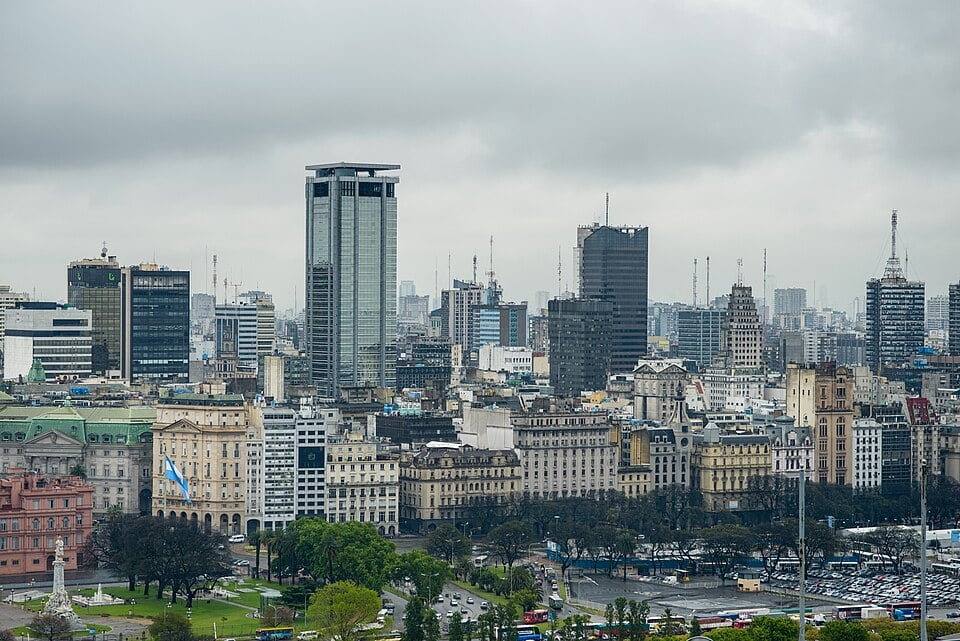
Argentina country risk rose for five straight days, from 485 to 524 basis points by Friday, 18 September 2026. The S&P Merval stock index ended the week about 2.5% lower.
How Argentina country risk moved day by day
Country risk measures the extra yield investors demand to hold Argentine dollar bonds instead of US Treasuries. The figure comes from JP Morgan’s EMBI index, and 100 basis points equal one percentage point.
The index closed at 485 on Friday, 11 September, its lowest level in a month. It rose to 492 on Monday, 14 September.
It then jumped 14 points to 506 on Tuesday, 15 September, and reached about 510 on Wednesday, 16 September.
It reached 515 on Thursday, 17 September, and 524 on Friday, 18 September. That was the fifth straight daily rise and the highest close since 20 August.
Financial daily Ámbito put Friday’s close at 526 and the weekly gain at 44 points. It called this the biggest weekly rise in six months.
Why the Merval stalled
The S&P Merval, the main index of Buenos Aires shares, had been recovering before the week began. The Fed decision and weaker local data interrupted that rebound.
The index fell 1.7% to 3,028,871 points on Wednesday, 16 September, the day of the Fed decision. It bounced 1.08% to 3,061,512 on Thursday.
On Friday it gave that gain back, closing 1.29% lower at 3,021,925.96 points. Measured from the previous Friday, the week’s loss was about 2.5%.
Ámbito put the weekly loss at 2.7% in pesos and 2% in dollars. The small gap comes from different data cuts.
Live Market IntelligenceArgentina — Live Market Board
Rio Times · Live Market Intelligence
Argentina — Live Market Board
-1.29%
185,229.17
-0.41%
63,375.93
-0.78%
11,381.18
+1.30%
3,021,926
-1.29%
2,548.22
+1.05%
60,023.65
-1.13%
| Instrument | Last | Change | YoY | Prev. | High | Low | Volume |
|---|---|---|---|---|---|---|---|
| MERVAL | 3,021,926 | -1.29% | +30.51% | 3,022,485 | 3,042,365 | 2,991,150 | — |
| USD/ARS | 1,493 | +0.10% | +12.96% | 1,491 | 1,494 | 1,480 | — |
| YPF | 7,810 | +0.26% | +72.84% | 7,790 | 7,850 | 7,600 | 1,763,858 |
| GGAL | 6,980 | -0.78% | +1.82% | 7,035 | 7,115 | 6,920 | 1,564,062 |
| PAMPA | 5,115 | +0.69% | +26.70% | 5,080 | 5,140 | 5,000 | 721,190 |
| TXAR | 747.50 | -2.35% | +18.67% | 765.50 | 770.00 | 742.50 | 771,892 |
| ALUAR | 938.00 | -1.21% | +29.83% | 949.50 | 951.00 | 932.50 | 135,426 |
| TGS | 8,870 | -0.17% | +15.05% | 8,885 | 9,075 | 8,720 | 143,546 |
| CEPU | 2,156 | +1.84% | +28.36% | 2,117 | 2,165 | 2,086 | 404,146 |
| MIRGOR | 1,650 | -1.20% | -92.90% | 1,670 | 1,670 | 1,635 | 20,877 |
| COME | 40.93 | -0.73% | -30.47% | 41.23 | 41.60 | 40.50 | 4,258,884 |
| LOMA NEGRA | 3,130 | +0.08% | +5.80% | 3,128 | 3,205 | 3,090 | 182,992 |
| BYMA | 275.00 | -1.70% | +35.14% | 279.75 | 282.50 | 272.00 | 1,409,575 |
| TELECOM ARG | 4,233 | -0.70% | +55.19% | 4,263 | 4,335 | 4,160 | 31,896 |
| GLOBANT | 38.10 | -2.26% | -49.65% | 38.98 | 38.70 | 36.77 | 793,552 |
| MERCADOLIBRE | 1,870 | -3.59% | -20.71% | 1,940 | 1,927 | 1,870 | 329,640 |
What pushed investors away
The US Federal Reserve voted unanimously on 16 September to raise its rate by 25 basis points. It was the first increase since 2023 and the first under chair Kevin Warsh.
Warsh said inflation has been too high for too long, and the Fed signalled further increases are likely. The 10-year US Treasury yield moved close to 5%.
Higher US rates make safe Treasury bonds more attractive. That usually lowers demand for riskier emerging-market debt, including Argentina’s.
Local news added pressure. On Thursday, 17 September, the INDEC statistics agency said the economy shrank 0.6% in the second quarter compared with the first.
The economy was still 2% larger than a year earlier. Unemployment rose to 7.9%.
Consulting firm 1816 said long-dated Argentine Global bonds now yield double digits again. According to the firm, that is the first time since early April.
The peso and the central bank
The peso stayed calm despite the bond sell-off, helped by steady central bank buying. The wholesale dollar closed Friday at 1,514.50 pesos to the dollar, a record, against 1,508.50 pesos to the dollar a week earlier.
The informal blue dollar ended at 1,550 pesos. For conversions, this article uses about 1,512 Argentine pesos to the dollar, at 19 September 2026 rates.
The central bank, known as the BCRA, bought US$36 million in the market on Friday. Gross reserves still fell to US$49.8 billion, from US$50.5 billion a week earlier.
What this means for expats and investors
For holders of Argentine dollar bonds, a higher spread means lower prices. According to Ámbito, Global bonds lost about 1% on average this week.
Bonds under New York law fell 1.22%. Peso bonds linked to inflation gained 1.08%, so not every Argentine asset lost ground.
For Argentine companies and the government, it means borrowing abroad costs more. Infobae reported that the Fed decision pushes back any return to international bond markets.
For expats paid in dollars, the peso barely moved this week. Their spending power in Argentina did not change much.
Rent, school fees and other local costs quoted in pesos cost roughly the same in dollars as a week ago. Anyone planning a large peso payment has had a stable week.
Investors with Buenos Aires shares or Argentine stocks listed in New York saw both lose value this week. Energy shares YPF and Vista each fell 5.2% in New York on 16 September.
What is not known
It is not known whether the rise will continue once the IMF mission starts work. The Fed has signalled that more rate increases are possible this year.
The exact Friday close differs by source, between 521 and 526 basis points. Most Argentine outlets reported 524.
What to watch next week
The IMF team arrives on Monday, 21 September, to start the third review of Argentina’s programme. It will look at reserve building and the fiscal surplus.
Argentina also faces a debt payment of about US$800 million on Friday, 25 September. Economy Minister Luis Caputo will travel with President Javier Milei to the United Nations in New York.
How the review and the payment go will likely shape Argentina country risk in the coming weeks.
Frequently Asked Questions
Frequently Asked Questions
What is Argentina’s country risk?
It is the extra yield investors want to hold Argentine dollar bonds instead of US Treasuries. JP Morgan calculates it, and higher numbers mean higher perceived risk.
How much did it rise this week?
It rose from 485 to 524 basis points between 11 and 18 September 2026, according to most Argentine outlets. Ámbito reported 526, up 44 points.
Did the peso weaken?
Only slightly. The wholesale dollar rose six pesos over the week to 1,514.50 pesos to the dollar, a record high.
Connected Coverage
Merval Falls 1.29% as Argentine ADRs Slide Across Latin America
Milei Tours Two Investment Projects in a City That Is Also a Campaign Stop
Sources: JP Morgan EMBI data via Infobae, TN and Hoy Día; Ámbito; EFE; INDEC via Perfil; US Federal Reserve decision via AFP and Jakarta Post; Infobae on the IMF mission.
This article was produced by The Rio Times’ automated newsroom system. How we use AI · Report an error
Read More from The Rio Times