ZIMBABWE · CULTURE
Key Facts
- The people 15,178,957 people at the April 2022 census; Shona is the home language of 80.9% of recorded speakers and Ndebele of 11.5%.
- Languages Sixteen officially recognised languages under the 2013 Constitution, among them Shona, Ndebele, Tonga, Venda, English and sign language.
- Heritage Five World Heritage sites, from Great Zimbabwe to Victoria Falls, plus the mbira and the Jerusarema dance on the UNESCO intangible list.
- Sport Kirsty Coventry, born in Harare in 1983, won seven Olympic medals and was elected president of the International Olympic Committee on 20 March 2025.
- Writers Tsitsi Dangarembga won the 2021 Peace Prize of the German Book Trade; NoViolet Bulawayo was shortlisted for the Booker Prize in 2013 and 2022.
- Art Harare hosts the 58th CIMAM museum conference on 20 to 22 November 2026, the first in its history held in Africa.
- Music Winky D headlines a Zimbabwe music night at Ellis Park Arena, Johannesburg, on 28 November 2026, with tickets from R300 (US$18).

In Plain English
Mbira: a Zimbabwean instrument with metal keys on a wooden board, plucked with the thumbs. UNESCO: the United Nations agency for education, science and culture, which keeps the World Heritage list and the list of intangible heritage such as music and dance.
IOC: the International Olympic Committee, which runs the Olympic movement. CIMAM: the International Committee for Museums and Collections of Modern Art, a global network of museum directors and curators.
Zimbabwe culture rests on the Shona and Ndebele peoples, the granite walls of Great Zimbabwe and the mbira, and as of October 2026 its best-known names include an Olympic swimmer who now presides over the Olympic movement, two novelists on Booker Prize shortlists and a National Gallery that hosts a world museum conference in Harare. This guide names only people, places and dates that the institutions behind them confirm, from the International Olympic Committee and UNESCO to the National Gallery and the national census office.
Where Zimbabwean Culture Comes From
Zimbabwe counted 15,178,957 people at its census of 20 April 2022, and 52% of them were women, according to the national statistics agency ZIMSTAT. As of October 2026 that census is still the population figure the agency publishes.
Shona was the home language of 80.9% of the 13.9 million people in the census table of mother tongues, about 11.25 million, and Ndebele of 11.5%, about 1.6 million. Ndau (372,607 speakers), Tonga (231,159) and Shangani (115,133) come next, followed by Venda, Kalanga and English.
Section 6 of the 2013 Constitution names sixteen officially recognised languages: Chewa, Chibarwe, English, Kalanga, Koisan, Nambya, Ndau, Ndebele, Shangani, Shona, sign language, Sotho, Tonga, Tswana, Venda and Xhosa. It orders the state and all its agencies to treat them equitably.
The same census found that 85.3% of Zimbabweans were Christian, 8.3% had no religion and 5.0% followed African traditional religion, with a small remainder in Islam, Judaism and Hinduism. Within Christianity the Apostolic sect was the largest group at 40.3%, ahead of Pentecostals at 17% and Protestants at 13.8%.
Great Zimbabwe and the World Heritage Sites
UNESCO lists five World Heritage properties in Zimbabwe as of October 2026: Mana Pools National Park with the Sapi and Chewore Safari Areas (1984), Great Zimbabwe National Monument and Khami Ruins National Monument (both 1986), Mosi-oa-Tunya, known as Victoria Falls (1989), and Matobo Hills (2003). Three are cultural sites and two are natural.
UNESCO says Great Zimbabwe was built between 1100 and 1450, and that its Great Enclosure, an ellipse of cut granite blocks south of the hills, dates to the 14th century. It calls the ruins a unique testimony to the Shona civilisation of the 11th to 15th centuries.
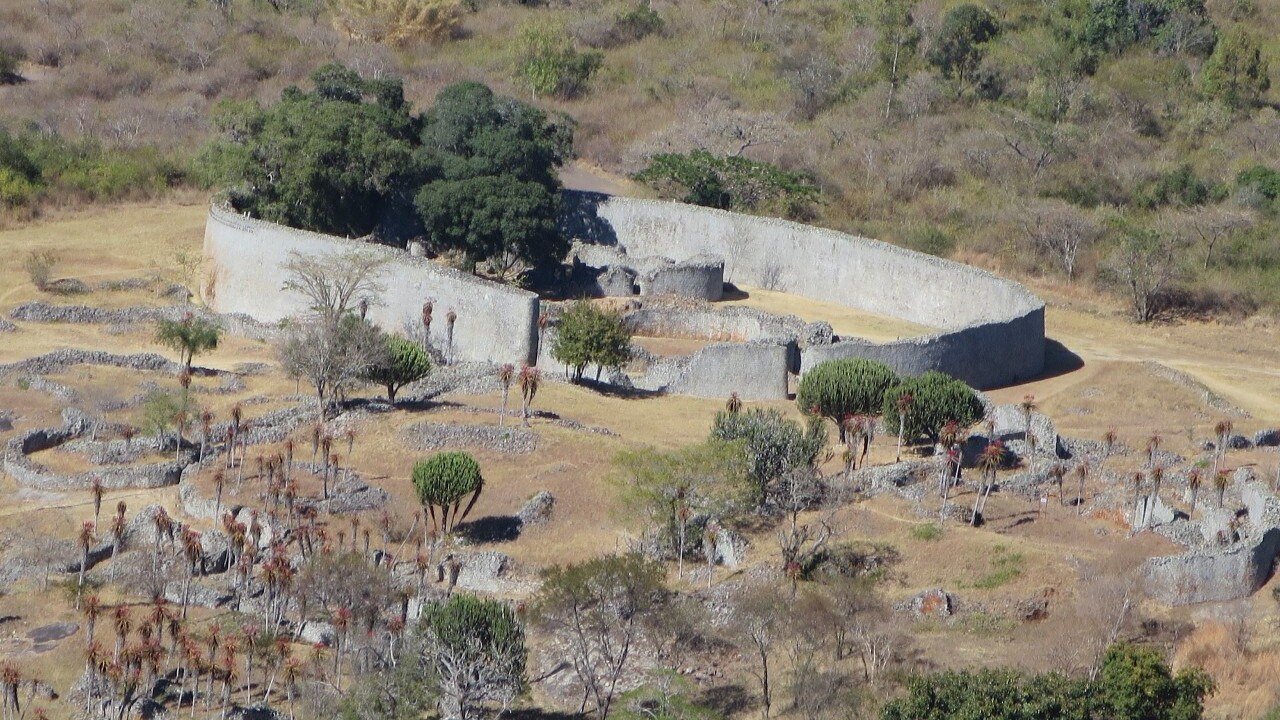
UNESCO adds that the entire nation identified with the ruins, which is why Zimbabwe adopted the steatite bird as its emblem. The aerial photograph above shows the elliptical form of a long granite wall among trees, with smaller stone enclosures around it.
Matobo Hills hold one of the highest concentrations of rock art in southern Africa, with paintings dating back at least 13,000 years, in UNESCO’s description. The listing also covers the living shrine traditions of the Mwari religion, centred on Matobo, which UNESCO says may date back to the Iron Age.
Mbira, Jerusarema and the Sound of Zimbabwe
UNESCO inscribed the art of crafting and playing mbira, shared with Malawi, where the instrument is called sansi, on its list of intangible cultural heritage in 2020. The basic instrument is a wooden board with metal keys, sometimes mounted on a calabash or wooden resonator.
The keys are made from spoon handles, bicycle spokes or spring wire and are plucked with the thumbs or with thumbs and fingers, producing a fluid percussive sound that UNESCO calls mystic, tranquil and enchanting. The music is cyclical, and UNESCO says its making and playing traditionally passed through family apprenticeship but is now also taught in some schools.
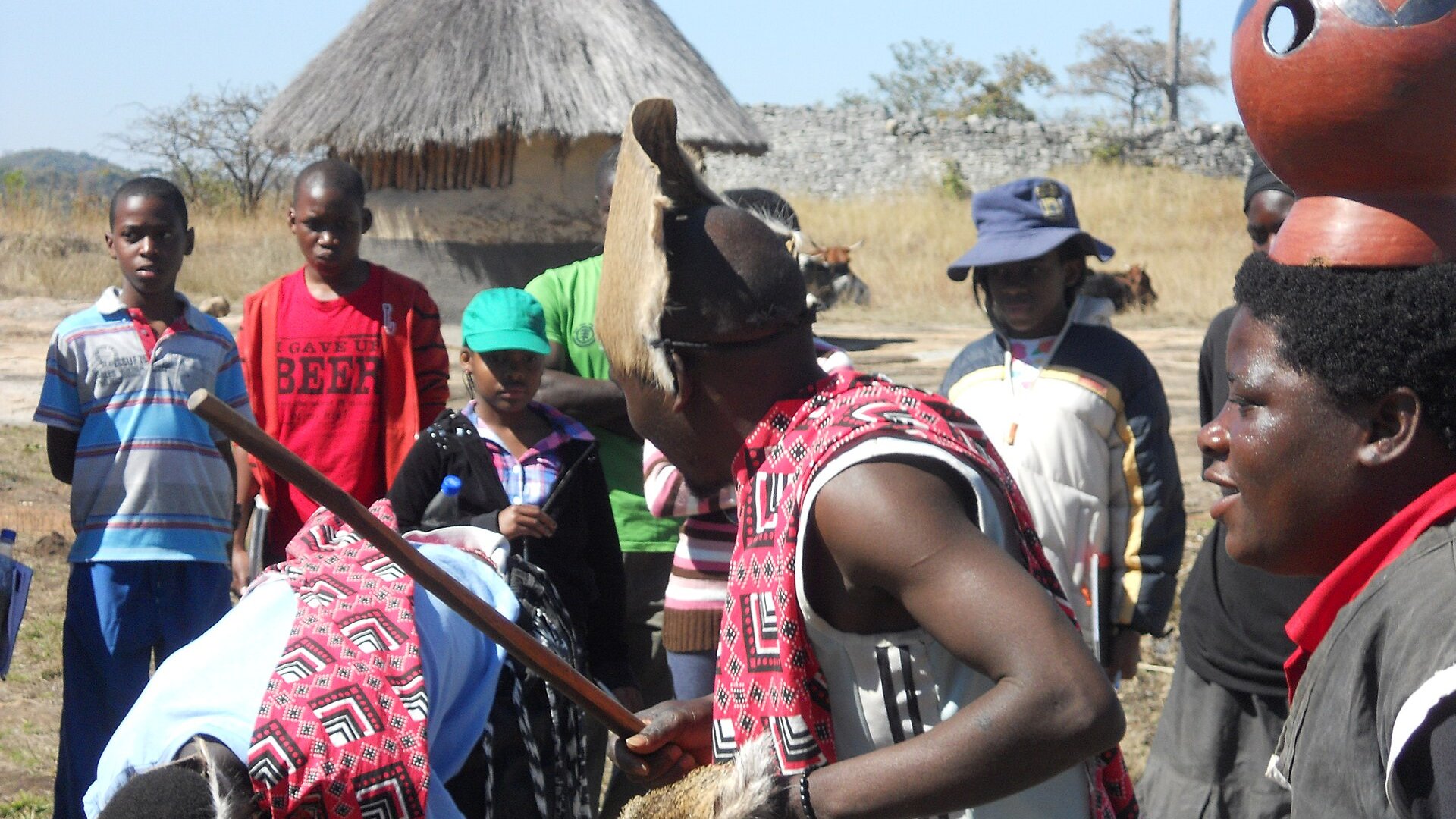
The Mbende Jerusarema dance, inscribed by UNESCO in 2008 after a first proclamation in 2005, is practised by the Zezuru Shona people of eastern Zimbabwe, especially in the Murewa and Uzumba-Maramba-Pfungwe districts. A single master drummer drives it, with woodblock clappers, handclapping, yodelling and whistles, and it has no songs or lyrics.
Before colonial rule the dance was called Mbende, the Shona word for mole, a symbol of fertility, and missionaries who disapproved of it gave it the name Jerusarema, from Jerusalem. UNESCO says it became a source of pride and identity in the struggle against colonial rule, and warns that tourist shows and political rallies are changing its meaning.
Among living performers, the name on a concert ticket in late 2026 is Winky D, who headlines a Zimbabwe music festival night at Ellis Park Arena in Johannesburg on Saturday 28 November 2026, with Oriyano and Chillmaste as supporting acts, according to the organiser Tanaro Investment’s ticketing page. Doors open at 4 pm and the show starts at 6 pm, with general access at R300 (US$18), VIP at R800 (US$48) and VVIP at R1,500 (US$90), converted at 16.64 rand per dollar, the European Central Bank rate of 29 October 2026.
A service piece on the Winky D show covers the ticket details for American buyers. No primary source ranks Zimbabwean performers, so this guide names Winky D because the show is dated and ticketed, not because of a chart position.
Booker Shortlists and the Writers to Read
Tsitsi Dangarembga is a Zimbabwean novelist, filmmaker and playwright who lives in Harare and directs the Institute of Creative Arts for Progress in Africa Trust, according to the Booker Prize Foundation’s author page. Her novel Nervous Conditions won the Commonwealth Writers’ Prize.
Her novel This Mournable Body, the sequel to Nervous Conditions that follows the character Tambudzai through a Harare youth hostel and an ecotourism job, was shortlisted for the 2020 Booker Prize. The jury of the Peace Prize of the German Book Trade describes her novel trilogy as the story of a young woman’s struggle for a dignified life and self-determination in Zimbabwe.
On 24 October 2021 she received that Peace Prize in the Paulskirche in Frankfurt, and the jury’s citation calls her one of her country’s most important artists and a widely heard voice of Africa in contemporary literature. The citation also notes that her films explore conflicts between tradition and modernity.
NoViolet Bulawayo’s debut novel We Need New Names, a bittersweet portrayal of life in a ramshackle Zimbabwean shantytown called Paradise in the Booker Prize’s own description, was shortlisted for the 2013 Man Booker Prize. Her second novel Glory, the story of an uprising told by a chorus of animal voices, was shortlisted for the Booker Prize in 2022.
Kirsty Coventry, From Harare to the IOC
Kirsty Coventry was born on 16 September 1983 in Harare and won seven Olympic medals, more than any other African athlete, according to the International Olympic Committee’s biography of its president. Two were gold, both in the 200 metres backstroke, in 2004 and 2008.
In Athens in 2004 she became the first athlete from Zimbabwe to win an individual Olympic gold, and the IOC says she received a hero’s welcome in Harare at a time of domestic turmoil. In Beijing in 2008 she added four more medals, a second gold and three silvers.
She studied hotel and restaurant management at Auburn University in Alabama, where the IOC says she led the Tigers to three national college championships in 2002, 2003 and 2004. The IOC says she credits a large part of her success to a scholarship grant through Olympic Solidarity.
In 2018 she was appointed Zimbabwe’s Minister of Youth, Sport, Arts and Recreation, a post she held until 2025 and used to push legislation against match-fixing, abuse and sexual harassment in sport. On 20 March 2025 the 144th IOC Session in Costa Navarino, Greece, elected her the 10th president of the IOC, the first woman and first African to hold the post.
She is the sitting IOC president as of October 2026 and was in Dakar in October 2026 for the Youth Olympic Games, which run from 31 October to 13 November 2026 and which the IOC calls the first Olympic sports event on African soil. The IOC’s headline for her arrival quotes her as saying “It’s time for Africa; it’s time for Senegal!”
Stone, Paint and the National Gallery
The National Gallery of Zimbabwe says it was formally established by the National Gallery Act of 1953 and that its building in Harare opened to the public on 16 July 1957. A revised Act in 1972 brought the Bulawayo gallery under the same board of trustees, and its branches page also lists a Tengenene branch in Guruve.
Its school of visual arts and design traces back to the Workshop School that Frank McEwen founded in the 1960s, which nurtured early talents including the sculptor Henry Munyaradzi. Today the school offers a National Diploma in Fine Art.
The gallery’s artist list for the CIMAM conference includes Portia Zvavahera, an internationally exhibited painter whose dreamlike works draw on Apostolic religious imagery and personal narrative. It also names Moffat Takadiwa, a Harare-based sculptor known for large works made from discarded consumer objects that address language, colonialism and waste.
Tapfuma Gutsa is listed as a pioneering figure in Zimbabwean sculpture who blends traditional stone-carving techniques with contemporary form. Thomas Mukarobgwa is listed as one of the first Black Zimbabwean artists to gain international recognition, celebrated for expressive paintings of the countryside.
CIMAM 2026 Brings the Art World to Harare
CIMAM holds its 58th annual conference in Harare from 20 to 22 November 2026, hosted with the National Gallery of Zimbabwe. It is the first time in CIMAM’s history that the conference takes place on the African continent.
The conference theme is Museums Beyond Limits: Imagining Repair Across Cultures, Ecologies and Knowledges, and CIMAM says general registration is open. The National Gallery says Harare was chosen to question Western-centric definitions of best practice in museum work and to centre African institutional knowledge.
An optional post-conference tour on 23 and 24 November goes to Great Zimbabwe, Masvingo and Serima Mission, which CIMAM describes as a journey through heritage, spirituality and artistic innovation. CIMAM has also awarded travel grants to 42 museum directors, curators and other art professionals from 26 countries.
What It Means for US Readers
The State Department rates Zimbabwe Level 2, exercise increased caution, because of crime and official harassment of US citizens, an advisory first issued on 27 June 2023 and reissued after a periodic review that still reads Level 2 as of October 2026. Its country page says US citizens need a passport, a visa, a return ticket and adequate funds, and that visas can be obtained at airports and other ports of entry.
Zimbabwean nationals face US entry limits as of October 2026 under Presidential Proclamation 10998, signed on 16 December 2025, which has suspended their entry as immigrants and on B-1, B-2, F, M and J visas since 1 January 2026. The proclamation cites Zimbabwe’s overstay rates of 7.89% for B-1/B-2 visas and 15.15% for F, M and J visas, exempts lawful permanent residents and athletes travelling for the Olympics or other major sporting events that the Secretary of State designates, and tells consular officers to shorten the validity of other nonimmigrant visas issued to Zimbabweans.
As IOC president, Coventry heads the movement that is preparing the Los Angeles 2028 Games, whose torch relay will visit all 50 US states, according to an IOC headline of 29 September 2026. She also studied at Auburn University, so her story runs through an American campus.
Travelers can read guides to Zimbabwe’s politics, its economy and its visa rules before a trip, and the Zimbabwe section collects the latest coverage. The wider story of the ZiG currency and the state is in an explainer on Zimbabwe.
What Is Not Known
The census table of mother tongues covers 13.9 million people, fewer than the 15.2 million counted overall, and the census text does not say which groups are missing from it. The percentages for Shona and Ndebele in this guide are therefore shares of recorded speakers, not of the whole population.
CIMAM calls its programme preliminary and says more guests will be announced, so the sessions, speakers and venues of the Harare conference are not settled. The National Gallery’s own conference page also still carries placeholder sessions.
The organiser lists only Phase 1 ticket prices for the Winky D show, so later prices, the arena capacity and whether the night sells out are not known. No primary source publishes streaming, sales or attendance rankings for Zimbabwean music, so this guide does not say who is the biggest performer.
The guide leaves out cricket, film, festivals and most musicians, because no primary source for them could be read when it was written. Anything not confirmed by an institution, an organiser or a primary document was cut rather than repeated.
Frequently Asked Questions
What languages are spoken in Zimbabwe?
The 2013 Constitution recognises sixteen official languages, among them Shona, Ndebele, English and sign language. Shona was the home language of 80.9% of recorded speakers in the 2022 census, and Ndebele of 11.5%.
Who is Kirsty Coventry?
Kirsty Coventry is a Zimbabwean swimmer who won seven Olympic medals, including two golds, and was elected president of the International Olympic Committee on 20 March 2025. She is the first woman and the first African to hold the post.
What is the mbira?
The mbira is a finger-plucked instrument with metal keys on a wooden board, sometimes mounted on a calabash resonator. UNESCO listed the art of crafting and playing it as intangible heritage in 2020, jointly with Malawi.
How many World Heritage sites does Zimbabwe have?
Five: Great Zimbabwe, Khami Ruins, Matobo Hills, Mana Pools and Mosi-oa-Tunya, known as Victoria Falls. Three are cultural and two are natural, according to UNESCO.
Which authors in this guide were Booker Prize shortlisted?
Tsitsi Dangarembga was shortlisted in 2020 for This Mournable Body. NoViolet Bulawayo was shortlisted in 2013 for We Need New Names and in 2022 for Glory.
Is Zimbabwe safe for American travelers?
The State Department rates Zimbabwe Level 2, exercise increased caution, citing crime and official harassment of US citizens. A visa is required and can be obtained at airports and other ports of entry, according to its country page.
When is the CIMAM conference in Harare?
CIMAM’s 58th annual conference runs from 20 to 22 November 2026, the first in its history held on the African continent. An optional tour to Great Zimbabwe follows on 23 and 24 November.
Sources: Zimbabwe National Statistics Agency, 2022 Population and Housing Census report and home page; Constitution of Zimbabwe, 2013; UNESCO, World Heritage, Zimbabwe, Great Zimbabwe, Matobo Hills, Mbira/Sansi and Mbende Jerusarema dance; International Olympic Committee, biography of Kirsty Coventry and Dakar 2026; Booker Prize Foundation, Tsitsi Dangarembga, This Mournable Body, NoViolet Bulawayo and We Need New Names; Peace Prize of the German Book Trade, 2021; National Gallery of Zimbabwe, history and leadership, branches, Map of Zimbabwean Art and artist pages for Zvavahera, Takadiwa, Gutsa, Munyaradzi and Mukarobgwa; CIMAM, Annual Conference 2026 Harare and the gallery page; Tanaro Investment, Winky D: Tete-A-Tete ticket page; European Central Bank, euro rates, 29 October 2026; US State Department, Zimbabwe travel advisory and country information page; US President, Proclamation 10998, Federal Register, 19 December 2025.
Editorial responsibility: Matthias Camenzind, Editor-in-Chief · Editorial standards · Report an error
Expat Guide to Zimbabwe
What The Rio Times publishes for foreigners who live in or move to Zimbabwe.
Start here
Understand Zimbabwe