Uruguay Convicts 35 in Prison-Run Criminal Group Case

SECURITY · URUGUAY
Key Facts
- —The country Uruguay. The case centres on Colonia, across the River Plate from Buenos Aires. It includes the tourist town of Colonia del Sacramento.
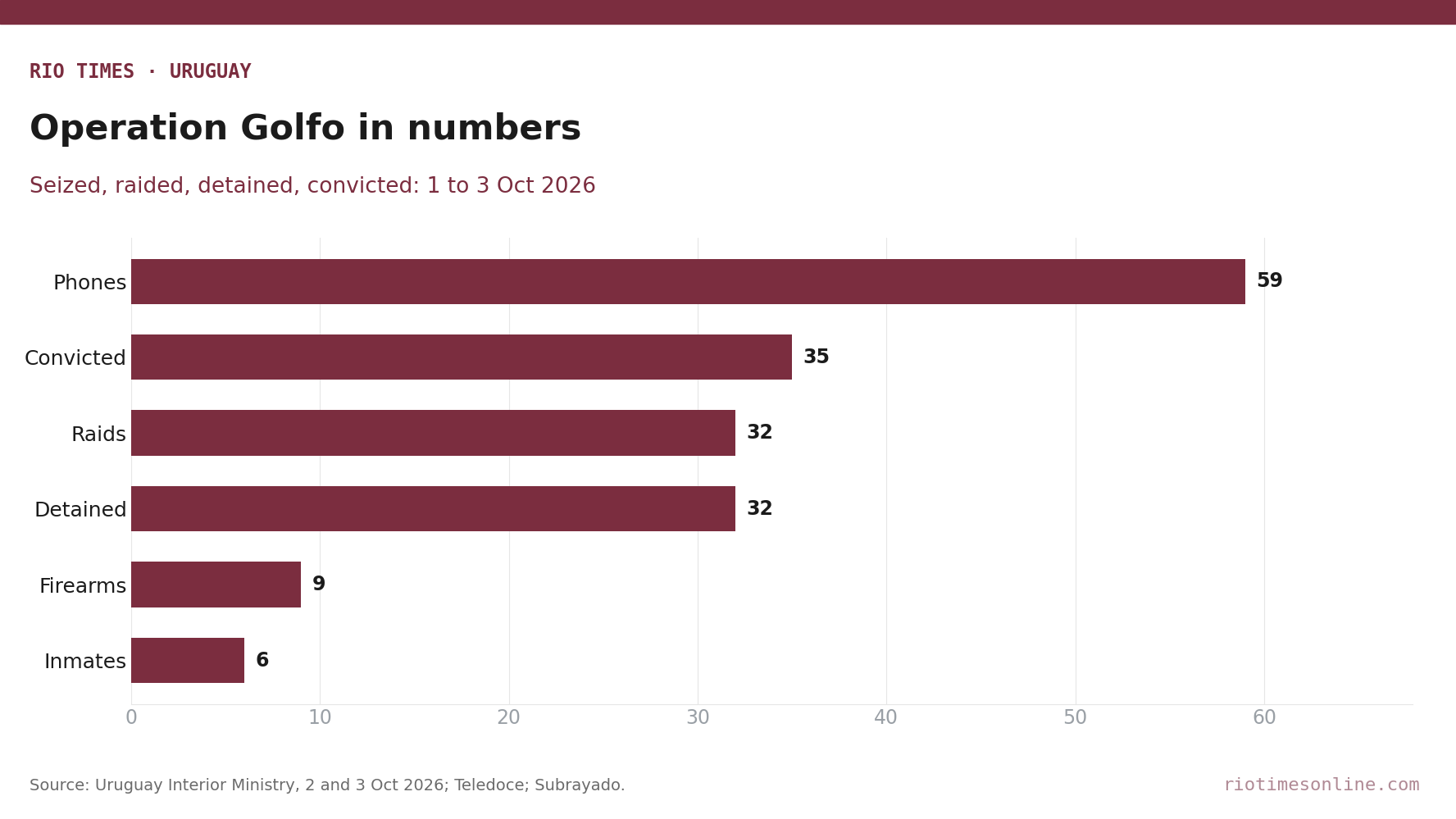
- —What happened Courts convicted 35 people, 25 men and 10 women, after Operation Golfo, the Interior Ministry said on 3 October 2026. Police raided 32 addresses on 1 October.
- —The numbers Sentences run from six months to seven years, most above two years. Police seized nine firearms, 59 mobile phones and five vehicles (ministry, 2–3 October).
- —What it means for you Police say six inmates led these prison-run criminal groups. The minister wants a high-security prison for such profiles, which Uruguay does not yet have.
- —Still open Three suspects are still wanted, according to the ministry. The money-laundering strand and the inmates’ own cases have not been detailed.
Uruguay has convicted 35 people after a police operation against prison-run criminal groups in the department of Colonia. The Interior Ministry announced the sentences on Saturday 3 October, two days after the raids.
The case, known as Operation Golfo, was first presented by police and Interior Minister Carlos Negro on 2 October. According to the police, six prison inmates led the groups and kept directing them from their cells.
What the courts decided
The ministry said the 35 were convicted of aiding drug trafficking, supplying illegal drugs, internal arms trafficking and criminal association. The list also includes aggravated drug dealing, theft and receiving stolen goods, “among others”.
Sentences range from six months to seven years, and the ministry said most exceed two years. Teledoce and Subrayado, two Montevideo television news outlets, both carried the ministry’s figures.
The heaviest single sentence went to a 51-year-old man, who received seven years. He was convicted of supplying drugs and of repeatedly paying or promising payment to minors for sexual acts.
An 18-year-old woman was placed under restrictions, including a fixed address and a ban on leaving the country. The ministry said three more people are wanted in the investigation.
How seized phones led to Golfo
Teledoce reported that the case grew out of mobile phones seized in two earlier operations, called Delta and Dos Ríos. Analysis of those devices pointed investigators to the Colonia network.
The raids took place on Thursday 1 October and involved more than 100 police officers, the ministry said. Of the 32 addresses searched, 28 were in Colonia, including Nueva Helvecia, Colonia del Sacramento, Colonia Valdense and Rosario.
The others were in San Luis, in Canelones, and in Montevideo. Officers also searched three units of the National Rehabilitation Institute (INR), Uruguay’s prison service, and took six inmates before the court.
Police detained 32 people, 30 on warrants and two caught in the act. They seized nine firearms, 53 cartridges, about a kilo of cocaine and marijuana, cocaine paste, cash, 59 phones and five vehicles.
Why prison-run criminal groups are the harder problem
Negro called the case “a clear example” of the link between prisons and crime outside them. He said police work does not end at the prison gate. Cutting inmates’ contact with the outside is part of the job, he added.
He repeated the ministry’s call for a prison for high-risk criminal profiles, which he said Uruguay does not have. Subrayado reported that the ministry is working on such a facility, but no site or date has been given.
The operation fits a wider picture. On 29 September Negro told senators that police count 2,723 gang members, 649 of them in prison. The figures are set out in Uruguay Maps 2,723 Gang Members in 137 Structures.
Negro stressed that drug cases must also hit criminal finances, not only seize drugs. Regulators are pursuing that front separately, as in Uruguay Central Bank Investigates Monex Exchange House Over Drug Money.
What Is Not Yet Known
The ministry has not said how many of the 35 were among the six inmates or the 32 people detained. Nor has it said which sentences were agreed in abbreviated proceedings and which, if any, followed a trial.
Money laundering featured in the investigation, yet it does not appear in the ministry’s list of convictions. It is also unclear whether the investigation into the trafficking of minors will produce further charges.
Sources: Uruguay Interior Ministry, “Operación Golfo: una nueva ofensiva contra el narcotráfico y el lavado de activos”, 2 October 2026; Teledoce, 2 October and 3 October 2026; Subrayado, 2 October and 3 October 2026.
This article was produced by The Rio Times’ automated newsroom system. How we use AI · Report an error · Editorial responsibility: Matthias Camenzind, Editor-in-Chief
Read More from The Rio Times