Uruguay Gang Members: Police Map 2,723 People in 137 Active Criminal Structures
SECURITY · URUGUAY
Key Facts
- —The country Uruguay, a country of about 3.5 million people, where the share of killings tied to conflicts between criminals has risen steadily since 2013.
- —What happened On Tuesday 29 September, Interior Minister Carlos Negro told a Senate committee that police intelligence counts 137 active criminal structures with 2,723 identified members.
- —The numbers Of the 2,723 gang members, 1,903 are free, 649 are in prison and 82 have died, Telenoche reported. Sixty-four of the 137 structures are family clans.
- —What it means for you Conflict between criminals drives 58% of killings this year, the ministry said. Of 284 homicides so far in 2026, 157 have been solved, the ministry said.
- —Still open The full report has not been published. It is unclear how police define membership, and Negro said the effect of new measures can only be judged at year end.
Uruguay’s police have put a number on the country’s organised crime: 2,723 gang members in 137 active criminal structures. Interior Minister Carlos Negro presented the figures to the Senate security committee on Tuesday 29 September, Subrayado and Telenoche reported.
The count is the first detailed map of who drives Uruguay’s homicide rate. It also shows that most of these structures are small family clans rather than large cartels.
Four kinds of criminal structure
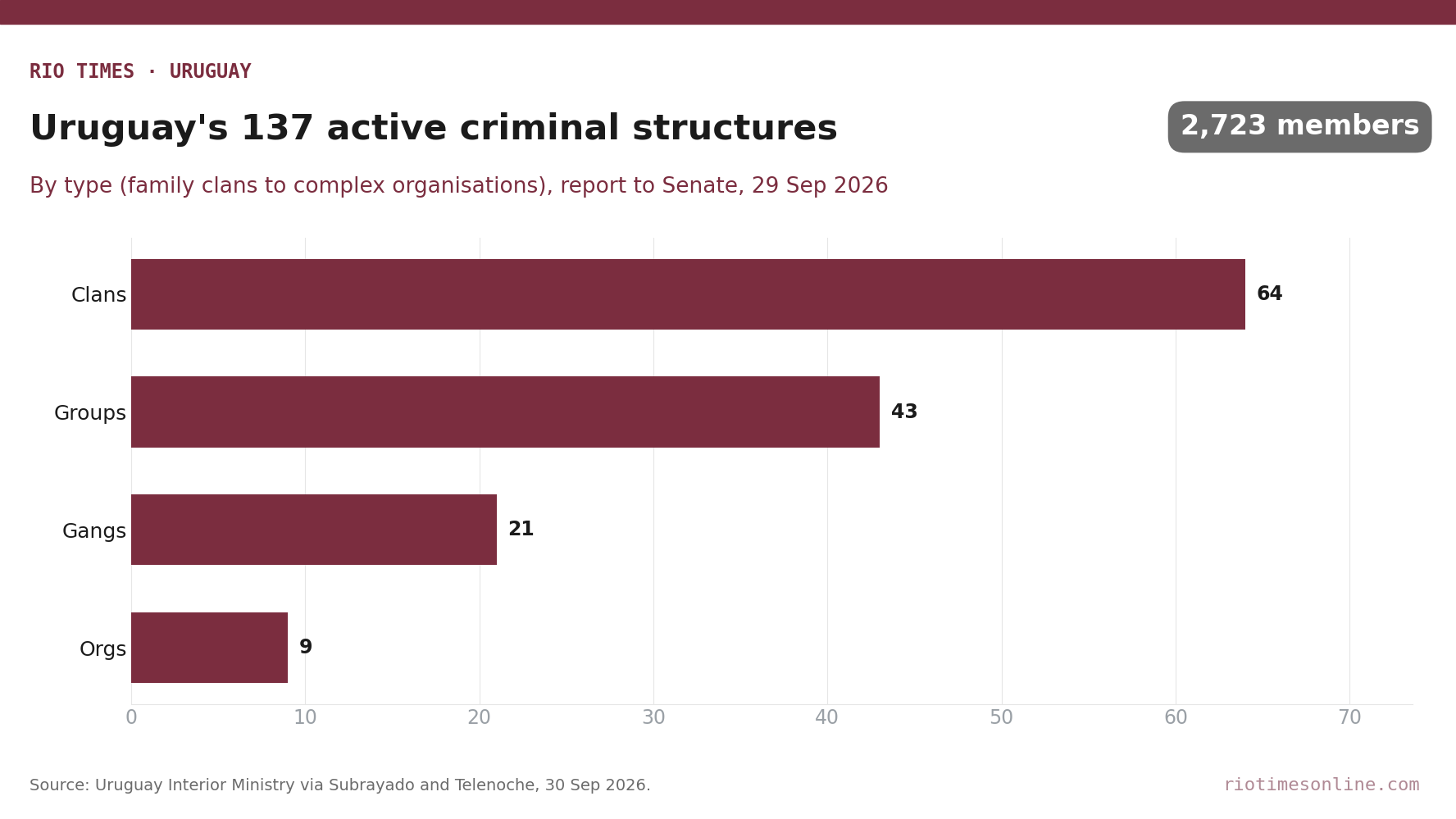
Police intelligence sorts the 137 structures into four types by organisation and permanence. The largest category is 64 family clans, built on kinship, trust and continuity.
Next come 43 criminal groups with basic coordination and some stability, and 21 opportunistic gangs with little organisation. Only nine are classed as complex criminal organisations with a hierarchy.
Of the 2,723 gang members, 1,903 are at liberty, according to Telenoche. A further 649 are in prison, 82 have died, 23 are abroad and 39 are wanted by the courts.
Where the gangs operate
Thirty-seven of the structures operate in Montevideo neighbourhoods, Subrayado reported. Marconi has the most, with five, followed by Villa Española, Piedras Blancas, Cerro and La Cruz de Carrasco with four each.
None of the five named districts is in the city centre. The ministry did not detail where the other structures operate.
Gang conflict behind 58% of killings
Negro told senators that conflict between criminals is “the main apparent motive” of homicides from January to August. The share of victims killed in such conflicts rose from 30% in 2013 to 58% so far in 2026.
In Montevideo, 176 people were killed between January and August. In 98 of those cases, the victim or the killer had a link to a criminal structure, Subrayado reported.
Uruguay recorded 284 homicides so far this year, the ministry said. Of those, 157 have been solved and 49 show progress, Telenoche reported.
Pressure on the government
Security is the main political test for the centre-left government of President Yamandú Orsi, in office since March 2025. Drug money has also reached politics, with a party aide jailed for laundering drug money in September.
Regulators are tightening controls on the financial side too. The central bank is investigating the Monex exchange house over drug money, as reported this week.
Mapping gang members does not reduce violence by itself. But a named and located target list gives police and prosecutors a clearer basis for investigations.
Negro said homicides rose by slightly more than 6% in the first half, Subrayado reported. He added that killings fell almost 30% in September, but warned against early conclusions.
What Is Not Yet Known
The ministry has not published the full report, and the figures come from outlets that saw it. It is not clear how police decide who counts as an active member.
Negro said measures such as more patrols and tougher gun penalties need until year end to be judged. It is also unclear how many of the 1,903 members at liberty are under investigation.
Sources: Uruguay Interior Ministry report to the Senate security committee (29 September 2026) via Subrayado and Telenoche; Subrayado (30 September 2026); Telenoche (30 September 2026); Subrayado on Negro’s measures (29 September 2026).
Read More from The Rio Times