Uruguay Explained 2026: The Country, Its Stability, Its Economy and What to Watch
GUIDES · URUGUAY
Key Facts
- —Capital Montevideo, on the Río de la Plata estuary. The 2023 census counted 1.30 million people in Montevideo department, about 37 percent of the national total.
- —Population 3,499,451 at the 2023 census, slightly fewer than live in Connecticut. That is only 2.5 percent above the statistics office’s revised 2011 figure.
- —Currency The Uruguayan peso (UYU). The central bank’s closing rate was 40.214 pesos to the US dollar on 24 September 2026. The bank targets inflation of 4.5 percent.
- —Language Spanish, in the Rioplatense variety also spoken in Buenos Aires. Portuguese is widely heard along the northern border with Brazil.
- —GDP About US$85.3 billion in 2025, or roughly US$25,200 per person, World Bank data show. That is above Chile and Argentina, and about 28 percent of the US level.
- —Government A unitary presidential republic of 19 departments. The president serves five years with no immediate re-election. Yamandú Orsi has held office since 1 March 2025.
Uruguay explained from the ground up: how it is governed, what it sells, what it costs, and which dates matter next.
Uruguay explained properly begins with a contrast. Its institutions rank among the strongest anywhere. Yet its economy is small, open and exposed to the weather and to two giant neighbours. Calm politics does not guarantee a calm economy, and 2026 shows it.
What kind of country is this?
Uruguay covers about 176,000 square kilometres, a little smaller than the US state of Washington. Brazil lies to the north. Argentina lies to the west, across the Uruguay River and the Río de la Plata.
Most of the interior is rolling grassland given over to cattle, soy and plantation forests. People cluster on the southern coast. Of the 3,499,451 residents counted in 2023, 1.30 million live in Montevideo department.
Uruguay became independent in 1828 as a buffer state between Argentina and Brazil. A military dictatorship ruled from 1973 to 1985. Since then, elections have been held on schedule, and power has changed hands peacefully between rival parties.
The international scorecards agree on the result. Freedom House gave Uruguay 97 out of 100 in its 2026 report. The Economist Intelligence Unit (EIU), a London-based research firm, ranked it 12th of 167 countries for 2025 and classed it a full democracy.
On corruption, Transparency International scored Uruguay 73 out of 100 for 2025, 17th of 182 countries. That is ahead of the United States on 64 and the United Kingdom on 70, though three points down on 2024. The Bertelsmann Transformation Index for 2026 ranked it first of 137 developing and transition countries for political transformation.
For a foreigner, that stability is practical. Laws change through parliament, and losing candidates concede. Álvaro Delgado accepted defeat on election night in November 2024, while votes were still being counted.
Who runs Uruguay and how
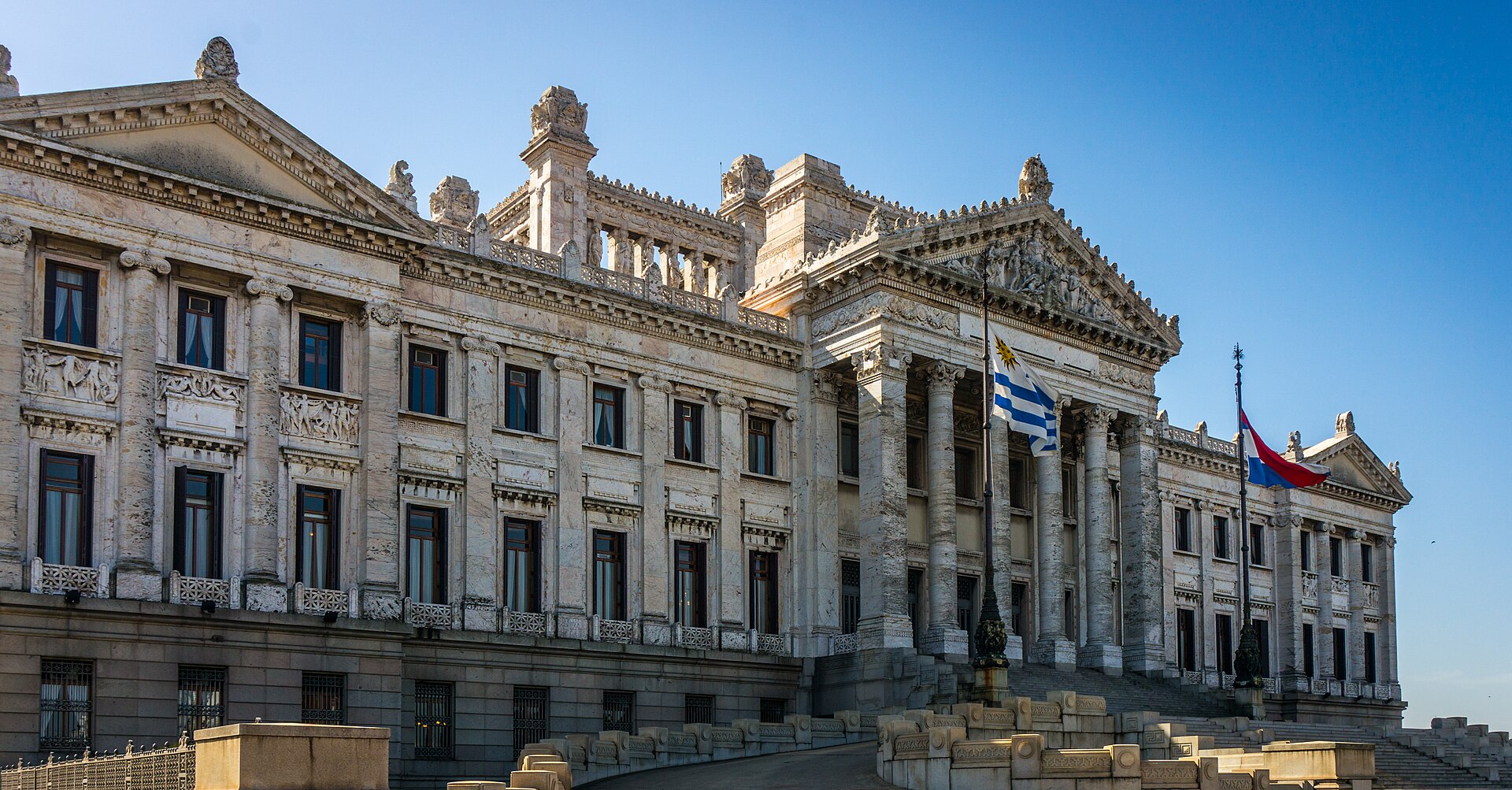
Uruguay is a unitary presidential republic of 19 departments, each with an elected intendente, or governor. The president is head of state and of government, elected for five years. The constitution bars a second consecutive term: a former president must wait five years to run again.
Yamandú Orsi of the Frente Amplio (Broad Front), a centre-left coalition of parties, took office on 1 March 2025. He previously served as intendente of Canelones, the department next to Montevideo. He won the runoff of 24 November 2024 with 49.8 percent of votes cast. Álvaro Delgado of the National Party took 45.9 percent.
Voting is compulsory under the constitution, and general elections fall on the last Sunday of October every five years. The next is due on 28 October 2029, with a new term starting on 1 March 2030. Vice-President Carolina Cosse presides over the Senate.
The General Assembly has two chambers. The Frente Amplio won 16 of the 30 elected Senate seats in October 2024, a majority. In the 99-seat Chamber of Representatives it won 48, two short of a majority on its own.
The opposition Coalición Republicana groups the National Party, with 29 deputies, the Colorado Party with 17 and the Independent Party with one. Two small parties hold two seats each, Identidad Soberana and Cabildo Abierto. Cabildo Abierto’s two votes carried the government’s budget update through the lower house in August 2026.
Economic policy runs through the Ministry of Economy and Finance (MEF), led by Gabriel Oddone. The central bank is the Banco Central del Uruguay (BCU). The minister and the bank’s board sit together on a coordination committee that sets the inflation target.
How the economy works
Uruguay earns its hard currency from grass, trees and soy. Goods exports reached US$13.49 billion in 2025, the highest in a decade, according to Uruguay XXI, the state export agency. Beef led with a record US$2.68 billion, a fifth of the total.
Wood pulp came second at US$2.31 billion, down 9 percent as world prices fell. Soybeans brought in US$1.42 billion and dairy products US$928 million. The pulp comes from very large mills built by foreign investors, including the Finnish group UPM.
China is the biggest customer, buying US$3.49 billion of goods, or 26 percent. Brazil took US$1.96 billion, the European Union US$1.84 billion and the United States US$1.55 billion. American purchases rose about 30 percent, and beef made up just over half of them.
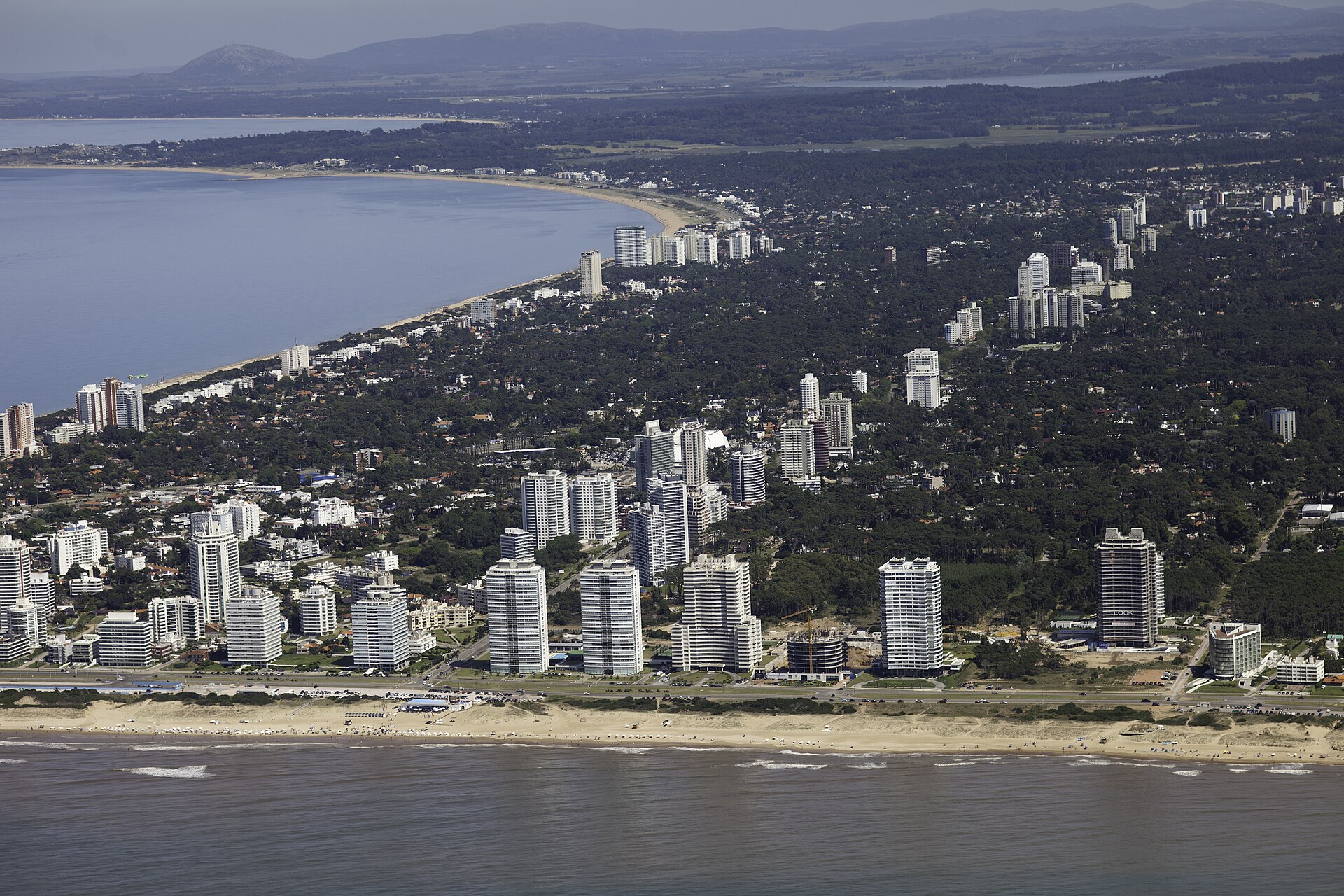
Tourism is the other great earner, and it is mainly Argentine. The tourism ministry counted 3.6 million visitors in 2025, who spent US$2.04 billion, close to the value of pulp exports. About 2.4 million of them came from Argentina and spent US$1.18 billion.
Argentina’s exchange rate therefore matters here almost as much as Uruguay’s own. It decides how many Argentines can afford a Uruguayan summer.
Money is managed by inflation targeting. The BCU aims for 4.5 percent a year, with a tolerance band of 1.5 points either side. Twelve-month inflation was 4.55 percent in August 2026, according to the national statistics institute (INE).
The policy rate is 5.75 percent. The BCU cut it seven times in a row between July 2025 and March 2026, by 3.5 points in all. It has held since. The peso strengthened beyond 38 to the US dollar in January 2026, and the bank brought a rate meeting forward. It has since eased back above 40.
Public finances are the weak point. In the twelve months to July 2026 the whole public sector ran a deficit of 4.4 percent of output, the MEF reports. That is 157.6 billion pesos, about US$3.9 billion.
Net central government debt stood at an estimated 57.6 percent of output in June, below the 65 percent anchor in the fiscal rule. Markets remain open: in July the government raised the equivalent of US$1.7 billion by reopening a peso bond and a dollar bond.

What is happening right now
As of 25 September 2026, the economy is stalling. Output fell 0.8 percent in the second quarter from the first, seasonally adjusted, and 0.5 percent from a year earlier. The central bank published the figures on 15 September.
Farming, fishing and mining shrank 22.2 percent, mainly because drought cut soybean yields in the 2025/26 harvest. Manufacturing grew 1.9 percent, helped by pulp, and construction 4.2 percent, partly on a data-centre project. Final consumption by households and government rose 2.4 percent.
Economists surveyed by the BCU in September cut their median 2026 growth forecast to 1.0 percent, from 1.2 percent in August. Unemployment was 7.0 percent in July, but 21.1 percent among 14-to-24-year-olds, INE data show.
The political story is the budget update. Each year a Rendición de Cuentas law reports on the previous year’s spending and adjusts the five-year budget; this is Orsi’s first. By 23 September 2026 the Senate had given it final approval without changes, and it takes effect on 1 January 2027.
The opposition voted against the bill as a whole but backed 216 of its 312 articles. Frente Amplio senators point to more money for children and homeless people, and to an end to VAT on materials for cooperative housing. Opposition senators call its fiscal projections close to impossible.
Orsi’s standing has slipped since 2025. An Equipos Consultores poll taken from 11 to 31 August 2026 found 28 percent approving of his performance and 51 percent disapproving. That was two points better than in June, a change within the margin of error.
Energy prices are the other pressure. Since April the government has cushioned pump prices against oil rises linked to the Middle East conflict. For September it froze all fuel prices, although the regulator’s reference implied a 25 percent rise for diesel.
Trade is the brighter side. Mercosur is the South American trade bloc founded by Argentina, Brazil, Paraguay and Uruguay. Uruguay ratified the European Union–Mercosur agreement on 26 February 2026, the same day as Argentina. The interim trade deal has applied provisionally since 1 May 2026.
What to watch
The central bank’s next scheduled rate meeting falls in early October 2026. Minutes of the August meeting flagged three risks: El Niño weather, a weaker global dollar and the Middle East conflict. The business daily Ámbito read them as leaving a rate rise before year-end on the table.
INE publishes September inflation in early October; the August rate was 4.55 percent. The MEF publishes twelve-month fiscal results around the end of each month. In October the tax authority (DGI) also starts collecting withholdings and advance payments under the new foreign-income rules, which it had postponed.
The central bank publishes third-quarter output in December. Another fall would mean two consecutive quarterly contractions, the common definition of a technical recession. The Rendición de Cuentas then takes effect on 1 January 2027.
The southern summer, when most Argentine visitors arrive, starts in December. The BCU is also watching El Niño, which its August minutes flagged as a risk to prices.
In Europe, the full EU–Mercosur agreement still needs the European Parliament’s consent. In January 2026 the Parliament asked the EU Court of Justice for an opinion first, and no date is set. The next Uruguayan general election falls on Sunday 28 October 2029.
What this means for foreigners
Entry is simple. The interior ministry’s admission rules exempt ordinary US and Canadian passports, and EU passports, from tourist visas. Our moving and residency guides set out the routes to legal residence.
Tax is where the rules changed. Law 20,446, the 2025–2029 budget, took effect on 1 January 2026. It extended the 12 percent personal income tax on foreign investment income to foreign rental income and capital gains.
New residents can still choose an 11-year holiday from that tax. Since 2026, though, they qualify only by spending more than 183 days a year in Uruguay, or by investing. The thresholds are property worth over 12.5 million indexed units (about US$2 million), or 625,000 units a year (about US$100,000) in approved funds.
The indexed unit is an inflation-linked accounting unit, worth 6.64 pesos (about US$0.17) on 28 August 2026. People who took up the old regime by 31 December 2025 keep their terms. A decree of 10 August 2026 filled in the details, and our taxes and retirement pillars cover the consequences.
A few everyday benchmarks help set expectations. The standard VAT rate is 22 percent, with 10 percent on food, medicines and hotels. Super 95 petrol costs 88.67 pesos a litre in September 2026 (about US$2.21, or US$8.35 per US gallon).
The national minimum wage has been 25,383 pesos a month (about US$631) since 1 July 2026. Healthcare runs through the National Health Fund (FONASA) and private mutual providers, which our healthcare pillar explains.
Uruguay explained in one line: a small, rule-bound democracy with calm politics, a weather-dependent economy and new tax rules for newcomers.
Connected Coverage
Uruguay vs Paraguay for Expats in 2026: Cheap Living or a Tax Holiday
Uruguay Residency Visa Rules and the 12 Percent Tax on Foreign Income
Buying Property in Uruguay as a Foreigner 2026: No Restrictions, One Myth
Investing in Uruguay: High Ratings, Almost No Stock Market
Opening a Bank Account in Uruguay as a Foreigner
Healthcare in Uruguay for Expats: Mutualistas, FONASA and What It Costs
Uruguay Tightens Expat Income Tax as 2026 Foreign Source Rules Land
Uruguay Welcomes Retiree Residency as Foreign Pensions Face No Fixed Minimum
Is Uruguay Safe? Guide for Expats
Moving to Uruguay: Residency Steps for Expats
Uruguay Grants New Residents an 11-Year Foreign Income Tax Holiday
Sources: Population from the Instituto Nacional de Estadística (INE); inflation, the policy rate, output and the exchange rate from the Banco Central del Uruguay; public finances and debt from the Ministry of Economy and Finance; exports from Uruguay XXI; tourism from the Ministry of Tourism; election results from the Inter-Parliamentary Union. All accessed 25 September 2026.
- Instituto Nacional de Estadística — Census 2023 final results
- Instituto Nacional de Estadística — Activity, employment and unemployment, July 2026
- Banco Central del Uruguay — Monetary Policy Committee communiqués
- Ministerio de Economía y Finanzas — public sector result, twelve months to July 2026
- Ministerio de Economía y Finanzas — sovereign debt report, August 2026
- Uruguay XXI — 2025 annual foreign trade report
- Ministerio de Turismo — 2025 visitors and tourism revenue
- IMPO — Constitution of the Republic, articles 77 and 152
- IPU Parline — October 2024 elections, Chamber and Senate results
- Congressional Research Service — Democracy in Latin America and the Caribbean: a compilation of selected indices (2026)
- Junta de Transparencia y Ética Pública — Corruption Perceptions Index 2025
- Ministerio de Industria, Energía y Minería — fuel prices for September 2026
- Ministerio del Interior — visa admission rules by nationality
- PwC Worldwide Tax Summaries — Uruguay, 2025–2029 Budget Law changes for individuals
- World Bank — Uruguay GDP and GDP per capita, 2025
What Is Not Known
Whether the slowdown becomes a recession. Output fell 0.8 percent in the second quarter, and the third-quarter figure arrives only in December. The median forecast for 2026 growth is 1.0 percent, and Itaú, one of the larger banks, is at 0.8 percent.
Where interest rates go next. The BCU has held at 5.75 percent since March. Its own minutes list El Niño, oil prices and a weaker global dollar as risks. Itaú expects a hold for the rest of 2026 and says tightening cannot be ruled out.
Whether the deficit path holds. The authorities plan to cut the structural deficit from 4.0 percent of output in 2026 to 2.6 percent in 2029. A September analysis in El País set out that path. With growth near 1 percent, and no opposition votes for new revenue, the route there is not settled.
How the new tax rules change the flow of foreign residents. The wider foreign-income tax and the tighter holiday apply from 2026, and the decree detailing the holiday came only in August. No official data yet show whether wealthy newcomers are arriving more slowly.
How the weather and Europe play out. El Niño’s effect on the next harvest cannot be known until it arrives. No opinion from the EU Court of Justice on the EU–Mercosur agreement had been reported. Such opinions have taken up to two years.
Frequently Asked Questions
Who is the president of Uruguay in 2026?
Yamandú Orsi of the Frente Amplio (Broad Front), in office since 1 March 2025. He won the runoff on 24 November 2024 with 49.8 percent of votes cast, against 45.9 percent for Álvaro Delgado. Presidents serve five years and cannot be re-elected immediately.
Is Uruguay a stable democracy?
By international measures, yes. Freedom House scored it 97 out of 100 in 2026, the Economist Intelligence Unit ranked it 12th of 167 countries for 2025, and Transparency International placed it 17th of 182 for perceived corruption.
What currency does Uruguay use?
The Uruguayan peso. The central bank’s closing rate was 40.214 pesos to the US dollar on 24 September 2026. The central bank targets inflation of 4.5 percent, and prices rose 4.55 percent in the twelve months to August 2026.
What does Uruguay export?
Mainly farm and forest products. Goods exports were US$13.49 billion in 2025, led by beef at US$2.68 billion, pulp at US$2.31 billion and soybeans at US$1.42 billion. China bought 26 percent of the total.
Do Americans need a visa to visit Uruguay?
No. Holders of ordinary US and Canadian passports, and of European Union passports, can enter as tourists without a visa, according to the interior ministry’s admission rules.
How is Uruguay’s economy doing in 2026?
It is slowing. Output fell 0.8 percent in the second quarter from the first, mainly because drought hit the soybean crop. Economists surveyed by the central bank expect growth of 1.0 percent in 2026, and unemployment was 7.0 percent in July.
This article was produced by The Rio Times’ automated newsroom system. How we use AI · Report an error
Read More from The Rio Times