Safety in Mexico 2026, Only Two States Rate US Level 1
Guides · Mexico
—The stakes. Foreign residents in Mexico face medium overall risk, but daily exposure depends almost entirely on state, city, and neighborhood choice.
—The pattern. Only Yucatán and Campeche hold the lowest U.S. advisory Level 1, while six cartel-conflict states sit at Level 4 Do Not Travel.
—The hubs. Mexico City, Mérida, Puerto Vallarta, and Cancún show far lower violence than national figures, though street crime and scams persist.
—The rules. Long-term foreign residents rely on app-based rides, guarded ATMs, daylight toll-road travel, and rejection of unofficial police fines.
—The comparison. Mexico’s resident-foreigner risk profile sits between Brazil’s urban robbery exposure and Colombia’s targeted kidnap-for-ransom dynamic.
Mexico is a country of violent statistics and peaceful enclaves. For long-term foreign residents, the operative question is less about headline murder counts and more about where one lives, how one moves, and which rules one follows.

The National Numbers That Frighten and Mislead
Mexico recorded 30,523 murder victims in 2023, according to the Executive Secretariat of the National Public Security System (SESNSP).
That figure represented a reduction of 1,431 victims versus 2022 but still marked the sixth consecutive year above 30,000.
The national intentional homicide rate for 2023 stood near 24.9 per 100,000 people, placing Mexico among the most lethal countries globally.
Yet this rate is not evenly spread across the country, and foreign residents rarely appear among the victims.
Cartel violence is intensely concentrated in specific states, corridors, and municipalities, not in most expat neighborhoods.
How the U.S. State Department Maps the Risk
The United States classifies Mexico at Level 2 Exercise Increased Caution due to crime, kidnapping, and terrorism.
That country-level label masks a wide internal distribution, with six states at Level 4 Do Not Travel as of June 2026.
Those states are Colima, Guerrero, Michoacán, Sinaloa, Tamaulipas, and Zacatecas.
Only two states, Yucatán and Campeche, hold Level 1 Exercise Normal Precautions, the lowest possible warning.
For a foreign resident, advisory geography is the first filter, and Level 4 states are generally considered unsuitable for relocation.
What Cartel Violence Means and Does Not Mean for Expats
Cartel organizations are the main actors behind Mexico’s extreme homicide rates, especially in contested plazas and trafficking routes.
The violence is typically about territorial control, rival enforcement, extortion networks, and supply-chain discipline, not random attacks on foreigners.
Foreign residents are rarely targeted directly, but they can be exposed through kidnapping, express kidnapping, or armed confrontation in the wrong location.
High-crime states such as Guerrero, Michoacán, and Zacatecas have documented road blockades and disappearances that make travel inherently hazardous.
For expats, the realistic risk is less cartel assassination and more being caught in a volatile context that does not distinguish outsiders.
Mexico City: Patchwork Safety in a Critical Threat Zone
The U.S. Overseas Security Advisory Council (OSAC) assesses Mexico City as a critical threat location for crime affecting official U.S. interests.
The city’s homicide rate stood near 11.01 per 100,000 in 2024, up from 10.42 in 2023.
That is lower than Chicago’s roughly 18 per 100,000, and guides describe the capital as patchwork safe rather than uniformly dangerous.
Safer colonias frequently cited include Polanco, Santa Fe, Lomas de Chapultepec, Coyoacán, Condesa, Roma, Narvarte, Juárez, and Del Valle.
In these areas, long-term foreign residents report low incident rates, though phone theft and pickpocketing remain common around transit and nightlife.
Mérida: The Level 1 Exception That Attracts Retirees
Yucatán and neighboring Campeche are the only Mexican states at Level 1 Exercise Normal Precautions.
Mérida is consistently described as Mexico’s safest major city and among the safest in the Americas.
City homicide estimates hover between 1.3 and 2.5 per 100,000, with Yucatán state around 2 to 4 per 100,000 against the national rate near 23.
More than 70 percent of Mérida residents say they feel safe walking alone at night, according to national perception surveys.
An expat population estimated at 10,000 to 15,000, mostly retirees, lives with low violent crime but still faces petty theft and taxi overcharging.
Puerto Vallarta and the Jalisco Paradox
Puerto Vallarta sits in Jalisco, a state often flagged at Level 3 Reconsider Travel because of operations by the Jalisco New Generation Cartel (CJNG).
The violence in Jalisco concentrates in non-tourist and rural zones, while Puerto Vallarta’s coastal expat areas see far lower homicide exposure.
Tourist-facing districts around the Malecón, the Romantic Zone, and marina areas operate with heavy informal security and tourism-dependent order.
Foreign residents in Puerto Vallarta still follow standard rules on night transport and ATM use, but the daily risk is notably lower than state-wide figures suggest.
The key distinction for expats is that Jalisco’s conflict geography does not map directly onto Puerto Vallarta’s tourist core.
Cancún and the Riviera Maya: Tourist Corridors with Hinterland Risk
Cancún and the Riviera Maya occupy Quintana Roo, a state with Level 2 advisory but recurrent cartel enforcement activity along drug corridors.
Violent incidents do reach the resort zone, though they generally involve rival criminal groups rather than targeting foreign tourists or residents.
Large all-inclusive zones and gated expat communities provide physical separation, but petty crime and scams still cluster around taxi ranks and nightlife.
Practical guidance for the Riviera Maya emphasizes using official hotel taxis or app rides and avoiding unlit beach areas after hours.
The standing rule among foreign residents is that Cancún remains workable with discipline, while inland Quintana Roo and nearby border zones require more caution.
Transport, ATMs, and Nightlife: The Resident Rulebook
Long-term foreign residents in Mexico avoid street-hailed taxis, especially at night, in favor of Uber, DiDi, Cabify, or official hotel taxi stands.
Unlicensed street taxis in Mexico City have been associated with express kidnapping, in which victims are forced to withdraw cash from ATMs and then released.
ATMs at banks, shopping centers, or lobbies are preferred over standalone street machines because skimming and card cloning are documented risks.
Nightlife practice among expats includes staying in groups, limiting cash carried, and choosing well-lit venues in safer colonias.
The constant rule is never to resist an armed robbery and to limit what a thief can take by carrying only one card and small cash amounts.
Road Travel: Toll Roads versus Libre Roads
For intercity travel, foreign residents overwhelmingly favor cuota toll roads over libre free roads, despite the cost.
Toll roads offer controlled access, limited stopping points, and more consistent police or Guardia Nacional presence.
Libre roads pass through small towns and rural areas where roadblocks and extortion checkpoints are more common in high-risk states.
Daytime driving is the standard, with drivers avoiding routes through Guerrero, Michoacán, Zacatecas, or Tamaulipas entirely.
In safe states like Yucatán or Querétaro, the toll versus libre distinction matters less, but toll roads remain the default for cross-state movement.
Common Scams and Fake Police Encounters
Fake plain-clothes police demanding on-the-spot fines or ATM withdrawals are a documented threat for foreigners in Mexico City and other hubs.
UK government guidance tells visitors to be wary of criminals posing as police, to avoid paying on the spot, and to request official fine documentation.
Standalone ATM skimming, cloned cards, and taxi overcharging are the most common non-violent scams affecting foreigners.
Short-change fraud, fabricated damage claims from car rentals, and overpriced services aimed at tourists appear across expat hubs.
The standard response among long-term residents is to decline informal fines, request written verification, and use only regulated or app-based services.
Guardia Nacional, Emergency Numbers, and Institutional Limits
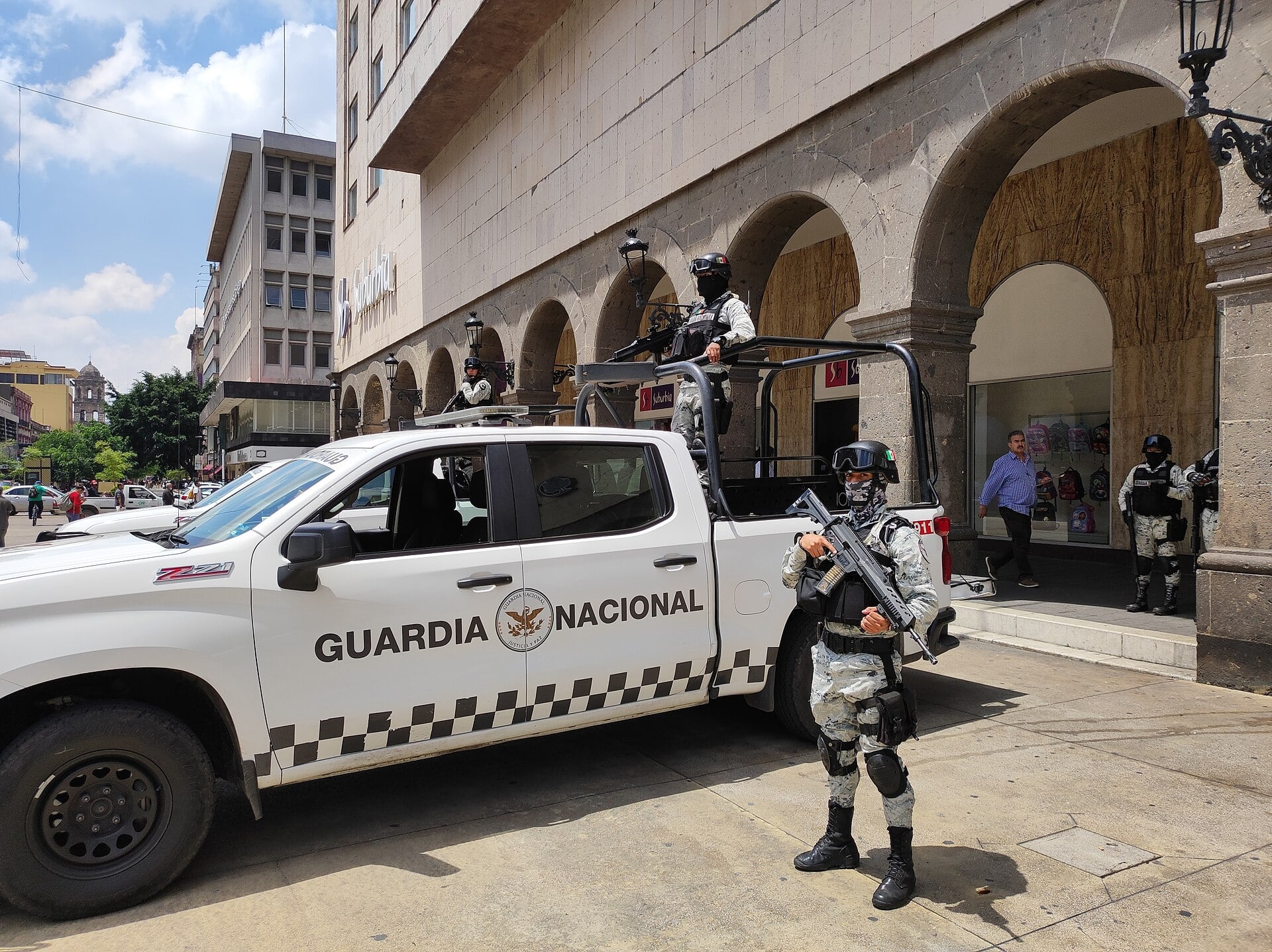
The Guardia Nacional is Mexico’s federal militarized police force, created to address public security and increasingly deployed for highway and strategic patrol.
Its creation and expansion have faced scrutiny over militarization and human rights concerns, but it remains a visible presence on major roads.
Mexico’s nationwide emergency number is 911, with tourist assistance available through dedicated state-level lines and consular support for foreign citizens.
Foreign residents register with their embassies or consulates and keep local contacts for their specific state’s tourist police.
In practice, institutional response quality varies, and many expats rely on private security in gated communities and on personal avoidance rules.
The big picture: Mexico explained — economy, politics, society and daily life in one read.
Mexico versus Brazil and Colombia for Resident Foreigners
Mexico’s risk profile for foreign residents is often described as street crime exposure plus cartel geography, not systematic targeting.
Brazil presents a different pattern, with higher rates of opportunistic armed robbery and urban violence in cities like Rio and São Paulo.
Colombia historically combined cartel and guerrilla dynamics with a higher incidence of targeted kidnap-for-ransom, though urban hubs like Bogotá and Medellín have improved.
All three countries share a rulebook for residents: avoid known conflict zones, use secure transport, and limit wealth display in public.
For Mexico specifically, the decisive variable remains state and city selection, with Mérida operating at a fundamentally different risk level than Culiacán or Acapulco.
Connected Coverage
Mexico City Grand Prix 2026: Schedule, Tickets, Altitude and Travel Guide
Banxico Sets December Deadline for New App Transfer Rules Across Mexico
The Big Picture
This article was produced by The Rio Times’ automated newsroom system. How we use AI · Report an error · Editorial responsibility: Matthias Camenzind, Editor-in-Chief
Expat Guide to Mexico
What The Rio Times publishes for foreigners who live in or move to Mexico.
Start here
- Mexican Peso Falls Past 18.40 on Central Bank Minutes
- Crocodiles in Puerto Vallarta Safety Guide
- Mexico Security and Crime Explained 2026
- Mexico Visa Options 2026 Explained
City guides
Mexico City, Playa del Carmen, Tulum, Puerto Vallarta, Mérida, Oaxaca, San Miguel de Allende, Guadalajara, Monterrey, Cancún
Coming up in Mexico
- Xcaret Festival Opens in Playa del Carmen on 30 October 30 Oct
- Mexico City Grand Prix 2026: Schedule, Tickets and TV 30 Oct
- Day of the Dead 2026 in Mexico City: Dates and Parade 31 Oct
- When Is Day of the Dead 2026? 1 and 2 November 2 Nov
Understand Mexico