Mexico Judicial Reform Explained: Elected Judges, 13% Turnout and What Investors Face
GUIDES · MEXICO
Key Facts
- —The country Mexico is the second-largest economy in Latin America and one of the largest trading partners of the United States. How its courts work decides how contracts, taxes and disputes end.
- —What it is A constitutional amendment published on 15 September 2024 that makes federal judges, magistrates and Supreme Court justices stand for popular election.
- —The numbers 881 federal posts were filled on 1 June 2025. Turnout was about 13 percent of nearly 100 million registered voters. The Supreme Court shrank from 11 justices to nine.
- —Why it matters Every foreign company in Mexico eventually meets a Mexican judge, over tax, a contract, a permit or a labour claim. Who picks that judge has changed.
- —The catch A new elected disciplinary tribunal can remove judges without appeal. Critics say that leaves judges answerable to the politics that nominated them.
- —What to watch The next USMCA review on 1 July 2027 and the second judicial election, moved to the first Sunday of June 2028.
The Mexico judicial reform explained: how the 2024 amendment works, what the first judicial election produced and who now sits on the Supreme Court.
Mexico now chooses its federal judges, up to the Supreme Court, by popular vote. Few countries anywhere do the same. For an American or European company with a factory, a contract or a tax dispute in Mexico, that is not an abstract debate. It changes who decides the case.
What the reform changed
Until 2024, Mexican federal judges were career officials. They entered through exams and training, and a council of the judiciary appointed and promoted them. Supreme Court justices were nominated by the president and confirmed by the Senate, for 15-year terms.
The Mexico judicial reform replaced that model with elections. Supreme Court justices, circuit magistrates and district judges now reach the bench by winning a vote. Judges serve nine-year terms and may be re-elected once. Supreme Court justices serve a single 12-year term.
The court itself shrank from 11 justices to nine. Its presidency now rotates every two years and goes to the candidates who drew the most votes. The old Federal Judiciary Council was abolished. Administration moved to a new Judicial Administration Body, and discipline to a new Judicial Disciplinary Tribunal.
Candidates need a law degree with an average grade of at least 8 out of 10 and five years of professional practice. They also submit an essay and five letters of reference. Evaluation committees appointed by the executive, Congress and the judiciary then screen the applicants and draw up the lists voters see.
Two further provisions drew particular criticism. The reform allows “faceless” judges, whose identity is withheld, in organised crime cases. It also caps judicial pay so that no judge earns more than the president.
How it became law
President Andrés Manuel López Obrador sent the proposal to Congress on 5 February 2024, as part of a wider package of constitutional changes. His movement, Morena, and its allies won large majorities in the June 2024 elections. That gave them the two-thirds needed to amend the constitution.
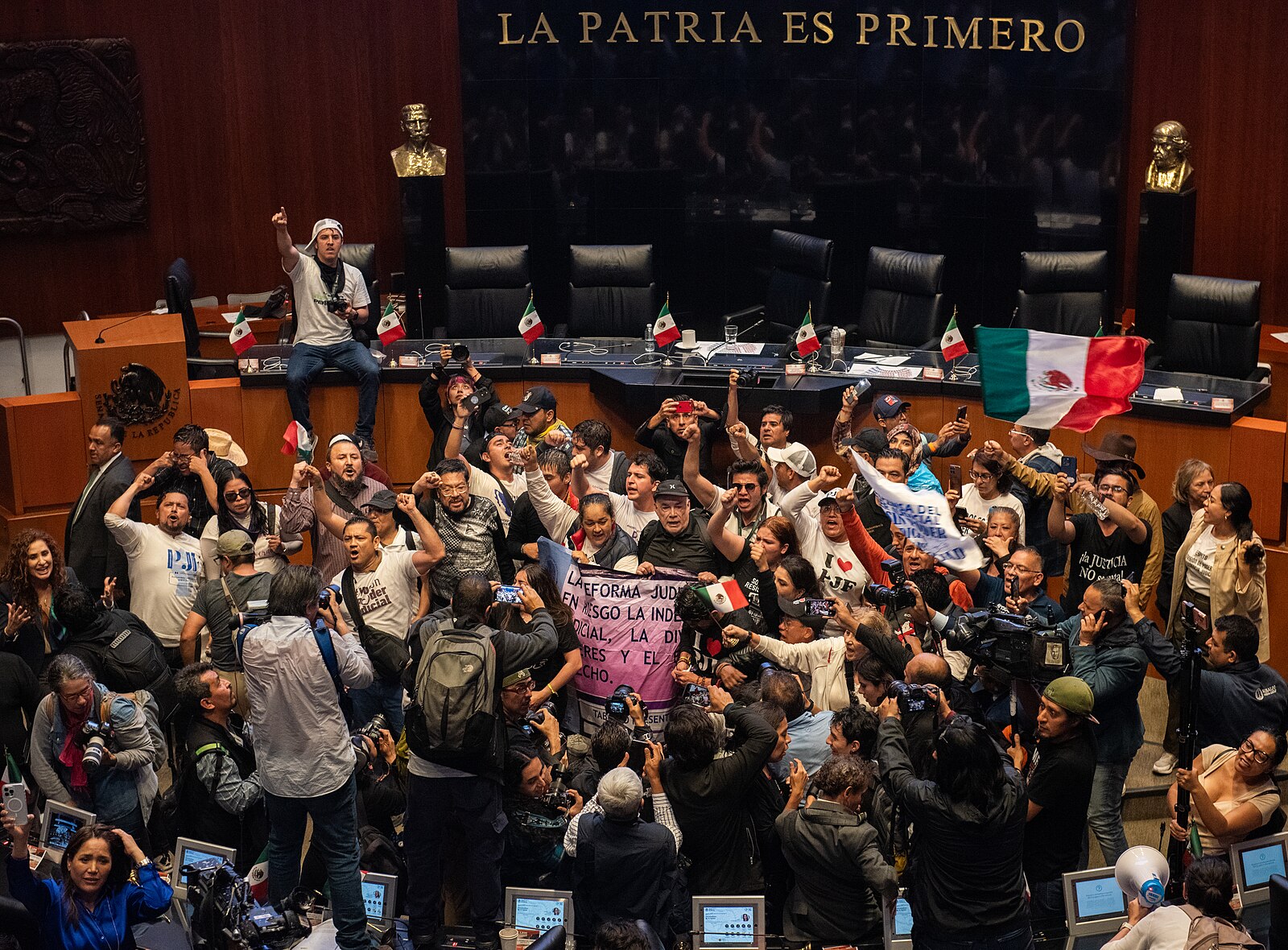
The Chamber of Deputies approved the reform by 357 votes to 130 on 4 September 2024. The Senate followed on 11 September by 86 votes to 41, after protesters had broken into the chamber the day before. A majority of state legislatures ratified it within about a day.
López Obrador signed the decree and it was published in the Diario Oficial de la Federación, the official gazette, on 15 September 2024. It took effect the following day. Federal court staff and many judges had already been on strike since August in protest.
The old Supreme Court tried to cut the reform back. On 5 November 2024 a draft ruling would have struck down the election of lower-court judges while keeping elections for the top court. Seven justices backed it, one short of the eight votes required. The reform stood in full.
The June 2025 judicial election in numbers
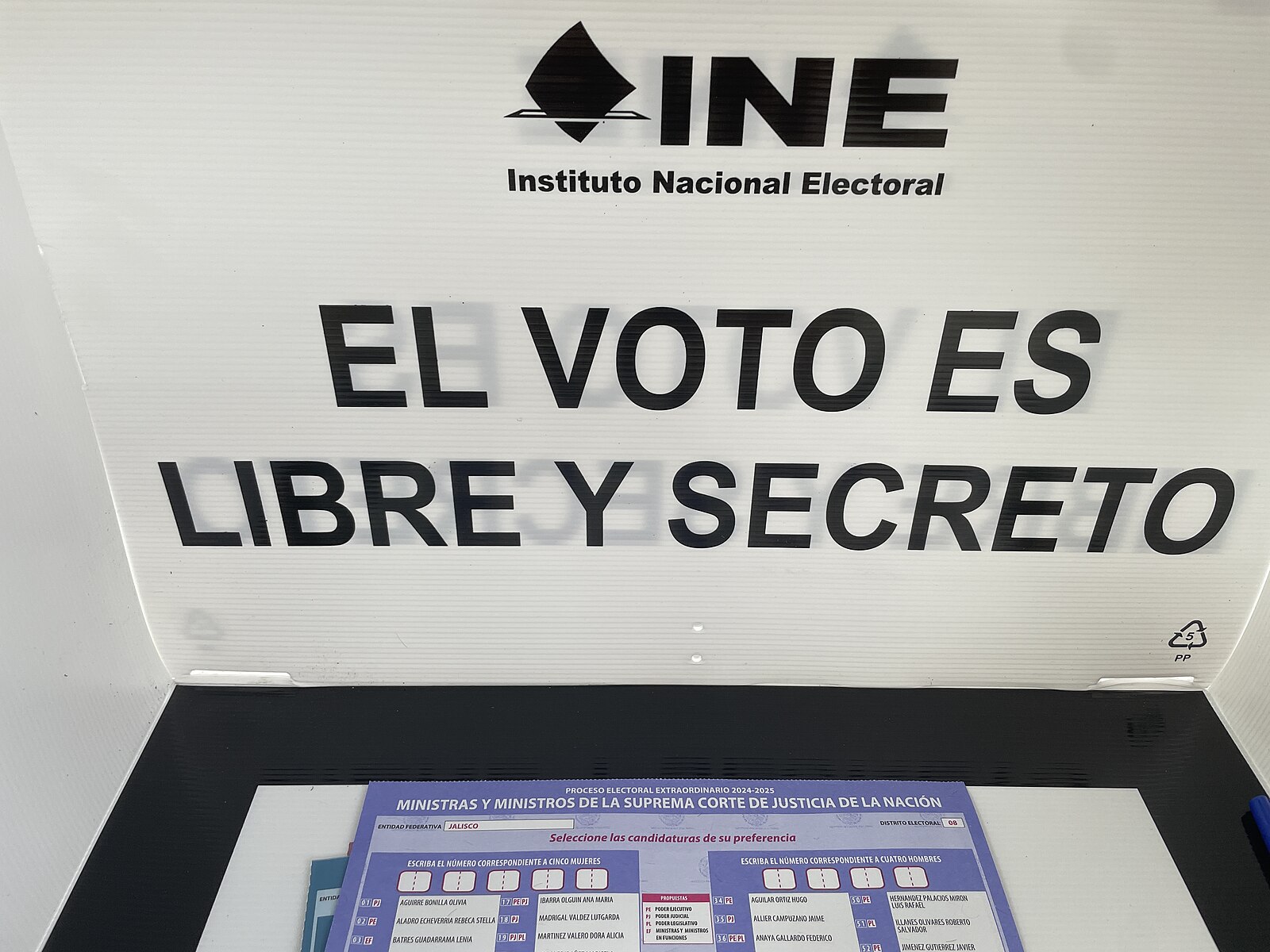
Mexico held its first judicial election on Sunday 1 June 2025. Voters filled 881 federal posts, including all nine Supreme Court seats and the five seats on the Disciplinary Tribunal. States elected their own judges on the same day, taking the national total past 2,600 posts.
The National Electoral Institute, known as the INE, had about 99.9 million people on the electoral roll. Its quick count put turnout between 12.57 and 13.32 percent, or roughly 13 million voters. Mexican presidential elections normally draw well over half the electorate.
Many of those who did vote rejected the ballot. In the Supreme Court race the INE classed about 10.8 percent of votes as null, according to Expansión. Counting unmarked ballots as well, around 23 percent of votes cast were not for any candidate. The Center for Strategic and International Studies, a Washington think tank, cites the same figure.
Ballots were long and the names mostly unfamiliar. In the final days, printed guides telling voters whom to choose spread widely on WhatsApp. Mexicans call such cheat sheets acordeones. The INE received complaints about them, but the electoral court struck down the resulting sanctions in October 2025, so nobody was ultimately punished.
Candidate quality also became an issue. CSIS noted that a former lawyer for the drug trafficker Joaquín “El Chapo” Guzmán won a judgeship in Ciudad Juárez. Supporters of the reform replied that the old appointment system had its own record of nepotism and corruption.
Who sits on the new Supreme Court
The nine elected justices took office on 1 September 2025, the day after the old court was dissolved. Five are women and four are men. Three of them, Lenia Batres Guadarrama, Yasmín Esquivel Mossa and Loretta Ortiz Ahlf, already sat on the previous court.
The other six are Hugo Aguilar Ortiz, María Estela Ríos González, Sara Irene Herrerías Guerra, Giovanni Azael Figueroa Mejía, Irving Espinosa Betanzo and Arístides Rodrigo Guerrero García. El País described all nine, before they took office, as having marked closeness to Morena.
Hugo Aguilar Ortiz won the most votes of the 64 candidates and became the court’s president. He is a Mixtec lawyer from Oaxaca, born in 1973. He had coordinated indigenous rights at the National Institute of Indigenous Peoples since 2018, and his presidency runs to September 2027.
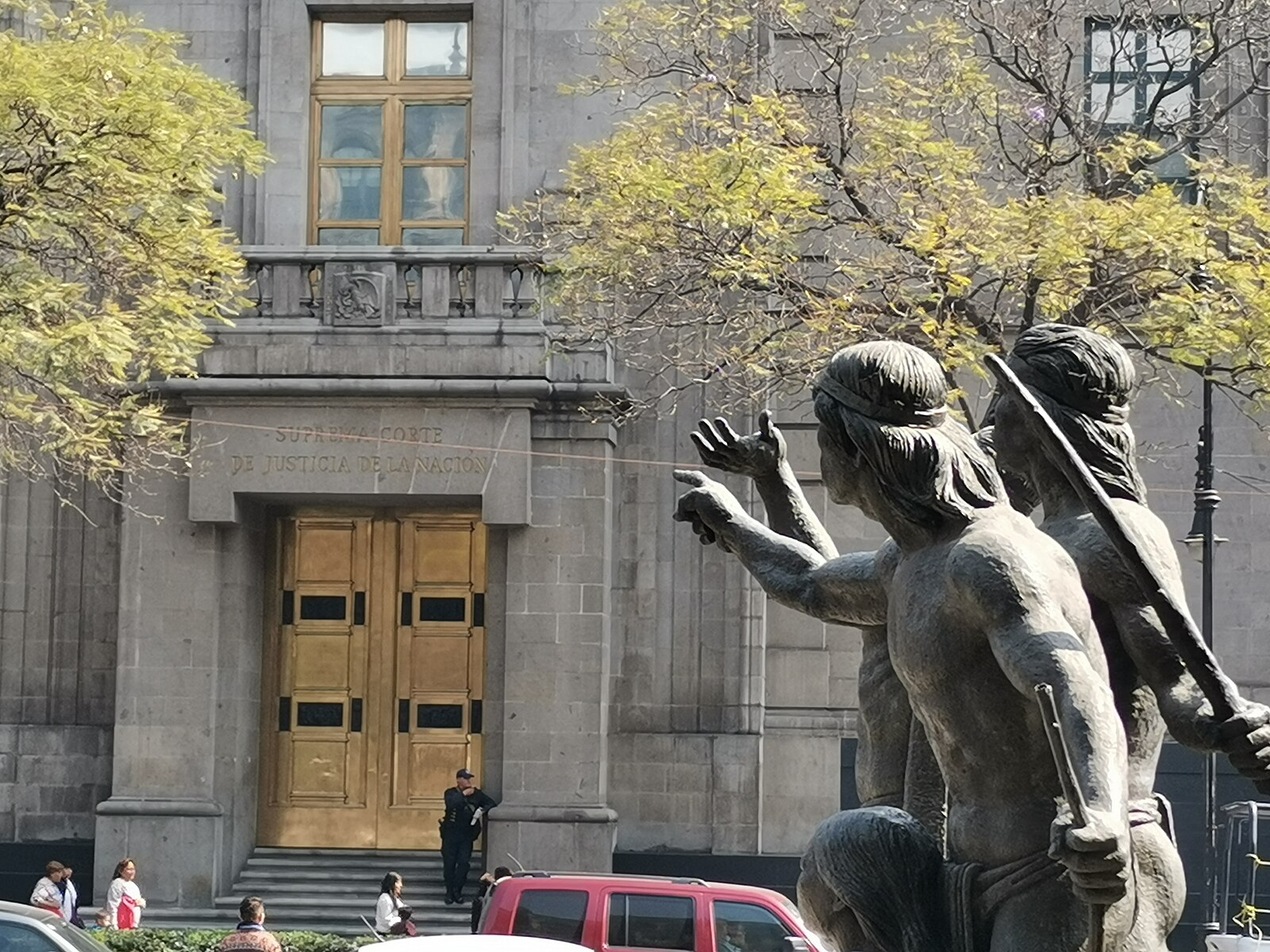
The court’s first year gave investors an early signal on tax. On 13 November 2025 it unanimously threw out Grupo Elektra’s appeal against a tax bill of 33.3 billion pesos (about US$1.85 billion). The retailer belongs to Ricardo Salinas Pliego’s Grupo Salinas, which had failed to have Justice Lenia Batres removed from the case.
In January 2026 Grupo Salinas agreed to pay the tax authority 32.1 billion pesos (about US$1.78 billion) in instalments, ending two decades of litigation.
Peso amounts in this guide use a rate of 18.02 pesos to the US dollar on 30 September 2026.
The amparo law and the 2026 amendment
The amparo is the lawsuit Mexicans and companies use to challenge government acts. A suspension within it can freeze a tax demand, a permit decision or an account freeze while the case runs. For businesses it is the main shield against the state.
Congress rewrote the Amparo Law in October 2025. The amendment was published on 16 October and took effect the next day. Plaintiffs must now show a real, current and differentiated injury. Suspensions of final tax bills require a deposit or letter of credit, and provisional suspensions are barred for operations possibly linked to money laundering.
Then the government adjusted the reform itself. President Claudia Sheinbaum sent a new constitutional amendment to Congress on 20 May 2026. Both chambers passed it in an extraordinary session in the last week of May. It was published on 2 June 2026 and took effect the following day.
The second judicial election, due in 2027, moves to the first Sunday of June 2028, together with state judicial votes. Evaluation committees will shortlist four candidates per post instead of ten, cut to two by public draw. Judges elected in 2028 serve eight years, and the Supreme Court may again sit in two chambers.
Sheinbaum presented the change as a scheduling adjustment, to keep the judicial vote apart from the June 2027 midterm elections. ConstitutionNet, a constitutional research platform, argues the shorter lists also respond to the problems seen in 2025. The vote exposed divisions inside Morena, with 22 of its deputies abstaining over a late clause on electoral judges. It passed the lower house by 322 votes to 132.
Winners, losers and the argument
Supporters make a democratic case. López Obrador and Sheinbaum argue that an unelected bench protected the powerful and blocked reforms voted by Congress. An elected judiciary, they say, answers to citizens rather than to a closed professional caste.
Critics make an independence case. The United States ambassador at the time, Ken Salazar, called the reform a major risk to Mexico’s democracy. The United Nations special rapporteur on judicial independence, Margaret Satterthwaite, warned it could undermine that independence.
The clearest winner is the governing movement, whose preferred candidates dominated the ballot. The clearest losers are the career judges and clerks who lost their posts or chose not to run. Litigants sit in between: their cases continue, but before new judges still learning the job.
The Disciplinary Tribunal is the part lawyers watch most closely. Its five members are elected for six years and can sanction, suspend or remove judges. Its decisions cannot be appealed, so a judge ruling against the state in a sensitive case works under that shadow.
What it means for investors and the USMCA
Foreign investors voted with their research notes before the reform passed. Morgan Stanley cut Mexico to underweight in August 2024, citing it. CSIS reported that foreign firms were holding back about US$35 billion of projects in September 2024.
The legal exposure is practical. Arbitration awards still have to be enforced through Mexican courts, as CSIS points out. Tax disputes, permits and labour claims all end before domestic judges, and the new amparo rules make it harder to pause a government demand while contesting it.
The trade link runs through the USMCA, the free-trade agreement between the United States, Mexico and Canada. At the joint review on 1 July 2026, Washington declined to extend it. That triggers annual reviews, and Washington has not publicly tied an extension to Mexico’s courts.
Lawyers are adapting contracts rather than leaving. Law firms such as Jones Day advise structuring investments through countries that have investment treaties with Mexico. That can open the door to international arbitration, though enforcing an award against Mexican assets still runs through local courts.
Former justices remain openly sceptical. Javier Laynez, who sat on the dissolved court, spoke at a Mexico City law forum on 3 September 2026. He warned of up to ten years of legal uncertainty, Infobae reported. For a company signing a 15-year supply contract, that horizon matters.
What to watch
The next USMCA annual review falls on 1 July 2027. Any sign that Washington or Ottawa links extension to judicial independence would turn a domestic reform into a trade issue.
The June 2027 midterm elections will show whether Morena keeps the two-thirds majority that allows it to amend the constitution alone. Without it, further changes to the judiciary would need opposition votes.
Aguilar’s presidency of the court ends in September 2027. The rotation rule points to Lenia Batres, the second most-voted justice. But an unamended article still describes a four-year president chosen by the justices, so the succession is disputed.
Then comes the second judicial election, set for Sunday 4 June 2028. Turnout and the shorter candidate lists will show whether the 2026 fixes worked.
Finally, watch the court’s big-ticket rulings on tax, energy and concessions. They are the best available evidence of how an elected bench treats the state when the state is a party.
Connected Coverage
Mexico Elects 881 Federal Judges as USMCA Investors Watch Rule of Law Shift
Mexico Judicial Reform: Norma Piña Reappears With a Pointed Joke
Who Is Claudia Sheinbaum? Mexico’s President Explained: Her Path, Her Policies and What to Watch
Mexico Nearshoring Explained: Record FDI, the USMCA Review and What Could Stop It
Sheinbaum Faces USMCA Tariff Threat as Mexico New Investment Plunges 13 Percent
Sources: The reform decrees from the Diario Oficial de la Federación, election data from the Instituto Nacional Electoral, the Supreme Court’s own records, and analysis from CSIS, ConstitutionNet and law firms advising on the reforms, all accessed 23 September 2026.
- Mexico Business News — judicial reform published in the Diario Oficial, 15 September 2024
- Garrigues — the 2 June 2026 constitutional amendment and the 2028 election
- Garrigues — Amparo Law amendment published 16 October 2025
- INE quick count via La Razón — turnout of 12.57 to 13.32 percent
- Expansión — null and unmarked votes in the Supreme Court race
- CSIS — effects of the judicial reform on foreign investment and the USMCA
- ConstitutionNet — Bargaining Among Partners: Mexico’s 2026 Constitutional Reforms
- Suprema Corte de Justicia de la Nación — composition and presidency
What Is Not Known
How the elected courts rule in ordinary commercial cases. There is no published, docket-wide comparison of rulings before and after September 2025. The Grupo Elektra decision is a single high-profile tax case, not a pattern.
How the Disciplinary Tribunal uses its power. Its authority to remove judges without appeal is clear on paper. How often it acts, and against whom, will only emerge over years.
Whether the USMCA partners press the issue. Neither the United States nor Canada has made judicial independence a published condition of extending the agreement. Whether that changes before the 2027 review is open.
Whether turnout rises in 2028. The shorter lists are meant to make ballots manageable, but no one can yet say whether they will bring more voters out or reduce the role of printed guides.
More: Mexico news in English, every day from The Rio Times.
Frequently Asked Questions
What is the Mexico judicial reform?
It is a constitutional amendment published on 15 September 2024. It makes federal judges, magistrates and Supreme Court justices stand for popular election, cuts the Supreme Court from 11 to nine members, and creates an elected Judicial Disciplinary Tribunal.
What was the turnout in Mexico’s judicial election?
About 13 percent. The electoral institute’s quick count put turnout between 12.57 and 13.32 percent of nearly 100 million registered voters in the election of 1 June 2025, which filled 881 federal posts.
Who is the president of Mexico’s Supreme Court?
Hugo Aguilar Ortiz, a Mixtec lawyer from Oaxaca who won the most votes in the 2025 election. He took office on 1 September 2025, and his presidency runs to September 2027 under the two-year rotation rule.
When is Mexico’s next judicial election?
On the first Sunday of June 2028. An amendment published on 2 June 2026 moved it from 2027 and merged it with state judicial elections. Shortlists fall to four candidates per post, cut to two by public draw.
Does the judicial reform affect foreign investors?
Yes, mainly through tax, permit, labour and contract disputes that end before Mexican judges. The 2025 Amparo Law changes also make it harder to suspend government demands. Law firms advise investors to structure holdings so that treaty protection and international arbitration remain available.
This article was produced by The Rio Times’ automated newsroom system. How we use AI · Report an error
In depth
Read More from The Rio Times