GUINEA · NEIGHBOURHOOD
Key Facts
- The country Guinea has 15.1 million people and a US$28.3 billion economy (2025 figures) on the Atlantic coast of West Africa.
- Land neighbours Senegal and Mali to the north, Côte d’Ivoire to the east, Liberia and Sierra Leone to the south, Guinea-Bissau to the west.
- Rivers The Niger, Senegal and Gambia rivers all start in Guinea and flow on into neighbouring countries.
- Bauxite Guinea mined an estimated 150 million tons of bauxite in 2025, about 34% of the world total and the largest national share.
- Railway The Simandou iron-ore line runs more than 600 km (373 miles) to a new Atlantic port, and the first shipment sailed in December 2025.
- Regional clubs ECOWAS, the 12-member West African bloc, and the four-nation Mano River Union, plus river-basin bodies for the Niger, Senegal and Gambia.
- US travel advice Level 1 for Senegal, Level 2 for Guinea, Level 4 for Mali, as of October 2026.

Guinea is a West African country of 15.1 million people that shares land borders with six neighbours: Senegal, Mali, Côte d’Ivoire, Liberia, Sierra Leone and Guinea-Bissau. It is also the starting point of the Niger, Senegal and Gambia rivers, the world’s largest bauxite producer, and the owner of a new railway of more than 600 km (373 miles) that carries iron ore to the Atlantic, as of October 2026.
Guinea in Plain English
Guinea, officially the Republic of Guinea and sometimes called Guinea-Conakry after its capital to tell it apart from Guinea-Bissau and Equatorial Guinea, covers 245,857 square kilometres (about 94,900 square miles) of Atlantic coast, plateaus and mountains. The government says it stretches 800 km (497 miles) from east to west and 500 km (311 miles) from north to south, with 333 km (207 miles) of coastline.
The government divides the country into four natural regions: Lower Guinea on the coast, Middle Guinea with its mountain massifs, Upper Guinea with plateaus and wooded savanna, and the Forest Region with mountains of its own. Rainfall is heaviest on the coast, at 3,000 to 4,000 millimetres (118 to 157 inches) a year, and lightest in Upper Guinea, at 1,000 to 1,500 millimetres (39 to 59 inches).
As of October 2026 the latest World Bank figures, for 2025, count 15.1 million people in Guinea and an economy of US$28.3 billion, about US$1,900 per person. Real growth was 7.45% in 2025, and the International Monetary Fund (IMF), the global lender that supports governments with loans and advice, projects 8.7% for 2026.
The country has a long history of its own, and the Rio Times Guinea explainer covers its politics, bauxite and Simandou iron ore. This guide looks outward instead, at the neighbours, rivers, railways, borders and regional clubs that tie Guinea to the rest of West Africa, and it follows the wider Rio Times Africa coverage.
Six Land Neighbours
Senegal and Mali lie to the north of Guinea, and Guinea’s rivers run into both of them. Senegal, covered in a separate Rio Times guide, has 18.9 million people and a US$37.0 billion economy, and Mali has 25.2 million people and a US$30.1 billion economy, in World Bank data for 2025.
Mali is landlocked, and its head of state, Assimi Goïta, carries the title President of the Transition on the presidency’s website. It shares the Niger and Senegal river basins with Guinea and belongs to the two bodies that manage them, the Niger Basin Authority and the Organisation for the Development of the Senegal River.
Côte d’Ivoire, to the east and covered in its own Rio Times guide, is the giant of the neighbourhood, with 32.7 million people and a US$99.8 billion economy that is about 3.5 times the size of Guinea’s. Its foreign minister at that date, Nialé Kaba, represented the country as a witness at the border summit held in Conakry on 16 March 2026.
Liberia and Sierra Leone lie to the south and are much smaller, with 5.7 million and 8.8 million people and economies of US$5.2 billion and US$7.5 billion. Their presidents, Joseph Boakai and Julius Maada Bio, both attended the same border summit, and the Rio Times has separate guides to Liberia and Sierra Leone.
Guinea-Bissau, to the west, is the smallest neighbour, with 2.2 million people and a US$2.5 billion economy. Its prime minister at that date, Ilídio Vieira Té, was received in Conakry on 22 April 2026 and said that his country wanted to draw on Guinea’s experience of managing natural resources, including the Simandou project.
Together the six neighbours have about 93.6 million people and a combined economy of about US$182 billion. That is more than six times Guinea’s population and more than six times its output, as of October 2026.
Rivers That Start in Guinea
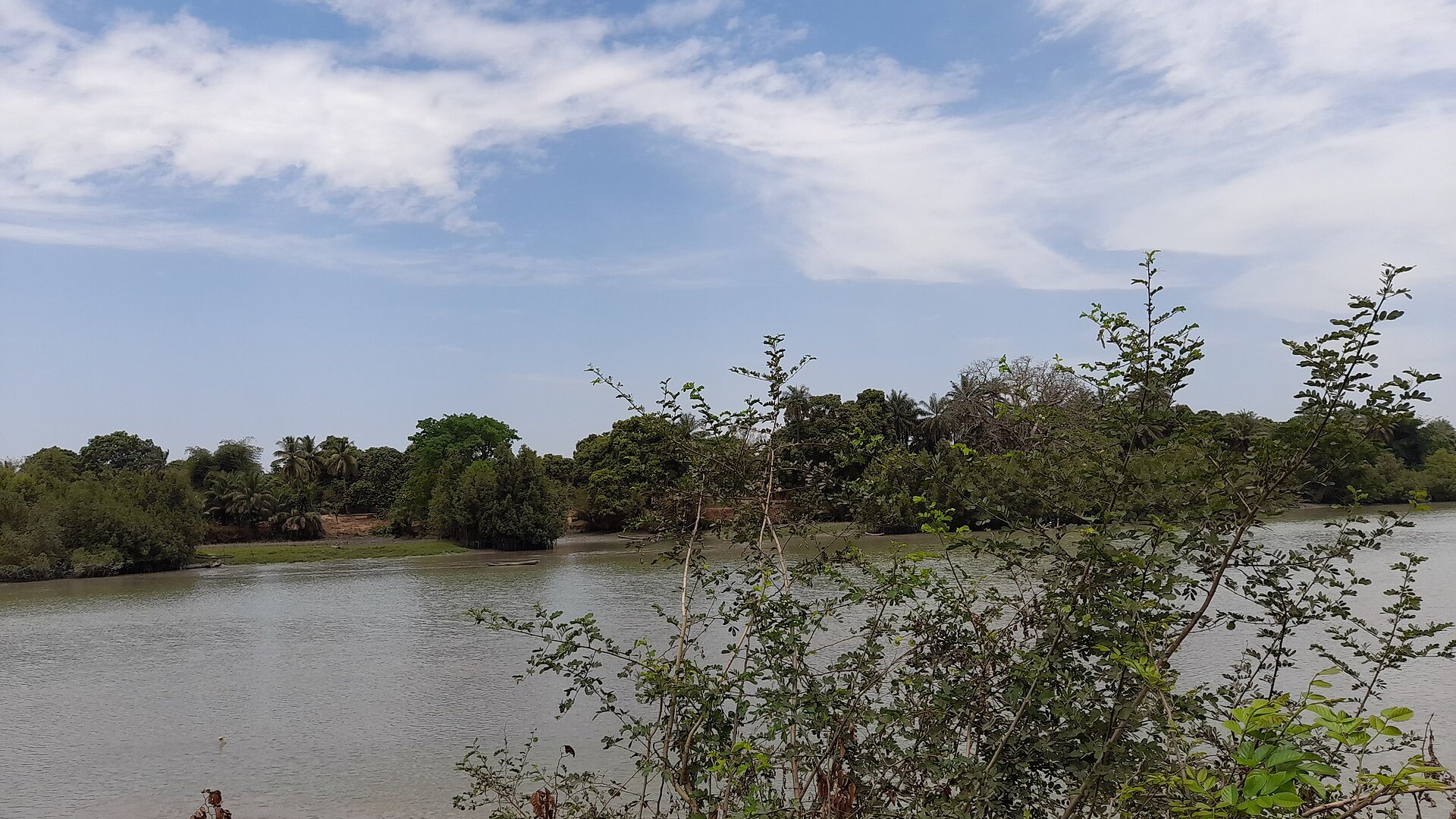
The Guinean government says its territory gives birth to the main rivers of the sub-region: the Senegal, the Niger, the Gambia, the Konkouré, the Kolenté and the Lofa. A country that holds a river’s headwaters, the place where it starts, is called upstream, and what happens to the water there matters to every country downstream.
The Senegal River is 1,790 km (1,112 miles) long and begins where two streams meet, the Bafing, which comes down from the Fouta Djallon highlands at 800 metres (2,625 feet), and the Bakoye. The Organisation for the Development of the Senegal River, known by its French initials OMVS, was founded on 11 March 1972 by Mali, Mauritania and Senegal, and Guinea joined in 2006.
A sister body, the Gambia River Development Organisation (OMVG), brings together The Gambia, Guinea-Bissau, Guinea and Senegal for the Gambia, Kayanga-Geba and Koliba-Corubal basins. The Niger Basin Authority has nine members, Benin, Burkina Faso, Cameroon, Côte d’Ivoire, Guinea, Mali, Niger, Nigeria and Chad, and it replaced an older Niger River Commission on 21 November 1980.
Simandou, Bauxite and the Trade Routes
Simandou is a mountain range in south-eastern Guinea whose iron ore is now moving to market on a new railway of more than 600 km (373 miles) that ends at a port in Forécariah prefecture on the coast. Rio Tinto, the mining company that holds blocks 3 and 4 through its Rio Tinto SimFer venture, calls it Africa’s largest mining and related infrastructure project.
The railway company, La Compagnie du TransGuinéen (CTG), was set up in March 2022 and is owned 42.5% by Rio Tinto SimFer, 42.5% by Winning Consortium Simandou (the developer of blocks 1 and 2) and 15% by the Guinean government. The first shipment of Simandou ore left Guinea in December 2025, and Rio Tinto expects a ramp-up of about 30 months to 60 million tonnes a year at its own mine once the shared rail and port facilities are commissioned.
In October 2026 the head of state, Mamadi Doumbouya, made the inaugural trip on the CTG passenger train, 148 km (92 miles) from the port city of Morébaya to Kassa in Mamou prefecture, as the presidency reports. The route passes through an 11.6 km (7.2 mile) tunnel that the presidency presents as the longest rail tunnel in West Africa.
Guinea mined an estimated 150 million metric tons of bauxite, the ore of aluminium, in 2025, which is 34% of the world’s 440 million tons, in the 2026 summary of the US Geological Survey, the federal agency that tracks minerals. The same table gives Guinea 7.4 billion of the world’s 29 billion tons of reserves, about 26%, so it leads the world in both output and reserves, as of October 2026.
The summary names Jamaica, Turkey, Guyana and Australia as the main sources of US bauxite imports from 2021 to 2024, and Guinea is not among them. It also records that in August 2025 the Guinean government revoked the bauxite licences of a subsidiary of an aluminium producer based in the United Arab Emirates after a dispute over a refinery, and reallocated the concessions to a state-backed company.
Guinea’s own sums for the project are covered in the Rio Times report on Simandou revenue plans, and the railway and port are followed in earlier coverage of the line and the report on the Morébaya port. Those reports track a fast-moving project, so the figures in this guide are the ones dated as of October 2026.
People, Money and Migration
The World Bank’s 2024 migrant counts show how differently the neighbours attract people from abroad: 2.9 million international migrants lived in Côte d’Ivoire, 545,000 in Mali, 282,000 in Senegal and 117,000 in Guinea. Liberia (72,000), Sierra Leone (50,000) and Guinea-Bissau (15,000) hosted far fewer, and the counts cover migrants of every origin, not only Guineans.
Guinea itself hosted about 2,150 refugees at the end of 2025, of whom 1,650 came from Sierra Leone and 289 from Liberia, in the figures of the UN refugee agency (UNHCR). Far more Guineans are abroad as refugees or asylum seekers, with UNHCR counting 47,692 refugees and 56,626 asylum seekers from Guinea worldwide.
France hosts the most Guinean refugees and asylum seekers, 39,004 at the end of 2025, followed by the United States with 19,420, of whom 17,586 are asylum seekers with claims still open. Germany has 11,104 and Canada 5,701.
Money sent home by workers abroad reached US$616 million in Guinea in 2024, about 2.5% of its economy, while Liberia received US$1.02 billion, about 21% of its economy. Côte d’Ivoire received US$1.77 billion and Mali US$1.07 billion that year, in World Bank estimates.
Trade weighs more in Guinea’s economy than in any of the five neighbours with a 2025 figure: exports of goods and services were 41.4% of output, against 32.5% in Senegal, 29.8% in Côte d’Ivoire, 22.1% in Mali, 20.9% in Sierra Leone and 13.9% in Guinea-Bissau. The share matters because a country that earns so much from selling abroad depends on open ports, rails and borders.
Borders and the Mano River Union
Guinea’s land borders with Sierra Leone and Liberia have seen friction, and the heads of state of the three countries met in Conakry on 16 March 2026 to calm it, with Côte d’Ivoire as a witness. The Guinean presidency says they pledged to settle border disputes peacefully under Article 33 of the United Nations Charter, to step up joint patrols and intelligence sharing, and to set up fast communication links between local authorities.
The leaders also told technical services to meet quickly and continue the work of clarifying and marking the land and maritime borders, and agreed to call a summit of the Mano River Union within a month. The statement stressed dialogue, international law and existing regional mechanisms rather than force.
The Mano River Union was created in 1973 by Liberia and Sierra Leone, Guinea joined in 1980, the Union was revived in 2004 after the civil wars in Liberia and Sierra Leone, and Côte d’Ivoire joined in 2008. Its secretariat is in Freetown, and its Secretary-General, Ambassador Simeon Moribah, marked the 53rd anniversary on 3 October 2026 with a call to move “from aspiration to implementation”.
Border mountains are shared too: Mount Nimba Strict Nature Reserve covers 17,540 hectares (about 43,300 acres), of which 12,540 are in Guinea and 5,000 in Côte d’Ivoire, according to UNESCO, the UN culture agency. UNESCO adds that the Liberian part of the massif is greatly degraded by former mining and is not part of the protected property.
ECOWAS, the Sahel Alliance and Politics
The Economic Community of West African States (ECOWAS), the regional bloc working for integration since 1975 with its headquarters in Abuja, Nigeria, lists 12 member states as of October 2026, after Burkina Faso, Mali and Niger left on 29 January 2025. Guinea is on the member list, and President Doumbouya took part in the bloc’s 69th ordinary summit in Freetown, the capital of Sierra Leone, on 19 July 2026.
Burkina Faso, Mali and Niger now act together as the Alliance of Sahel States (AES, from its French name), and ECOWAS appointed a chief negotiator for talks with them on 23 March 2026, Lansana Kouyaté, a former prime minister of Guinea. On 29 January 2025 the bloc had announced that, until further notice, citizens of the three states would keep visa-free movement and residence rights in its member countries.
Guinea held a presidential election in December 2025, and ECOWAS sent a mission of 40 election experts to the legislative and local elections scheduled for 31 May 2026, which were to choose 147 members of parliament and 342 mayors. In October 2026 the presidency received foreign parliamentarians who had attended the opening session of the new tenth legislature.
Guinea has also pledged a motorised company to the ECOWAS Standby Force, the bloc’s on-call peacekeeping unit, and a team carried out a readiness inspection of it, in Conakry and at its base in Kindia, from 6 to 12 July 2026. The ECOWAS website lists Senegal’s President Bassirou Diomaye Faye as Chair of the Authority of Heads of State and Government as of October 2026.
In Plain English
ECOWAS is the 12-nation West African bloc, the Mano River Union is a four-nation group, and the Alliance of Sahel States is the three-nation group of Burkina Faso, Mali and Niger. OMVS, OMVG and the Niger Basin Authority are the river-basin bodies for the Senegal, Gambia and Niger rivers.
CTG is the railway company that moves Simandou ore, and Rio Tinto SimFer and Winning Consortium Simandou are the two mining groups that share the iron-ore blocks. UNHCR is the UN refugee agency, and the World Bank and the IMF are the lenders whose data this guide uses.
What It Means for US Readers
As of October 2026 the US State Department rates Guinea Level 2, Exercise Increased Caution, in an advisory dated 25 February 2026 that cites crime, unrest and weak health infrastructure. It also bars US government employees in Guinea from travelling between cities at night.
Its neighbours range from Level 1, Exercise Normal Precautions, for Senegal (1 December 2025) to Level 4, Do Not Travel, for Mali (8 June 2026), with Côte d’Ivoire at Level 2 (18 February 2026), Liberia at Level 2 (11 December 2025), Sierra Leone at Level 2 (15 September 2025) and Guinea-Bissau at Level 3, Reconsider Travel (11 December 2025). The advisory for Guinea-Bissau adds that there is no US embassy or consulate there.
A presidential proclamation signed on 16 December 2025 and in force since 1 January 2026 fully suspends entry into the United States for nationals of Mali and Sierra Leone, and suspends immigrant visas and tourist, business, student and exchange visas for nationals of Côte d’Ivoire and Senegal. Guinea, Guinea-Bissau and Liberia are not named in it, and the Rio Times explainer on Mali shows how the rule works in practice.
For US businesses and investors, the main Guinean links are bauxite, where Guinea supplied an estimated 34% of world output in 2025, and the Simandou iron-ore railway and port. For Guineans in the United States, the figure to know is 19,420, the number of Guinean refugees and asylum seekers that UNHCR counted in the country at the end of 2025.
What Is Not Known
It is not known when the technical teams will finish marking the borders between Guinea, Sierra Leone and Liberia, because the presidency statement of 16 March 2026 set no deadline. The Mano River Union summit that the three presidents agreed to call within a month also has no date in that statement.
It is not known how fast Simandou exports will rise, because Rio Tinto’s ramp-up of about 30 months to 60 million tonnes a year at its own mine starts only once the rail and port facilities are commissioned. The company’s project page names no date for that step.
It is also not known how the talks between ECOWAS and the three Sahel states will end, or how long visa-free movement for their citizens will last. The US entry lists are reviewed every 180 days, so the limits on Mali, Sierra Leone, Côte d’Ivoire and Senegal could change.
Frequently Asked Questions
Which countries border Guinea?
Guinea borders six countries: Senegal and Mali to the north, Côte d’Ivoire to the east, Liberia and Sierra Leone to the south, and Guinea-Bissau to the west. Its Atlantic coastline is 333 km (207 miles) long.
Which rivers start in Guinea?
The Guinean government says the Senegal, Niger, Gambia, Konkouré, Kolenté and Lofa rivers all start in its territory. The Senegal River, one of them, is 1,790 km (1,112 miles) long.
Is it safe for Americans to travel to Guinea?
The US State Department rates Guinea Level 2, Exercise Increased Caution, in its advisory of 25 February 2026, citing crime, unrest and weak health infrastructure. Neighbouring Mali is Level 4, Do Not Travel, as of October 2026.
What is Simandou?
Simandou is an iron-ore mountain range in south-eastern Guinea and the name of the mining and railway project built around it. Rio Tinto calls it Africa’s largest mining and related infrastructure project.
Is Guinea in ECOWAS?
Guinea is on the member list of the Economic Community of West African States (ECOWAS), whose website shows 12 members as of October 2026. Mali, Burkina Faso and Niger left on 29 January 2025.
How many people live in Guinea and its neighbours?
Guinea had 15.1 million people in 2025 and its six neighbours about 93.6 million, in World Bank data. Côte d’Ivoire is the largest neighbour, with 32.7 million.
Sources: World Bank indicators for Guinea and its neighbours, population, GDP, trade and remittances, 2023 to 2025; Guinean government, country presentation; Guinean presidency, border summit, 16 March 2026; Guinean presidency, passenger train, 12 October 2026; Guinean presidency, Guinea-Bissau prime minister, 22 April 2026; Guinean presidency, ECOWAS summit, 19 July 2026; Senegal River Development Organisation, history; Gambia River Development Organisation; Niger Basin Authority, history and members; Rio Tinto, Simandou project page; US Geological Survey, Mineral Commodity Summaries 2026, bauxite and alumina; UNHCR population statistics, end of 2025; UNESCO World Heritage Centre, Mount Nimba; International Monetary Fund, Guinea country page; Mano River Union, history; Mano River Union, 53rd anniversary, 7 October 2026; ECOWAS, member states; ECOWAS, withdrawal of three states, 30 January 2025; ECOWAS, chief negotiator, March 2026; ECOWAS, election mission to Guinea, 30 May 2026; ECOWAS, Standby Force inspection, July 2026; ECOWAS, home page, 30 October 2026; Executive Mansion of Liberia; Presidency of Mali; White House, proclamation of 16 December 2025; US State Department, travel advisory feed.
This article was produced by The Rio Times’ automated newsroom system. How we use AI · Report an error · Editorial responsibility: Matthias Camenzind, Editor-in-Chief
Critical Minerals in Africa
- Africa’s Critical Minerals 2026: Who Holds What and Why
- DR Congo Explained 2026, Its War, Cobalt and Politics
- Zambia Explained: The Country, Its Copper Economy, Its Politics and What to Watch
- The Lobito Corridor: A New Railway for African Copper