
INFRASTRUCTURE · GUINEA
Key Facts
- —The country Guinea, a West African state led by President Mamadi Doumbouya, holds Simandou, which Rio Tinto calls Africa’s largest mining and related infrastructure project.
- —Why it matters The TransGuinéen railway carries Simandou iron ore to the Atlantic coast, adding a large new source of high-grade ore to world steel markets.
- —Why now On Monday 12 October Doumbouya rode the Simandou train and said a new tunnel near Kindia was in service.
- —What happened He crossed a double-track tunnel of nearly 12 km, which he said was designed, built and commissioned in under three years.
- —The numbers Doumbouya cites a double-track corridor of over 650 km and over 1,300 km of rails; Rio Tinto describes about 600 km of rail.
- —What it means for US readers US locomotive maker Wabtec signed a US$277 million contract for the line in 2024, and Rio Tinto shares trade in New York.
- —Still open No timetable, fares or start date for regular passenger services were announced, and no tunnel cost was given.
Guinea’s President Mamadi Doumbouya rode the Simandou train through a new tunnel of nearly 12 km near Kindia on Monday. The line carries Simandou iron ore to the Atlantic coast, which matters to world steel markets, investors and US equipment suppliers.
He announced the trip on Facebook on Monday 12 October, travelling with the Simandou Strategic Committee and senior officials. Three Guinean news sites, Guineenews, Mediaguinee and Ledjely, reported the post that afternoon.
A Tunnel Built in Under Three Years
Doumbouya wrote that the double-track tunnel was designed, built and commissioned on Guinean soil in under three years. He gave no construction cost and named no contractor in the post.
He said the tunnel sits on a double-track corridor longer than 650 km, equal to more than 1,300 km of rails. Rio Tinto, the Anglo-Australian miner that co-owns the line, describes the rail infrastructure as about 600 km long.
In July 2024, then mines minister Bouna Sylla said the project had 205 bridges totalling 77 km and six tunnels totalling 27 km. By that count, the Kindia bore alone accounts for close to half of all tunnel length on the route.
Mediaguinee noted that the trip came 31 years after traffic stopped on the old Conakry-Kankan railway in 1995. The TransGuinéen is a separate, new corridor built mainly to move ore rather than passengers.
Iron Ore Is Already Moving to the Coast
Simandou started operations at a ceremony at the port in Forécariah prefecture on Tuesday 11 November 2025, according to Rio Tinto. The first shipment of ore left Guinea in December 2025, the company says.
Winning Consortium Simandou (WCS) develops blocks 1 and 2 of the deposit, while Rio Tinto SimFer holds blocks 3 and 4. SimFer ore runs on a spur to the main line and ships through the WCS port until SimFer’s own port is finished.
Rio Tinto expects a 30-month ramp-up to 60 million tonnes a year at SimFer once shared rail and port commissioning ends. Chinese groups Baowu and Chinalco also joined the November 2025 ceremony as project partners, the company said.
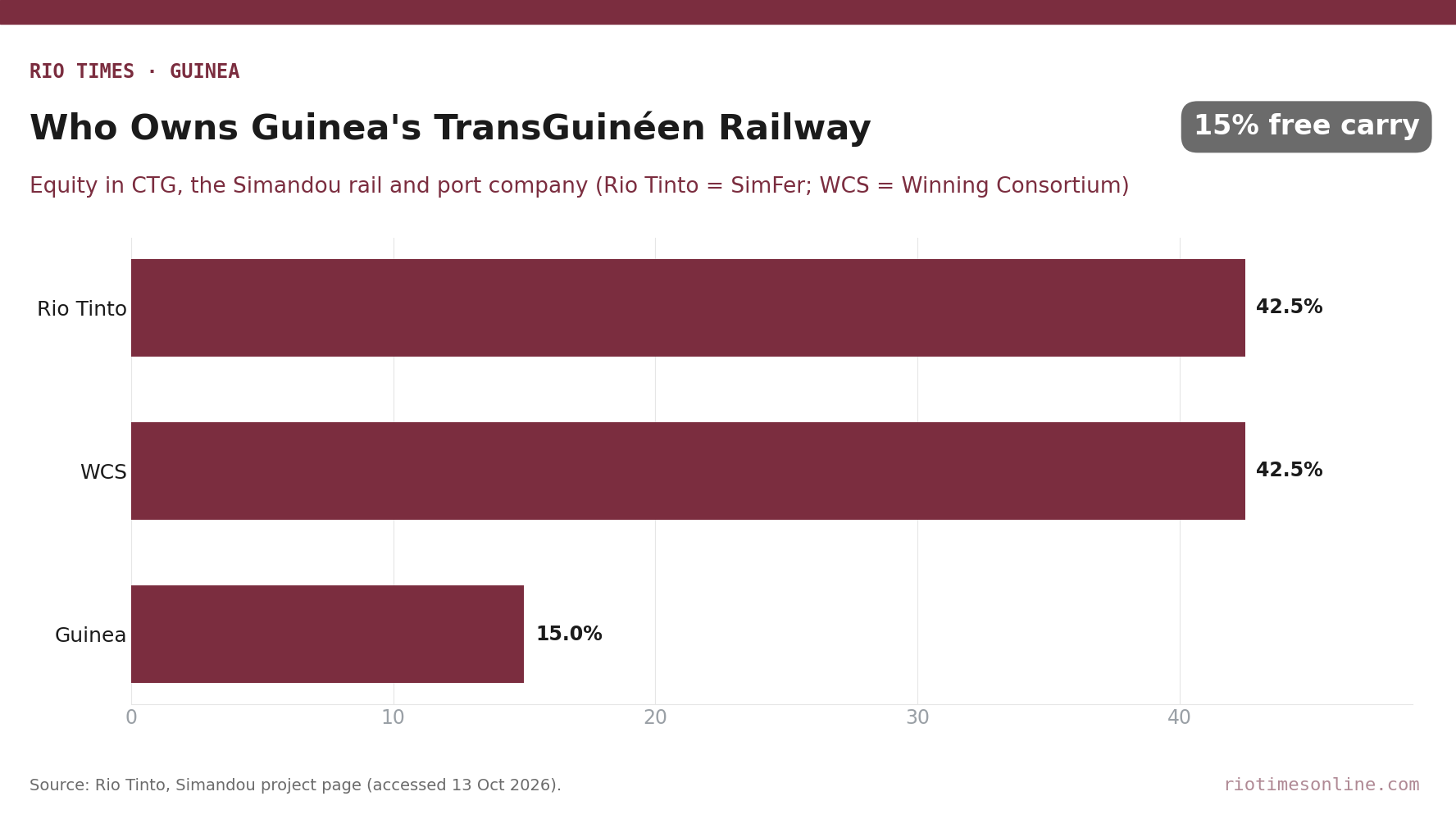
The rail and port operator, La Compagnie du TransGuinéen (CTG), was incorporated in March 2022. Rio Tinto SimFer and WCS each hold 42.5%, and the Guinean government holds a 15% free-carried stake.
Doumbouya Frames Simandou as Sovereignty
“Simandou is not only a mining project,” Doumbouya wrote, calling it an affirmation of Guinea’s economic sovereignty and a lever for change. “Our iron will serve Guineans first,” he added, citing jobs, local business, training and local processing.
He tied the line to Simandou 2040, the government’s long-term development programme, and to the Simandou Academy training initiative. He said order and discipline would remain the pillars of that programme.
He closed with a promise that “the train of the future is on the move” and that nothing would stop it. The steadying fact is that ore already moves on the line, so the tunnel extends a working system rather than starting one.
What It Means for US Readers
Simandou adds a large new source of high-grade iron ore to a seaborne market long led by Australia and Brazil. More supply could weigh on ore prices over time, which matters to holders of Rio Tinto’s New York-listed shares.
US industry is already inside the project, through the locomotives that haul the ore. On Tuesday 30 July 2024, Guinea and its partners signed a US$277 million locomotive contract with Pittsburgh-based Wabtec, Ledjely reported.
For background, see Guinea Has Started Switching On the Port That Simandou Was Built For. The maintenance side is covered in US Firm Wins US$700 Million-Plus Deal to Service Guinea’s Iron-Ore Trains.
For US steel buyers the effect is indirect, since American mills draw mainly on domestic ore and scrap. The wider point is that a major new West African supply chain now runs through Chinese and Western partners together.
What Is Not Known
Doumbouya did not say when a regular Simandou train service for passengers will start, what it will cost or where it stops. Guineenews noted that he gave no details on commercial operation or a timetable for the full corridor.
The gap between his 650 km figure and Rio Tinto’s 600 km description was not explained in the post. Neither the cost of the tunnel nor current monthly export volumes were published with the announcement.
Frequently Asked Questions
What did Guinea’s president announce on 12 October?
Mamadi Doumbouya said he rode a TransGuinéen passenger train and crossed a double-track tunnel of nearly 12 km near Kindia, which he said is now in service.
How long is the Kindia tunnel?
Doumbouya described it as a double-track tunnel of nearly 12 km, designed, built and commissioned in under three years.
Who owns the Simandou railway?
The operator, La Compagnie du TransGuinéen (CTG), is owned 42.5% by Rio Tinto SimFer, 42.5% by Winning Consortium Simandou and 15% by the Guinean government, according to Rio Tinto.
When did Simandou start exporting iron ore?
Rio Tinto says the first shipment of Simandou ore left Guinea in December 2025, after a start-of-operations ceremony on 11 November 2025.
Is there a US link to the Simandou train?
Yes. Guinea and its partners signed a US$277 million locomotive contract with US company Wabtec in July 2024, and Rio Tinto shares trade in New York.
Sources: Mediaguinee (full text of the president’s post, 12 Oct 2026); Guineenews (12 Oct 2026); Ledjely (12 Oct 2026); Rio Tinto, Simandou; Ledjely, Wabtec contract (31 Jul 2024).
This article was produced by The Rio Times’ automated newsroom system. How we use AI · Report an error · Editorial responsibility: Matthias Camenzind, Editor-in-Chief
Part of our ongoing coverage
Africa: The New Scramble — the great-power contest over the continent.