Guinea Has Started Switching On the Port That Simandou Was Built For
GUINEA · MINING
Key Facts
The step: SimFer has begun the progressive commissioning of key infrastructure at the Morebaya port, south of Conakry.
The timetable: The port was about 78% complete in March, with full commissioning expected in the first quarter of 2027.
Already moving: SimFer ore is currently railed to the main line and shipped through the Winning Consortium Simandou port to international customers.
The rail: The 70km SimFer rail spur reached full commissioning in the first quarter of 2026.
The scale: SimFer and Winning Consortium Simandou together plan to export up to 120 million tonnes of iron ore a year.
The context: Guinea’s Council of Ministers set five non-negotiable spending rules for the Simandou 2040 programme earlier this month.
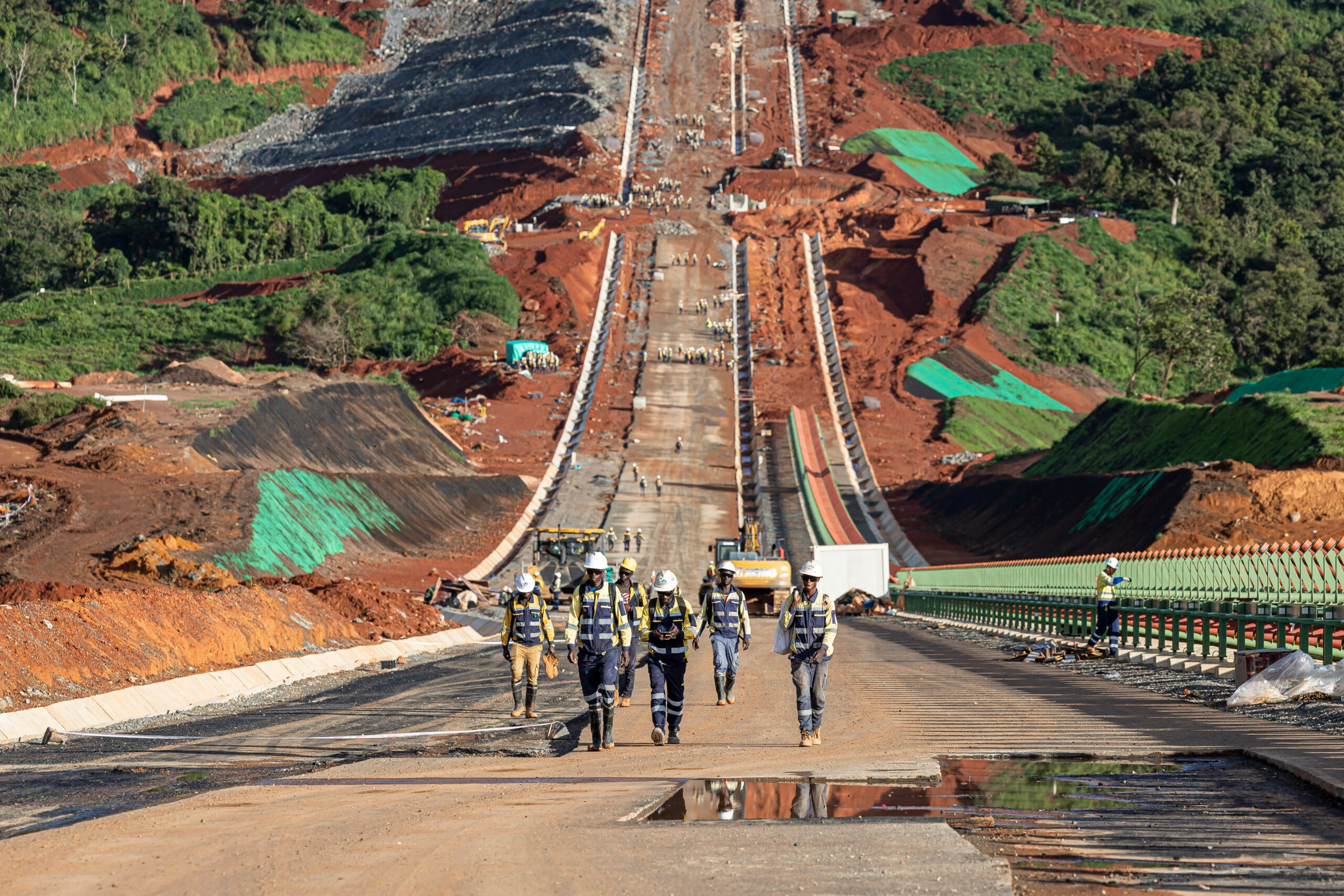
Guinea’s Morebaya port has begun progressive commissioning of key infrastructure, SimFer announced, bringing the last link of the Simandou iron ore chain into service. Full commissioning of the port is still expected in the first quarter of 2027.
What is being switched on at Guinea’s Morebaya port
Morebaya is the dedicated export terminal built for SimFer, which holds two of the four Simandou blocks. Rio Tinto owns 53% of the Jersey holding company and a Chinalco-led consortium 47%, with the Guinean state taking 15% of the Guinean operating company. It sits on the coast south of Conakry, at the end of a railway that crosses the country.
SimFer said this week that progressive commissioning of key infrastructure at the port has begun. That means individual systems are being energised and tested rather than the terminal opening for business.
Full commissioning is still expected in the first quarter of 2027. The port was about 85% complete at the end of June, up from 78% in March.
The ore is already leaving, by someone else’s berth
Simandou did not wait for Morebaya. SimFer ore is railed from the mine along its own 70km spur onto the main line, and then shipped through the port built by Winning Consortium Simandou, the Chinese-led consortium holding the other two blocks.
That spur reached mechanical completion in the first quarter of this year. The arrangement means one partner is currently exporting through a competitor’s infrastructure.
Once Morebaya is running, each side controls its own outlet. Together they intend to move up to 120 million tonnes a year.
Why 120 million tonnes matters to everyone else
Simandou holds some of the highest-grade undeveloped iron ore on earth, and at full rate it would be one of the largest new sources of seaborne supply in decades. That volume lands in a market dominated by Australia and Brazil.
For steelmakers, particularly Chinese ones, it is a second geography. For Rio Tinto’s competitors it is additional tonnage arriving whether prices are strong or not.
The project is also the clearest single example of Chinese and Western capital building the same asset in Africa side by side.
Guinea has tried to fix the terms in advance
The government’s Simandou 2040 programme now carries five requirements President Mamadi Doumbouya described as non-negotiable, set out at the Council of Ministers on 3 September. Only one is strictly about spending, governing how the state’s share of proceeds may be used. It is an attempt to avoid the pattern in which resource revenue arrives and disappears.
Guinea also banned raw gold exports earlier this year to force local refining. The instinct across the government is to capture more of the value chain at home.
Whether rules written before the money arrives survive contact with it is the open question. They usually have not, in West Africa or anywhere else.
The infrastructure is the real asset
The railway and the two ports were built for iron ore, but they cross a country with almost no other heavy transport. Guinea’s bauxite industry, its agriculture and its interior towns all sit near the same corridor.
Access terms for third parties have not been published. That single question will determine whether Simandou becomes a national asset or an enclave with a fence around it.
How Simandou was finally unlocked
The deposit was discovered in the 1990s and spent a quarter of a century in litigation, corruption investigations and ownership disputes. Rio Tinto wrote down its investment, a rival claim was cancelled, and the project stalled repeatedly.
What broke the deadlock was infrastructure sharing. The two consortia agreed to a co-developed railway and to run their operations through a single trans-Guinean corridor.
That co-development is why the mine is exporting now, and why one partner is temporarily using the other’s port.
Guinea’s take, and what it is worth
The Guinean state holds equity in the infrastructure and in the mining entities, alongside royalties and taxes. Its revenue therefore rises with volume rather than only with price.
At full rate the fiscal transfer would be transformative for a country whose budget is a fraction of the project’s capital cost. It would also make Guinea considerably more exposed to the iron ore price than it is today.
The corridor’s second life
A railway built for one commodity rarely stays that way. Guinea’s bauxite producers, its farmers and its interior towns all sit near the Simandou line.
Whether third parties can use it, and at what price, is not yet public. That single term will decide how much of the project’s value stays in Guinea.
What to watch next
The first marker is confirmation that Morebaya has loaded its own first vessel. The second is the ramp-up schedule towards the 120 million tonne figure.
The third is fiscal: how much of the state’s revenue actually flows through the Simandou 2040 rules, and how quickly.
For how the port fits into Guinea’s wider economy and politics, see our Guinea explainer.
Frequently Asked Questions
What is happening at Guinea’s Morebaya port?
SimFer has begun the progressive commissioning of key infrastructure at the port. Full commissioning is still expected in the first quarter of 2027.
Is Simandou already exporting?
Yes. SimFer ore is railed to the main line and shipped through the Winning Consortium Simandou port while its own terminal is completed.
How much will Simandou export?
SimFer and Winning Consortium Simandou together plan to move up to 120 million tonnes of iron ore a year.
Who owns SimFer?
It is a joint venture involving Rio Tinto, Chinalco and the Guinean state, holding two of the four Simandou blocks.
What are the Simandou 2040 rules?
Guinea’s Council of Ministers set five non-negotiable spending rules this month governing how proceeds from the programme may be used.
Connected Coverage
The spending rulebook is covered in Guinea’s iron-ore programme now has a spending rulebook, the wider minerals contest in Africa: The New Scramble, and the region’s other big export corridor in the Lobito corridor.
This article was produced by The Rio Times’ automated newsroom system. How we use AI · Report an error · Editorial responsibility: Matthias Camenzind, Editor-in-Chief
LatAm Markets: Live Signals → — real-time movers, turnover leaders and FX across Latin America.
Critical Minerals in Africa
- Africa’s Critical Minerals 2026: Who Holds What and Why
- DR Congo Explained 2026, Its War, Cobalt and Politics
- Zambia Explained: The Country, Its Copper Economy, Its Politics and What to Watch
- The Lobito Corridor: A New Railway for African Copper