Who Dominates Ecuador, Elites and Regions Explained
ECUADOR · WHO HOLDS POWER
Key Facts
- —Who rules President Daniel Noboa, re-elected in April 2025, governs with his ADN party (National Democratic Action) and a working majority in the 151-seat Assembly.
- —Money Banana, shrimp, oil, banking and retail families hold the wealth, and the port city of Guayaquil and the capital, Quito, compete for influence.
- —People Of 16,938,986 people in the 2022 census, 77.5% were mestizo, 7.7% Indigenous, 7.7% Montubio (coastal farm people) and 4.8% Afro-Ecuadorian.
- —Inequality Income poverty was 21.4% in December 2025 but 37.6% in rural areas; the richest tenth earned 17.5 times the poorest tenth.
- —Next test Voters elect mayors, prefects and councillors on Sunday 29 November 2026, while Luisa González, the opposition’s 2025 presidential candidate, sits in prison.
- —Power Index Ecuador ranks 8th of 14 in The Rio Times Latin America Power Index, with 38.2 points (October 2026 edition).
Ecuador power rests with a young president, his security forces and a close partnership with Washington. Old business families, three regions and an Indigenous movement pull the other way, and this guide explains who dominates whom in 2026.

The President and His Cabinet
Ecuador power starts at the Carondelet Palace in Quito, because the president appoints ministers and provincial governors and commands the armed forces. Daniel Noboa won a runoff on 13 April 2025 and serves until May 2029.
Noboa leads Acción Democrática Nacional (ADN, National Democratic Action), a pro-business party built around his name. He is the son of Álvaro Noboa, a banana magnate who ran for president five times.
In June 2026 Noboa cut his cabinet to 10 ministries, and the presidency lists all ten on its website in October 2026. Bernardo Cordovez, from the state social security institute, became minister of Economic and Productive Development, the top economy post, on 28 September 2026.
Ecuador power is personal in style, because the president sets the line on security, subsidies and foreign policy. Ministers carry it out and change often.
- ADN: Noboa’s governing party, pro-business and conservative, formed around his name.
- Revolución Ciudadana (RC, Citizen Revolution): the left-wing movement of former president Rafael Correa, the main opposition.
- Correísmo: the political camp around Correa, president from 2007 to 2017.
- CONAIE: the national confederation of Indigenous nationalities, the strongest street movement.
- Prefect: the elected head of a province, while a mayor runs a city or county.
The Assembly, the Courts and the Referees
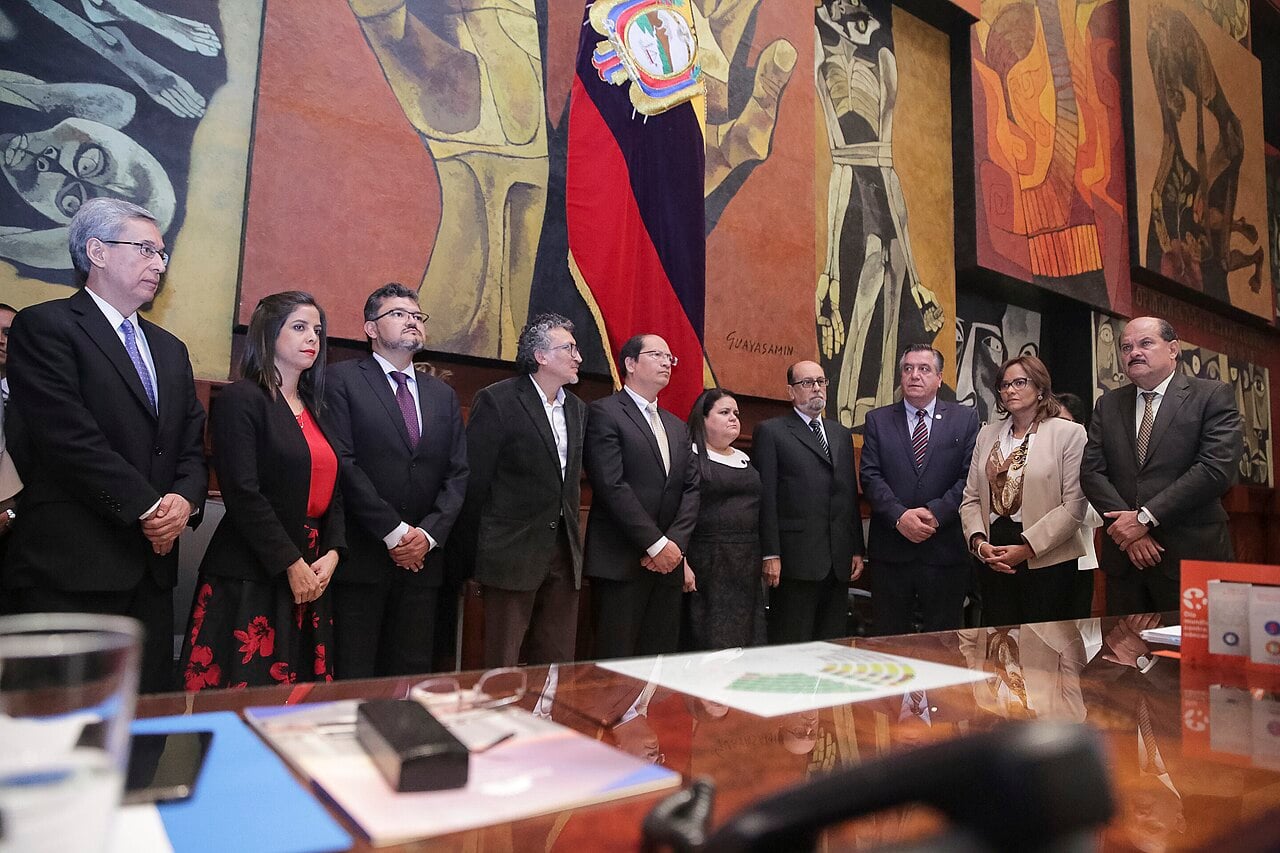
The National Assembly is a single chamber with 151 members, so a majority needs 76 votes. In February 2025 Revolución Ciudadana and its allies won 67 seats and ADN won 66, and neither side had a majority.
ADN has since built working majorities with smaller parties and defectors. On 29 October 2026 the plenary passed a Quito quarry-mining resolution with 83 votes and a labour report with 85, the Assembly says.
Mishel Mancheno of ADN became Assembly president in June 2026 after Niels Olsen resigned. Voters can still say no to Noboa: on 16 November 2025 they rejected all four referendum questions, including foreign bases.
The nine-judge Constitutional Court can strike down decrees and laws, which makes it the main legal brake on the president. The Electoral Disputes Tribunal suspended Revolución Ciudadana for nine months in March 2026 over alleged irregular campaign financing, which party leaders dispute.
The National Electoral Council moved the local vote from 14 February 2027 to Sunday 29 November 2026 over El Niño rain risk. By 11 September 2026 it had qualified 14,830 candidates, including 528 for mayor and 70 for prefect or vice-prefect.
Prosecutors, Prisons and the Opposition
Courts have become a front line of Ecuador power in 2026. Aquiles Álvarez, mayor of Guayaquil, was detained on 10 February 2026 without the ankle monitor a judge had ordered in another case.
He was then sentenced to three years in prison in the Grillete case, upheld on appeal on 16 September 2026. His defence has appealed and calls the case a political response.
The Luisa González Case
Luisa González, the Revolución Ciudadana candidate who lost the 2023 and 2025 runoffs to Noboa, was detained on 22 October 2026 in Manabí province. Prosecutors say the money behind the 2023 campaign shows inconsistencies in its amounts and origin, in a money-laundering case called Laberinto.
On 23 October a judge ordered her held in prison before trial, and she is held in Riobamba, in the mountains. Her lawyer filed an appeal on 26 October, she has not been convicted, and she calls the case political persecution.
Elite Families and Business
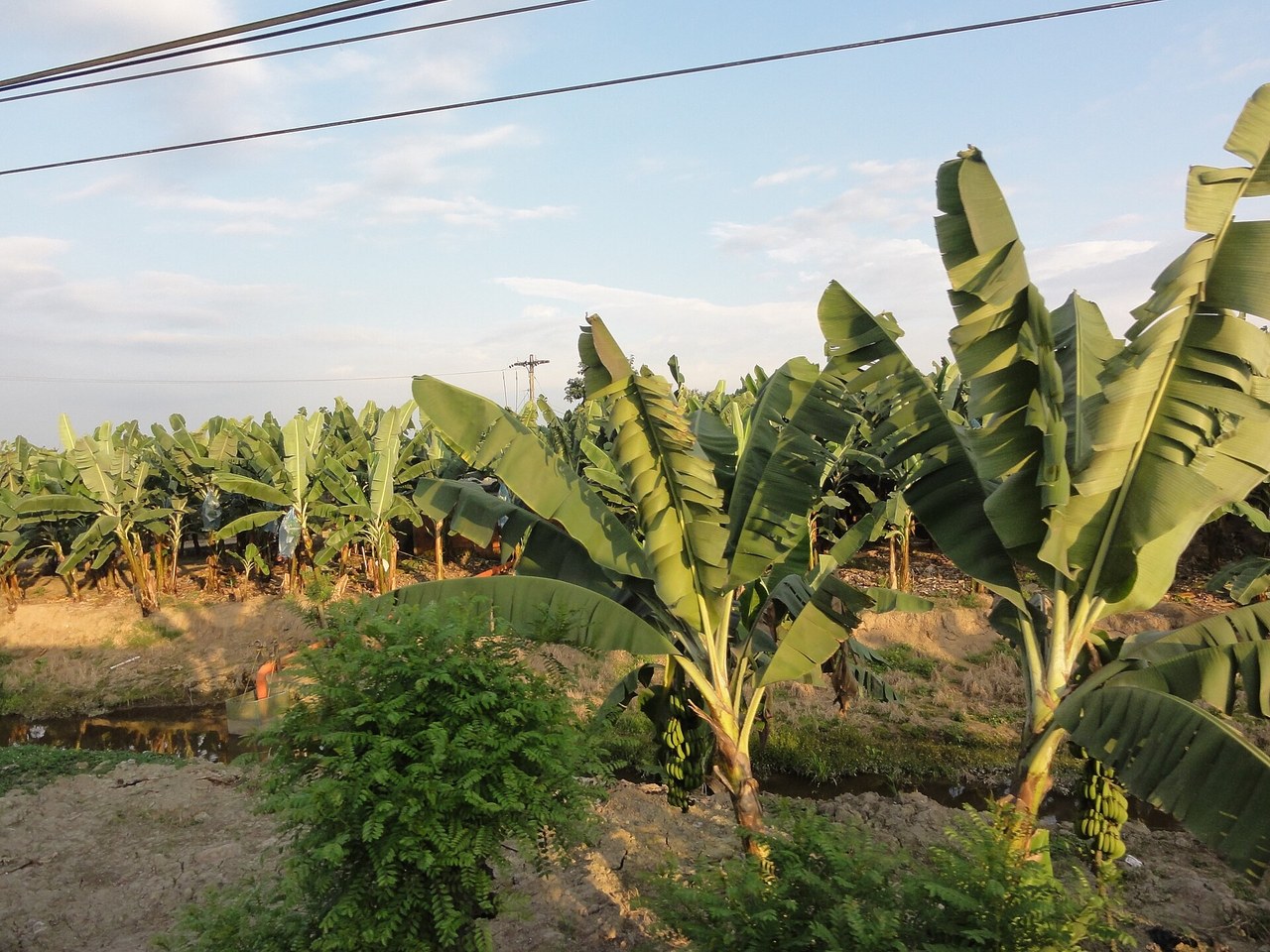
Ecuador is one of the world’s largest banana and shrimp exporters, and it also sells crude oil, cocoa and flowers. The dollar has been the national currency since 2000, so banks, importers and exporters all keep their accounts in US$.
Wealth sits with a few family groups, from banana dynasties such as the Noboas to banking, retail, shrimp and flower exporters. The Wright family’s supermarket chain, Corporación Favorita, is among the best known.
Business chambers in Guayaquil and Quito lobby for lower taxes and fewer rules. Guillermo Lasso, a former banker, was president from 2021 to 2023, and Noboa himself is a banana heir.
The state still owns the oil company Petroecuador and the power company CELEC, and a drought forced rolling blackouts in 2024. Our own guides to the Ecuador economy and to Ecuador politics list the main companies and officeholders.
Coast, Mountains and Amazon
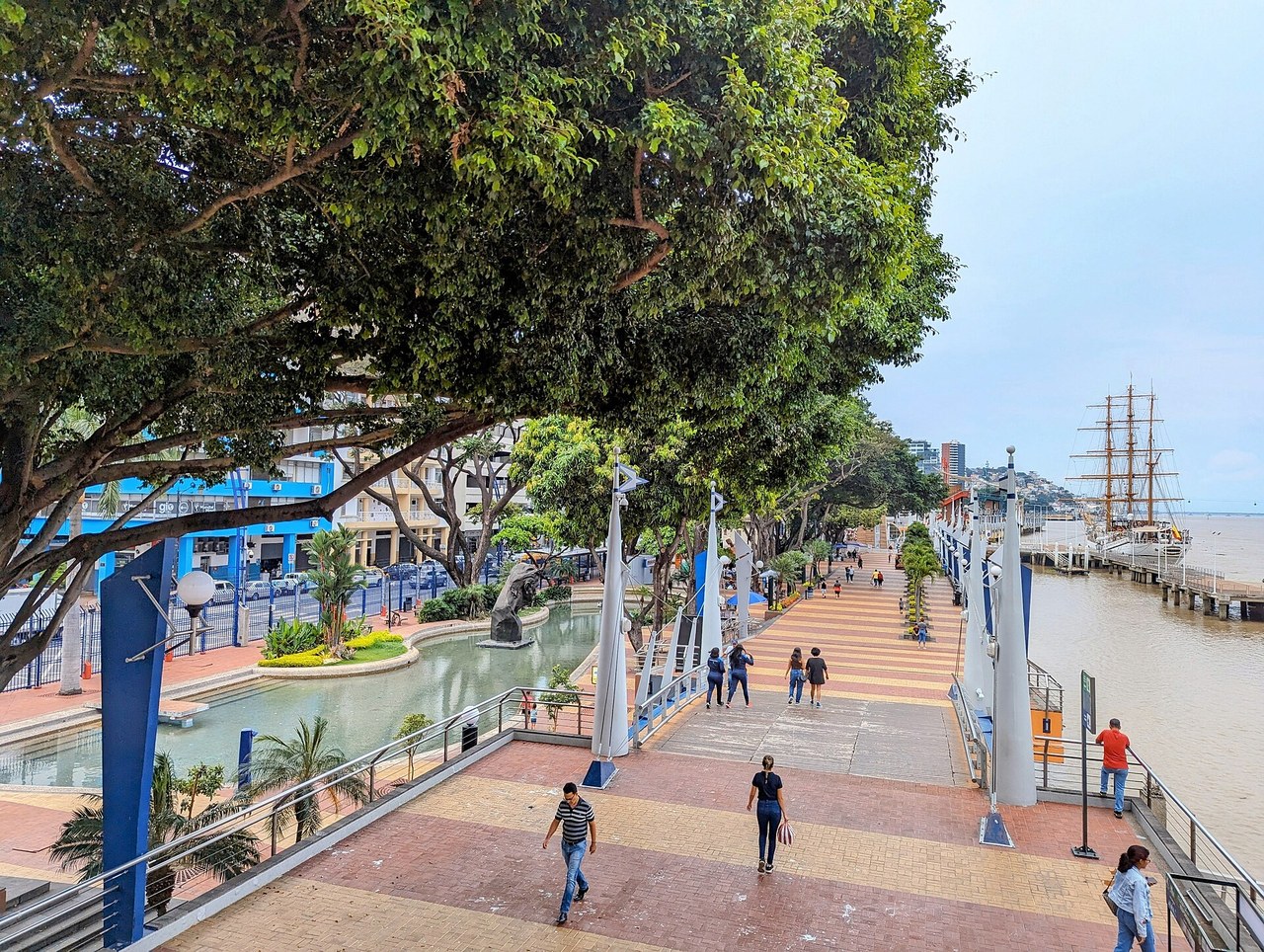
Ecuador has three main regions: the Pacific coast, the Andean highlands and the Amazon, plus the Galápagos Islands. Guayas and Pichincha, home to Guayaquil and Quito, are the two most populous provinces.
Guayaquil is the port and business capital, while Quito is the seat of government, and their rivalry shapes every election. In Quito, Mayor Pabel Muñoz of Correa’s camp seeks re-election for the Alianza Ciudadana coalition, against Harold Burbano of ADN.
The 2022 census counted 16,938,986 people, of whom 77.5% called themselves mestizo, or mixed European and Indigenous. Another 7.7% were Indigenous, 7.7% Montubio, who are rural people of the coast, and 4.8% Afro-Ecuadorian, down from 7.2% in 2010.
Afro-Ecuadorian groups have challenged the census method, and the largest Afro communities live in Esmeraldas province on the northern coast. The 2008 constitution calls Ecuador plurinational and intercultural, and Indigenous voices speak mainly through CONAIE and its political arm.
Our population guide, Ecuador Population and Ethnic Groups Explained, covers the groups in detail. For the capital, see our Quito city page and our wider Ecuador coverage.
Army, Police and the United States
Since January 2024 the government has called its fight against criminal gangs an internal armed conflict, and soldiers patrol streets and prisons. The defence ministry commands the army, navy and air force, while the interior ministry runs the police.
Washington is the closest security partner, but the constitution bans foreign military bases, and voters upheld that ban in the November 2025 referendum. Ecuador therefore works with the United States through cooperation agreements rather than bases.
The Rio Times Latin America Power Index ranks 14 countries, and its October 2026 edition puts Ecuador 8th with 38.2 points out of 100. Its best pillar is military strength at 55.3, ahead of state capacity at 45.3 and economic weight at 40.7.
Where Ecuador Is Weak
Ecuador scores only 14.1 on international influence and 31.0 on future resources, and the index groups it as closer to Washington. The full ranking sits on our Latin America Power Map, and our guide to Ecuador geopolitics explains how Quito balances the United States and China.
Churches, Unions and the Indigenous Movement
The constitution defines the state as secular, yet the Catholic Church and fast-growing evangelical churches remain loud voices on family, schools and social peace. Neither is a political party, but both can move voters.
The United Workers’ Front, a union federation, still calls marches, but its weight is small beside the Indigenous movement. CONAIE helped topple President Jamil Mahuad in 2000 and led national strikes in 2019 and 2022.
In September 2025 CONAIE began a national strike against the end of the diesel subsidy, which ended in October 2025 without bringing it back. Its political arm, Pachakutik, holds a small bloc of Assembly seats.
These groups matter because they can block roads and cut supply to the capital within days. In the Assembly they carry less weight, since ADN and the left hold most seats and decide Ecuador power.
Inequality and Who Is Left Out
The national statistics office, INEC, counted income poverty at 21.4% in December 2025 and extreme poverty at 8.3%. In cities the rate was 13.8%, but in the countryside it was 37.6%, and 19.7% of rural people were extremely poor.
The poverty line was US$92.40 per person a month, and the extreme poverty line was US$52.07. Inequality is high, with an income Gini coefficient of 0.470, where 0 means equality and 1 means one person has everything.
In 2024 and 2025 the richest tenth of people earned US$1,115 a month per person and the poorest tenth US$64, a gap of 17.5 times. The richest tenth took 35.2% of all income and the poorest tenth 2.0%.
Those left out are mostly rural families, many of them Indigenous, Montubio or Afro-Ecuadorian, plus informal workers and poor neighbourhoods on the edge of Guayaquil. They have little say in the Assembly, and gang violence hits them hardest.
What It Means for US Readers
Ecuador uses the US dollar, so its politics shows up in security, oil, bananas and bond risk rather than in an exchange rate. US refiners are among the buyers of Ecuadorian crude.
US commercial crude stocks fell 1.9 million barrels to 410.6 million in the week to 23 October 2026, the US Energy Information Administration says. That helps set the oil price on which the Ecuador budget depends.
Investors should watch the 29 November vote, the González case and the clash of Ecuador power between president and courts. Travellers should read the State Department’s current advisory for Ecuador before any trip, especially to coastal cities.
What Is Not Known
It is not known whether ADN can hold its Assembly majority after the November vote, or how the González case will end. The final candidate lists are due on 9 November 2026, and appeals can still change them.
The exact wealth and ownership of the largest family groups are not published in full. How far the US presence goes under the cooperation agreements is also not public.
Frequently Asked Questions
Who holds power in Ecuador?
President Daniel Noboa holds the most power, backed by his party, ADN, and a working majority in the National Assembly. Courts, the Indigenous movement and voters can still block him.
Which families are most powerful in Ecuador?
Banana, banking, retail and shrimp families dominate the economy, including the Noboa family and the Wright family behind Corporación Favorita. Full ownership data is not public.
Why do Guayaquil and Quito compete?
Guayaquil is the main port and business centre, while Quito is the capital and seat of government. Money sits on the coast and formal power in the mountains.
What role does the army play in Ecuador?
Since January 2024 soldiers have fought criminal gangs in what the government calls an internal armed conflict. They patrol streets and prisons, and they work with US partners without foreign bases.
Who is left out of power in Ecuador?
Rural families, Indigenous peoples, Montubio and Afro-Ecuadorian communities and informal workers have the least say. Rural poverty was 37.6% in December 2025.
When are Ecuador’s next elections?
Ecuador votes for mayors, prefects and councillors on Sunday 29 November 2026. The next presidential vote is due in 2029.
Sources: Presidency of Ecuador, official website, list of ministries and executive decrees, 2026-10-31; National Assembly of Ecuador, plenary news and president of the Assembly, 2026-10-29; National Electoral Council of Ecuador (CNE), 2026 local elections calendar and candidate figures, 2026-09-11; INEC, Census of Population and Housing 2022 results, 2023-11; INEC, ENEMDU poverty and inequality bulletin, December 2025, 2026-01-08; INEC, ENIGHUR household income and expenditure survey 2024-2025, 2026-07; Prosecutor General’s Office of Ecuador (Fiscalía), Laberinto case announcements, 2026-10-23; U.S. Energy Information Administration, Weekly Petroleum Status Report, week ending 23 October 2026, 2026-10-28; The Rio Times Latin America Power Index, October 2026 edition, 2026-10.
This article was produced by The Rio Times’ automated newsroom system. How we use AI · Report an error · Editorial responsibility: Matthias Camenzind, Editor-in-Chief
Expat Guide to Ecuador
What The Rio Times publishes for foreigners who live in or move to Ecuador.
Start here
- Best Places to Live in Ecuador for Expats 2026
- How to Get Residency in Ecuador in 2026: Visas From US$1,446 a Month
- Cost of Living Cuenca, Ecuador — Rent, Bills and Doctors, Priced in Dollars
- Healthcare in Ecuador for Foreigners: Costs & Steps
City guides
Coming up in Ecuador
- Carlos Rivera and Reik in Ecuador: Joint Tour Plays Quito on 5 November and Guayaquil on 7 November 5 Nov
- Shakira in Quito, Ecuador: Three Stadium Nights at Estadio Olímpico Atahualpa on November 8, 9 and 11 8 Nov
- Soy Luna Ecuador: Guayaquil on 12 November, Quito on 14 November 12 Nov
- Anuel AA Guayaquil 2026: Puerto Rican Artist Plays Estadio Alberto Spencer, Ecuador, on 14 November 14 Nov
Understand Ecuador
Brazil runoff date: Sunday, October 25, poll closing times and when results start · Brazil runoff polls: Flávio 51%, Lula 49% · Kalshi and Polymarket odds
Rotate for Best Experience
This report is optimized for landscape viewing. Rotate your phone for the full experience.
You've reached your free article limit
Subscribe to The Rio Times for unlimited access to our news, expat and nomad guides and market intelligence on Latin America and Africa.
Keep reading for free
Your first article was on us. Register with your email address to read 6 free articles every month. You will also receive The LatAm Brief: what moved in Latin American markets, politics and expat life, every weekday morning.
Expat Guide to Ecuador
What The Rio Times publishes for foreigners who live in or move to Ecuador.
Start here
- Best Places to Live in Ecuador for Expats 2026
- How to Get Residency in Ecuador in 2026: Visas From US$1,446 a Month
- Cost of Living Cuenca, Ecuador — Rent, Bills and Doctors, Priced in Dollars
- Healthcare in Ecuador for Foreigners: Costs & Steps
City guides
Coming up in Ecuador
- Carlos Rivera and Reik in Ecuador: Joint Tour Plays Quito on 5 November and Guayaquil on 7 November 5 Nov
- Shakira in Quito, Ecuador: Three Stadium Nights at Estadio Olímpico Atahualpa on November 8, 9 and 11 8 Nov
- Soy Luna Ecuador: Guayaquil on 12 November, Quito on 14 November 12 Nov
- Anuel AA Guayaquil 2026: Puerto Rican Artist Plays Estadio Alberto Spencer, Ecuador, on 14 November 14 Nov
Understand Ecuador