Noboa Extends Ecuador Security Crackdown as 2026 Homicides Strain Investment
Politics · Ecuador
—The stakes. Ecuador recorded 9,216 homicides in 2025, its most violent year on record, with a national rate near 51 per 100,000.
—The date. President Daniel Noboa renewed a nationwide state of emergency on April 8, 2026, for a further 60 days.
—The policy. The government has relied on military deployments, curfews, and emergency decrees since declaring an internal armed conflict in January 2024.
—The economy. Gang control has hit tourism, port traffic, and logistics costs, raising everyday prices for imported goods and fuel.
—The advice. Foreign residents and investors must navigate curfews, ID checks, and rising security expenses in coastal provinces.
The collapse of citizen security in Ecuador has shifted from a law enforcement emergency into a structural drag on the dollarized economy. For foreign residents and investors, the question in 2026 is no longer just about headline homicide counts but about how persistent gang control and militarized emergency rule are repricing daily life and cross-border trade.
The 2025 Homicide Record and 2026 Trend
Ecuador’s Interior Ministry reported 9,216 homicides in 2025, up from 7,063 in 2024, an increase of roughly 30 percent.
That pushed the national homicide rate to about 50 per 100,000 inhabitants, according to People’s Dispatch and other tallies.
It placed Ecuador second only to Haiti in Latin America for violent deaths, surpassing Venezuela and Honduras.
Early 2026 data shows some cooling, but the baseline remains extraordinarily high for the region.
National Police data cited by IA Watch recorded 4,154 homicides between January and June 2026.
That was an 11 percent reduction, or 515 fewer violent deaths, against the same period in 2025.
The semester homicide rate fell from 25.5 to 22.5 per 100,000, still among the hemisphere’s highest tallies.
January 2026 alone brought 747 homicides, only marginally below January 2025, reported The Rio Times.
Territorial Reconfiguration of Gang Violence
Violence is not static across Ecuador’s coastal provinces, where cocaine trafficking routes meet Pacific ports.
El Oro province became the new epicenter in early 2026, with homicides up 63 percent between January and June.
The count in El Oro jumped from 319 to 521 violent deaths in the semester comparison.
Meanwhile, Guayas and Los Ríos, historically dominant homicide zones, saw declines of 23 percent and 28 percent.
This shift does not mean gangs have lost territorial power, only that the front line has moved.
The provinces of Guayas, Manabí, and Esmeraldas have anchored gang-linked violence since late 2020.
In 2023, Ecuador recorded 8,237 homicides, a rate of 46.18 per 100,000 and an increase of about 66 percent on 2022. Guayas province accounted for 47 percent of the national total and the city of Guayaquil alone for 29 percent.
From 2019 to 2024, homicides rose roughly 400 percent, from 1,397 to 6,964, before reaching 9,216 in 2025, the highest annual toll on record.
Focus on Travel News notes that murders climbed from 1,187 in 2019 to 8,004 in 2023.
The Internal Armed Conflict Legal Framework
President Daniel Noboa declared an internal armed conflict against criminal gangs on January 9, 2024.
The declaration came after a gang takeover of a television studio in Guayaquil shocked the country.
It imposed a nationwide state of emergency, restricted rights for 60 days, and set a curfew from 11 p.m. to 5 a.m.
Since that moment, Noboa has governed under near-continuous emergency powers, reported The Rio Times.
The BTI 2026 country report called the internal armed conflict the most far-reaching legal restriction of the period.
Military deployments did not dismantle criminal groups nor eliminate violent deaths, the report found.
However, the homicide rate did fall by 7.2 points in 2024 to 39.1 per 100,000, a 15 percent drop.
That temporary 2024 decline, with 7,033 violent deaths, gave the government its clearest security-policy success.
States of Emergency in 2025 and 2026
Noboa has signed more than a dozen emergency decrees since early 2024, according to Rio Times reporting.
In November 2024, a State of Exception covered El Oro, Guayas, Los Ríos, Santa Elena, and Manabí, among others.
That decree also included areas of Cotopaxi and Bolívar and was scheduled to run until January 3, 2026.
Before the year closed, Police reported 1,232 intentional homicide victims from November 1 to December 23, 2025.
Those killings occurred in the nine coastal and central provinces that anchor the emergency response.
On January 2, 2026, Noboa declared a new 60-day state of emergency in nine provinces and three municipalities.
Coverage included Guayas, Manabí, Santa Elena, Los Ríos, El Oro, Esmeraldas, Pichincha, Santo Domingo, and Sucumbíos.
The stated purpose was to contain high-intensity violence and dismantle criminal structures.
Curfews in four coastal provinces were set to run through March 31, 2026, according to ExpatEcuador.
Nationwide Extension and Militarization Content
On April 8, 2026, Ecuador renewed the state of emergency for another 60 days, according to TravelWarningCheck.
Unlike earlier provincial measures, the April extension applied nationwide for the first time.
That extension ran through early June 2026 and reflected a deteriorating security situation across the country.
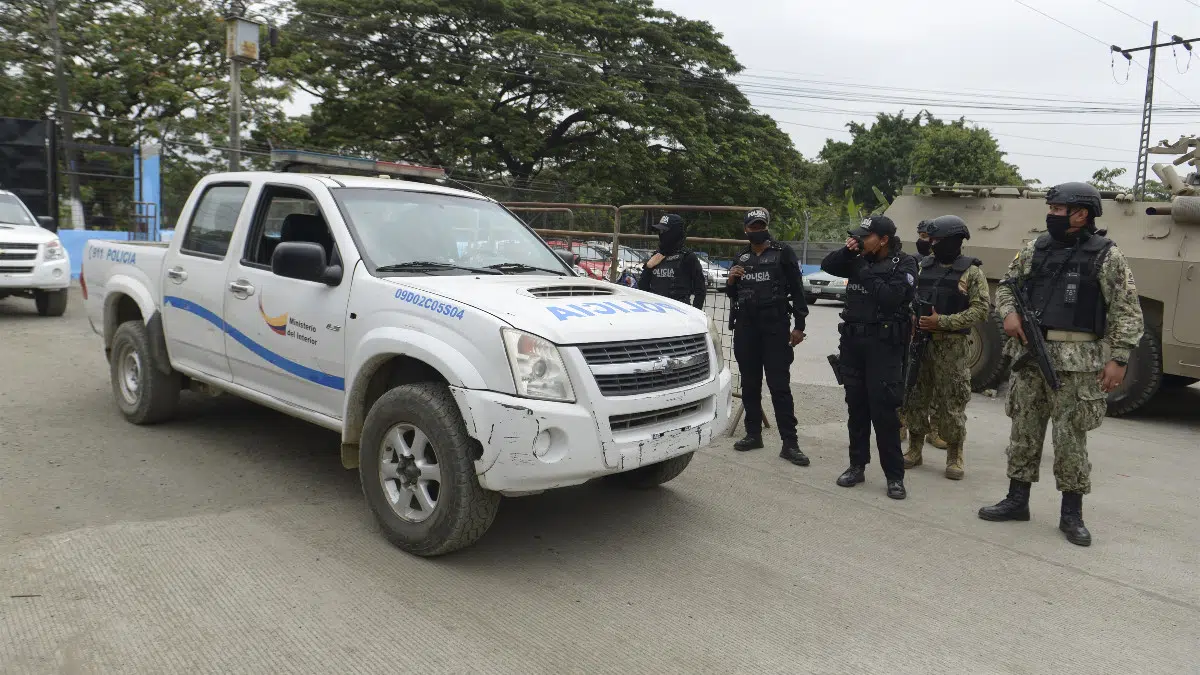
Riskline advisories tell travelers to expect a strong military presence in Quito and most coastal provinces.
Operations may include monitoring personal communications, entering homes, and restricting movement and assembly.
Reuters reported that Noboa has deployed more than 10,000 military personnel to the highest-violence provinces.
The policy model treats gang activity as a war, not merely as criminal disorder.
That framing gives the armed forces expanded powers over prisons, ports, and city streets.
Gang Control over Port and Trade Logistics
Ecuador’s dollarized economy depends on the Pacific ports that serve as exit points for bananas, shrimp, and unfortunately cocaine.
Territorial gang control around Guayaquil’s port system raises insurance premiums for cargo owners.
Shipping and logistics firms now budget for private escorts, GPS tracking, and armed guards on high-value routes.
These security costs are not absorbed by exporters; they pass through to importers and final consumers.
El Oro’s rise as a homicide hot spot matters because the province sits on key export corridors.
Continued curfews restrict night-time loading and truck movement, slowing port turnaround times.
Foreign traders already report that emergency decree rules increase documentary checks at roadblocks.
The cumulative effect is higher cost per container and longer dwell times in the country.
Tourism and Investor Sentiment
The security collapse has re-priced Ecuador as a travel destination for foreign visitors.
Focus on Travel News cites the 2019–2023 homicide surge, from 1,187 to 8,004 murders, as a central reputational shock.
Travel advisories from Riskline and national governments now warn of military checkpoints and curfews in tourist zones.
Coastal tourism in Manabí and Santa Elena, historically popular with surfers and expats, sits inside emergency zones.
Foreign investors in real estate and hospitality now factor private security into operational budgets.
Some urban landlords in Quito and Guayaquil report tenant demand shifting to gated communities with armed entry control.
The dollarized economy, once a stability signal, cannot fully offset the operational burden of crime-linked risk.
Investment committees now treat Ecuador’s security expense as a recurring fixed cost, not an episodic crisis.
Everyday Costs for Foreign Residents
Foreign residents encounter the security crisis most directly in daily logistics and compliance.
Curfews in coastal provinces, most recently through March 31, 2026, limit evening movement for families.
ID checks and warrantless searches in certain zones mean foreigners must carry original documents at all times.
Residential security costs have climbed, with more neighborhoods hiring armed patrols and access control.
Grocery and consumer import prices reflect the added freight and insurance charges on container traffic.
Fuel distribution disruptions, when emergencies restrict movement, can create localized shortages and price spikes.
Foreign residents in El Oro, Guayas, and Manabí now plan errands and business travel around military roadblock schedules.
The result is a security surcharge embedded in nearly every euro- or dollar-denominated household budget.
Noboa’s Policy Limits and Fiscal Trade-offs
Militarization has consumed public spending that could otherwise go to civilian institutions.
The 2024 homicide decline showed that heavy deployments can temporarily suppress violence.
But the 2025 rebound to 9,216 homicides revealed that suppression is not the same as dismantling criminal control.
The BTI report concluded that militarization did not dismantle criminal groups nor eliminate violent deaths.
Emergency decrees now resemble a permanent administrative state rather than a temporary response.
Foreign analysts watching Ecuador’s budget see security as crowding out education, health, and infrastructure spending.
Persistent violence in El Oro despite military operations suggests gangs relocate and adapt faster than the state.
Without controlling prisons and ports, the war framework may simply shift battle zones from one province to the next.
What Foreign Residents Should Know
Verify whether your home canton falls inside a current state of emergency before travel or relocation.
Understand that curfews, originally set through March 31, 2026, could be renewed without advance notice.
Keep digital and paper copies of residence documents available at military checkpoints.
Avoid movement in Guayaquil’s southern corridors and El Oro’s border routes after dark.
Ask landlords and building administrators about private security coverage and emergency protocols.
Budget for rising insurance deductibles on vehicles, homes, and cargo stored in coastal provinces.
Monitor police and municipal channels for real-time changes to curfew hours and road closures.
For investors, treat security spending as an operating line, not an optional contingency.
The Economic Cost Outlook for 2026
Ecuador’s economic cost from the security crisis is now structural rather than episodic.
Port trade, tourism, and everyday consumption all carry a measurable crime-related premium.
The nationwide state of emergency extension in April 2026 signals that the government itself sees no near-term exit.
Each month of emergency rule adds costs to logistics, staffing, and insurance contracts.
The high-value shrimp and banana export sectors remain exposed to gang extortion and transport risk.
Foreign direct investment in retail, hospitality, and warehousing continues to require security-linked returns.
Unless El Oro and the Guayaquil port corridor stabilize, 2026 could match the fiscal strain of 2025.
For foreign residents, the practical guidance is simple: plan around the emergency, because it is now the baseline.
Connected Coverage
Los Ilinizas Fire Burns About 200 Hectares in Ecuador
The Big Picture
Latest developments
- Iron Maiden Plays Quito, Ecuador, on 14 October — 4 October 2026
- Cárcel del Encuentro Splits Ecuador Gangs, Experts Say — 4 October 2026
- Ecuador Family Says Remains Near Quito Are Joselyn Oña — 4 October 2026
- Ecuador Court Fines Two Amigo Movement Leaders US$9,200 — 4 October 2026
This article was produced by The Rio Times’ automated newsroom system. How we use AI · Report an error · Editorial responsibility: Matthias Camenzind, Editor-in-Chief
LatAm Markets: Live Signals → — real-time movers, turnover leaders and FX across Latin America.
Expat Guide to Ecuador
What The Rio Times publishes for foreigners who live in or move to Ecuador.
Start here
- Best Places to Live in Ecuador for Expats 2026
- How to Get Residency in Ecuador in 2026: Visas From US$1,446 a Month
- Cost of Living Cuenca, Ecuador — Rent, Bills and Doctors, Priced in Dollars
- Healthcare in Ecuador for Foreigners: Costs & Steps
City guides
Coming up in Ecuador
- Def Leppard in Quito, Ecuador: Rock Legends at the Estadio Olímpico Atahualpa on October 30, with Extreme 30 Oct
- Carlos Rivera and Reik in Ecuador: Joint Tour Plays Quito on 5 November and Guayaquil on 7 November 5 Nov
- Shakira in Quito, Ecuador: Three Stadium Nights at Estadio Olímpico Atahualpa on November 8, 9 and 11 8 Nov
- Soy Luna Ecuador: Guayaquil on 12 November, Quito on 14 November 12 Nov
Understand Ecuador