Who Is Daniel Noboa? Ecuador’s President, His Gang War and What Comes Next
PROFILE · ECUADOR
Key Facts
- —Who he is A Miami-born banana heir, aged 38, who has led Ecuador since November 2023.
- —His mandate Re-elected in April 2025 with 55.63 percent, he governs until May 2029.
- —His signature A declared war on drug gangs, yet killings hit a record 9,216 in 2025.
- —The country Ecuador has about 18 million people and has used the US dollar since 2000.
- —The next test Local elections on 29 November 2026, with the largest opposition party suspended.
Daniel Noboa, son of a banana tycoon and perennial candidate, took office at 35 and won a full term in 2025. This profile explains who he is, how he rules, what his critics allege and what his presidency means for foreigners.
Ecuador is a country of about 18 million people on South America’s Pacific coast, between Colombia and Peru. It uses the US dollar, and since late 2023 its politics have revolved around one young, wealthy and divisive man.
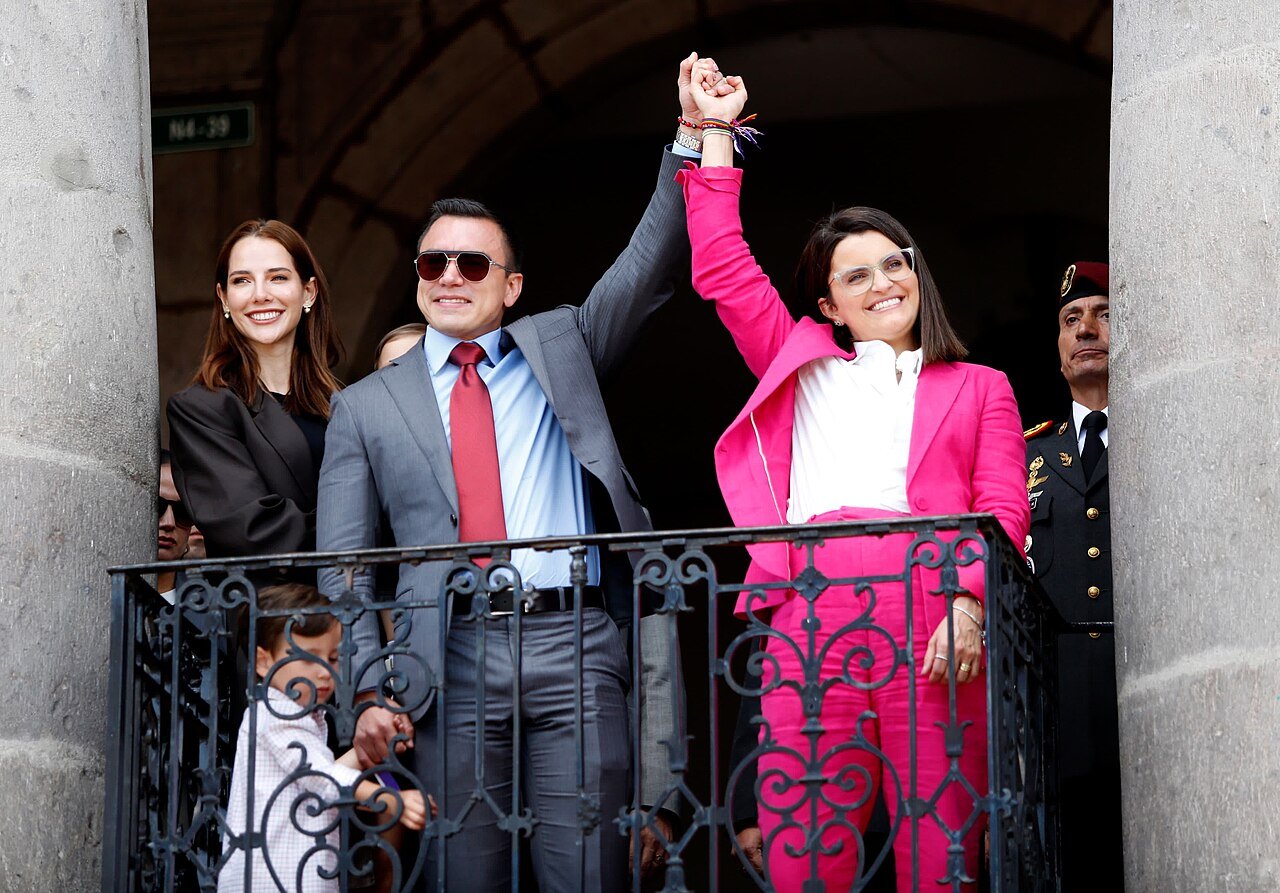
From Banana Fortune to Carondelet Palace
Daniel Roy Gilchrist Noboa Azín was born in Miami on 30 November 1987 and holds Ecuadorian and US citizenship. His father, Álvaro Noboa, built the country’s largest banana fortune and ran for president five times without winning.
The family conglomerate, Grupo Noboa, owns the Bonita banana brand and spans shipping, property and finance. Daniel founded an events company at 18 and later worked as a logistics and commercial director in the family business.
He studied business at New York University and earned further degrees from Northwestern, Harvard and George Washington University. He married Lavinia Valbonesi in 2021 and has three children from two marriages.
A short apprenticeship in parliament
Noboa entered politics in 2021, winning a seat in the National Assembly, Ecuador’s single-chamber parliament, for coastal Santa Elena province. There he chaired the economic development committee until the assembly was dissolved in May 2023.
That dissolution came from President Guillermo Lasso, a conservative banker who faced impeachment. He used a constitutional clause called “muerte cruzada”, or mutual death, which forces fresh elections for both president and parliament.
How He Won Power Twice
Noboa entered the snap election of August 2023 polling in single digits, then took 23.47 percent in the first round. In the October runoff he beat Luisa González of Revolución Ciudadana, the movement of former left-wing president Rafael Correa.
He was sworn in on 23 November 2023 at 35, the youngest elected president in Ecuador’s history. That first mandate only covered the rest of Lasso’s term, which ended in May 2025.
In the general election of February 2025 Noboa took 44.17 percent against 43.97 percent for González, almost a tie. In the April runoff he won 55.63 percent to 44.37 percent, a gap of more than 11 points.
González refused to accept the result and called it “the worst and most grotesque fraud in Ecuador’s history”, Primicias reported. The European Union observer mission, led by the Spanish politician Gabriel Mato, said election day was transparent and found no fraud.
The same observers criticised an uneven playing field, noting that Noboa did not take leave from office while campaigning. He began his full four-year term on 24 May 2025, with María José Pinto as vice-president.
His party, Acción Democrática Nacional (ADN, National Democratic Action), became the largest bloc in the 151-seat assembly. With allies, it elected ADN’s Niels Olsen as assembly president with 80 votes in May 2025, El Diario reported.
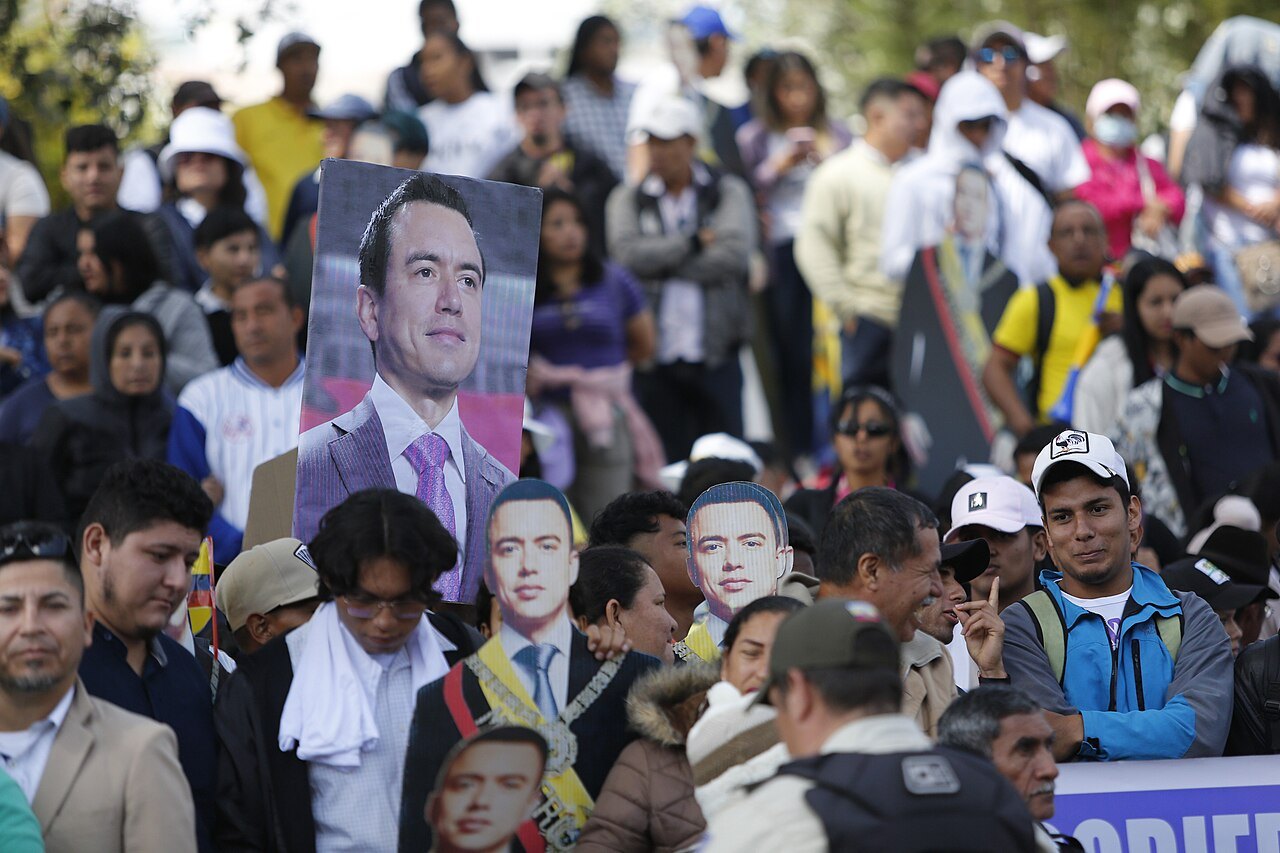
The War on the Gangs
Security defines Noboa’s presidency more than any other issue. Gangs fighting over cocaine routes to the Pacific ports pushed killings to 8,237 in 2023, the year he took office.
In January 2024 the gang boss José Adolfo Macías, alias “Fito”, fled prison and gunmen stormed a live television broadcast. On 9 January Noboa signed Decree 111, declaring an “internal armed conflict” and labelling the gangs terrorist groups.
Even the left-wing opposition backed him at first, saying that organised crime had declared war on the state. Emergency powers let soldiers patrol streets and take control of prisons, and a 2024 referendum allowed Ecuadorians to be extradited.
Fito was later caught again and extradited to a New York court on 20 July 2025, where he pleaded not guilty. Noboa marked the moment on social media with two words: “Hasta nunca” (goodbye forever).
He frames the fight in stark terms, telling the newspaper El Mercurio that “it’s a war, a total conflict” against mafias. Interior Minister John Reimberg credits the president’s “firm decisions” and the sustained deployment of security forces, Al Jazeera reported.
The results are mixed, because homicides fell in 2024 but rose to a record 9,216 in 2025. That equals about 51 killings per 100,000 people, the highest rate in Latin America that year, according to InSight Crime.
Between January and August 2026 the authorities counted 5,676 homicides, 6.4 percent fewer than a year earlier. Violence has shifted rather than ended, as killings in El Oro, on the Peruvian border, rose 63 percent in early 2026.
Noboa governs through repeated states of exception, emergency decrees that suspend some civil rights for 60 days. Decree 498 of 15 September 2026 covers eight provinces and is roughly the twentieth since 2024, as The Rio Times reported.
The Economy: Dollars, Debt and the IMF
Ecuador adopted the US dollar in 2000, replacing its old currency, the sucre, at 25,000 sucres per dollar. Because it cannot print money, the government relies on oil revenue, taxes and foreign loans to pay its bills.
In May 2024 the International Monetary Fund (IMF), the global lender of last resort, approved a 48-month loan programme for Ecuador. It was enlarged in July 2025 to about US$5 billion, tying Noboa to targets on deficits and subsidies.
The IMF completed its fifth review on 22 April 2026, releasing about US$400 million despite waivers for missed fiscal targets. A sixth review worth about US$394 million was still pending in late September 2026.
A severe drought in 2024 emptied hydropower reservoirs and caused blackouts of up to 14 hours a day. A US$149 million emergency contract for thermal generators with the firm Progen then failed to deliver the promised power.
In September 2025 Decree 126 scrapped the diesel subsidy, lifting the price from US$1.80 to US$2.80 a gallon. The Indigenous confederation CONAIE called a national strike that lasted a month and ended on 22 October without concessions.
Growth has returned, with the Central Bank reporting 3.7 percent expansion in 2025. Output grew 2.1 percent year on year in the second quarter of 2026, and annual inflation was 1.12 percent in August.
Noboa is courting private capital, tendering Amazon oil blocks and creating technology free zones with five years of zero income tax. Exports reached a record US$37.15 billion in 2025, led by shrimp, although oil sales fell 19 percent.
Friends and Enemies Abroad
Noboa has tied Ecuador closely to Donald Trump’s United States. He met Trump in March 2025, and Washington later named the gangs Los Choneros and Los Lobos foreign terrorist organisations.
In March 2026 the two countries launched joint military operations, and in June Defence Secretary Pete Hegseth received Noboa at the Pentagon. Hegseth praised allies “willing to carry their own weight”, the Guayaquil daily Expreso reported.
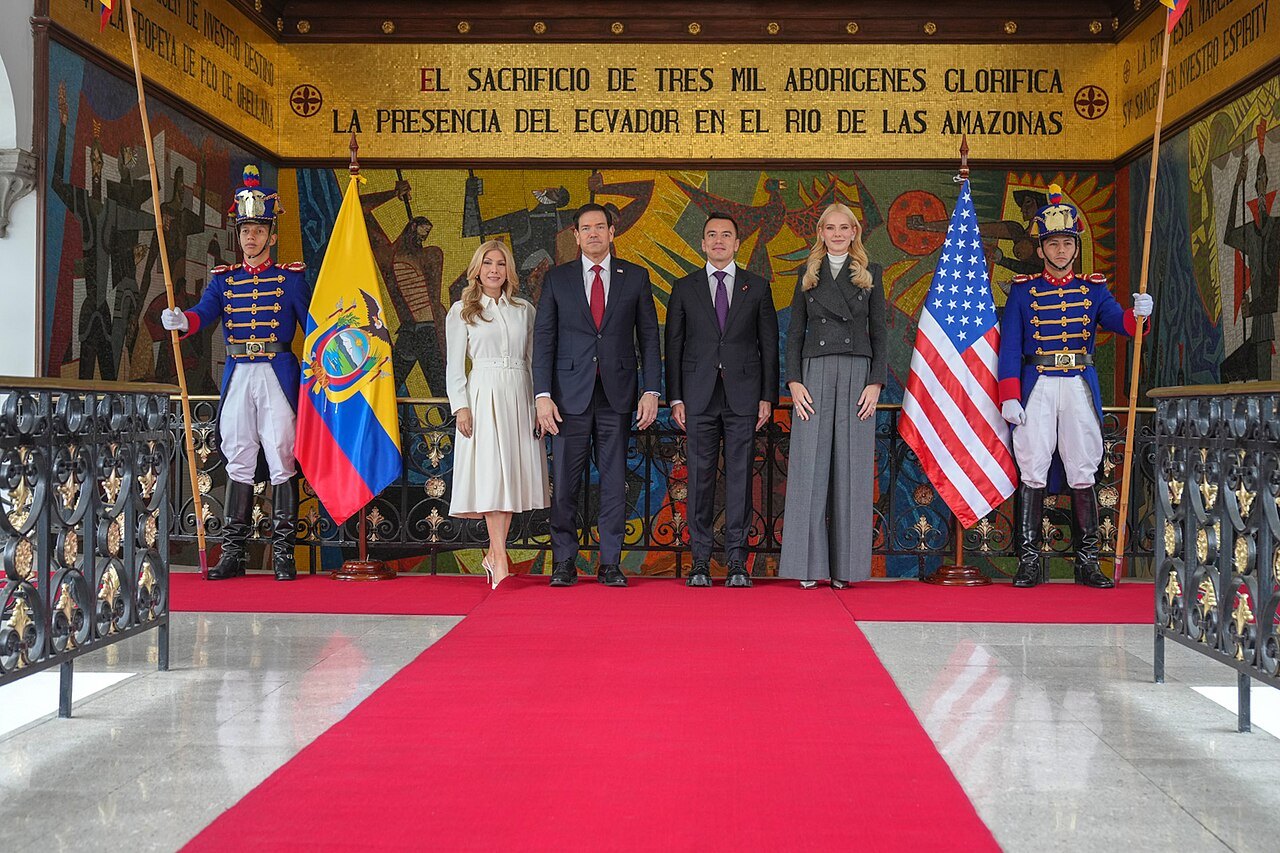
Visiting Quito on 9 September 2026, Secretary of State Marco Rubio said: “We have no better ally in the region”. Rubio planned to ask Congress for US$45 million in security aid, Reuters reported, and Noboa awarded him the Grand Cross of Merit.
Ecuadorian legislators publicly rejected the honour, because US strikes on suspected drug boats have also hit Ecuadorian fishing crews. In late September about 50 US troops joined Ecuadorian raids on alleged drug traffickers, Semafor reported.
The alliance has limits at home, because 60.82 percent of voters rejected foreign military bases in a referendum on 16 November 2025. In September 2026 Noboa removed the air force commander, who had sought written rules for US flights from Taura air base.
Clashes with the left in Mexico and Colombia
In April 2024 police raided Mexico’s embassy in Quito to arrest Jorge Glas, a former vice-president convicted of corruption. Mexico broke off diplomatic relations, and both countries have taken the dispute to the International Court of Justice.
In early 2026 Noboa imposed a “security tariff” on Colombian goods, accusing Bogotá of weak anti-drug efforts. By May it reached 100 percent, and Colombia retaliated with its own tariffs and cut electricity exports to Ecuador.
Ecuador scrapped the tariff on 1 June 2026, which Noboa presented as a deal with the right-wing candidate Abelardo de la Espriella. Colombia’s foreign ministry said the move simply complied with an order from the Andean Community trade bloc, El Tiempo reported.
Controversies and Allegations
Human rights bodies have raised serious concerns about the security campaign. In March 2026 a UN committee reported at least 51 victims of enforced disappearance involving security forces in 2024 and 2025.
A joint Ecuador-US strike near the Colombian border on 6 March 2026 hit what later reporting identified as a dairy farm. Twenty members of the US Congress asked for an investigation in May, the left-leaning Washington think tank CEPR noted.
Ahead of the local elections, an electoral judge suspended Revolución Ciudadana for nine months over alleged Venezuelan campaign funding. Authorities also dissolved two smaller parties, Construye and Unidad Popular, although a tribunal later reversed the Unidad Popular decision.
Natasha Rojas of Unidad Popular said the government bans parties and candidates who could win, The Rio Times reported. The CNE said both parties had failed to meet membership-reporting rules, and the Revolución Ciudadana suspension runs past the November vote.
The president’s wealth
Noboa’s personal fortune is another flashpoint, and the government published his sworn asset declarations only after public interest grew. Sworn statements released on 1 September 2026 list assets of US$3.55 million, up from US$1.62 million a year earlier, Vistazo reported.
Most of the rise came from revaluing his beach property in Olón, Santa Elena, from US$1.5 million to US$3.4 million. The presidency said Noboa had filed his declarations as the law requires.
Liliana Durán, a lawmaker for Revolución Ciudadana, asked the Comptroller General’s Office to examine where the money came from. Her request is an allegation, and as of September 2026 no court or auditor has ruled on it.
What It Means for Foreigners and Investors
For investors, Noboa offers a pro-market, pro-Washington government in a dollarised economy with very low inflation. His team is tendering oil blocks, opening tax-free tech zones and keeping an IMF programme alive despite missed targets.
The risks are concrete, because emergency decrees can bring curfews and searches at short notice. Decree 498 imposed a night curfew in four coastal provinces in September 2026, including Guayas, home to Guayaquil’s port.
Polls show a divided public rather than a dominant leader. A Click Research survey of 3,800 people from 18 to 23 September 2026 found 43.88 percent approval and 49.49 percent disapproval.
The same poll found 75.98 percent trust in the armed forces, the institution at the centre of his strategy. For a wider view of the country, see our guide to Ecuador in 2026.
What to Watch
The local elections of 29 November 2026 are the first nationwide vote since the referendum defeat. About 13.8 million voters will choose 23 prefects, 222 mayors and members of the council that appoints key watchdogs.
Asked in September 2026 whether he would seek re-election in 2029, Noboa answered “Ahí veremos” (we will see). He added that presidents are “invited” by citizens rather than imposing themselves, La República reported.
Investors will watch the sixth IMF review and whether the 2026 homicide total ends below 2025. Rights groups will watch whether US military involvement grows, given that voters rejected foreign bases.
Frequently Asked Questions
Who is Daniel Noboa?
Daniel Noboa is the president of Ecuador, in office since 23 November 2023. Born in Miami in 1987, he is the son of banana magnate Álvaro Noboa and leads the ADN party.
When does Noboa’s term end?
His current four-year term began on 24 May 2025 and runs until May 2029. Asked about re-election in September 2026, he said only “we will see”.
Is Noboa left-wing or right-wing?
Noboa is generally described as centre-right and pro-business. He is a close ally of the Trump administration and his main rival is the left-wing movement of Rafael Correa.
Has crime fallen under Noboa?
Not consistently, because homicides fell in 2024 but hit a record 9,216 in 2025. Between January and August 2026 they were 6.4 percent lower than a year earlier.
What currency does Ecuador use?
Ecuador has used the US dollar as its official currency since 2000. Visitors and investors therefore face no exchange-rate risk inside the country.
Is Noboa accused of wrongdoing?
Opposition lawmakers have asked auditors to examine the rise in his declared wealth to US$3.55 million. As of September 2026, no court or auditor has ruled against him.
This article was produced by The Rio Times’ automated newsroom system. How we use AI · Report an error
Read More from The Rio Times